Showing posts with label Review. Show all posts

Thursday, May 13, 2010

Kate Gilmore, Walk the Walk, 2010 [Review]


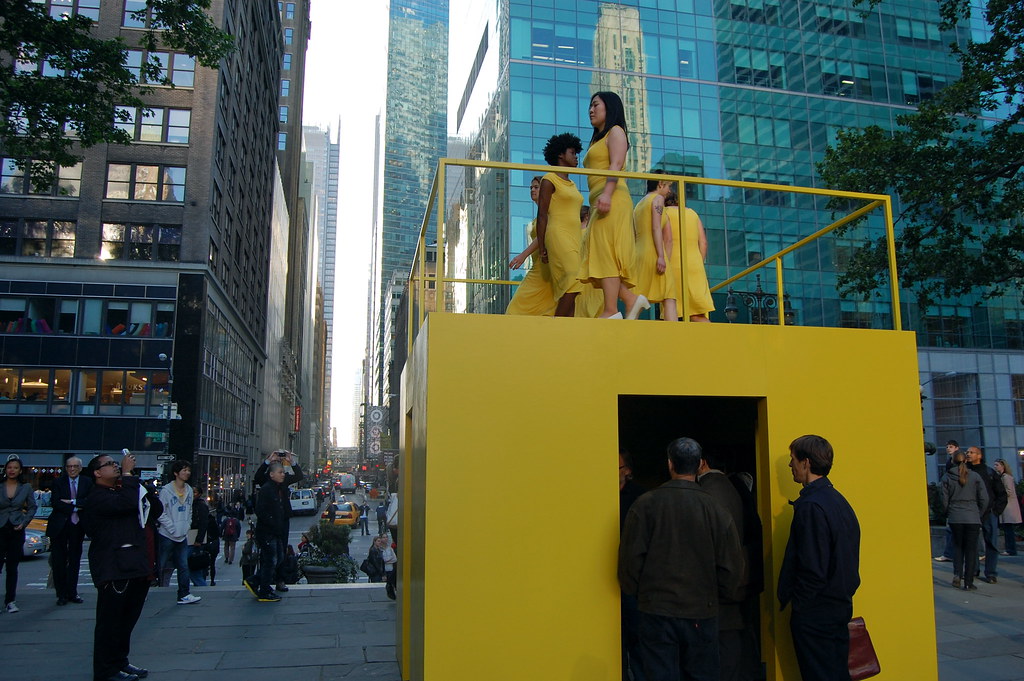
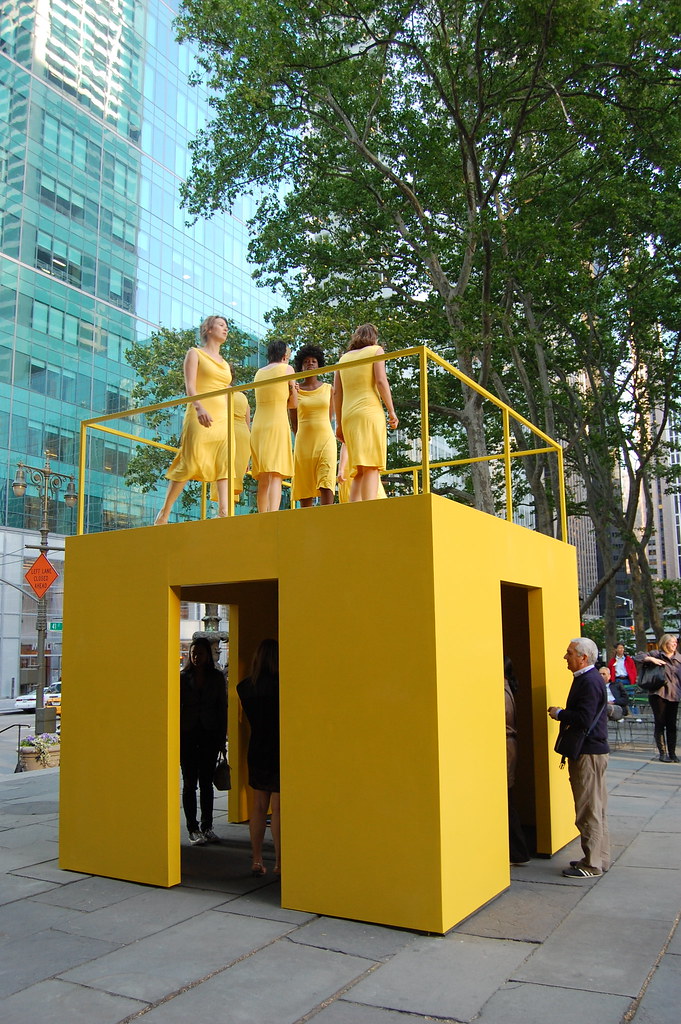
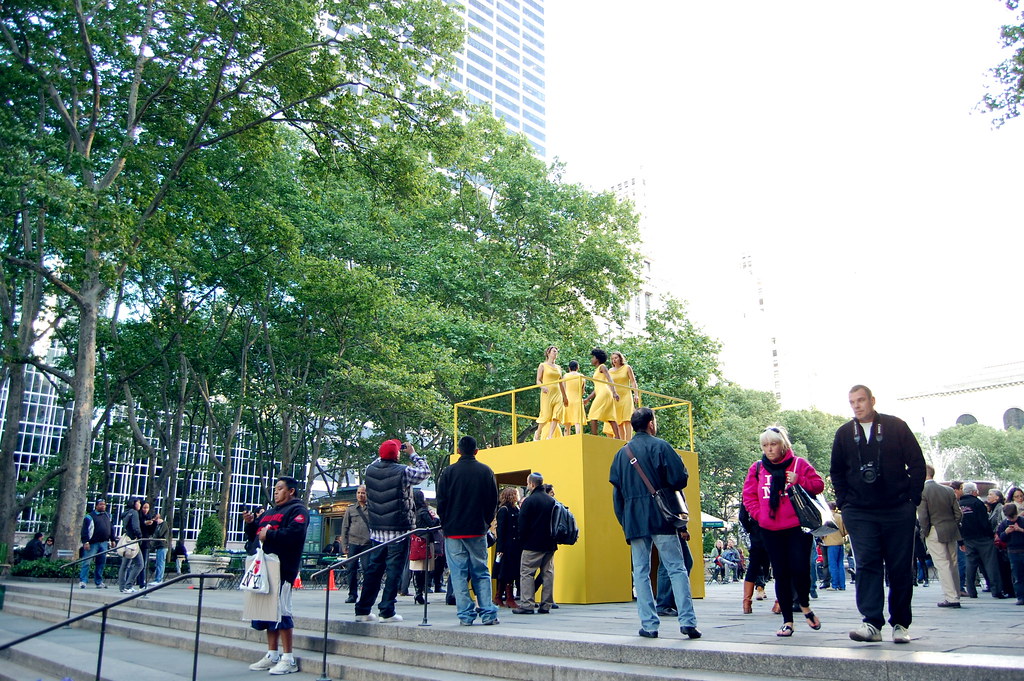
Kate Gilmore, Walk the Walk, 2010. Performance still of five-day performance piece, Bryant Park. Photos: 16 Miles [more]

Kate Gilmore's remarkable performance project, Walk the Walk, closes Friday, May 14, after its five-day run in Bryant Park. I'd like to encourage someone to set up a fund to keep the work going forever. They could even set up a Felix Gonzalez-Torres' 1991 Untitled (Go-Go Dancing Platform) nearby! In Gilmore's piece, a total of fourteen women perform for five hours each day, from 8:30 a.m. to 6:30 p.m. Since each women is paid $15/hour, running the project five days a week, for a year, would cost $273,000. That's not a modest sum of money, but it's only slightly more than someone paid for a 1992 Marc Newson table at Phillips de Pury & Company this evening.

Sadly, of course, Gilmore's piece is temporary. Here is an excerpt of a review I wrote about it for Modern Painters:
You can see them from a block away: seven women in yellow dresses walking back and forth on top of an eight-foot-tall yellow platform in Manhattan’s Bryant Park. They look straight ahead as they walk, unsmiling, unaware of the people below snapping photos and recording videos on their iPhones. One woman looks annoyed, another frustrated. Some stomp on the ground, while others shuffle and shimmy across the boards. They all look bored.


Sunday, March 21, 2010

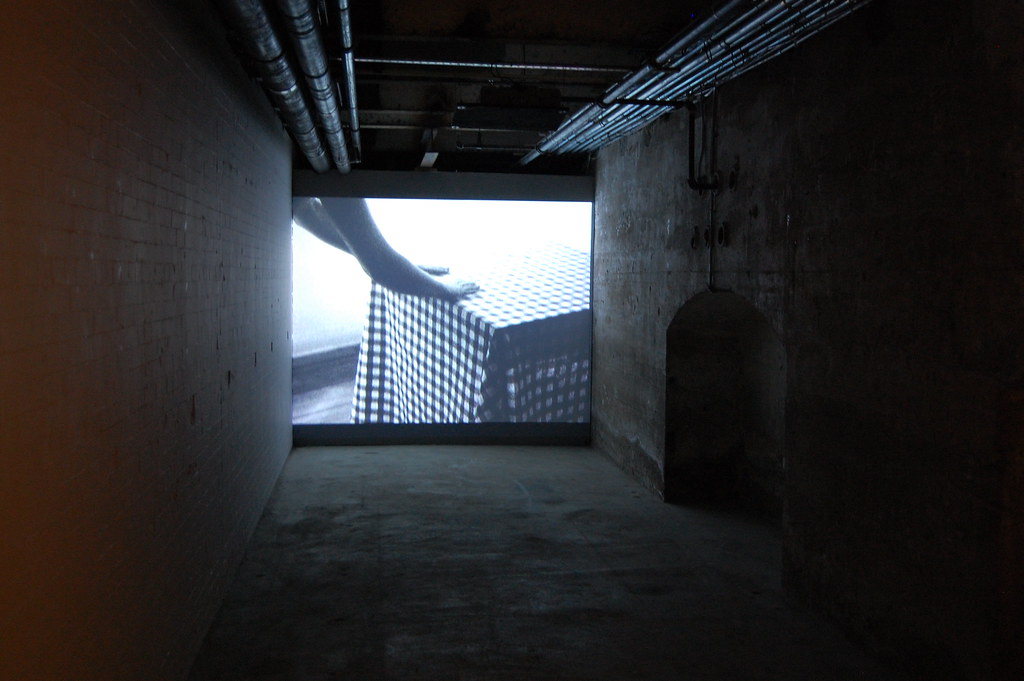
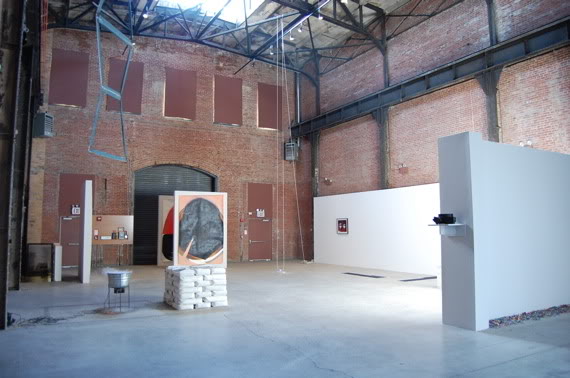
"Leopards in the Temple" at SculptureCenter, New York


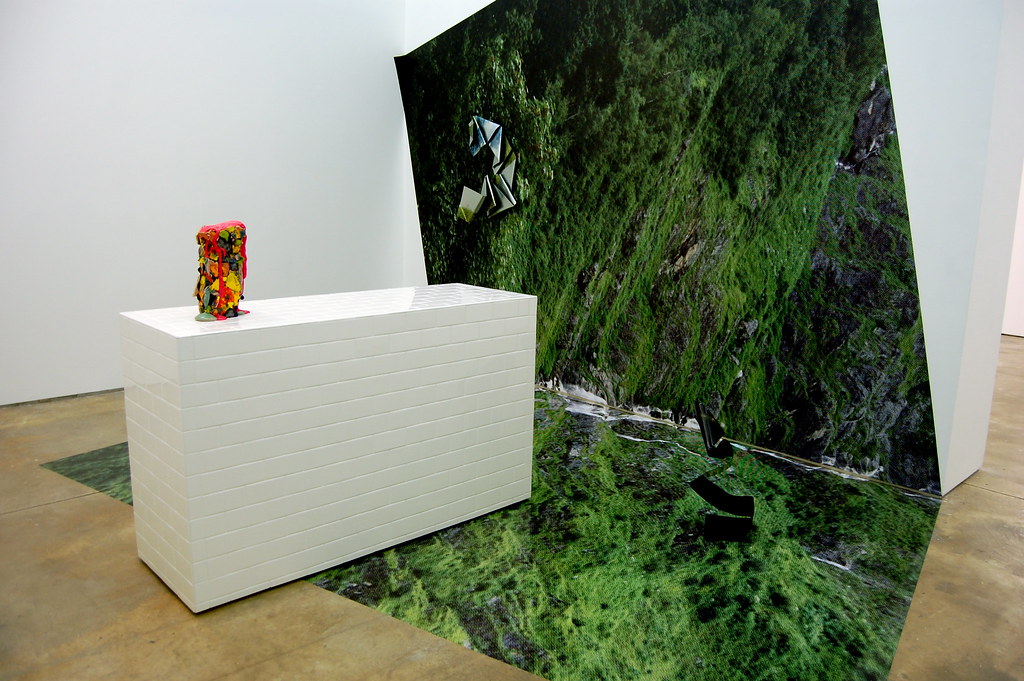
Installation view of "Leopards in the Temple," at SculptureCenter, New York, through March 30. Photos: 16 Miles [more]
Leopards break into the temple and drink to the dregs what is in the sacrificial pitchers; this is repeated over and over again; finally it can be calculated in advance, and it becomes a part of the ceremony.
— Franz Kafka, 1917
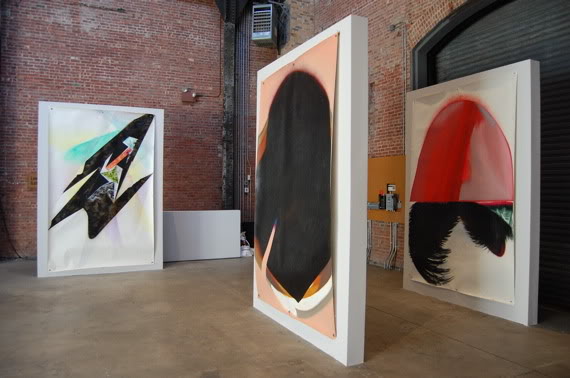

Kerstin Bräsch for DAS INSTITUT, And Let Me Know What You Think; Den Moch Ma!; Gib Mir Kraft (all from "New Images/ Unisex" series), 2009. Oil on paper, 72 x 110 in.
This dreamy little fable serves as an excellent metaphor for the cycles of modern art. The leopards are the artists of the avant-garde, instinctive animals like Picasso, Pollock and Julian Schnabel who desecrate the hallowed precincts of high art and introduce a wild new beauty and freedom. But then they keep coming back. Their once revolutionary gestures become routine, and they are absorbed into the pantheon.

...

No one here, however, is likely to topple the current regime of art, and in that respect these artists stand for the majority of contemporary strivers. They are resourceful, alert and eager to please, but are not wildly imaginative. Call them the mild ones.
— Ken Johnson, "Tamer Cats at Modern Art’s High Gates," New York Times, January 14, 2010


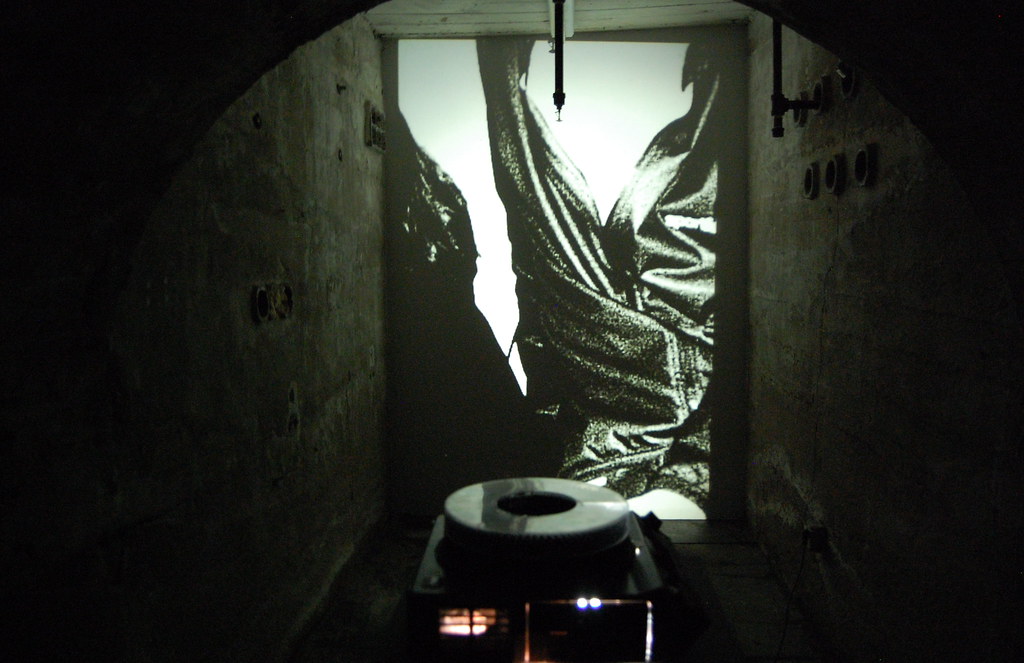
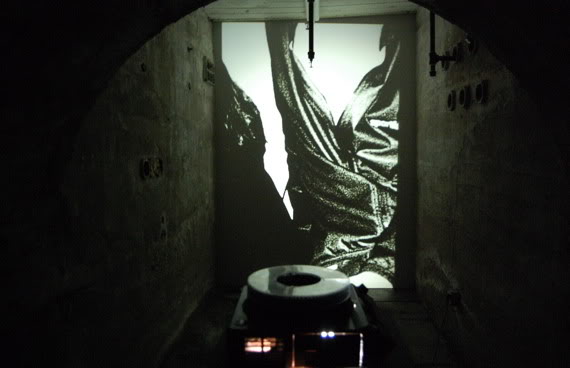
Nina Hoffmann, Motiv [detail], 2009. 35mm slide projection (81 images), dimensions variable.

Ken Johnson's reading of SculptureCenter curator Fionn Meade's "Leopards in the Temple" is one of the best reviews the Times has run this year: rigorously polemical, comprehensive, and historically grounded. I also think it is mostly right. For a century, the avant-garde has attacked, been canonized, and returned again, ad infinitum. Johnson wants to position the artists here in that "Leopard" lineage, though his choice of examples is odd: Picasso, Pollock, and Schnabel, three devout Modernists, with whom the show's artists have little in common, aesthetically or politically.

Unlike Picasso and company, most of the artists in the "Leopards in the Temples," seem little interested in "wild new beauty and freedom," as Johnson would have it. They aren't aiming to murder their forebears. Johnson writes, "Viewers unfamiliar with what’s been going on in art in the past 50 years might find some works outrageous." However, one suspects that the show's artists, at least, are familiar with that art. They aren't looking to provoke outrage; they are happy to tweak and twist that recent art — particularly of the conceptual, relational, and, neo-minimal strain — into smart, new aesthetic experiences. Picasso doesn't need to be murdered when Daniel Buren can be gently detourned. The days of ransacking the temple are over.
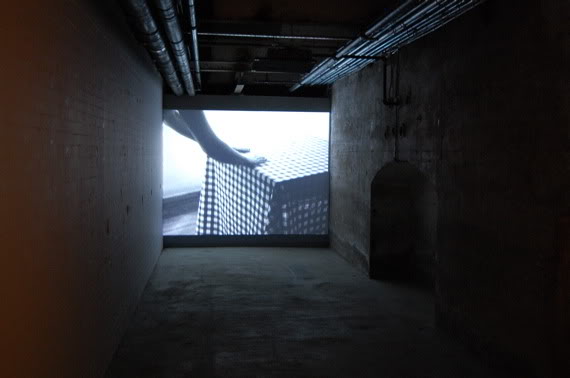

Kathrin Sonntag, Tango [still], 2006. 8mm film transferred to video, 2 min.
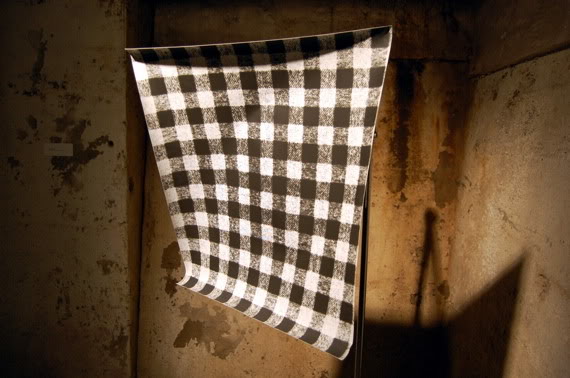

Lucas Knipscher, The Back Is As Big As The Front [detail], 2010. 4 yards of 100 white 2 x 2 in. Heritage Buffalo Hunting Plaid from Woolrich Fabrics, Woodrich, PA; One-Way/Two-Way Mirror Window Film with Silk Screen of Heritage Buffalo Hunting Plaid 101 1.25 x 1 1.5 in. B; Heritage Buffalo Hunting Plaid 101 White 1.25 x 1.5 in. B Photocopied on Greyback Canvas; Four Texts from Camera Lucida by Roland Barthes (Removed from Four Sheets of Vinyl); Two Photographs from the Seattle Arts Commission Photo Survey by Larry Fink in the Collection of the Smithsonian and the Collection of Woolrich Woolen Mills (WP Lavori and Corso srl, Bologna), dimensions variable.

Lucas Knipscher's sprawling installation, The Back Is As Big As The Front, 2010, for instance, consists of an outlandish list of materials includes outlandishly detailed specifics: "Four texts from Camera Lucida by Roland Barthes"; "Heritage Hunting Plaid from Woolrich Fabrics"; etc., a farcical take on overwrought installation art — and, perhaps, the meticulously sourced banality of artists like Luc Tuymans. At the same time, Knipscher seems to be trying to sneak some small beauty of that process of producing commentary.
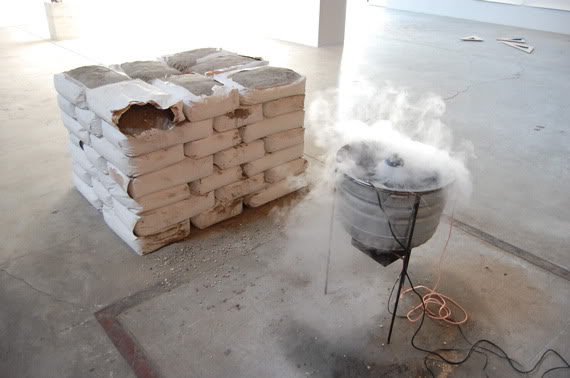

Nina Canell, Perpetuum Mobile (1800Kg), 2009. 30 liters of water, bucket, steel, hydrophone, amplifier, mist-machine, cable, 1800 kg cement, dimensions variable.

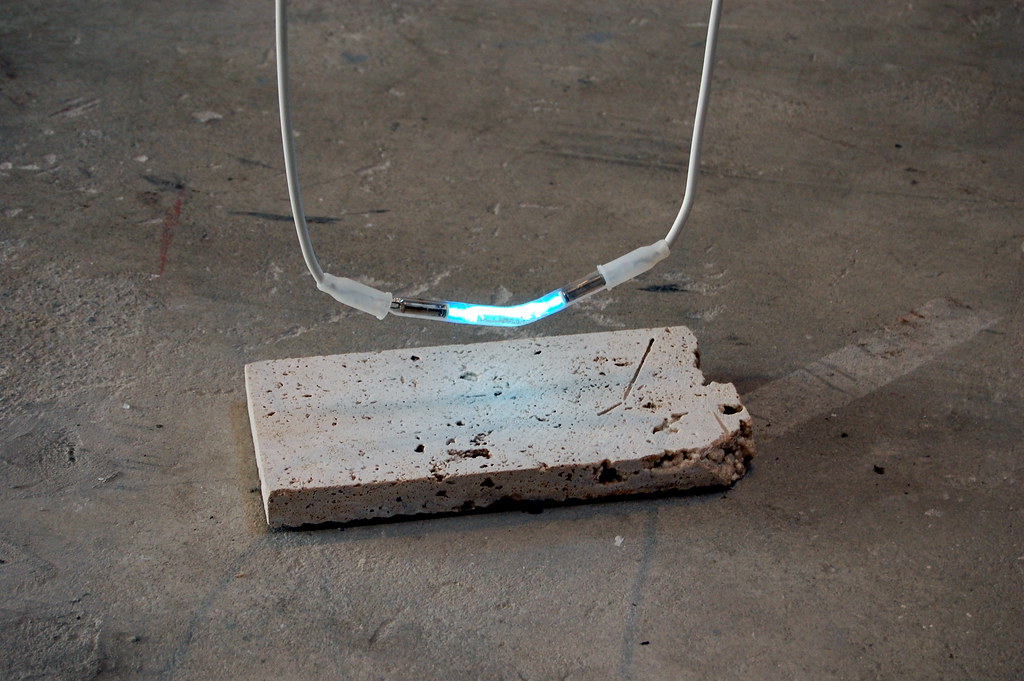
Nina Canell, meanwhile, apes Rirkrit Tiravanija. Instead of a smoking wok to serve food, she offers a bubbling, magical cauldron, which Johnson explains is vaporizing water, in order to harden the bags of concrete nearby. The visitor that misses Tiravanija's cooking gets to look at empty burners and pots. SculptureCenter visitors get to see the equipment hard at work but never witness any actual transformation. The artist, Canell jokes, works in mysterious ways. And yet, the piece is still faintly beautiful and mystical. (She did a larger, 2400Kg version at the Konrad Fischer Galerie recently: high-production-value conceptualism to fit a variety of spaces and needs.) Her 2009 Flat Earth, in detail below at the bottom of this post, features a small piece of neon hanging from cords attached to the gallery's soaring ceiling. The Peter Fischli and David Weiss influence, which Johnson spots throughout the exhibition, is on display here, with just a touch of the perennially under-appreciated Keith Sonnier.
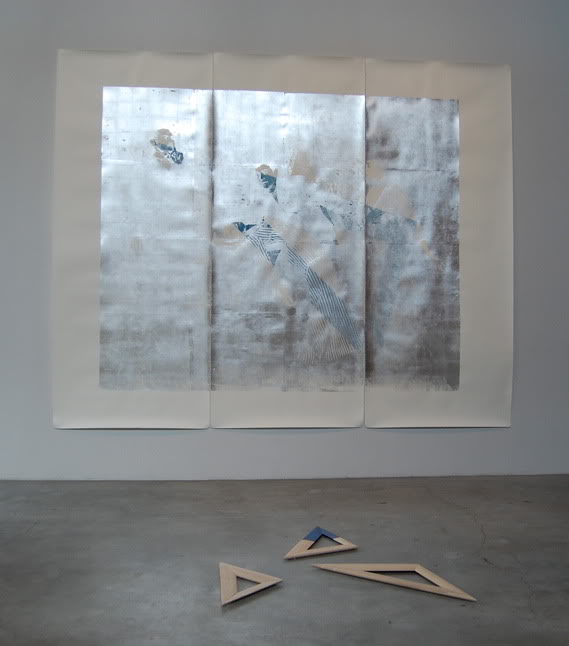

Lucy Skaer, Untitled, 2009. Watercolor and aluminum leaf on paper, 14 ft. 9 in. x 9 ft. 10 in.

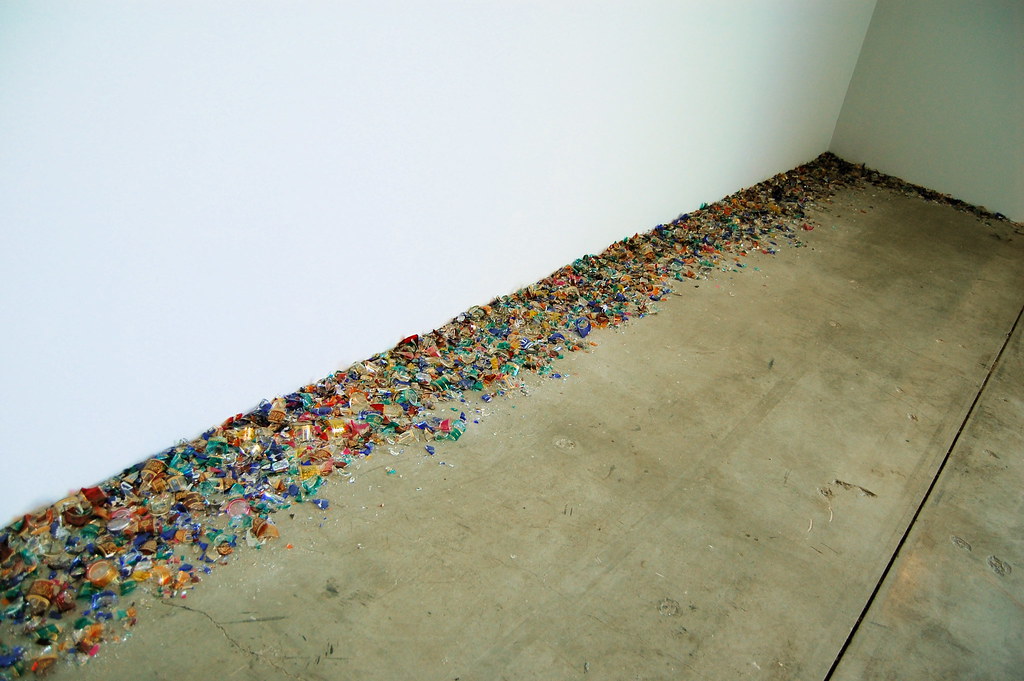
Writing in the Financial Times, Ariella Budick links Latifa Echakhch's long carpet of multi-colored broken glass, Erratum, 2004-10, to Robert Smithson's hefty pile of clear broken glass, Map of Broken Glass Atlantis, 1969, which is currently on display at Dia:Beacon. It's an apt comparison, with Echakhch's providing a simple, ornamental take on the Earth artist's hulking work. Indeed, none of the artists here has the ambition of a Smithson. No one is chasing revolutions — aesthetic, institutional, political, or otherwise. Duchamp and Cady Noland have shown that the only truly radical act left for artists is to quit making art, to stop visiting the temple altogether. However mild they appear, today's leopards want to look as they do here.
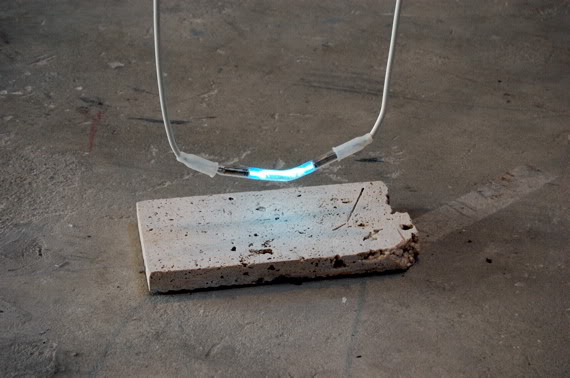

Nina Canell, Flat Earth [detail], 2009. Stepping stone, neon, cable, 1000V, dimensions variable.

"Leopards in the Temple"
SculptureCenter
44-19 Purves Street
Long Island City, New York
Through March 30, 2010

Thursday, December 24, 2009

Virginia Poundstone, "Illiquid," at Harris Lieberman [Review]


Virginia Poundstone, Floralife, 2009. Ceramic and pigmented expandable foam, 16 x 8 x 6 in. Photo: 16 Miles [more]

Virginia Poundstone has a great show at Harris Lieberman in New York right now. I reviewed her show, and she provided some picks for things to see and do over the next few months:
The title of Virginia Poundstone’s New York solo debut, “Illiquid,” refers to commodities not easily sold for cash. Petroleum is a classically liquid asset, while art is decidedly illiquid, worthless until a buyer decides to believe in it, a risky truth to relay to collectors in this post-boom time. From a formal viewpoint, her title is almost equally dubious, as four of the exhibition's five components seem nearly fluid, ready to melt away or evaporate.


Virginia Poundstone, "Illiquid" installation view, Harris Lieberman Gallery, New York


Virginia Poundstone, Valley of Flowers #3, 2008-2009. Laser printed steel, 18 x 14 in.

Virginia Poundstone, "Illiquid"

Harris Lieberman Gallery
89 Vandam Street, New York
Through January 16, 2009
[more photographs]

Sunday, November 8, 2009

Fischerspooner at MoMA / "100 Years..." at P.S.1 [Review]


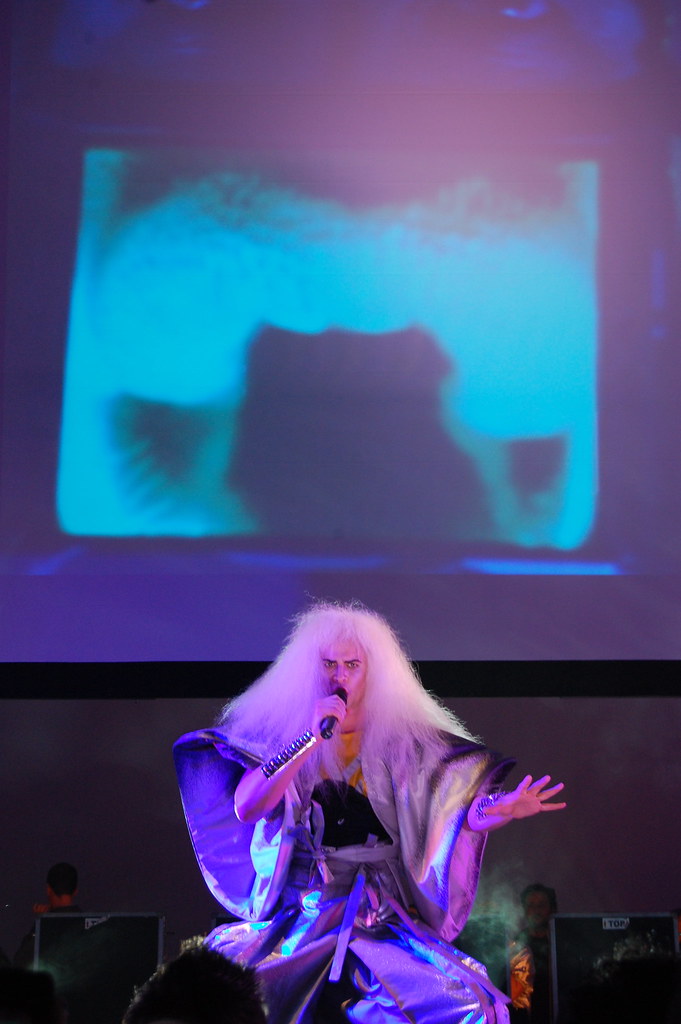
Fischerspooner, Between Worlds, Nov. 1, 2009 at the Museum of Modern Art, New York, for "Performance" 6. Photos: 16 Miles [more]

The first third of Performa 09, New York's performance biennial, has finished. The Museum of Modern Art staged a Fischerspooner show as part of the festivities (and as part of its performance series), while P.S.1 is hosting a short-term performance art exhibition curated by RoseLee Goldberg (Performa's founder) and P.S.1 director Klaus Biesenbach. Here's a review:
Midway through a Sunday night performance in the Museum of Modern Art’s atrium, Casey Spooner signaled his band Fischerspooner to a sudden halt. “I’m going to die!” he screamed to the young, fashion-conscious crowd, apparently displeased with their level of enthusiasm. “I’m a showbiz disaster. This is your last chance to show your love!” The crowd cheered, trying to oblige their fated star, and the noise appeared to be sufficient. Spooner who takes the role of a rampaging showman on stage — equal parts Boy George and Roman gladiator — motioned to his team, and the group’s raucous club music started again.


Monday, October 26, 2009

The In Sight From Way Out: Abe's Penny [Review]


Conelia Hediger, photograph for Abe's Penny Volume 1.8 (Issue 1 of 4)

The image above arrived in my mailbox as a postcard earlier this month with a message that begins as follows: "I told Chesikha before my last stunt that if I died, I'd come back a fish. Not thinking she'd remember I said that." A week later, another postcard arrived. Nine fish were flying through the air in this new photograph, as a woman — Chesikha? — looked on with great concern. The postcards are Abe's Penny, a "micro-magazine" that combines single images (New York-based photographer Cornelia Hediger here) with short texts (Adam Wade) in weekly supplements.

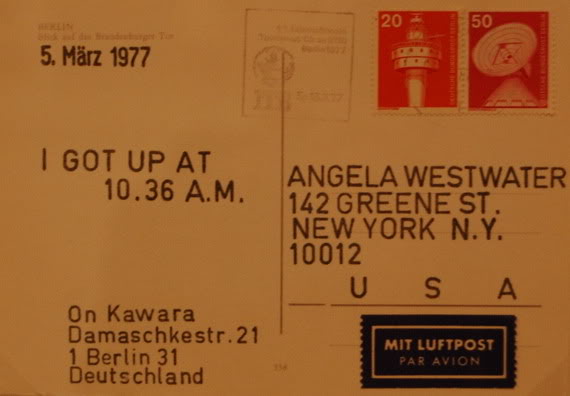
Part of the appeal here is the means of distribution. Some issues arrive with the U.S. Postal Service's faint orange bar code along the bottom of the cover photo, others are branded with a black code on the side with the message. There may be a little scrape along the front from a sorting machine or a creased corner from its long journey, but these tiny imperfections add to the fun. The scuffs — and the gorgeously hand written addresses — underscore the fugitive and personal nature of the notes. There is no web address, and no way to way to forward the message. On the magazine's Twitter page, the staffers document the mailing of each issue in a move that would have pleased On Kawara. An entry from Oct. 5 reads as follows: "1.8.1 mailed today at 4:40pm from Atlantic Street Station."

Ultimately, though, the quality of the material creates the lasting charm of the magazine. Abe's Penny is run by sisters Anna and Tess Knoebel out of Brooklyn, and they have recruited a list of contributors that have included formidable figures like Tod Seelie, Melanie Flood, and Skye Parrott to craft stories and photographs that range from the bizarre (the stunt man's monologue above) to the elegiac (the four issues of volume 1.7 were devoted to anonymous recollections of memories of parents). Given the cast and the quality involved, this seems likely to be one of those projects that will be spoken of reverentially and collected carefully in the future. It also may be one of the rare products that will deserve that treatment. (Subscribe now.)


On Kawara, Untitled, 1977. From the collection of the Museum of Modern Art, New York. Photo: 16 Miles

Tuesday, July 14, 2009

PLOT09: This World & Nearer Ones - Part 2 of 2 [Review]


Guido van der Werve, Number Seven: The clouds are more beautiful from above, 2006. Photo: 16 Miles [more]

Part 1 of our PLOT09 coverage, a series of photographs, is also available.

In the press release for their 1978 exhibition Art on the Beach, Creative Time quoted O. Henry’s on Manhattan: “It’ll be a great place if they ever finish it.” They were showing art on the Battery Park landfill, the center of the island’s latest transformation, created with dirt excavated for the building of the World Trade Center. Thirty years later, the organization has organized PLOT09 on Governors Island, just four hundred yards away from Battery Park in New York Harbor. A former Army and Coast Guard site, it is everything that Manhattan is not: pastoral, isolated, and historically static.

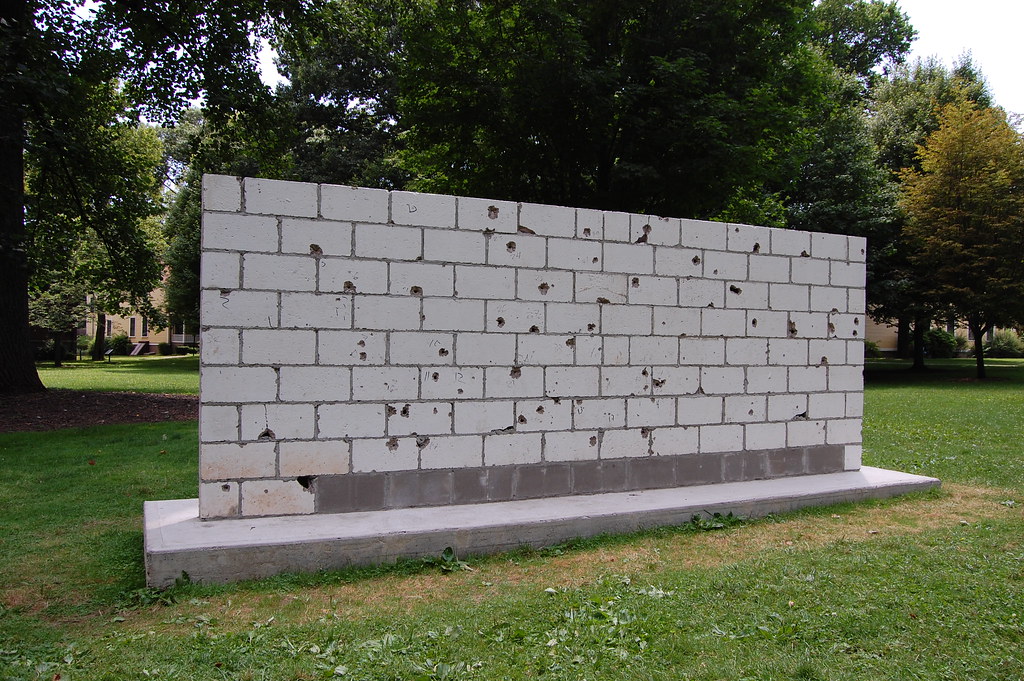
Curator Mark Beasley invited nineteen artists to contribute work for spaces on the island, and, perhaps not surprisingly, many of their responses attempt to puncture the island’s impermeable cultural wall, challenging the bureaucratic structures that underpin much of its past. Teresa Margolles contributes a bullet-ridden wall from her hometown of Culiacán to a quiet field. In a great photo-essay on the show Carefully Aimed Darts describes it as “bloodstained post-minimalism,” which is a neat summation. Violence, weapons, and death, all absent from this former military complex are brought into view.

Video scores the greatest triumphs and failures. In the former category, Bruce High Quality Foundation’s zombie film Isle of the Dead, shot on the island, is hilariously sublime, as is Judi Werthein’s The Land of the Free, which shows Colombian musicians, who have fled drug violence, singing their own translation of The Star-Spangled Banner. Presented inside an old Victorian house a quick hop across the water from Ellis Island, it merits repeat viewings. On the other hand, Adam Chodzko’s documentary about an imagined potlatch among children of military families stationed on the island, is a mess of ideas that never quite coheres.

Reviewing PLOT09, Roberta Smith wrote, “The world has an endless supply of sites, but more and more the specifics look very much the same,” arguing that some of weaker entries amounted to “garden variety Conceptualism … a tad obvious or exploitative." This could include Edgar Arceneaux, who channels low-frequency sounds through subwoofers, gently shaking the walls of one of the old mansions. Experiencing it is as exciting as listening to a washing machine run.

Insular Act, a piece by the collective Tercerunquinto, is at least a bit more curious. The three artists decided to throw a rock through the window of one of old administrative buildings for their contribution, documenting the act in drawings and a video. Happily, they first dutifully received all of the requisite governmental permissions. Institutions once vigorously resisted such institutional critique, as when the Guggenheim rejected Hans Haacke’s 1971 exposé on its trustees. Now they know it’s better simply to play along with the harmless fun. The window was replaced at a cost of $2,500, and the work amounts to a farce on the way in which bureaucratic institutions have come to operate in the service of purportedly radical, often-banal conceptual agendas. One hopes the satire is intentional.

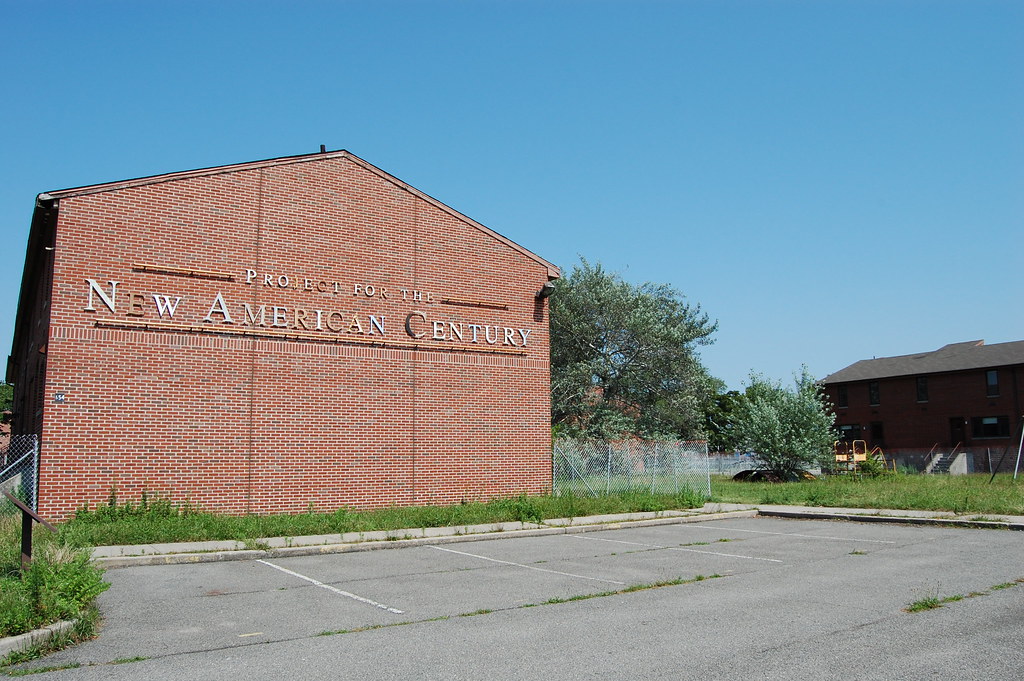
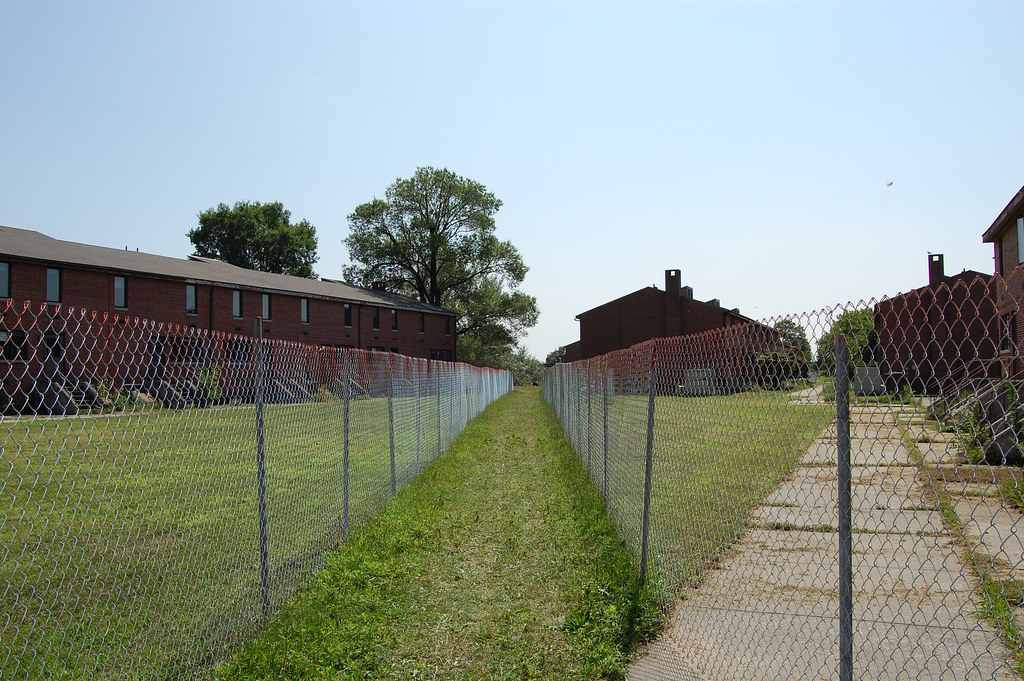
One of the best moments comes from Tue Greenfort’s Project for the New American Century. To view it, one walks or bikes through Brick Village, a condemned field of tract housing straight out of Dan Graham’s Homes for America. Rounding the corner of one brick house, in the middle of this manufactured suburbia (slated for demolition to make way for recreation grounds), one encounters the logo for William Kristol’s organization emblazed across its side, along with a plaque celebrating its cause. It is a perfect tribute to its location and our uncertain time.

The real surprise, though, comes from Patti Smith and her daughter Jesse Smith, who proffer a fifteen-minute recording to listen to while exploring the exhibition. Over a slow, drifting piano accompaniment, Patti Smith recites a panegyric to the beauty of Governors Island, the soldiers and families it held in isolation, and the sacrifices those that passed through the area over the past centuries endured. In a field enamored of dissonance, it is a rare call for a sincere commitment to engaging the island’s complex historical legacy. This seems essential. Crowds from across New York are flooding the ferries. Large swaths of buildings will be razed over the next few months. The artist’s interventions will be removed and shipped away. Governors Island is finally changing. There are things worth remembering.

Monday, July 13, 2009

PLOT09: This World & Nearer Ones - Part 1 of 2 [Photographs]


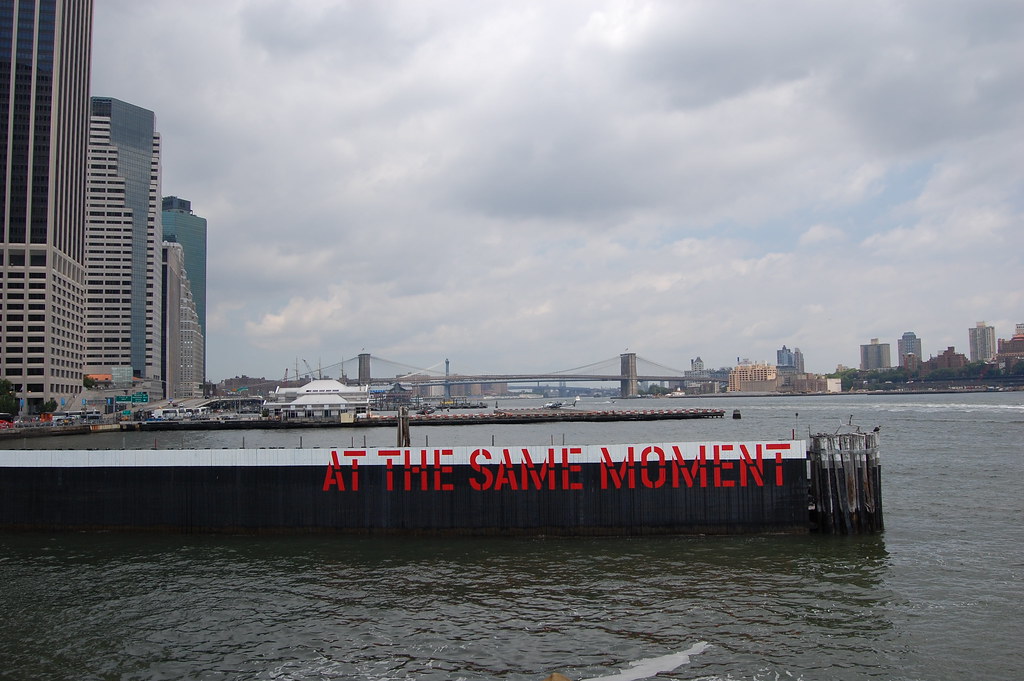
Lawrence Weiner, AT THE SAME MOMENT, 2000. Photos: 16 Miles [more]


Teresa Margolles, Muro Baleado / Shot-Up Wall, 2008.


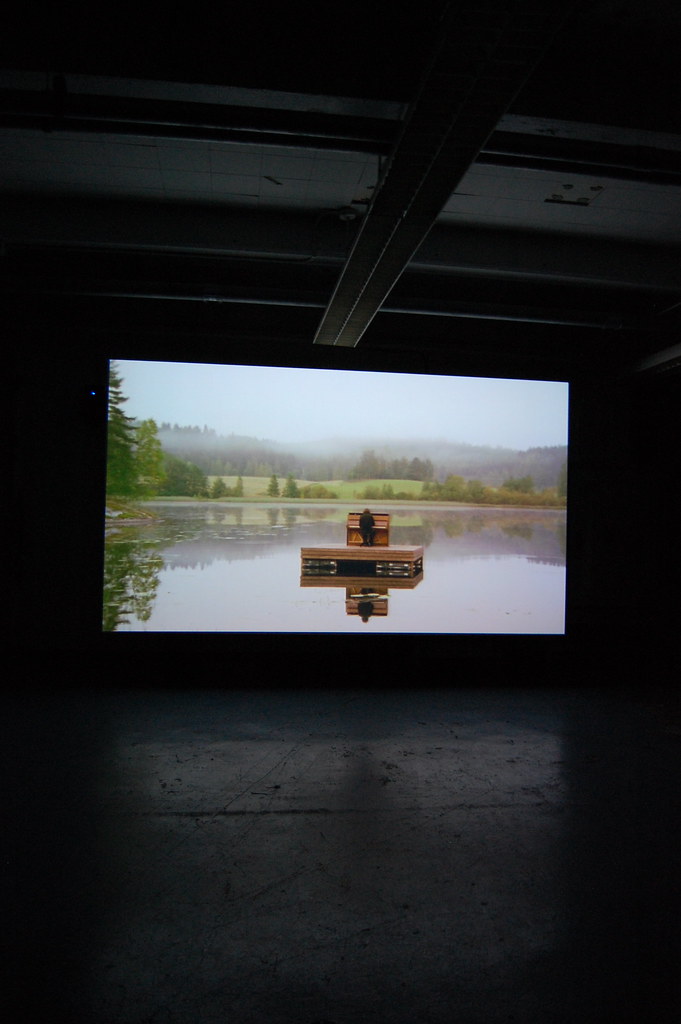
Guido van der Werve, Number Four: I don't want to get involved in this; I don't want to be part of this; talk me out of it, 2005.


Edgar Arceneaux, Sound Cannon Double Projection, 2009. CD players, subwoofers. Dimensions variable.


Tue Greenfort, Project for the New American Century, 2009.


Brick Village on Governors Island, site of Tue Greenfort's Project for the New American Century, 2009.


AA Bronson and Peter Hobbs, Invocation of the Queer Spirits (Governors Island), 2009.


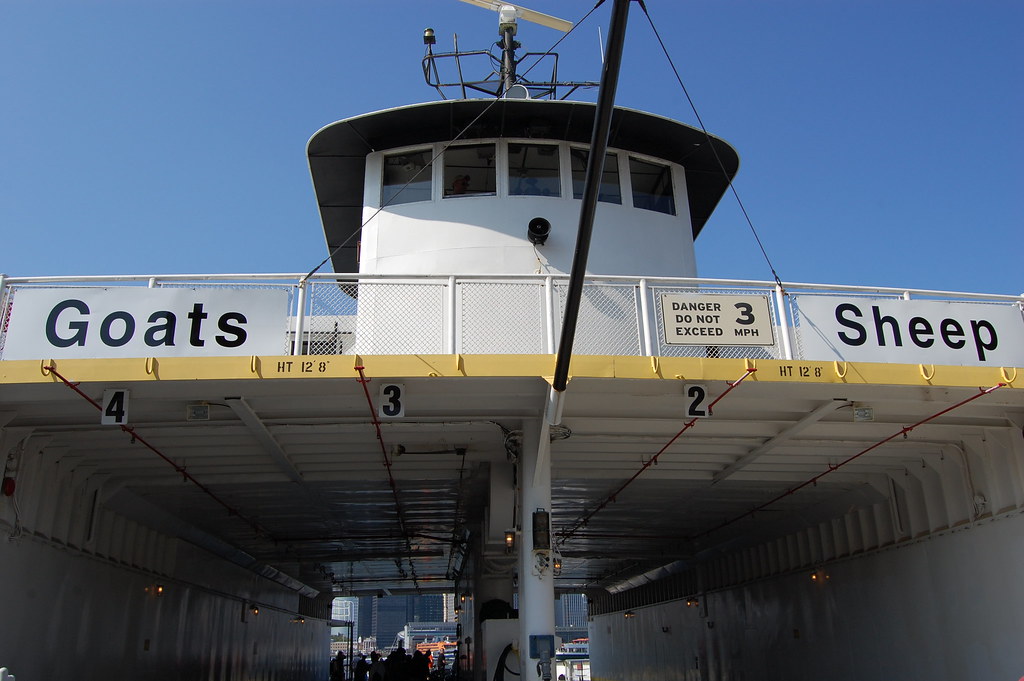
Mark Wallinger, Ferry, 2009.

PLOT09: This World and Nearer Ones
Curated by Mark Beasley
Governors Island, New York
Summer 2009
Photographs: 16 Miles [more]

Monday, May 11, 2009

Carrie Moyer, Arcana, at CANADA [Review]


Carrie Moyer, Tableau, 2008. Photo: 16 Miles.

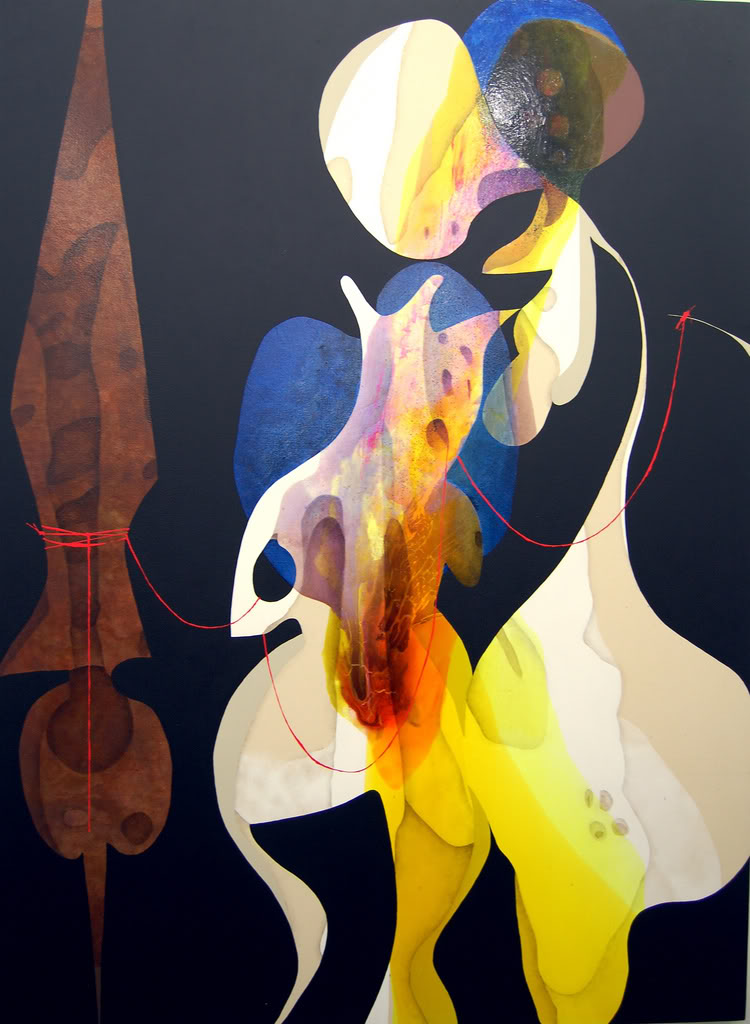
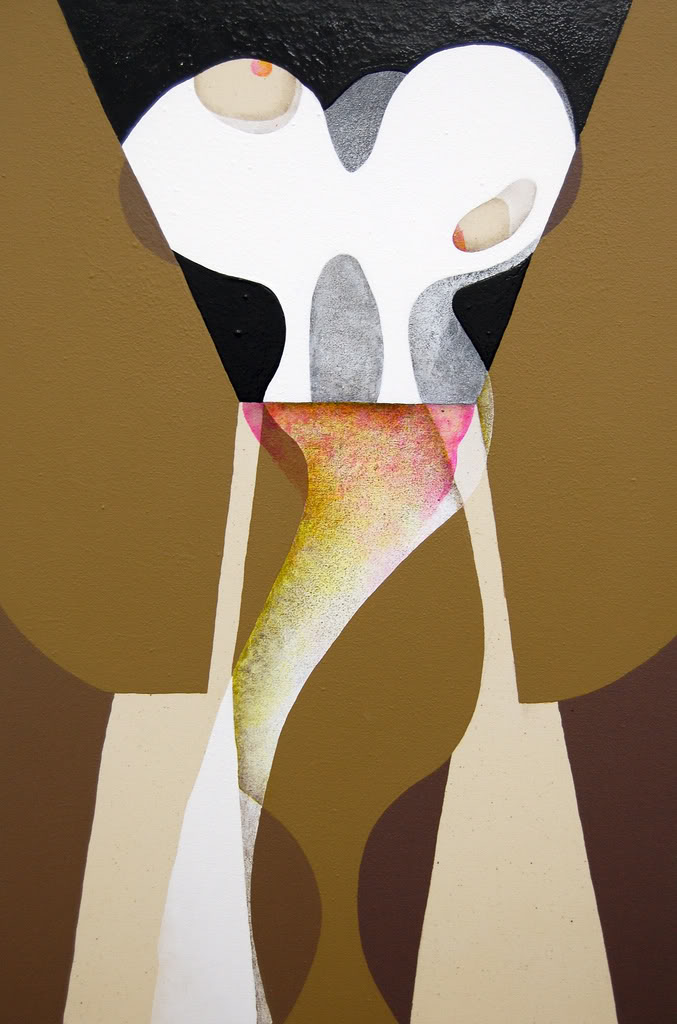
Moyer seems to finish each of her paintings with a final layer of opaque, neutral color, implying that we see only carefully chosen glimpses of a larger setting.  These bubbling spotlights suggest Miró, the very bottom layers O’Keefe, but the translucent, shimmering leaves between are harder to decipher.  As in past outings, she teases at figuration – are those breasts in Rebus, a monkey’s head in Tiny Dancer?  Moyer works more delicately here than she has in previous projects, glazing sections with sugary pinks, yellow and purples, and introducing glitter.  Because of that care, the dissonances that she sets cohere, which is probably why the best works here are a bit creepy: it’s unsettling to see mysteries this taut.


Carrie Moyer, at CANADA.  Photo: 16 Miles.

55 Chrystie Street
New York, New York
Through June 7, 2009

Wednesday, May 6, 2009

Miami Noir at Invisible-Exports [Review]


Jason Hedges, Untitled, 2009, at Miami Noir, at Invisible-Exports. Photo: 16 Miles

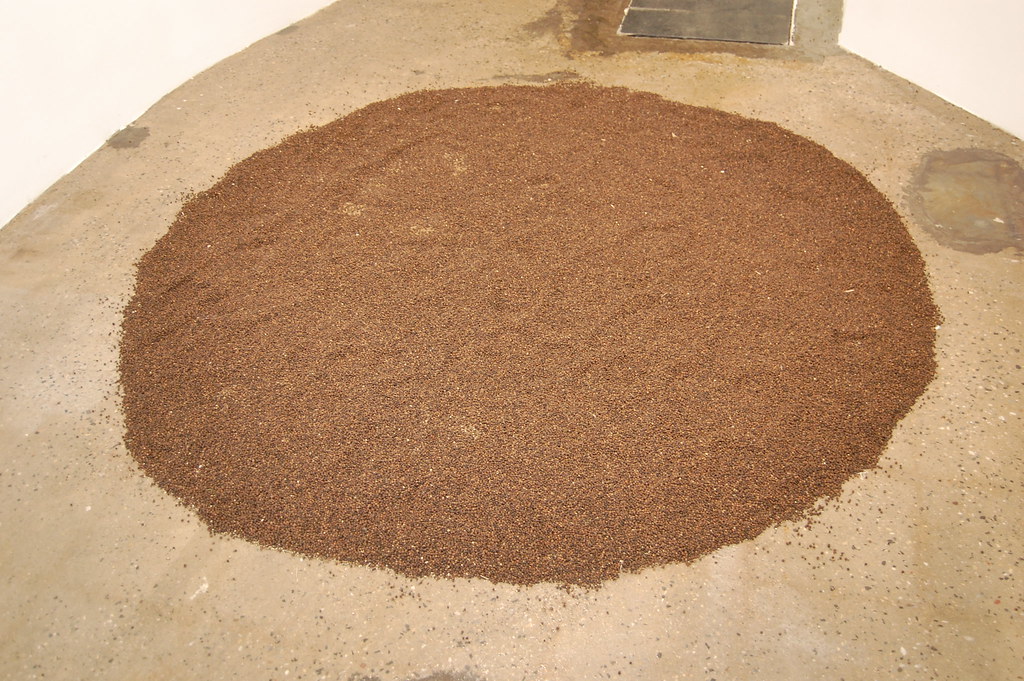
Miami Noir, the current show at Invisible-Exports, smells delicious. A sharp, familiar smell dominates first, emanating from a circle of peppercorns assembled on the floor, recalling Richard LongRobert Smithson, and Carl Andre.   I stepped gingerly around the seasoning to reach a tidy little wall sculpture by Matthew Schreiber, an assistant for James Turrell, which uses incense smoke to create a field for his laser and mirror sculpture.  

Later I learned that viewers are encouraged to trudge across the peppercorns, grinding them underfoot. When Christian Marclay scattered records across a gallery floor, he was chasing random destruction. (Andre's sculptures generally ignore viewers traipsing over them.) Here, Hedges is markedly more generous, letting us kick some spice up into the incense, warming the tightly curated show of Miami-based artists for the next visitor.


Cooper, Simple pleasures, lonely recording studios, dull mirrors, quiet suicides, bad debts, the theater and its double. In girum imus nocte et consumimur igni, 2008.  Photo: 16 Miles

Miami Noir
Curated by Adriana Farietta
14A Orchard Street
Through May 10, 2009

Saturday, April 25, 2009

Gavin Turk, Jazzz, at Sean Kelly Gallery [Review]


Gavin Turk, A Night at Bird Land [detail], 2009. Photo: 16 Miles    [more]


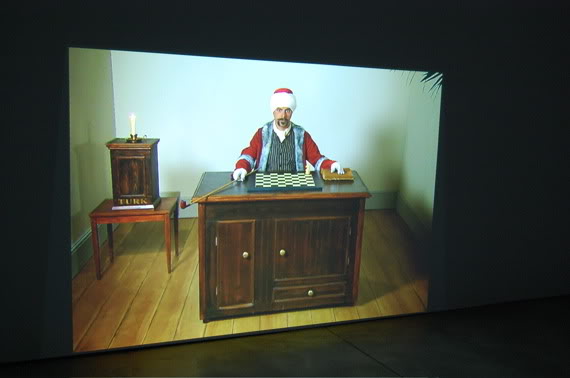
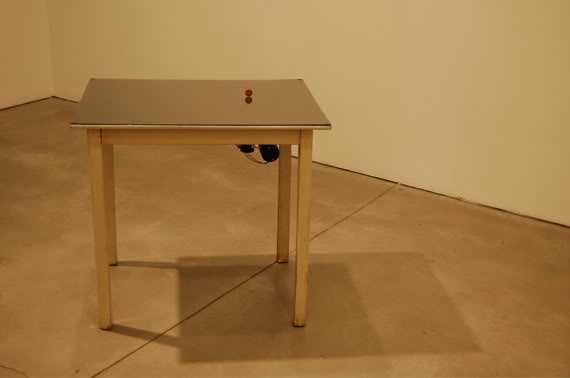
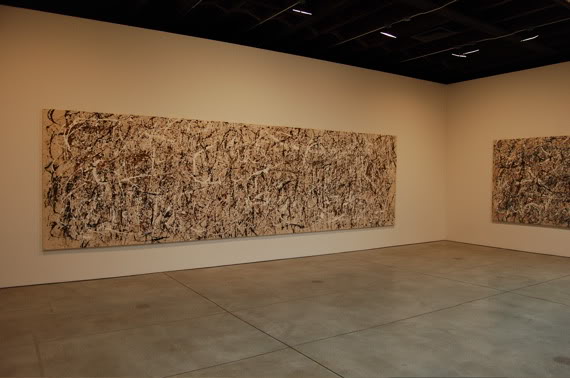
At first, it seems that Gavin Turk is following his usual formula, adopting Jackson Pollock as his latest macho disguise.  (Previous projects have explored Guevara, Presley, and Sid Vicious, most famously).  There are copies of Pollock drip paintings with manic, sardonic titles in the main space (Something Different!!!!!, Ascension, both 2009), while the side galleries contain various curiosities: 2008’s Ash, actually composed of bronze, and 50/50 (2007), a mirrored table with a continuously spinning copper coin.  A video features Turk dressed as a chess-playing automaton (The Mechanical Turk, 2008), moving the same, single piece around an empty board.  It’s a dangerously apt metaphor for Turk’s career of camouflage conceptualism.  If his parodic approach to art history seems tired – a caricature of itself – that’s the point.  The results, the Pollock copies especially, are intensely pleasurable, and, in photographs modeled on Hans Namuth’s mythologizing portraits of Pollock at work, Turk appears to be having the time of his life.  


Gavin Turk, Ash, 2008.  Photo: 16 Miles   [more]


Gavin Turk, The Mechanical Turk, 2008.  Photo: 16 Miles   [more]


Gavin Turk, 50/50, 2007.  Photo: 16 Miles   [more]


Gavin Turk, Ascension, 2009.  Photo: 16 Miles   [more]

Gavin Turk, Jazzz
Sean Kelly Gallery
528 West 29th Street
New York, New York
Through May 2, 2009

Sunday, April 5, 2009

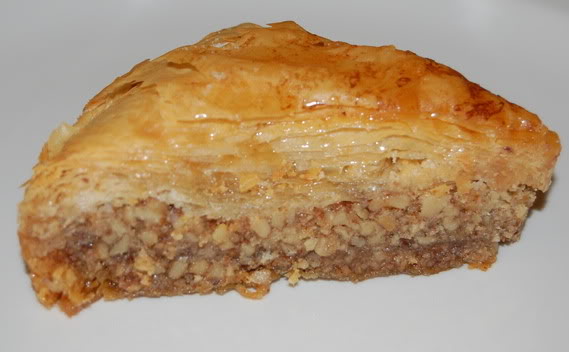
Hot & Crusty [Baklava Review #1]


Hot & Crusty, Baklava, $3.75, 2009.  Photo: 16 Miles

There has probably never been a bakery with a less-appealing name than the ignominious miniature chain Hot & Crusty.  I, for the record, can definitively say that I want nothing to do with anything (much less food) that contains those features.  Wandering by their First Avenue location recently and spotting baklava, then, I entered with almost unprecedentedly low expectations.

Surprisingly, the bakers managed a respectable showing.  $3.75 is a bit steep for a standard piece of the dessert, but Hot & Crusty rewards you with a towering (if deeply untraditional) hunk of phyllo and nuts.  The crust is the better half of the treat, fresh and crispy with the slightest sweet glaze resting on it.  The nuts, while ample,  are bland and too densely packed in syrup.  My fork became mired in the heart of it, torn free only with extreme force.  

There's a hint of rose water and a genuine savory sensibility in some bites.  It's greatest success, though, is in avoiding the problems that befall so many other mass-produced baklavas.  Unlike most chain varieties, the Hot & Crusty version manages to avoid tasting like it's been marinated for weeks in simple syrup or left to go squeaky and stale.

In truth, the real reason to approve of it may be that H & C is open twenty-four hours a day, making it the best place that I'm aware of that's available to handle that late night baklava snack attack.

Rating: 2
Hot & Crusty
231 1st Avenue
New York, NY

Scale
- - - - - - - - - - - - - - - - - - - - - - - - - - - - - - - - - - - - - - - - - - - - - - - - - - - - - - - - - - - - - - - - - - - - - - - - - - - - - - - - - - - - - - - - - - - - - - - - -
5: Best Baklava Ever   4: I Want to Eat This Every Day   3: Above-Average    2: Decent   1: Baklava Only for Emergencies   0

Sunday, March 22, 2009

Almost Baroque, at Triple Candie [Review]


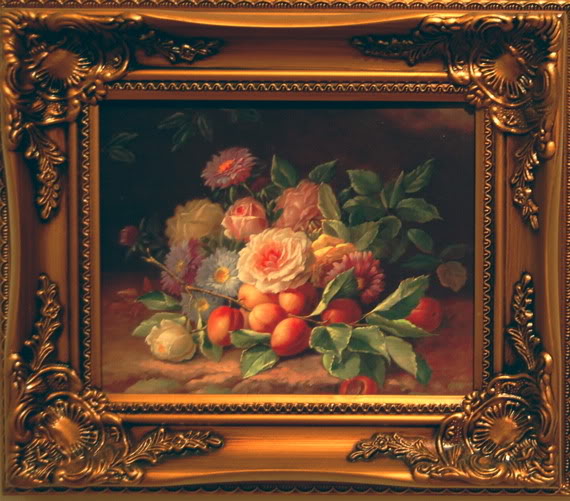
Unknown artists, [Peaches and Flowers], ca. 2008. Photo: 16 Miles

The social value of studying art history is dubious, but there are two basic arguments that people tend to make it its favor: (1) It teaches you in some vague way to look at visual culture more carefully, making you a more discerning, critical viewer, or (2) It gives you a more concrete understanding of the past that may have transferable value to the present; at the very least, it provides cocktail fodder. Rarely, of course, does the discipline actually pursue these two goals. There are usually two other, more vital issues involved: beauty and money.

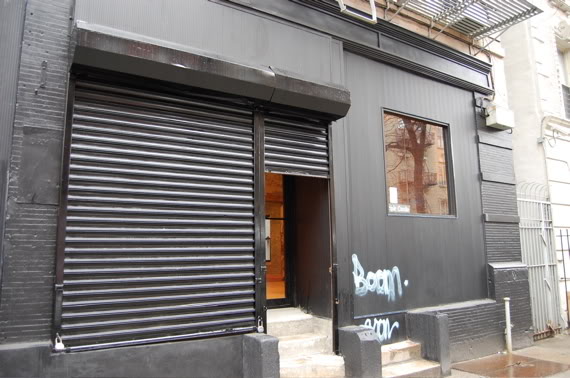
It was a joy, then, to walk into Triple Candie’s new Harlem space and find a clever, concise exhibition that attempts to tackle both those bigger goals and pleasurable realities. Directors Shelley Bancroft and Peter Nesbett have purchased and hung nine floral still life paintings produced in China and sold at the El Mundo department in Harlem for the show. “Clearly, they must be copies of historic paintings,” they initially thought, they admit in the press release. The rigorous investigation they mounted, detailed on placards hung alongside the works, reveals that their backgrounds were not so straightforward.

Saying much more will ruin the surprises that their research uncovered. (If you first want to find out in person, stop here.) We learn that at least two of the paintings were based on an eighteenth century Jan van Huysum. Some of the other works, though, remained unidentified, even after consulting outside experts. Are they based on forgotten or stolen paintings, art that has slipping out of the historical record, or are these Chinese designers playing with the form and conjuring their own, original still lifes? Do the Chinese factory artists view Dutch still life as a supreme marker of taste, or do they believe that Westerners, particularly those in the working and lower middle class who would be shopping at El Mundo, view them this way? (They are sort of classy.)

The questions just keep getting weirder. Delving into the past and returning with curious, incomplete answers, Bancroft and Nesbett highlight the contingency and levels of mediation inherent in all art and art history. Everything you’ve bought to hang on your walls begins to look a little less familiar, a bit uncanny.

More
Top 10 of 2008, #2 - Triple Candie's Thank You for Coming [16 Miles] 
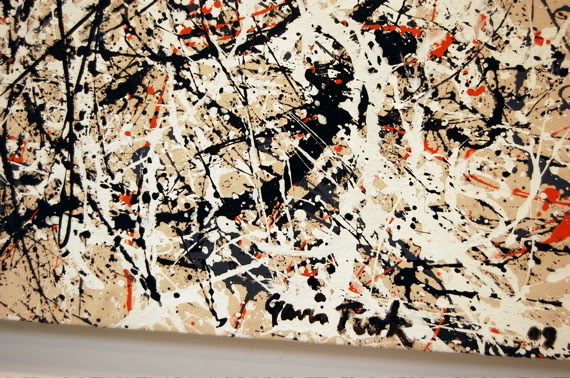

Outside the new Triple Candie space.  Photo: 16 Miles

Almost Baroque: An analysis of nine floral "paintings" from El Mundo
Triple Candie
500 West 148th Street, New York, NY
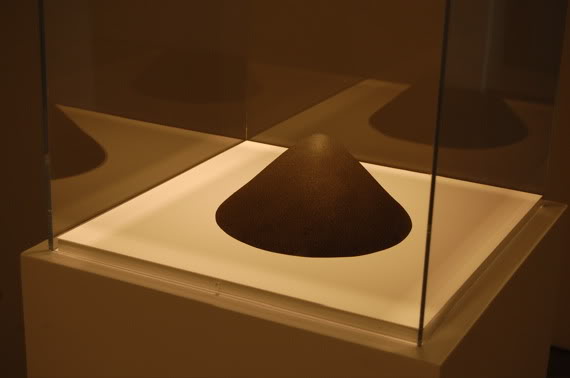
Through April 5, 2009

Wednesday, March 11, 2009

This-Has-Been at On Stellar Rays [Review]


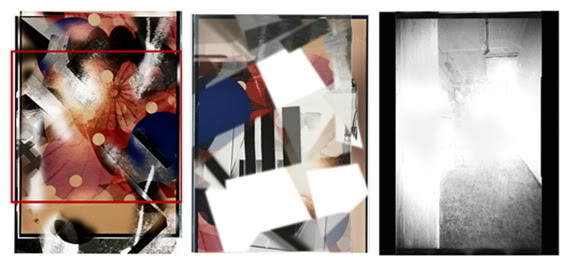
Tamar Halpern, Balcony Seats at a Murder (2008), Society Arrived Wearing Galoshes and Pearls (2009), Walker and 6th Ave. (2009).  Photo courtesy of On Stellar Rays.

The latest group show at On Stellar Rays, This-Has-Been, takes it title from Roland Barthes's Camera Lucida, in which the Frenchman discusses the elegy inherent in any photograph: the recognition of an indexical trace of someone that once was present and now is gone. Here, though, each medium’s normal function has been reconfigured. Photography is rendered mute, sculpture suddenly empowered with the power to haunt. Everything is wonderfully unstable.

Montreal artist Michel de Broin’s sculpture, Late Program (2008), composed of a charred wood-burning stove repurposed as a television, functions most like Barthes’s photographs. Its dilapidated, bruised body suggests a recent, violent past from which we have been excluded. Anne Deleporte construction achieves a similar inversion, repurposing the mass produced newspaper, for so long the definitive form of daily communication, as a pure abstraction.

Tamar Halpern, working against Barthes, takes photography and uses it for decidedly opaque ends. Scanning, editing, printing and rescanning photographs in a closed loop, she constructs bright abstractions that contain small glimpses of reality. Her titles come from classic Weegee images. Is that a bit of Weegee’s fire escape hidden beneath the bubbling roses and peaches of Balcony Seats at a Murder (2008)? Is that the sidewalk-crime scene in the corner? It’s impossible to say. Halpern only dangles the possibility of legibility in her images that seem to be growing increasingly lush.

If you’re looking to attract friends to the show, it might be worth mentioning that David Zwirner stalwart Marcel Dzama has a small, simple painting on display. Surprisingly, it’s one of the weaker pieces here. Set alongside Jenny Perlin’s quirky, faux-archival cartoon film Notes (2006), for example, it is only too familiar. The real mysteries are elsewhere. Roland Barthes in Camera Lucida once more: “What I can name cannot really prick me.”  This work can.

This-Has-Been
133 Orchard Street
Through March 29, 2009

Wednesday, March 4, 2009

Kurimanzutto, Inaugural Exhibition [Review]


Dr. Lakra. Photo courtesy of citoyenmag; more photographs available.

[Part 2 of our ongoing feature on contemporary art in Mexico City]

In the interest of full disclosure, I should mention that the staff members at Kurimanzutto are among the nicest I have ever met inside an art gallery. We first visited them about a year ago when they were without a permanent spaces, showing work out of their offices in Condesa. Equipped with only an address and a recommendation, we buzzed a random number on the side of an apartment building, walked up the stairs, and were warmly shown around the apartment (our nonexistent Spanish completely excused). A Gabriel Orozco painting hung on one wall, a sign of their centrality in the Mexican contemporary art world.

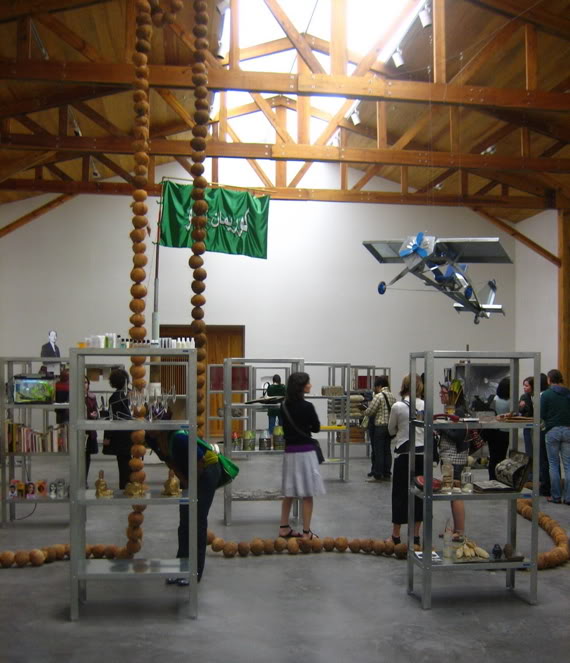
The venue’s latest show inaugurates their new space in the San Miguel Chapultepec neighborhood, a quiet, largely residential area with a handful of auto repair shops along their block. On the location of a former timber yard, Kurimanzutto (the name is a portmanteau of its founders, José Kuri and Mónica Manzutto) has constructed a warehouse that is, in scale and design, equivalent to the largest, more luxurious Chelsea showrooms. It’s an apt setting for their ambitious roster of well-known Latin American and international artists (Damián Ortega, Daniel Guzmán, Monika Sosnowska, and Tiravanija, who continues to be everywhere).


Installation view of Kurimanzutto, Inaugural Exhibiton. Photo courtesy of B.G.D.

The conceit of the exhibition is to give each Kurimanzutto artist (and six guest artists, including Thomas Hirschhorn and Allora & Calzadilla) space on a series of metal bookshelves, letting them present to the public a selection of their work. The artist’s bookshelf, the press release argues, “… is confidant and witness of the working processes of its owner, neatly reflecting his/her interests, obsessions, references, and current ideas.” There is a lot of possibility in that and, perhaps not surprisingly, the quality of the work varies considerably.

Most of the trademarks one would expect are here. Guzmán presents a skull sitting on a turntable, a summation of his twin interests that almost seems like caricature. Dr. Lakra has a series of his intricate drawings on paper, sculpture, and on top of vintage pinups, whom he’s delicately tattooed. They oscillate beautifully between irony and pure pleasure. First entering the gallery, I had no idea the metal shelves were supposed to represent artists’ bookshelves. They appeared to be simple, spare display cases for products, each artist rendered as a brand. Your détourned hair product boxes (Ortega) could be purchased from one shelf, your pinup photograph on another.


Rirkrit Tiravanija. Photo courtesy of citoyenmag.

This wasn’t quite a store, though. One shelf contained nothing but compact discs, Sosnowska had jammed a boulder between two others. No one was trying to ingratiate him or herself. (In fact, that generosity extended into the gallery's operations: the space was completely empty of employees when we visited, a show of trust that tends to be rare when tiny art pieces are sitting around.) Placing all their work on tiny, spare shelves, Kurimanzutto and the twenty-two artists invite a real critique of the quality of their practice. Ignore the fancy new surroundings, they seem to say: we don’t need charisma to succeed. They’re right.


Monika Sosnowska. Photo courtesy of citoyenmag.

Inaugural Exhibiton
Kurimanzutto
Gob. Rafael Rebollar 94, Col. San Miguel Chapultepec, Mexico City
Through March 21, 2009

Saturday, February 14, 2009

Keith Haring, The Ten Commandments, at Deitch Projects LIC [Review]


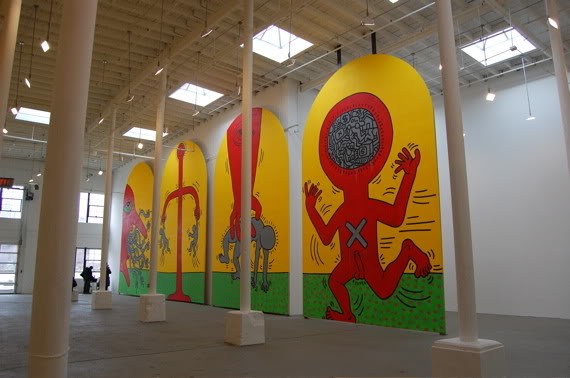
Keith Haring, The Ten Commandments [installation view], 1985

Long Island City is pretty much deserted on most Saturday afternoons.  You can walk from the Queensboro Plaza subway stop to Deitch Projects without seeing more than one or two other people walking the warehouse-lined streets.  Desolate and empty, the neighborhood is actually home to some of the city's most interesting art spaces: P.S.1, SculptureCenter, and the Fisher Landau Center.  Matthew Barney has a massive studio nearby.  You feel disconnected from Chelsea, but you're actually in the heart of the art world.

You might feel the same way looking at Keith Haring's work.  He looked like an outsider when he first became a star in the 1980's.  Though he never really got canonized or copied, most people with some interest in art can still spot a Haring today.  That said, I've never met anyone who claims to love his art.  Jeffrey Deitch does, though, and has recently decided to devote some of his considerable energy to the artist, releasing a luxurious book, reinstalling a mural on Houston and Bowery, and showing the largely unseen series of monumental canvases The Ten Commandments.

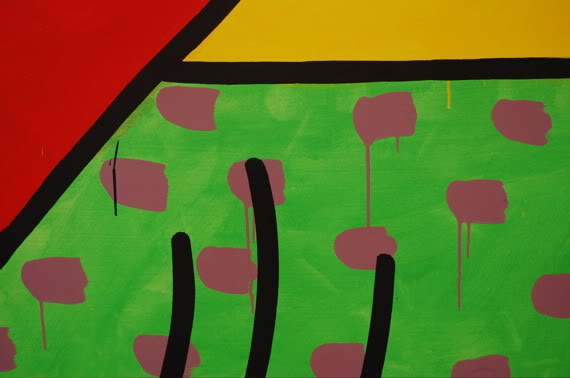
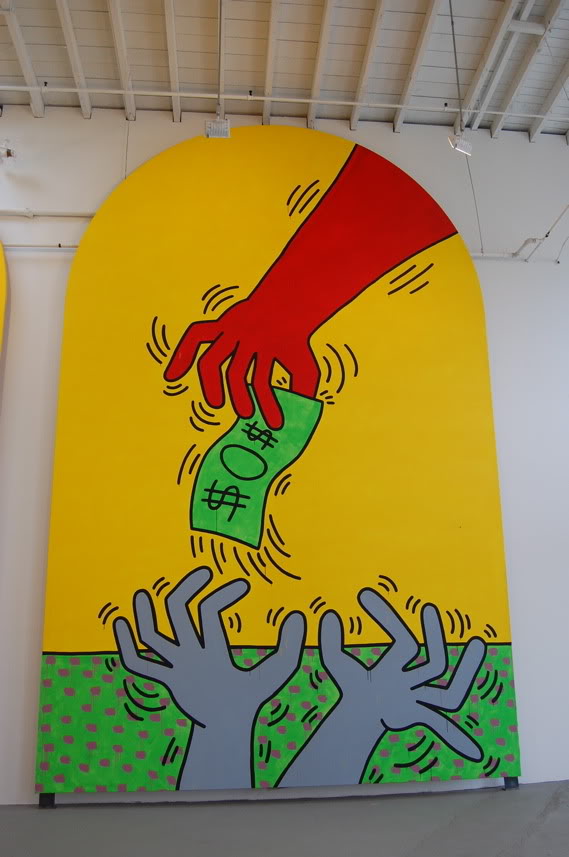
Originally painted for a 1985 show in Bordeaux, Deitch and company have taken good care of the works.  They're clean and crisp; the trademark bright paint looks fresh.  All the classic Haring figures are present in these visual depictions of their title: cartoon people, televisions, dollar signs.  Most of the constructions are pretty straightforward - a hand plucking a dollar bill from two other waving hands, two heads fellating a cross.  Haring has clever moments, but they're certainly not here.  Still, the show is worth seeing.  Unlike most the artist's work, the form here wins over the content.  It's fun looking at painting this massive and paint this bright.  They're simple, sugary curiosities, only barely cloying.


Keith Haring, The Ten Commandments [installation view] [detail], 1985


Keith Haring, The Ten Commandments [installation view], 1985

Keith Haring, The Ten Commandments
Deitch Projects
4-40 44th Drive
Long Island City, Queens, New York
Through February 15, 2009