Showing posts with label Triple Candie. Show all posts

Monday, April 18, 2011

An Orchid Sale, Hedda Sterne, Cinders Returns, Okiishi, etc. [Collected]


Very fragrant: Orchids raised by Helen and Charles Hersh, of Mount Prospect Orchids, on sale at The Artist's Institute, alongside a show of Jo Baer works, April 17, 2011. Photo: 16 Miles
  • Lower East Side alternative space The Artist's Institute held a sale of absurdly gorgeous orchids yesterday as part of its season of programming inspired by Jo Baer's life and work. It seems that Baer was an expert orchid cultivator and won an Award of Merit from the Greater New York Orchid Society in 1973 for the flowers she raised while living in Greenwich Village. Can we have more events inspired by artists' extracurricular interests? A feast of crisp Coca-Cola and fresh falafel at the next Robert Irwin exhibition? A dog show at a future Pettibon outing? [TAI]

  • Laura Gilbert highlights the radical parameters — the re-creations, exhibition copies, and croppings — of Richard Serra's drawings at the Metropolitan Museum of Art. [Art Unwashed]

  • Shelly Bancroft and Peter Nesbett reveal that, when they staged their Maurizio Cattelan retrospective at Triple Candie in 2009, "Maurizio Cattelan is Dead: Life and Work, 1960 - 2009," Cattelan actually came to visit the show and "generously arranged ... to ship it off to the DESTE Foundation in Athens," the nonprofit founded by collector Dakis Joannou. [Triple Candie in The Exhibitionist]

  • "You know, artists are never close-knit. They are only close-knit for a while if it's necessary and helpful." — The late Hedda Sterne in a 1981 interview with Phyllis Tuchman that also covers her fights with Clement Greenberg, her interest in Surrealism, her adoption of spray paint, and more. [Archives of American Art, via Modern Art Notes]

  • An interview with Pauline's proprietor Pauline Beaudemont. [Matilde Soligno]

  • There is one week left to see a choice Hedda Sterne painting in MoMA's "Abstract Expressionist New York" show. Another is on view at the McCoy Gallery through May 20. [MoMA and McCoy Gallery]

  • Cinders Gallery is reopening on Saturday, April 23, at 28 Marcy Avenue in Brooklyn. Its former Williamsburg location is becoming a bar. [Cinders]

  • Ken Okiishi's very wonderful (Goodbye to) Manhattan (2010), which appeared last year at Alex Zachary, is having its theatrical debut on Monday, April 25, at Anthology Film Archives. Okiishi will answer questions after the screening. [AFA]

  • Seven on Seven returns to the New Museum on Saturday, May 14. This year's artist participants include Michael Bell-Smith, Liz Magic Laser, and Rashaad Newsome. [Rhizome via Art Fag City]

Wednesday, September 29, 2010

Ryan Gander’s Double (or Triple?) Threat in New York


Ryan Gander, The Happy Prince, at Doris C. Freedman Plaza, New York, Public Art Fund. Photos: 16 Miles [more]

Depending on how one is counting, British artist Ryan Gander will soon have either two or three exhibitions open in New York. The Public Art Fund has installed The Happy Prince, a public art monument, in the southeast corner of Central Park, and the Guggenheim is set to open “Intervals: Ryan Gander,” a new site-specific installation in its reading room, on Friday. Meanwhile, uptown, there is a far stranger show at the consistently pleasurable alternative space Triple Candie called “An Exhibition That Will Tell You Nothing About Ryan Gander.” According to that show’s introductory placard, the work on view is “related to but not representative of Ryan Gander’s work.” It also notes, in what could be an all-time-great curatorial statement: “If you are unfamiliar with Gander’s art, let us say this: it is simultaneously nothing and everything at the same time.” The works on display are almost completely black so they do not photograph especially well. Make the trip to 148th Street.


"An Exhibition That Will Tell You Nothing About Ryan Gander" at Triple Candie, New York. Photos: 16 Miles [more]


Ryan Gander, "The Happy Prince"
Organized by the Public Art Fund
Doris C. Freedman Plaza, Central Park, near 60th Street and 5th Avenue
New York, New York
Through April 10, 2011

"An Exhibition That Will Tell You Nothing About Ryan Gander"
Triple Candie
500 West 148th Street
New York, New York
Through October 31, 2011

Monday, September 27, 2010

"Alternative Histories" at Exit Art in New York


Poster for the "Real Estate Show." Photo: 16 Miles [more]

Exit Art's newest exhibition, "Alternative Histories," is, without any qualifications, one of the most remarkable feats of curatorial organization in recent memory. Organized by Exit Art founders Papo Colo and Jeanette Ingberman with the aid of numerous other researchers, it tells the stories of (and brings together archival material from) more than 100 alternative spaces that have existed in New York over the past half century, ranging from early, short-lived arts venues, like art dealer Holly Solomon's 98 Greene Street performance space and the SoHo restaurant FOOD, to scrappy upstarts that have since become established institutions, like Creative Time and El Museo del Barrio.


Installation view of "Alternative Histories" at Exit Art

Viewing all of the material would take weeks: A long table at the center of Exit Art's space is lined with cardboard boxes that are filled with materials from many of the groups in the show, from P.S.1 to the X Initiative (which ended its run earlier this year), and there is an audio guide with dozens of interviews with many of the people that are mentioned in the show. In sum, it amounts to a moving account of the thousands and thousands of people who have worked in the arts in New York, often on the margins, over the past five decades.


Poster for Triple Candie, New York


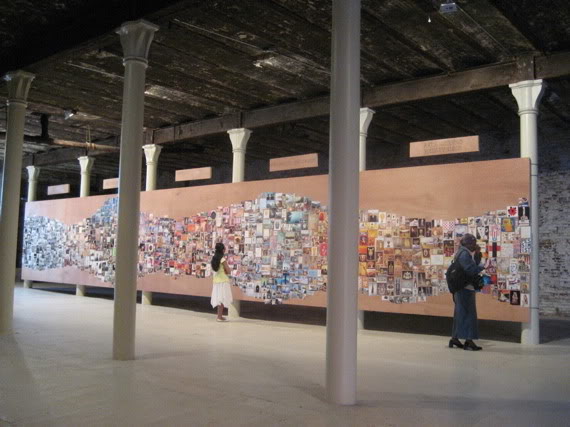
Installation views of "Alternative Histories" at Exit Art

A large section of the exhibition is devoted to groups formed in just the past decade, like Triple Candie, Participant, Inc., and the three-year project Orchard. A lot is still happening out there, the show argues. New York's best days may not be in the past. It's thrilling to think about all the people that may visit in the next two months and all of the new ideas that a show of his magnitude could spark in them.


"Alternative Histories"
Exit Art
475 10th Avenue
New York, New York
Through November 24, 2010

Sunday, March 22, 2009

Almost Baroque, at Triple Candie [Review]


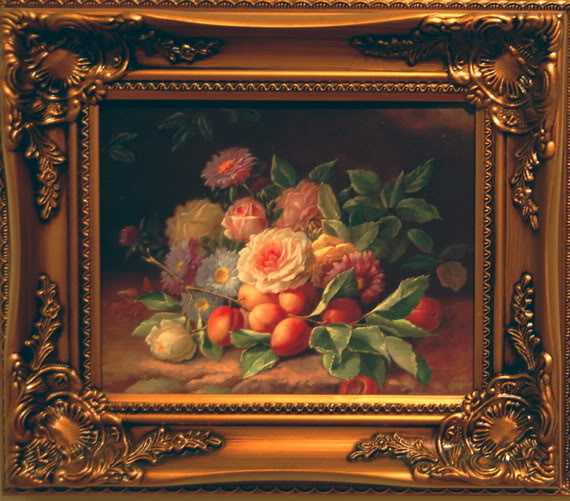
Unknown artists, [Peaches and Flowers], ca. 2008. Photo: 16 Miles

The social value of studying art history is dubious, but there are two basic arguments that people tend to make it its favor: (1) It teaches you in some vague way to look at visual culture more carefully, making you a more discerning, critical viewer, or (2) It gives you a more concrete understanding of the past that may have transferable value to the present; at the very least, it provides cocktail fodder. Rarely, of course, does the discipline actually pursue these two goals. There are usually two other, more vital issues involved: beauty and money.

It was a joy, then, to walk into Triple Candie’s new Harlem space and find a clever, concise exhibition that attempts to tackle both those bigger goals and pleasurable realities. Directors Shelley Bancroft and Peter Nesbett have purchased and hung nine floral still life paintings produced in China and sold at the El Mundo department in Harlem for the show. “Clearly, they must be copies of historic paintings,” they initially thought, they admit in the press release. The rigorous investigation they mounted, detailed on placards hung alongside the works, reveals that their backgrounds were not so straightforward.

Saying much more will ruin the surprises that their research uncovered. (If you first want to find out in person, stop here.) We learn that at least two of the paintings were based on an eighteenth century Jan van Huysum. Some of the other works, though, remained unidentified, even after consulting outside experts. Are they based on forgotten or stolen paintings, art that has slipping out of the historical record, or are these Chinese designers playing with the form and conjuring their own, original still lifes? Do the Chinese factory artists view Dutch still life as a supreme marker of taste, or do they believe that Westerners, particularly those in the working and lower middle class who would be shopping at El Mundo, view them this way? (They are sort of classy.)

The questions just keep getting weirder. Delving into the past and returning with curious, incomplete answers, Bancroft and Nesbett highlight the contingency and levels of mediation inherent in all art and art history. Everything you’ve bought to hang on your walls begins to look a little less familiar, a bit uncanny.

More
Top 10 of 2008, #2 - Triple Candie's Thank You for Coming [16 Miles] 


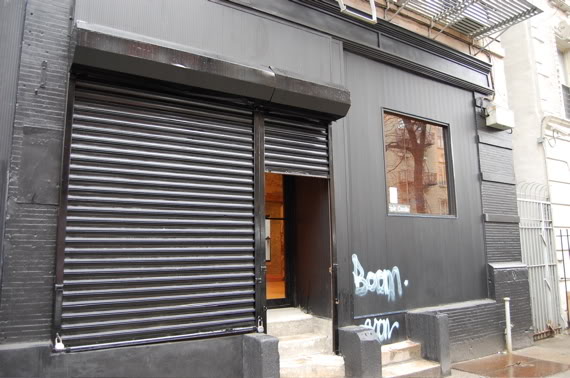
Outside the new Triple Candie space.  Photo: 16 Miles

Almost Baroque: An analysis of nine floral "paintings" from El Mundo
Triple Candie
500 West 148th Street, New York, NY
Through April 5, 2009

Friday, January 2, 2009

[Top 10 of 2008] #2 - Triple Candie, Thank You for Coming, 2001-2008


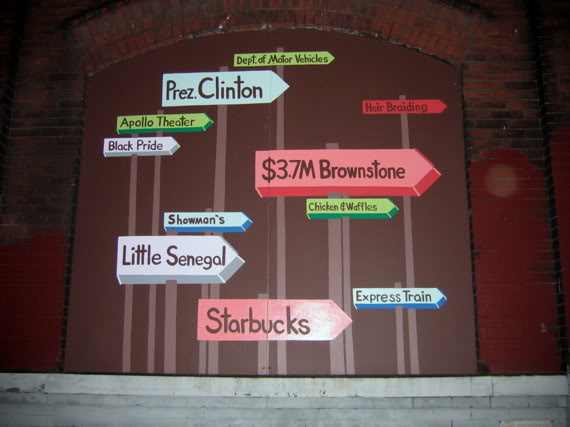
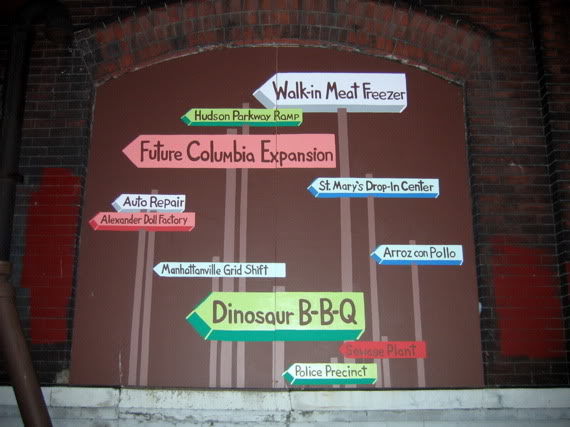
Unauthored, Tourist Information Center, 2006, mural on Triple Candie wall. Photo courtesy of Geog.

The story goes that, pressured by his partners at STT Records to sign Sonic Youth in the mid-1980’s, Joe Carducci vehemently refused, declaring that record collectors shouldn’t be in bands. While California hardcore’s anti-intellectualism certainly played a role in the rejection, his suspicion of the band’s knowing New York pretension is understandable: the most knowledgeable people in the room rarely make the best art.

Transposed into the world of contemporary art, Carducci’s polemic might read: curators shouldn’t be artists. Over the past decade, no group came closer to breaching this maxim than Shelly Bancroft and Peter Nesbett, founders and directors of Harlem alternative art space Triple Candie. Their programming began traditionally and tastefully enough in 2001, showing work by artists like Bruce Nauman, Kiki Smith, Matthew Brannon, and Taylor Davis, but then things began to get weird.

By 2006, Bancroft and Nesbett had largely abandoned standard shows of art for unusual curatorial experiments. Cady Noland Approximately featured recreations of the increasingly trendy artist’s work, David Hammons: The Unauthorized Retrospective was composed of over a hundred photocopies of the artists work (after he purportedly refused to participate in a retrospective), and Lester Hayes: Selected Work 1962-1975 devoted the gallery space to the influential (and fictional) African-Italian post-minimalist.

A few of these ideas made a few people angry, but, for the most part, Triple Candie was simply ignored. The space’s final show, Thank You for Coming, Triple Candie 2001-2008, a compendium containing bits of each show presented in the space’s eight years (a pack of Budweiser from the Noland show, some photocopies of Jacob Lawrence paintings from the retrospective they mounted of his Migration of the Negro) proved definitively that their curious, meandering programming deserved more attention than it received.

Bancroft and Nesbett may have been the two people in New York’s art world most familiar with and interested in engaging its voluminous history, but they never lapsed into the pedantry or solipsism one might have expected from such record collectors. If they were curators that slipped into the role of artists, it was only because there were things that they thought people had to see. At the moment, I can’t think of a better definition of a good artist. Nor can I think of anyone else recently who has so bravely chased that goal.


Unauthored, Tourist Information Center, 2006, mural on Triple Candie wall. Photo courtesy of Geog.


Museo de Reproducciones Fotograficas, 2007 exhibition at Triple Candie. Photo courtesy of Sofia.