Showing posts with label Harlem. Show all posts

Thursday, July 15, 2010

Eli Broad's Rent, Len Lye's Wind Wands, etc. [Collected]


Adam Pendleton, Collected (Flamingo George), 2009, at the Studio Museum in Harlem, July 14, 2010. Photo: 16 Miles
  • Eli Broad's Proposed Rent: $347 a month. But: "$1 rents are standard for museums. Pasadena rents the site of the Norton Simon Museum for $1 a year. Thirty-six years into the deal, how many Pasadenans regret that giveaway?" [LACMA on Fire]

  • The Wind Wand sculptures that stopped Robert Moses and saved the West Village. [Greg.org]

  • A comprehensive look at SFMOMA's Fisher Collection — and the museum's formidable art-themed cake offerings. [C-Monster]

  • MOCA takes a peek at the trippy, surreal photographs of Max Yavno, just donated to the museum by his estate. [The Curve]

  • After a visit to "Close Examination: Fakes, Mistakes and Discoveries" at the National Gallery, London, Michael Kimmelman writes one of his best pieces in years. [NYT]

  • Smithson's Wildman of Chelsea: Unrealized performance piece whose time has finally come? [Greg.org]

  • LACMA's head of painting conversation looks at works by Rembrandt and Picasso, "extensively reworked but still ... unresolved." [Unframed]

  • Does the Guggenheim's partnership with YouTube amount to pay-for-play? [Modern Art Notes]

  • 958 Words: Thoughts on what may be the longest sentence in modern literature, from Proust's Sodom and Gomorrah. [Theory Now]

  • "Really! That's wonderful. I don't think I want to drip." – Andy Warhol via Ivan Karp, in the first posthumous documentary of the artist. [The Artblog]

Friday, January 2, 2009

[Top 10 of 2008] #2 - Triple Candie, Thank You for Coming, 2001-2008


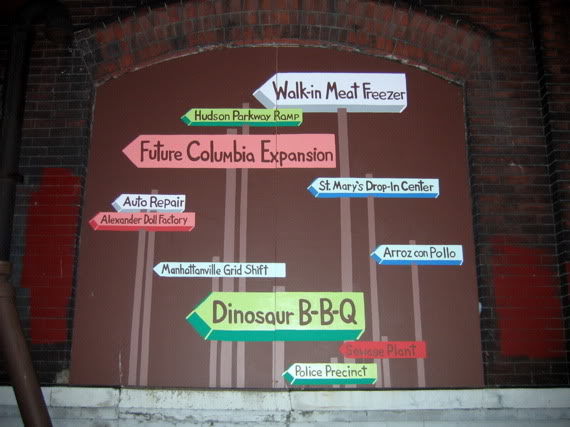
Unauthored, Tourist Information Center, 2006, mural on Triple Candie wall. Photo courtesy of Geog.

The story goes that, pressured by his partners at STT Records to sign Sonic Youth in the mid-1980’s, Joe Carducci vehemently refused, declaring that record collectors shouldn’t be in bands. While California hardcore’s anti-intellectualism certainly played a role in the rejection, his suspicion of the band’s knowing New York pretension is understandable: the most knowledgeable people in the room rarely make the best art.

Transposed into the world of contemporary art, Carducci’s polemic might read: curators shouldn’t be artists. Over the past decade, no group came closer to breaching this maxim than Shelly Bancroft and Peter Nesbett, founders and directors of Harlem alternative art space Triple Candie. Their programming began traditionally and tastefully enough in 2001, showing work by artists like Bruce Nauman, Kiki Smith, Matthew Brannon, and Taylor Davis, but then things began to get weird.

By 2006, Bancroft and Nesbett had largely abandoned standard shows of art for unusual curatorial experiments. Cady Noland Approximately featured recreations of the increasingly trendy artist’s work, David Hammons: The Unauthorized Retrospective was composed of over a hundred photocopies of the artists work (after he purportedly refused to participate in a retrospective), and Lester Hayes: Selected Work 1962-1975 devoted the gallery space to the influential (and fictional) African-Italian post-minimalist.

A few of these ideas made a few people angry, but, for the most part, Triple Candie was simply ignored. The space’s final show, Thank You for Coming, Triple Candie 2001-2008, a compendium containing bits of each show presented in the space’s eight years (a pack of Budweiser from the Noland show, some photocopies of Jacob Lawrence paintings from the retrospective they mounted of his Migration of the Negro) proved definitively that their curious, meandering programming deserved more attention than it received.

Bancroft and Nesbett may have been the two people in New York’s art world most familiar with and interested in engaging its voluminous history, but they never lapsed into the pedantry or solipsism one might have expected from such record collectors. If they were curators that slipped into the role of artists, it was only because there were things that they thought people had to see. At the moment, I can’t think of a better definition of a good artist. Nor can I think of anyone else recently who has so bravely chased that goal.


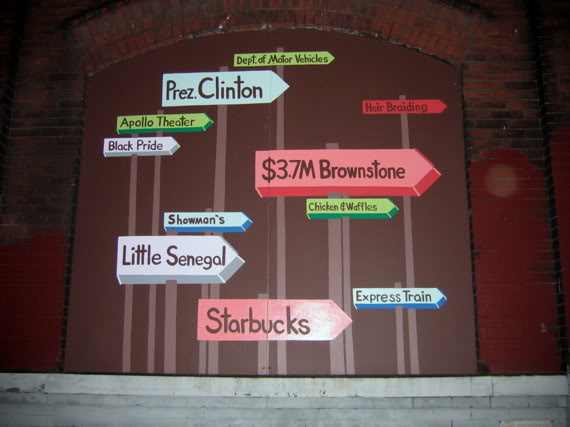
Unauthored, Tourist Information Center, 2006, mural on Triple Candie wall. Photo courtesy of Geog.


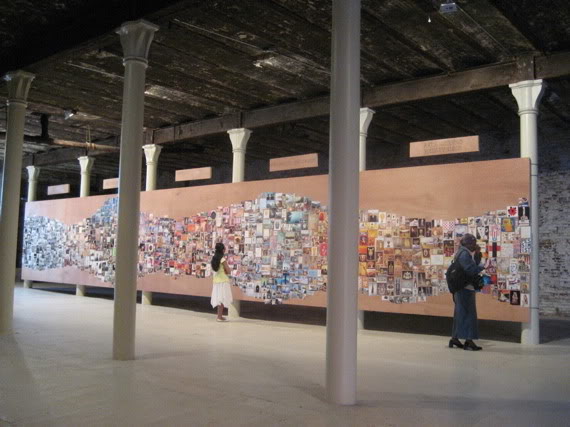
Museo de Reproducciones Fotograficas, 2007 exhibition at Triple Candie. Photo courtesy of Sofia.