Showing posts with label Mexico City. Show all posts

Saturday, March 7, 2009

Galleries in Mexico City


Mauricio Guillén, Net No. 1, 2008, at OMR.  Photo: 16miles

[Part 3 of our ongoing  feature on contemporary art in Mexico City]

Contemporary art galleries cluster together in New York.  Moving quickly, one can burn through dozens of shows over the course of a day in Chelsea and still have time to see a score on the Lower East Side and a handful more in SoHo.  That's not quite the case in Mexico City, where they're spread out widely over the city.  The subway is super fast, cheap, and safe, but the stops are fairly spread out, meaning that you'll be doing a fair amount of walking if you choose that option.  Your best bet is probably to hire a car for a day and hit everywhere you want to go.  About $50US should set you up for a full day, and you won't have to worry about encountering some of the supposedly more questionable taxis on the street.  

Polanco, Roma, and Condesa are the three main art neighborhoods.  Speaking very, very approximately, Polanco resembles the Upper East Side.  Relatively staid galleries here show "modern masters" and more established contemporary artists.  Roma and Condesa tend to have the younger, more experimental shows and are routinely described as the SoHo's of Mexico City.  That said, just as many galleries are located on random blocks throughout the city, making New York analogies fairly useless.  Having discussed local powerhouse Kurimanzutto earlier, here are our five essential galleries to visit.

Plaza Río de Janeiro 54, Colonia Roma
They’ve been around for twenty-five years and are perhaps the second most active space internationally after Kurimanzutto.  They show Candida Höfer, Mauricio Alejo, Rafael Lozano-Hammer, and a dozen other mid-career Mexican artists at Art Basel, ARCO, etc.  This year they're the lone Mexico City group at The Armory Show.  Note: their floors are oddly-leveled, so you feel like you’re on a boat as you walk around the space, which is fun.
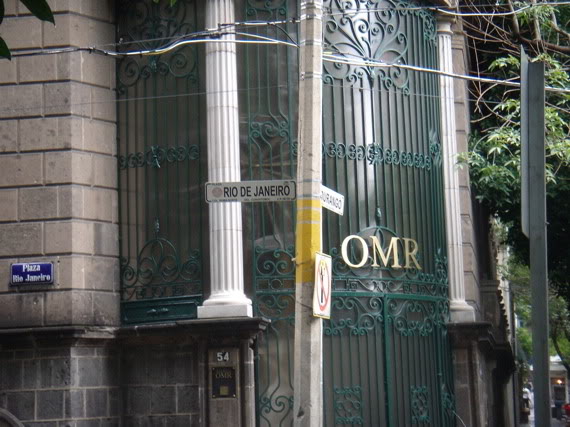
View of OMR from Plaza Rio Janeiro.  Photo courtesy of Zoecole

Zacatecas 93, Colonia Roma
Their building is three stories, sports spiral staircases, and shows by Davis Birks (from Seattle), Ciler (Mexico City street artist), and Esau de Leon are there now: classy in every way.  Also, they’re at Pulse New York and run art-collecting trips to Havana.  That's about all I could want in a gallery.
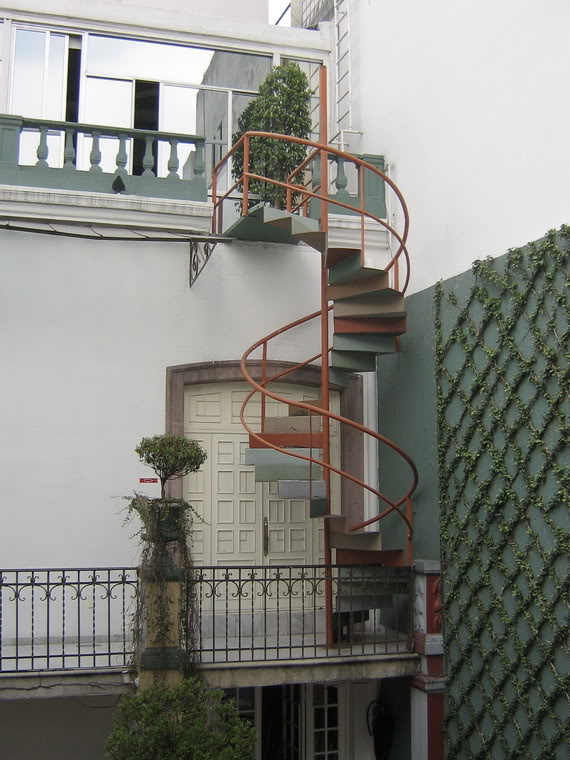
Interior of Nina Menocal.  Photo courtesy of mamichan

Hilario Galguera
Francisco Pimental 3, San Rafael
They have a beautiful townhouse with a large courtyard in a sleepy part of town. They also somewhat randomly represent Damien Hirst in Mexico and have a nice rotting cow head of his in their office.  Their shows are somewhat infrequent, but they have a nice mix of people, and they have a sister space in Leipzig.  Both show mostly European and Mexican artists, early to midcareer.

Atlixco 32, Condesa
EDS has a super young roster that includes Daniel Joseph Martinez (those gold paintings with names of terrorist groups on them at the 2008 Whitney Biennial), Federico Solmi (who shows with LMAK in New York), Marcos Erre, Miguel Sepulveda, Emilio Chapela Perez, and Christopher K. Ho (part of Winkleman's cadre).  They were at Pulse New York this year.

Oizaba 92, Colonia Roma
Sadly, they were closed - between shows - both times we visited Mexico City.  They represent five artists, and their parties at their Roma townhouse are apparently great.  Also, their openings are sponsored by major alcohol companies, which I appreciate.

Wednesday, March 4, 2009

Kurimanzutto, Inaugural Exhibition [Review]


Dr. Lakra. Photo courtesy of citoyenmag; more photographs available.

[Part 2 of our ongoing feature on contemporary art in Mexico City]

In the interest of full disclosure, I should mention that the staff members at Kurimanzutto are among the nicest I have ever met inside an art gallery. We first visited them about a year ago when they were without a permanent spaces, showing work out of their offices in Condesa. Equipped with only an address and a recommendation, we buzzed a random number on the side of an apartment building, walked up the stairs, and were warmly shown around the apartment (our nonexistent Spanish completely excused). A Gabriel Orozco painting hung on one wall, a sign of their centrality in the Mexican contemporary art world.

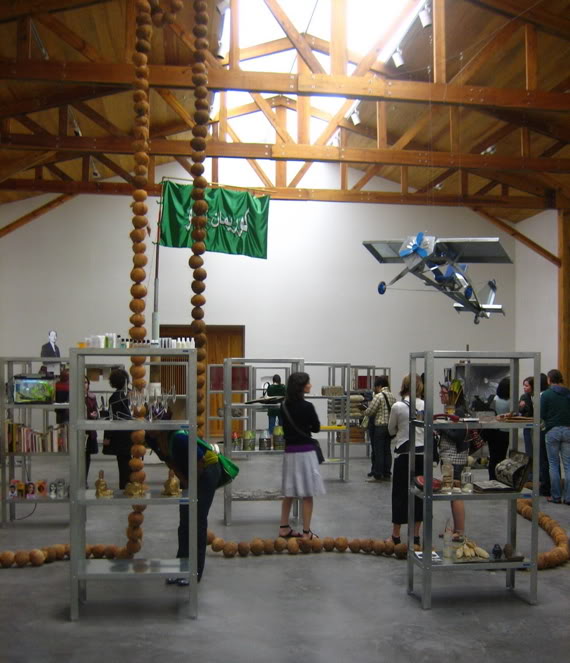
The venue’s latest show inaugurates their new space in the San Miguel Chapultepec neighborhood, a quiet, largely residential area with a handful of auto repair shops along their block. On the location of a former timber yard, Kurimanzutto (the name is a portmanteau of its founders, José Kuri and Mónica Manzutto) has constructed a warehouse that is, in scale and design, equivalent to the largest, more luxurious Chelsea showrooms. It’s an apt setting for their ambitious roster of well-known Latin American and international artists (Damián Ortega, Daniel Guzmán, Monika Sosnowska, and Tiravanija, who continues to be everywhere).


Installation view of Kurimanzutto, Inaugural Exhibiton. Photo courtesy of B.G.D.

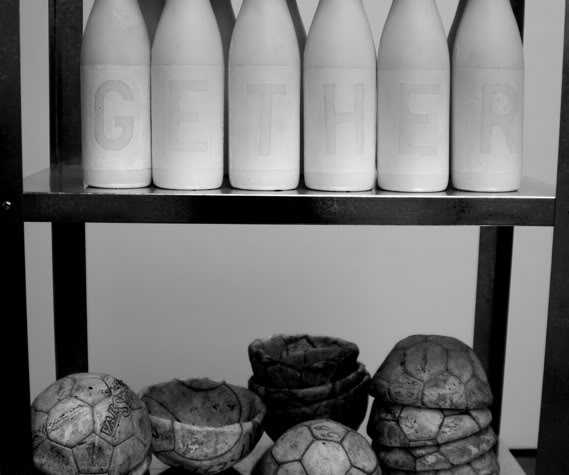
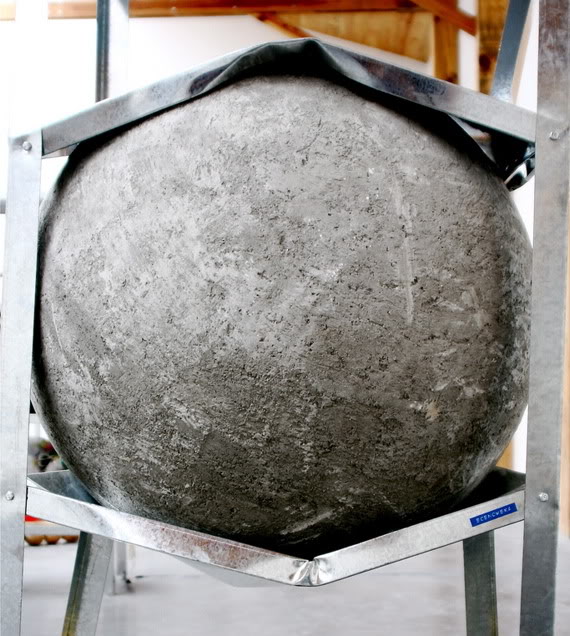
The conceit of the exhibition is to give each Kurimanzutto artist (and six guest artists, including Thomas Hirschhorn and Allora & Calzadilla) space on a series of metal bookshelves, letting them present to the public a selection of their work. The artist’s bookshelf, the press release argues, “… is confidant and witness of the working processes of its owner, neatly reflecting his/her interests, obsessions, references, and current ideas.” There is a lot of possibility in that and, perhaps not surprisingly, the quality of the work varies considerably.

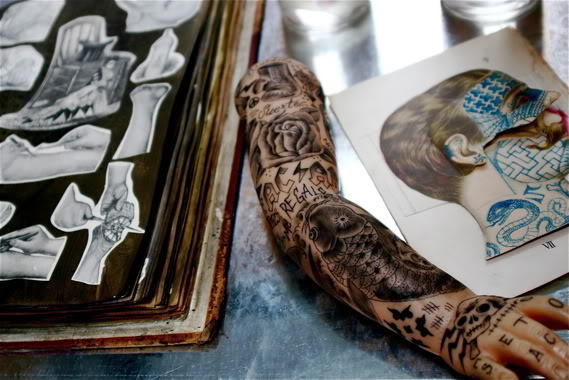
Most of the trademarks one would expect are here. Guzmán presents a skull sitting on a turntable, a summation of his twin interests that almost seems like caricature. Dr. Lakra has a series of his intricate drawings on paper, sculpture, and on top of vintage pinups, whom he’s delicately tattooed. They oscillate beautifully between irony and pure pleasure. First entering the gallery, I had no idea the metal shelves were supposed to represent artists’ bookshelves. They appeared to be simple, spare display cases for products, each artist rendered as a brand. Your détourned hair product boxes (Ortega) could be purchased from one shelf, your pinup photograph on another.


Rirkrit Tiravanija. Photo courtesy of citoyenmag.

This wasn’t quite a store, though. One shelf contained nothing but compact discs, Sosnowska had jammed a boulder between two others. No one was trying to ingratiate him or herself. (In fact, that generosity extended into the gallery's operations: the space was completely empty of employees when we visited, a show of trust that tends to be rare when tiny art pieces are sitting around.) Placing all their work on tiny, spare shelves, Kurimanzutto and the twenty-two artists invite a real critique of the quality of their practice. Ignore the fancy new surroundings, they seem to say: we don’t need charisma to succeed. They’re right.


Monika Sosnowska. Photo courtesy of citoyenmag.

Inaugural Exhibiton
Kurimanzutto
Gob. Rafael Rebollar 94, Col. San Miguel Chapultepec, Mexico City
Through March 21, 2009

Thursday, February 26, 2009

An Unruly History of the Readymade at the Jumex Collection [Review]


Richard Pettibone. Photo courtesy of fishercott.

[Part 1 of our ongoing feature on contemporary art in Mexico City]

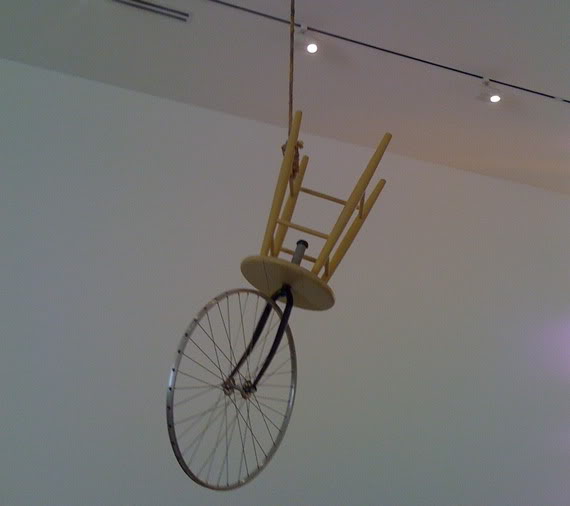
I had never witnessed a piece of art being put to death before. Walking into An Unruly History of the Readymade at the Jumex Collection, though, it’s the first thing one sees. Marcel Duchamp’s notorious Bicycle Wheel (1913) has been slid through a noose and hung from the ceiling of cavernous warehouse. Consulting my guide, I learned that it was actually a sculpture by serial reproducer Richard Pettibone.

Laid out on the floor as a gigantic chessboard that spirals chronologically toward the center of the room, the show (organized by Tate Modern curator Jessica Morgan) comprises about 100 works culled from the collection of juice scion Eugenio Lopez, presenting interpretations of Duchamp’s act of selection that range from the ludic to the staid, the hilarious to the banal.


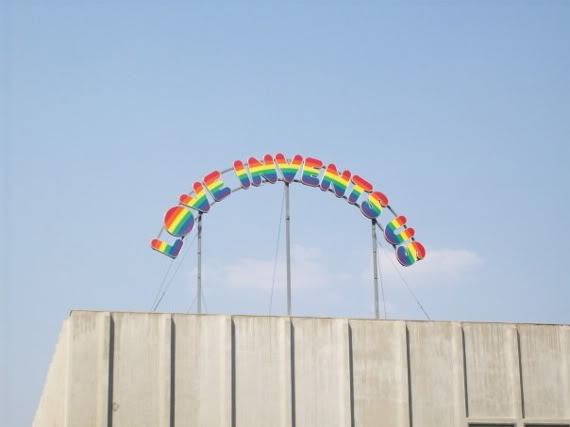
Ugo Rondione, Love Invents Us, 1999.

Given the sheer abundance of ideas that have been attributed to his work, it’s no surprise that the breadth of artists included in the rambling survey is enormous. A Warhol Jackie (Pettibone’s miniature copy is in a vitrine a few feet away) is hung a few spaces from On Kawara date paintings (with Mexico City newspapers included, of course). Elsewhere, artists like Johns, Jonathan Horowitz, Kippenberger, Kelley Walker, Elmgreen & Dragset, and Jim Hodges are present. Damian Ortega, Abraham Cruzvillegas, Sofía Táboas, and Gabriel Kuri form a portion of the Mexican contingent. (Interestingly, they’re all represented by Kurimanzutto, for which Mr. Lopez seems to have a particular obsession.)


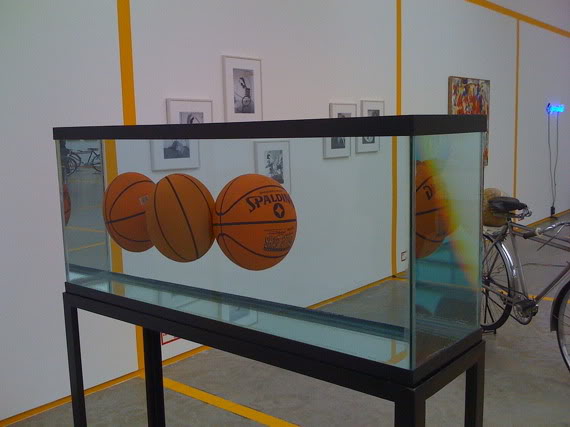
Jeff Koons, Three Ball Total Equilibrium Tank, 1985. Photo courtesy of fishercott.

Sturtevant’s meticulously replicated Johns painting represents the appropriation wing of the party, suggesting the choice of object could actually be another work of art. Warhol’s inclusion foregrounds the readymade as commercial image, Jackie Kennedy’s face plucked from a page in a newspaper. Rirkrit Tiravanija’s polished cooking equipment and its carrying case (shades of Boîte-en-valise) pursues the readymade into every day life, selecting a relational moment instead of a hat rack as the art. Cataloguing the complete set of readymade possibilities would yield scores of factions.

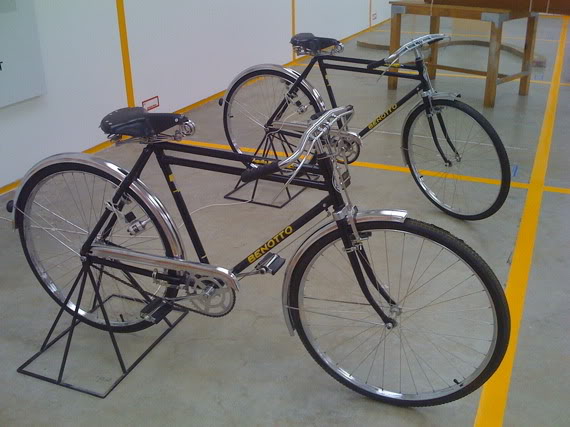
Maurizio Cattelan’s piece Dynamo Secession (1997) is where I paused for the first time, suddenly shaken out of my art history reverie. Twin bikes that can be pedaled to power a light bulb, he reanimates the bicycle wheel, as Duchamp did originally (“In 1913 I had the happy idea to fasten a bicycle wheel to a kitchen stool and watch it turn,” “Apropos of Readymades,” 1951.) It’s cute but also sinister. Simply lighting a bulb in a gallery already flooded with light, it uncomfortably highlights the self-referential (self-reverential) discourse at play. For a lot of people outside the hermetic seal of contemporary art, the readymade represents the moment that modern art became incomprehensible.


Maurizio Cattelan, Dynamo Secession, 1997. Photo courtesy of fishercott.

At the very center of the space, the final work is a banana skin tossed on the ground. Authored by Adriana Lara, the peel is replaced every day after someone from the museum consumes a banana. We can spot the references (to Warhol’s Velvet Underground & Nico cover and the food happenings of relational aesthetics) and get the joke. It may be too easy. The obsessive repetition of its production mirrors Cattelan’s piece. Put another way, we’re just spinning our wheels. There’s a tremendous amount of great, sublime, perplexing work here, and the show is generally crisply edited. There’s also a real danger of falling into a theoretical mise en abyme.

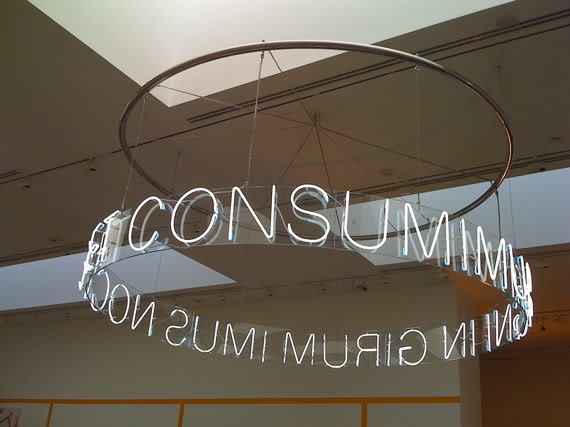
Overhead is a sculpture by Cerith Wyn Evans, a neon text (In Girum Imus Nocte et Consumimur Igni, “We enter the circle at night and are consumed by fire”) spun into a halo. It’s an ancient Latin palindrome, used by Guy Debord for the title of his final film. One thinks of one of the final lines from that film of 1978: “This civilization is on fire; the whole thing is capsizing and sinking.” It will take more than banana peels to confront that.


Cerith Wyn Evans, In Girum Imus Nocte et Consumimur Igni, 2006. Photo courtesy of fishercott.

An Unruly History of the Readymade
Via Morelos 272, Col. Sta. Maria Tulpetlac, Ecatepec
Through February 2009

Wednesday, February 25, 2009

Contemporary Art in Mexico City

For the rest of the week and through the weekend, I'll be running articles about art spaces in Mexico City. I've included a map showing some of the main venues below. First up: the Fundación/Colección Jumex.


View complete list and larger map.

Sunday, February 15, 2009

Traveling


There will be a brief pause in posting until next Saturday, when I get back from traveling.  If you have any recommendations for galleries, museums, or eateries in Mexico City, drop me an e-mail.  I'd love to know.  I'll be twittering and building the Mexico City Art Spaces feature in the meantime. Thanks for reading.