Showing posts with label Koons. Show all posts

Thursday, May 19, 2011

"Tilted Arc" and Drawing, Koons and the Met, Childe Hassam, etc. [Collected]


Koo Jeong A, Mystral, 2010, in "Koo Jeong A: Constellation Congress," at Dia at the Hispanic Society, New York, through June 26, 2011. Photos: 16 Miles [more]
  • The United States Government destroys art: Greg Allen on Richard Serra's post-Tilted Arc drawing show at Castelli in 1989. [Greg.org]

  • "If it looked like an anti-tank fortification, it was ahead of its time." — John Perreault on Tilted Arc, in a piece on Serra's current drawing show at the Metropolitan Museum of Art. [Artopia]

  • Jeff Koons is loaning paintings to the Met, Laura Gilbert notices. [Art Unwashed]

  • Tyler Green surveys recent and proposed arts-funding cuts in the U.S. and asks, "Why aren't Americans angrier?" [Modern Painters]

  • Mark Grotjahn, Amanda Ross-Ho, Jonas Wood, et al.: Picks from "Greater LA," the giant show now on view on the second floor of 483 Broadway in SoHo. [Two Coats of Paint]

  • Hotelier Andre Balazs is looking forward to the extension of the High Line. "As you walk along it, the intimacy and titillation is very tactile, very suggestive,” says Balazs, of the elevated park. "It’s a sexual way of interacting with the city. ... Walking from 13th Street to 30th Street along 10th Avenue is utterly banal. ... But walking from 13th to 30th Street on the High Line feels like you’re on your way to an orgasm.” [NYT]

  • 1918: "CHILDE HASSAM ARRESTED." — "Mr. Hassam then congratulated the policeman, saying that if every one was as alert there would not be so many dangerous enemy aliens traveling about the country." [NYT]

  • May 19: "We Regret To Inform You There Is Currently No Space Or Place For Abstract Painting," featuring Daniel Turner, Ben Schumacher, Sarah Crowner, and more, at Martos Gallery, 6–8 PM. [MG]
  • May 20: David Reed, Katy Siegel, and Lynne Cooke discuss Jo Baer's work, at The Artist's Institute, 6:30 PM. [TAI]

  • May 21: Hilary Lloyd at Artists Space, 6–8 PM. [AS]

  • May 22: Spring Open House 2011 at MoMA PS1, 12–6 PM. [MoMA PS1]

  • May 23: "Fünf Räume" ("Five Rooms") at the Austrian Cultural Forum, 6–8 PM. [ACF]

Thursday, November 4, 2010

Mike Kelley in Detroit, Critics, Palermo, etc. [Collected]


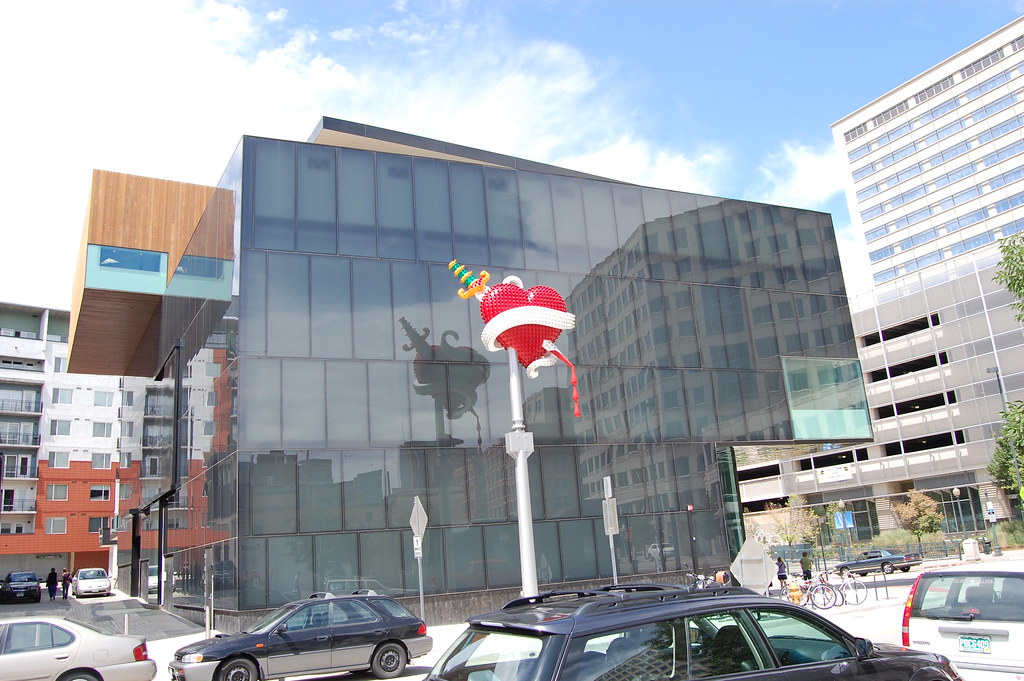
Jeff Koons, Balloon Flower (Red), 1995–1999, on view in front of 7 World Trade Center in New York. High chromium stainless steel with transparent color coating, 114 x 132 x 108 in. Photos: 16 Miles
  • Christie's international co-head of post-war and contemporary art Brett Gorvy notes that Jeff Koons has been very hands-on in preparing the Daimler Collection's Balloon Flower (Blue) for sale. [ARTINFO]
  • Mike Kelley carts a home around his hometown of Detroit on the back of a flatbed truck. [this is tomorrow]
  • Do you owe a critic a thank you card? New York dealer Edward Winkleman discusses the mysteries of the press. [Winkleman]
  • Roger White chats about his new show at Rachel Uffner and the Golden Age of Dutch painting: "So a little bit of death went a long way towards elevating those domestic scenes, and legitimizing the pleasure the viewer could take in admiring the fruit, the lobsters, the gleaming silver. Similarly there’s a sort of conceptual solidity — and maybe moralism? — in constantly evoking the specter of The End." [Idiom via Two Coats of Paint]
  • Who Was Blinky Palermo? Part 1: "Perhaps when the words meant something, Blinky Palermo was the very embodiment of the 'avant-garde.'" [Unframed]
  • Who Was Blinky Palermo? Part 2: "By all accounts, Palermo was a charming womanizer who nevertheless remained notoriously quiet in public and was especially reserved about his art. There were problems with alcohol and drugs, and he died on the remote Maldive island of Kurumba. It's the resume of a romantic." – From Christine Mehring's fantastic 2002 essay on Palermo [Artforum]
  • Who Was Blinky Palermo? Part 3: The artist versus the boxing promoter. [LACM on Fire via MAN]

Monday, October 18, 2010

Jeff Koons's "Made in Heaven" Series: A Critical Compendium


Jeff Koons, Fingers Between Legs, 1990. Oil inks silkscreened on canvas, 95.8 x 144.1 in. Photo: Luxembourg & Dayan

Works from Jeff Koons's "Made in Heaven" series — paintings and sculptures that depict the artist with his then-lover, Italian porn star Cicciolina, in a variety of romantic situations — have returned to New York, where many were first displayed in 1991 at the Sonnabend Gallery in SoHo. (Some pieces — of the slightly less hardcore variety — were shown at the 1990 Venice Biennale.) New York critics, with perhaps only one exception, have lambasted the current "Made in Heaven" show at the Upper East Side townhouse of Luxembourg & Dayan, following in a rich lineage of writers that have panned work. Over the past two decades, the series has earned near-universal scorn from most art critics and inspired some of the all-time-great takedowns in recent criticism. Here is a brief guide to that writing:
  • Judd Tully, Washington Post, 1991: "Heavily made up, grappling with the pink-booted, blond-tressed Cicciolina, Koons looks like a miscast version of Tarzan performing a skit on 'Saturday Night Live,'" Tully (who is currently editor at large at Art+Auction) wrote, describing the scene at the 1991 Sonnabend show. "But it's Koons's ability to get under critics' skins that makes his popular cultural promotions and advertising stunts effective despite their artful shallowness." Contemporary buyers take note: Tully reported that the most expensive (and largest) work in the 1991 show was Ilona on Top (Rosa Background), priced at $390,000.
  • Michael Kimmelman, New York Times, 1991: Kimmelman's thorough and savage attack on the Sonnabend show has been frequently quoted by writers assessing the series. The review is brutal: "Just when it looked as if the 80's were finally over, Jeff Koons has provided one last, pathetic gasp of the sort of self-promoting hype and sensationalism that characterized the worst of the decade," it opens. There's more: "His latest show takes advantage of a moment when art about sexuality has come under public attack. What is worse, it does so only to affirm sexist stereotypes." And more: "Mr. Koons's boring, dully conceived images are closer in spirit to the dead academicism against which Manet reacted."
  • Peter Plagens, Newsweek, 1991: Previewing the Sonnabend before it opened, Plagens (like Tully) noted Koons's skill at garnering attention: "Koons knows it's smart (profitable and fun) to be the artist everyone loves to hate." He also shared an all-time Koons classic: "'I want my work to be seen by young people, who are forming their opinions. If the work is closed down, it won't be effective,' he says. 'I think when people view these images, they will find not perversity, but something that is beautiful, like a flower.'" Like a flower.
  • Robert Hughes, Time, 1993: A characteristically acerbic Hughes was willing to give "Made in Heaven" a try as porn at a 1993 SFMOMA Koons exhibition, but he left unimpressed: "As pornography, these works are inefficiently winsome; as art, wholly inert beneath their gaudiness."
  • Calvin Tomkins, The New Yorker, 2007: Tomkins quotes Koons telling another interviewer, defending "Made in Heaven": "Sex with love is a higher state. It's an objective state, in which one lives and enters the eternal, and I believe that's what I showed people. That's why it wasn't pornographic." Tomkins is unconvinced. He writes, "Although the viewer might conceivably miss the higher state invoked here, the images were curiously non-arousing; they lacked the necessary artlessness of pure porn."
  • Jonathan Jones, Guardian, 2009: Ever the contrarian, Jones, in a profile of Koons, admits that he loves the series. "It was called Made in Heaven," he writes, "and, in my opinion, was his greatest work." Koons tells Jones, in another classic line, "If I think of the word beauty, I think of a vagina."
  • Paddy Johnson, Art Fag City, 2010: Johnson also likes "Made in Heaven." She writes, "I suspect I’m one of only one or two critics in the city that like Koons 'Made in Heaven' series, but so be it. Koons attention to detail is incredible." She is undoubtedly the only writer willing to admit being aroused by the works: "Occasionally they even manage to be a turn on."

  • Roberta Smith, New York Times, 2010: "They are in step with an aggressive political incorrectness pursued in the same period (albeit to very different effect) by Kara Walker and Sue Williams, who addressed racism and sexism in similarly inflammatory ways," Smith writes. "The innocence of the child is replaced by the cluelessness of the man, one who confuses posing and empty exhibitionism with emotional vulnerability." She concludes with an argument that could almost apply to the late Michael Jackson: "Perhaps the truth is that Mr. Koons makes a better child than adult, and that for all his genius, he is a kind of naïf."
  • Christian Viveros-Fauné, Village Voice, 2010: "There is, to put it simply, absolutely no valid reason besides money to exhibit this dreck today," Viveros-Fauné writes, who also takes the unique approach of reviewing Amalia Dayan's sales pitch: "The exhibition's last hardcore picture waited: Titled Dirty Ejaculation, it bore a feces-flecked close-up of Koons's dick pulling out of Cicciolina's bunghole. 'I think it's radical,' Dayan purred. Uh, yeah!, I mouthed archly. And if this load were music, you would be the New York Philharmonic."
  • Peter Schjeldahl, The New Yorker, 2008: Reviewing the Museum of Contemporary Art Chicago's 2008 Koons retrospective, Schjeldahl sums it up best: "I’ve never known what to do with the 'Made in Heaven' works, other than to gawk at them in vague alarm."

  • Unbylined, The New Yorker, 2010: The New Yorker brutalized the Luxembourg & Dayan show in its Goings on About Town section. It begins, "Koons’s wretched digital porn paintings, made in 1990-91 from photographs of himself simpering and grappling with Ilona Staller, are back, augmented with hardcore shots not shown in New York before. A wizard about objects, Koons is stone numb to two-dimensional aesthetics." And it gets more tougher from there.

Sunday, February 7, 2010

Jeff Koons's Studio [Photographs]


Jeff Koons's Studio, February 2, 2010. Photos: 16 Miles [more]

It's a little surprising that it took until 2010 for BMW to commission Jeff Koons to participate in its 'art car' series. The company picked Warhol to make the 1979 edition, 17 years after his high-art debut in New York. Koons, in contrast, has been producing inflatable sculptures for 31 years. (By the way, Warhol, the great assembly–line artist, made the charmingly perverse decision to paint his contribution by hand.)

Nevertheless, BMW has finally asked Koons to participate, and the artist opened his studio last week for a party to make the official announcement. Some of his assistants stayed after work to paint a bit and explain the studio process for the assembled masses. Discoveries: lunch-time soccer games (sans Koons) are frequent, more than 100 work there every day, and the starting wage is $19 an hour. Multiplying that number over a year for the full staff and then adding in other costs of running the workshop, his profit margin would seem to be less than one would expect.

The quality of the cars in BMW's series varies considerably, but the project at least invites a fun thought-experiment about how other artists might handle the commission. Robert Barry? All the doors would be locked. Damien Hirst? Formaldehyde–covered animals boxed in the trunk like massive subwoofers. James Turrell? One giant moon-roof. Yayoi Kusama? A giant, mobile, polka-dot-covered mushroom.

There are more photos and an article.


Tuesday, December 1, 2009

Felix Gonzalez-Torres's lover, cranberry-pomegranate chutney, etc. [Collected]


Karl Haendel, Scribble, 2009. Photo: 16 Miles

Friday, August 21, 2009

Monday, April 27, 2009

The Pig at Deitch Projects Long Island City [Photographs]


The Pig [installation view], Deitch Projects, Long Island City. Photo: 16 Miles   [more]


The Pig [installation view], Deitch Projects, Long Island City. Photo: 16 Miles   [more]


The Pig [installation view], Deitch Projects, Long Island City. Photo: 16 Miles   [more]

The Pig [installation view], Deitch Projects, Long Island City. Photo: 16 Miles   [more]


The Pig [installation view], Deitch Projects, Long Island City. Photo: 16 Miles   [more]


The Pig [installation view], Deitch Projects, Long Island City. Photo: 16 Miles   [more]


The Pig [installation view], Deitch Projects, Long Island City. Photo: 16 Miles   [more]


The Pig [installation view], Deitch Projects, Long Island City. Photo: 16 Miles   [more]


The Pig [installation view], Deitch Projects, Long Island City. Photo: 16 Miles   [more]

4-40 44th Drive
Long Island City, New York
Through August 9, 2009

Thursday, February 26, 2009

An Unruly History of the Readymade at the Jumex Collection [Review]


Richard Pettibone. Photo courtesy of fishercott.

[Part 1 of our ongoing feature on contemporary art in Mexico City]

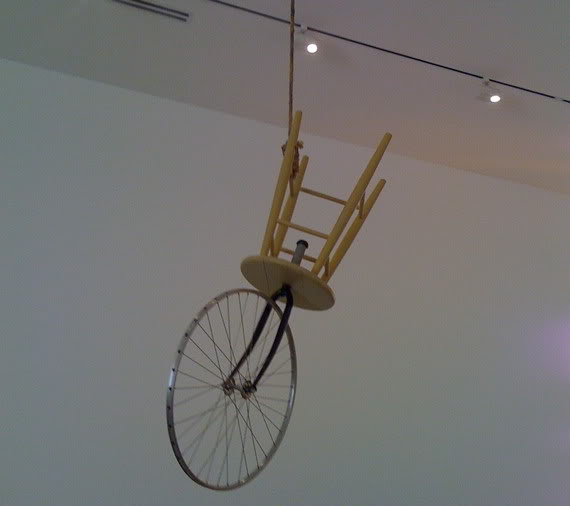
I had never witnessed a piece of art being put to death before. Walking into An Unruly History of the Readymade at the Jumex Collection, though, it’s the first thing one sees. Marcel Duchamp’s notorious Bicycle Wheel (1913) has been slid through a noose and hung from the ceiling of cavernous warehouse. Consulting my guide, I learned that it was actually a sculpture by serial reproducer Richard Pettibone.

Laid out on the floor as a gigantic chessboard that spirals chronologically toward the center of the room, the show (organized by Tate Modern curator Jessica Morgan) comprises about 100 works culled from the collection of juice scion Eugenio Lopez, presenting interpretations of Duchamp’s act of selection that range from the ludic to the staid, the hilarious to the banal.


Ugo Rondione, Love Invents Us, 1999.

Given the sheer abundance of ideas that have been attributed to his work, it’s no surprise that the breadth of artists included in the rambling survey is enormous. A Warhol Jackie (Pettibone’s miniature copy is in a vitrine a few feet away) is hung a few spaces from On Kawara date paintings (with Mexico City newspapers included, of course). Elsewhere, artists like Johns, Jonathan Horowitz, Kippenberger, Kelley Walker, Elmgreen & Dragset, and Jim Hodges are present. Damian Ortega, Abraham Cruzvillegas, Sofía Táboas, and Gabriel Kuri form a portion of the Mexican contingent. (Interestingly, they’re all represented by Kurimanzutto, for which Mr. Lopez seems to have a particular obsession.)


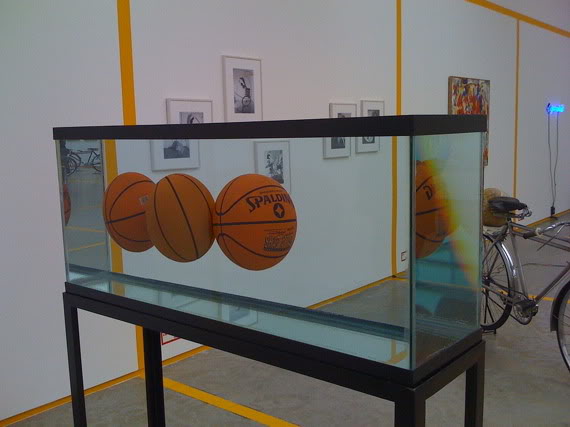
Jeff Koons, Three Ball Total Equilibrium Tank, 1985. Photo courtesy of fishercott.

Sturtevant’s meticulously replicated Johns painting represents the appropriation wing of the party, suggesting the choice of object could actually be another work of art. Warhol’s inclusion foregrounds the readymade as commercial image, Jackie Kennedy’s face plucked from a page in a newspaper. Rirkrit Tiravanija’s polished cooking equipment and its carrying case (shades of Boîte-en-valise) pursues the readymade into every day life, selecting a relational moment instead of a hat rack as the art. Cataloguing the complete set of readymade possibilities would yield scores of factions.

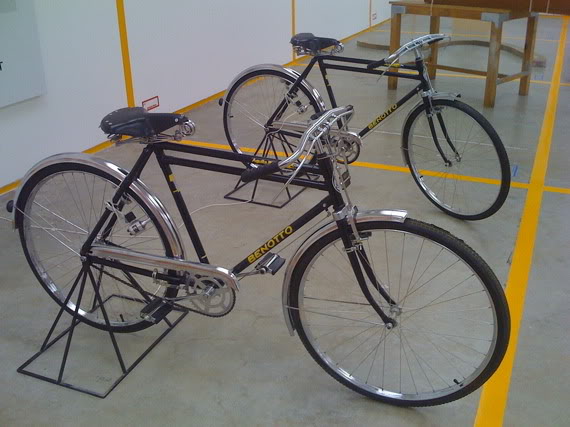
Maurizio Cattelan’s piece Dynamo Secession (1997) is where I paused for the first time, suddenly shaken out of my art history reverie. Twin bikes that can be pedaled to power a light bulb, he reanimates the bicycle wheel, as Duchamp did originally (“In 1913 I had the happy idea to fasten a bicycle wheel to a kitchen stool and watch it turn,” “Apropos of Readymades,” 1951.) It’s cute but also sinister. Simply lighting a bulb in a gallery already flooded with light, it uncomfortably highlights the self-referential (self-reverential) discourse at play. For a lot of people outside the hermetic seal of contemporary art, the readymade represents the moment that modern art became incomprehensible.


Maurizio Cattelan, Dynamo Secession, 1997. Photo courtesy of fishercott.

At the very center of the space, the final work is a banana skin tossed on the ground. Authored by Adriana Lara, the peel is replaced every day after someone from the museum consumes a banana. We can spot the references (to Warhol’s Velvet Underground & Nico cover and the food happenings of relational aesthetics) and get the joke. It may be too easy. The obsessive repetition of its production mirrors Cattelan’s piece. Put another way, we’re just spinning our wheels. There’s a tremendous amount of great, sublime, perplexing work here, and the show is generally crisply edited. There’s also a real danger of falling into a theoretical mise en abyme.

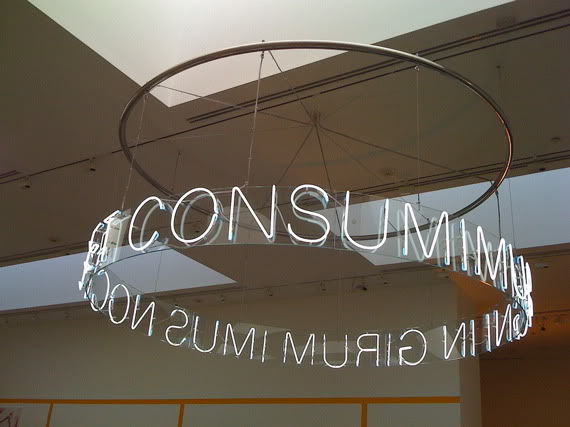
Overhead is a sculpture by Cerith Wyn Evans, a neon text (In Girum Imus Nocte et Consumimur Igni, “We enter the circle at night and are consumed by fire”) spun into a halo. It’s an ancient Latin palindrome, used by Guy Debord for the title of his final film. One thinks of one of the final lines from that film of 1978: “This civilization is on fire; the whole thing is capsizing and sinking.” It will take more than banana peels to confront that.


Cerith Wyn Evans, In Girum Imus Nocte et Consumimur Igni, 2006. Photo courtesy of fishercott.

An Unruly History of the Readymade
Via Morelos 272, Col. Sta. Maria Tulpetlac, Ecatepec
Through February 2009

Tuesday, June 3, 2008

Jeff Koons on Coffee Shops and Classism

Jeff Koons wants you to know the following:
I'm very anti-classism. I like to go to coffee shops, I like the lack of
pretension.

You can read other thoughts from him in this piece, which coincides with the opening of his exhibition at the Museum of Contemporary Art Chicago.

Recently opened: The Metropolitan Museum of Art's gorgeous Jeff Koons on the Roof.