Showing posts with label Saltz. Show all posts

Tuesday, January 4, 2011

Pat Steir's "Line" in Video, Katharina Grosse, Alec Soth as Critic, etc. [Collected]


Martha Friedman, Rubbers, 2010. Cast silicon, pigment, and metal, 134 ½ x 3 ½ x 3 in. at Wallspace's "Swagger, Drag, Fit Together." Photo: 16 Miles
  • Drawing Pat Steir's "The Nearly Endless Line" at Sue Scott Gallery in New York. [Art Clogged]
  • Martin Bromirski visits Katharina Grosse's sprawling MASS MoCA show. Her last one-person show in New York was in 1997. [Anaba]
  • Will Cotton: "I do love sugar. But I used to have other vices too. I think the other vices have just fallen by the wayside, and sugar has stepped up a little bit to take their place." [The 99 Percent]
  • "It seems to me that Saltz just took a shot at something new, intrigued by the prospect of quick and unmediated feedback." Sharon Butler on art critics and the Internet. [Two Coats of Paint]
  • New York experimental masters Excepter tackle "Little Drummer Boy," "Deck the Halls," and "Carol of the Bells." It sounds even better in the new year. [A Million Keys]
  • "The dreamer emerges, not as a collection of biologic urges, but as the mastermind capable of creating such a nuanced, intricate and meaning-laden world." Elif Batuman on "Why Criticism Matters." [New York Times]
  • Cracklings, wafer cookies, Daniel Spoerri, and more: With Nicole Caruth and Megan Fizell (of Feasting on Art, mentioned above!), I recently wrote about art involving food and art involving food. [Art21]

  • In anticipation of Joe Bradley's Canada/Gavin Brown doubleheader, a classic review in Frieze (via @gregorg), with commentary by Dan Colen. Conveniently, work by Martin Barré goes on view at Andrew Kreps this Saturday evening.

Sunday, February 21, 2010

Jerry Saltz and Jeffrey Deitch on Rob Pruitt


Rob Pruitt, Mark Rothko, 2008, in "The Living and the Dead," at Gavin Brown's enterprise, July 1 through August 7, 2009. Photo: 16 Miles [more]

When one of the chief criticisms levied against an artist is that his success is a result of relentless, soulless networking, it's somewhat refreshing to see him unashamedly create a book reviewing his entire career that is comprised almost entirely of quotations culled from influential friends, acquaintances, hangers–on, and famous names. And that appears to be what Rob Pruitt has done for his new book, Pop Touched Me.

The quality of these testimonies vary from the pleasantly kind (Jeff Koons: "I've always loved Rob's work.") to the somewhat lackluster (Sofia Coppola: "I like his pandas, and he seems like a cool guy."), but it amounts to a fairly comprehensive history of the last two decades of a certain group of artists working in New York. Jerry Saltz and Jeffrey Deitch present some of the book's more entertaining moments:
The last time I ever did cocaine was when Rob laid his fifty-foot long line of coke on mirrors on the floor of that loft on 14th street.
– Jerry Saltz
The most arresting memory that I retain from the most historic downtown art event of the early 1990s, the opening of Jeff Koons's "Made in Heaven," is not of Jeff, but of Rob Pruitt and his partner, Jack Early. Jeff's old friend Andy Moses had hosted a party at his Broome Street loft after the public opening at the Sonnabend Gallery. I was standing in the kitchen area, talking with some friends, when I was halted in mid-sentence by an astonishing image. Rob and Jack were moving toward us, propping up Anthony Haden-Guest, holding his penis as they gingerly guided him toward an open garbage pail. With a courtly gesture, which reminded me of the way a gentleman would help a lady with her coat, Rob directed Haden-Guest's penis into the center of the garbage can and held it there as the famous journalist relieved himself.

– Jeffrey Deitch, "The Story of Rob Pruitt"

Tuesday, December 1, 2009

Felix Gonzalez-Torres's lover, cranberry-pomegranate chutney, etc. [Collected]


Karl Haendel, Scribble, 2009. Photo: 16 Miles

Saturday, September 5, 2009

Wednesday, June 3, 2009

Buying Sehgal's Kiss, Funding Mass MoCA, etc.[Collected]


Yayoi Kusama, Aftermath of Obliteration of Eternity, 2009. Photo: 16 Miles
“Buying Kiss was a huge ordeal,” Biesenbach reports. The negotiations involved a dozen different people, including lawyers, curators, dealers, conservators, and an “interpreter” for Sehgal.
- Linda Yablonsky, on collecting the ephemeral, in ArtNews. More of this, please.

Friday, May 22, 2009

The Mona Lisa, David Zwirner, and Art Pastries [Collected]


Alice Neel, Nadya and Nona, 1933, at Alice Neel: Nudes of the 1930's, at Zwirner & Wirth.  Photo: 16 Miles.

Monday, February 2, 2009

"From the Archives: 40 Years / 40 Projects" at White Columns [Review]

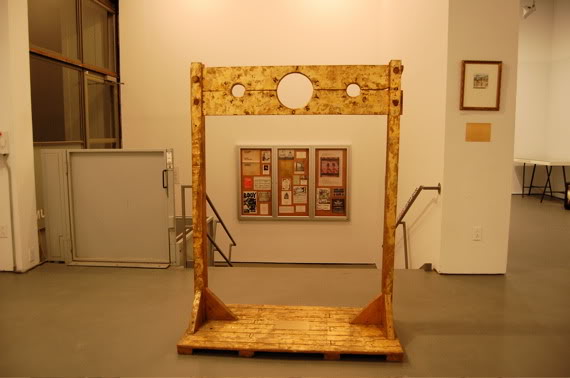
Kathe Burkhart, Pillory of History, 1993

The first object one sees on entering White Columns is a large, golden instrument of torture, Kathe Burkhart’s Pillory of History (1993). Looking closer, around the holes carved for a prisoner’s head and hands are three finely inscribed words: “History repeats itself.” It’s a daring piece to put at the beginning of a retrospective tasked with crafting an historical account of the oftentimes remarkable, consistently unusual path the storied alternative space has taken over the last forty years.

While Gordon Matta-Clark is probably the artist most readily associated today with the early years of 112 Greene Street (the original name of White Columns), the show begins by highlighting the underlying philosophy espoused by cofounder Jeffrey Lew, who, in a 1978 interview posted on the walls of the gallery, admits, “None of the doors in 112 were ever locked,” a fact that succinctly embodies the freewheeling atmosphere of the space’s early years, in which artists randomly installed and removed works without any curatorial oversight. “There wasn’t a first show because everybody just arrived,” Lew explains. “I never understood the difference between selection and eliteism [sic].” That anarchic aesthetic, the show makes clear, did not last long.

White Columns director Matthew Higgs and curator Amie Scally, after digging through the reportedly decrepit archives and combining their discoveries with material from artists’ holdings, selected a single exhibition for each year in the institution’s existence. Grouping this detritus with art from some of the shows, they have chronologically ordered the projects along the walls of the gallery in the form of a timeline, which abounds, especially in the first two decades, in surprises from a smaller, arguably more adventurous art world. Perhaps most remarkable is the 1974 entry, a contract signed by Leo Castelli agreeing to participate in Richard Serra’s game theory experiment and video Prisoner’s Dilemma, a sign of just how quickly and aggressively 112 Greene Street became a pivotal force in New York.
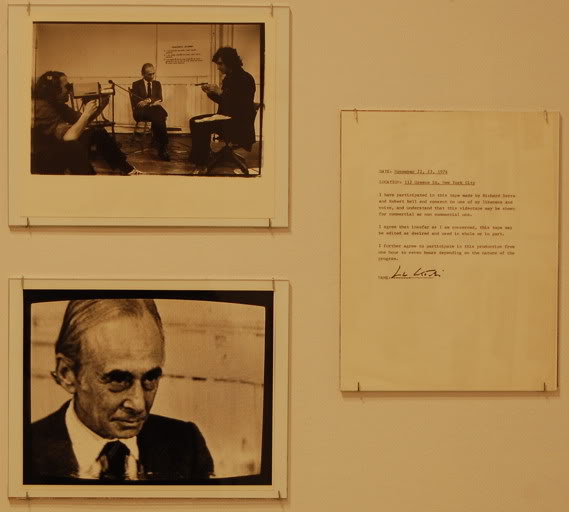

Richard Serra, Prisoner's Dilemma, 1974.

Other artifacts reveal a New York cultural world shifting throughout the 70’s and 80’s. A price list from 1988’s “Real World” offers Perfect Lovers, Felix Gonzalez-Torres’s twin clocks, for $350. (One set – of an edition of three – hangs over the front desk, ticking fifteen seconds apart on both days I visited.) Elsewhere, Allan McCollum submits a brief, typewritten proposal for a show in 1980. On the other side of the wall, remnants from Kim Gordon’s 1981 project, including a grainy photograph of the installation and a press release in which she quotes both Walter Benjamin and the Au Pairs, are on display. Her credibility is established through mention of her work with Glenn Branca and Rhys Chatham; Sonic Youth had yet to cut a record. It is these moments, when one witnesses artists on the verge of their breakthroughs, that are most pleasurable – and problematic.

There is, after all, a profound triumphalism inherent in the mode of selection on display. Far from Lew’s dream of an open utopia, the viewer bears witness largely to history’s winners and sees White Columns positioned as prophet. In the introductory text to the exhibition, though, Scally and Higgs are honest on this point, admitting that their undertaking is “celebratory” and “inevitably partial.” Hundreds of artists not in the exhibition also made use of the space and clout of White Columns, one is reminded. For an endless number of reasons their work didn’t last. Limiting their focus to a single work each year, the curators foreground this arbitrariness and, in their rigid chronological construction, reveal the contingency embedded in all art historical narratives. Entering the more contemporary end of the timeline and encountering works from less canonical names, this technique also allows for thrilling viewing: Where, one wonders, has White Columns bet correctly?

It is in inviting this glorification and questioning that “40 Years / 40 Projects” is at its best, outlining a thorough, persuasive advertisement for the importance of an active, engaged White Columns. The press releases, invitation cards, letters, and photographs come to function as non-sites, always pointing elsewhere: to installations disassembled (but present in the photographs of Matta-Clark projects), to political opportunities squandered (in the transcripts of Group Material discussions and the Silence = Death card on the entry bulletin board), and to art objects dispersed around the world. It is, for example, genuinely frustrating to squint at tiny photographs of Sarah Sze’s 1997 installation after reading Jerry Saltz describe it as a “Rimbaud-like vision of the abyss” in a page from Time Out New York torn out and tacked to the wall. Seeing the under-represented Jack Pierson’s rustic, elegant painting Lucky Strike (1986) provides only some temporary sense of relief.
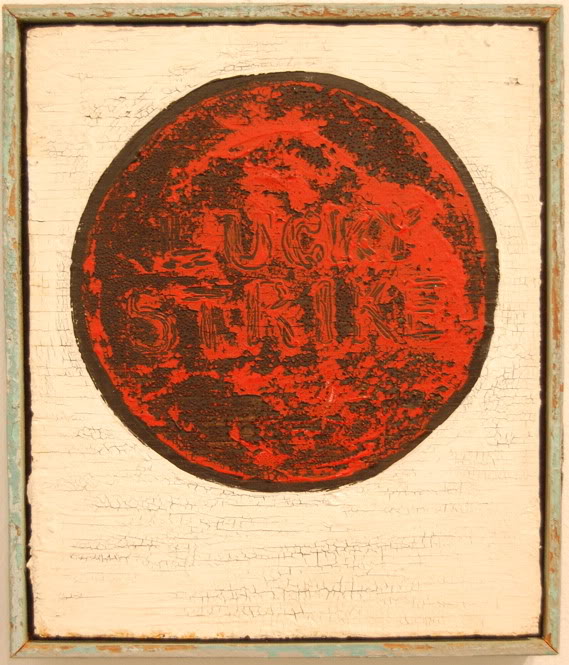
Jack Pierson, Lucky Strike, 1986

Viewed from today’s frenetic, relatively prosperous art world, the early anarchic years of 112 Green Street at first appear tremendously liberating, but it’s also clear that there was very little at stake. By the mid-1980’s, in the midst of the AIDS crisis, continued urban decay, and the national dominance of conservative politics, White Columns would come to view itself as an essential space for the promulgation of oppositional political and aesthetic practice, a place where it was possible both for Judith Barry and Peter Halley to debate the efficacy of political art and for curators to stage a Sturtevant retrospective. A committed, discursive community had blossomed, the show argues.

In contrast to this rigor, some of the inclusions in the 1990’s and 2000’s seem less urgent and less interesting, products perhaps of their relatively halcyon times. Jessica Craig-Martin’s photograph from 1999 is alluring but almost flippant in its implied critique. The group show “What I Did on My Summer Vacation,” which invited artists and curators to take a disposable camera and document their idyll days (representing 1996) is novel but borders on being self-congratulatory, celebrating the hermetic networks of artists and curators that have dominated so much recent art.

Ultimately, though, as these rich, diverse fragments, these non-sites, inevitably point to the work they once promoted and supported, they also point to inspiring pasts, signaling how high a level of quality is required for today’s institutionalized White Columns to compete with its legendary history. In a new period of political crisis, then, Scally and Higgs seem to be welcoming a challenge.

Tuesday, January 6, 2009

Everything Good in 2008

With 2008 now over, it's time to look over the Top 10 and year end lists that came out throughout December.  (I posted my list last week.)  In New York, William Eggleston: Democratic Camera at the Whitney, Abstract/Abstraction at the Jewish Museum, and Catherine Opie: American Photographer at the Guggenheim seemed to be the big winners.

Some year end pieces:
  • Jerry Saltz - # 1 - Tino Sehgal at Marian Goodman, "I was horrified, mortified, and thrilled."
  • Hrag Vartanian - #1: Abstract/Abstraction at the Jewish Museum, "a fascinating take on a topic that has been done to death."
  • Joanne Mattera - Mary Heilmann at the New Museum, "The perfect yin and yang of loose-limbed geometry and aggressive color."
  • Anaba (Bromirski) - RH Quaytman, Michael Zahn, Megan Pflug, and a bunch of other art no one else was covering.
  • Modern Art Notes (Green) - Sarah Oppenheimer at the Mattress Factory, "stole the show" from the nearby Carnegie International.  
  • Jen Graves - #1: WACK!  Art and the Feminist Revolution, "I just want to keep looking. And looking. And looking."
  • Peter Schjeldahl - Jeff Koons retrospective in Chicago and his sculptures on top of the Met, "the most perfect—and perfectly enchanting—valedictory to the era suddenly past."
  • Christopher Knight - Catherine Opie: American Photographer at the Guggenheim, "a marvelous retrospective whose only real drawback is that it won't travel west from its originating venue."
Two quirkier, wonderful lists:
Finally, Charles Finch has some predictions for the art world in 2009: "Damien Hirst's career is over. Like those of Schnabel, Cucchi, Salle and other victims of the late 1980s crash, Hirst’s values will never recover."

Thursday, July 17, 2008

The New York City Waterfalls (2008) by Olafur Eliasson [Review]


Living in New York, I think I'm obligated to share some photographs of Olafur Eliasson's The New York City Waterfalls, which are up until mid-October. I took these along the East River, just north of the Manhattan Bridge.

It was perhaps inevitable that most writers would discuss Eliasson's work in the context of that last massive work of public art in New York, Christo and Jeanne-Claude's The Gates. The general consensus seems to be that Eliasson wins that battle, and I tend to agree. Though it's odd to say about gigantic, industrial towers of plumbing, The Waterfalls are elegant, cleverly understated in their size and sound, and a charm to see on repeat viewings. In short, they are everything that The Gates were not.

Viewing the works from various points along the East River or via the subway crossing the Manhattan Bridge, each viewer constructs their own vision of it piece by piece, which tend to lead to sometimes widely divergent views. On multiple occasions, I've heard debates among friends and strangers on the D train about how many waterfalls there are. (Four.)


The waterfall situated under the eastern support of the Brooklyn Bridge is undoubtedly the most fun as the water appears to gush out of the century-old brick. The freestanding works, which don't signify so surreally (they're clearly man-made), on Governors Island, the Brooklyn Promenade, and Manhattan's east shore are the ones that make the project work, though. As Jerry Saltz notes, they invite you to confront the massive scale all around you. Next to the bridges and towers of New York, they're beautiful - and quaint - marking off and making you see the scale of the landscape in new ways. Distances spread and contract, depending on your viewing place.


The Waterfalls function perfectly as a phenomenological experiment, but their greatest success may be as a massive invitation for New Yorkers to embrace their newly-refurbished shorelines, a subtle social engineering that exists in some of Eliasson's best work. Walking along the Henry Hudson down in the West Village last weekend, it was remarkable seeing the hundreds of people from all over Manhattan who were out enjoying the fresh parks and piers. The shores on the other side aren't nearly as developed for public space, but they're improving.

Thanks to The Waterfalls, New Yorkers - who have so often reveled in their island-exceptionalism while neglecting their waterfronts - are for the first time beginning to wander over to them. Hopefully, as some viewers peer through chain-linked fence along the Manhattan side, the project will serve as an advertisement for further investment in not only intelligent public art but thoughtful public space, as well.

Tuesday, April 29, 2008

Jerry Saltz on 40 Years of Art in New York City

Jerry Saltz, adopting the chronological format of Foster, Buchloh, Bois, and Krauss in Art Since 1900, has published a list of the major events of the last forty years in New York art. (There's also an abridged version in New York.) There won't be many surprises for anyone who's been paying some degree of attention, but he does mention a few pieces that unfortunately don't get talked about much anymore: Walter De Maria's New York Earth Room, Daniel Joseph Martinez's I Can't Ever Imagine Wanting to Be White, and Alan Sonfist's Time Landscape.

While New York's editors isolate the inclusion of a 1986 Warhol self-portrait as a serious 'argument starter', the real controversy would seem to come from the 2004 entry (emphasis added):
Having opened a 292,000-square-foot space in upstate Beacon, N.Y., the year before, Dia, under director Michael Govan ... unforgivably closes down Dia’s West 22nd Street building. Thus, Govan oversaw the loss of the first space in Chelsea -- one of the most important exhibition sites in the world. This is the most lamentable misstep in New York exhibition history.

Even if you can't get endorse that type of hyperbole, there are still enough great moments to make it worth reading. A choice anecdote from Saltz's 1993:

At a dinner given for Anselm Kiefer, after his opening at Marianne Goodman Gallery, raw food is served to the crème-del-a-crème of the art world as they sit at long white tables atop a floor covered with white sand, as actors mimed dance. The decadent dinner marks the last gasp of 1980s hubris. As we entered the dining hall, artist David Salle looked at me and said, "They’re going to kill us all." And then he left.