Showing posts with label Quotation. Show all posts
Showing posts with label Quotation. Show all posts
Sunday, August 9, 2009

Monday, March 9, 2009
Two Letters on Tehching Hsieh in the Times
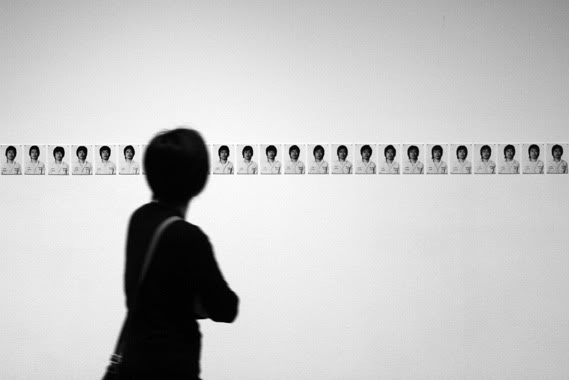
Performance 1: Tehching Hsieh at the Museum of Modern Art. Photo courtesy of Michael.
There was a rare gem of a letter to the arts section of The New York Times over the weekend. A gentleman wrote from Copenhagen to describe a conversation he had with Tehching Hsieh after calling him on a number he found in a New York phone book. The artist's view on his legacy and lack of documentation: “If art good, people remember. If art bad, history clean up.”
Less of a gem was the letter from a New Yorker accusing Tehching Hsieh of "obvious mental illness."
Tuesday, December 30, 2008
Dzama, Bergdoll, Neuberger on 2009 Resolutions
The Wall Street Journal asked a variety of people to share their New Year's resolutions. Marcel Dzama's: "Read more and plant a garden in my backyard." He also shares, "I have recently made sketches for a piece in Mexico that will be permanently installed in a botanical garden in Culiacán. It will be a snowman kept alive by solar panels."
MoMA curator Barry Bergdoll, dealer Mary Boone ("To laugh more.") and legendary collector Roy R. Neuberger (going strong 105 years old!) make up the rest of the art world contingent, alongside some other interesting picks. This will probably be the only time that Chris Brown and Danny Meyer will ever appear in the same article.
Monday, December 22, 2008
Franz Kline and the Immorality of Art Education
Wayne Thiebaud visited Franz Klein's studio back in the 1950's.
"The only insult I ever heard him utter," Thiebaud said, "was when I told him I was teaching and he said, 'How can you do that? That's an immoral act.' But he'd gone to art school, so I wanted to know how he could say that. 'Because most teachers want to be believed,' he said, 'and that's immoral.' " [via Modert Art Notes]
Monday, September 1, 2008
Michael Baxandall, 1933-2008
Monday, August 25, 2008
John Russell, 1919-2008
"When art is made new, we are made new with it. We have a sense of solidarity with our own time, and of psychic energies shared and redoubled, which is just about the most satisfying thing life has to offer."
- John Russell
Tuesday, June 3, 2008
Jeff Koons on Coffee Shops and Classism
Jeff Koons wants you to know the following:
I'm very anti-classism. I like to go to coffee shops, I like the lack of
pretension.
You can read other thoughts from him in this piece, which coincides with the opening of his exhibition at the Museum of Contemporary Art Chicago.
Recently opened: The Metropolitan Museum of Art's gorgeous Jeff Koons on the Roof.Thursday, April 24, 2008
Proust and the Vulgarity of Photographic Reproduction
'Young Marcel' on his grandmother:
She would have liked me to have in my room photographs of the most beautiful monuments or landscapes. But at the moment of buying them, and even though the thing represented had an aesthetic value, she would find that vulgarity and utility too quickly resumed their places in that mechanical mode of representation, the photograph. She would try to use cunning and, if not to eliminate commercial banality entirely, at least to reduce it, to substitute for the greater part of it more art, to introduce into it in a sense several "layers" of art: instead oh photographs of Chartres Cathedral, the Fountrains of Saint-Cloud, or Mount Vesuvius, she would make inquiries of Swann as to whether some great painter had no depicted them, and preferred to give me photographs of Chartres Cathedral by Corot, of the Fountains of Saint-Cloud by Hubert Robert, of Mount Vesuvius by Turner, which made one further degree of art. But if the photographer had been removed from the presentation of the masterpiece or of nature and replaced by a great artist, he still reclaimed his rights to reproduce that very interpretation. Having deferred vulgarity as far as possible, my grandmother would try to move it back still further. She would ask Swann if the work had not been engraved, preferring, whenever possible, old engravings that also had an interest beyond themselves, such as those that represent a masterpiece in a state which we can no longer see it today (like the engraving by Morghen of Leonardo's Last Supper before its deterioration). It must be said that the results of this interpretation of the art of gift giving was not always brilliant. The idea I formed of Venice from a drawing by Titian that is supposed to have the lagoon in the background was certainly far less accurate than the one I would have derived from simple photographs.Marcel Proust, Swann's Way, Trans. Lydia Davis (New York: Penguin Books, 2002), p. 40-41.
Monday, March 17, 2008
Seeing is Forgetting the Name of the Thing One Sees
Robert Irwin, on deciding to take painting seriously:
"There was a certain point when I realized that if I was going to play, I was going to have to make the commitment necessary to do it. There was no simple shortcut. It was a question of, 'Do you want to do it, or don't you?' And I don't remember what it was that instigated it, but at one point I decided I really wanted to do it."
Lawrence Weschler, Seeing is Forgetting the Name of the Thing One Sees: A Life of Contemporary Artist Robert Irwin (Berkeley, California: University of California Press, 1982), p.52
Thursday, August 23, 2007
Cage to Boulez
"Let them build whatever walls; someone will always be getting out."- John Cage to Pierre Boulez in a letter dated May 1, 1953
Works Cited: Branden Joseph, "The Tower and the Line: Toward a Genealogy of Minimalism," Grey Room 27 (Spring 2007), p. 58-81.
Subscribe to:
Posts (Atom)