Showing posts with label Tiravanija. Show all posts

Thursday, July 7, 2011

The Sweet Spot: Peter Nadin's Bootleg Buying Club


Peter Nadin, The Bo'sun's Chair, 2011. Fifty-seven hemlock logs, terracotta, wood, string, nutria fur, wax, fabric, indigo pigment, bronze and galvanized nails ranging from 60 to 122 inches high, in Peter Nadin, "First Mark," at Gavin Brown's enterprise, New York, through July 30, 2011.


Peter Nadin, Raft, 2011. Honey, terracotta, wood, twine, bank run, wax and ham, 288 x 288 x 9 1/2 in.


Eggs, honey, and maple syrup are just part of the bounty, from the Old Field Farm, in Cornwallville, New York, which is available at GBE and poorly photographed here.

After a brief break, necessitated by its food-free Nate Lowman exhibition "Trash Landing," Gavin Brown's enterprise once again has a commissary. In the gallery's rear kitchen, in which Rirkrit Tiravanija operated a soup kitchen back in March, artist Peter Nadin has set up what he terms a "Bootleg Buying Club," a miniature market that sells goods from his 150-acre Old Field Farm, in Cornwallville, New York. A soup kitchen it is not. Instead it's artisanal and luxurious and just slightly tinged with nostalgia: contemporary Brooklyn as captured by the New York Times Dining section, which has already taken note. (As Paddy Johnson points out, Nadin is a press magnet.)

Nadin's gourmet heaven stocks pork rillettes and eggs, fine herbs and maple syrup, as well as jars of bright amber-colored honey, which seem likely to be popular with visitors given that three tons of that relatively pungent ingredient are sitting in the adjoining room, serving as a foundation of sorts for his Raft (2011) sculpture. (Interestingly, Nadin did not use Old Field Farm honey for the piece, though he did use local honey, purchased from a nearby county.) I couldn't resist buying a small jar on opening night, moved, in part, by the idea that I would go home and make John Cage cookies using Peter Nadin honey. (Wild, I know.) Of course, I stupidly forgot one of the cornerstone principles of Cage's macrobiotic regime: "Honey is sugar; don't use it." Regardless, it's great when slathered on English muffins or melted into tea.

Tiravanija's installation-heavy show manages to look somewhat restrained when compared with Nadin's offerings, which include not only 6,000 pounds of honey but also a forest of 57 towering hemlock trees and a suite of huge paintings rubbed with materials like wax, honey, and black walnut — bombastic updates, perhaps, on Ed Ruscha's Stains (1969). Witnessing all of this, it's hard not to wonder how smaller, quieter, more intimate shows will feel in Brown's year-old space.

Monday, May 9, 2011

Down and Then Out: 18 Murals on the Gates of the Bowery


Lawrence Weiner's painting at 134 Bowery, New York, for "After Hours: Murals on the Bowery," organized by the Art Production Fund. Photos: 16 Miles [more]

In December 2009, the New York City Council voted to require business owners to replace garage-style security gates with ones that allow views into the stores behind them by July 2026. "Roll-down gates are essentially large metal canvases," the New York Times' James Barron wrote in a report on artists who criticized the ban on the metal walls (which can no longer be installed after July 1 of this year). Barron noted that some painters have made their names on those gates, like octogenarian Franco Gaskin (also known as Franco the Great or the Harlem Picasso), who has painted scores of them around the world and more than a dozen along 125th Street in Manhattan. In other cases, a street-level mural may be one of the highlights of an artist's career. The city is filled with them.

All of which is to say that the Art Production Fund's latest project, which involved commissioning contemporary artists to design murals for 18 security gates along the Bowery, between Houston and Grand Streets, has an elegiac element alongside its more celebratory aspects. The works, which officially debuted on the evening of May 7 (they're only visible when the stores are closed: at night and on Sunday, in most cases), are on view for only two months, after which they'll be painted over, embodying the upcoming legislated disappearance of the gates across the city. A medium is slowly being ushered offstage.


Mary Heilmann's work at 220 Bowery, just feet from Prince Street

At a time when street art by its most famous practitioners is sometimes sliced off of buildings and sold, I'm a little surprised that no one has proposed auctioning off the soon-to-be-defunct gates to raise money for the APF or the nearby New Museum, especially since some of the works are really wonderful. Three of the most interesting are the abstract works by Mary Heilmann and Jacqueline Humphries and a characteristically manic, brushy text piece by Judith Bernstein, which could all be mistaken for the graffiti that appears on almost every other gate in the neighborhood. They appear to have been quickly and roughly painted, like many of the tags on the surrounding gates, and their work slips easily into the visual landscape of that stretch of blocks. Of course, the murals were in fact meticulously executed by teams of artists working from blueprints. They possess what art historian Rosalind Krauss, discussing Impressionist painting, calls the "codified sign or seme of spontaneity." They look easy, but they're hard-won: painting with the speed of a graffiti artist is difficult work.


A tricolor triptych! Jacqueline Humphries at 153 Bowery, inches from Broome Street.


Two people walking by the Judith Bernstein mural at 272 Bowery


The Kool-Aid man emerges: artists at work on Richard Prince's mural at 265 Bowery.

In other cases, the translation from contemporary painting to street mural is more awkward, as in Richard Prince's enormous Kool-Aid Man or Lawrence Weiner's gorgeous blue text piece. They're both stunning, particularly the Weiner, but they feel slightly out of place along the Bowery. This refusal of site specificity and the unique context and history of the street is a missed opportunity: these murals could be anywhere.


Ne travaillez jamais: Rirkrit Tiravanija's diptych at 180 Bowery

That can't be said of Rirkrit Tiravanija's piece, with its awkwardly shaped letters and occasional patches of sloppy painting, recalling the hand-painted "no parking" signs that adorn the storefront gates of many businesses around the city. It reads, "STOP WORK / NEVER WORK," a slogan plucked from the graffiti of Paris's 1968 revolts ("ne travaillez jamais") and sometimes attributed to Situationist International founder Guy Debord. That phrase also happens to be the text I had printed on the Tiravanija T-shirt that I picked up recently at the artist's "FEAR EATS THE SOUL" show at Gavin Brown's enterprise. Painted on the Bowery, on gates just a few blocks away from the Bowery Mission homeless shelter, it becomes far less easy to consume.


The Bowery Mission at 227 Bowery


Adam McEwen at 212 Bowery


The Danish duo Elmgreen & Dragset's piece at 213 Bowery, right next to Rivington Street


214 Bowery: Deborah Kass and Pulp, Ink have painted the gate of The Chair Factory.

Wednesday, March 23, 2011

A Surprise Steinbach, Michael E. Smith's Sublimity, Lucy Lippard, etc. [Collected]


Installation view of Haim Steinbach's Mothers, Daughters, Children (with 37 Stories About Leaving Home by Shelly Silver), 1997-2011. Metal shelving, sand, wood and metal tables, wood and metal chairs, LCD TV, galvanized bucket, and latex balloon, dimensions variable. In "Entertainment" at Greene Naftali, New York, March 3, 2011.Photos: 16 Miles [more]
  • "His first exhibition was with André Breton ... and his last years were spent with Keith Haring and George Condo," curator Laura Hoptman says of "idea machine" Brion Gysin in a conversation with Marina Cashdan in a new La Revue Blanche-inspired publication. [The White Review]
  • "We can't help but be impressed by the three shows produced thus far by the former Citibank art advisor and freelance curator Jeffrey Deitch in his closely watched new space on Grand Street," John Good writes in "Nari Ward at Jeffrey Deitch Projects," an Artnet review published in 1996. [Artnet via Edward Winkleman]

  • Four hours at the Armory. "You can drink champagne from nine in the morning until four at night," says one gentleman. Adds a lady, "The contemporary is very fresh, very alive." [Paper Monument]

  • Chris Sharp on Michael E. Smith's recent exhibition at Clifton Benevento, one of my favorite shows of past last year: "It seemed as if the entire exhibition had issued from some defunct civilization whose resources had been entirely exhausted, and the artist, sifting through the rubble, had taken it upon himself to experimentally explore potential alternative resources. [K A L E I D O S C O P E]

  • William Powhida, An Incomplete and Biased Guide to Some Critics, 2011. [Hyperallergic]

  • Paddy Johnson points out that the two artists who took Gavin Brown's car for a spin, mistaking it for part of Rirkrit Tiravanija's current show at GBE, do not seem to have been too apologetic about the mistake. Writes Johnson, "... I’d make sure my apology was front and center..." [Art Fag City]

  • Greg Allen reads Richard Prince's deposition from Cariou v. Prince, which stems from his 2008 "Canal Zone" show at Gagosian. In it, the artist mentions to Cariou's lawyer that he gave a copy of Spiritual America IV (2005) to Brooke Shields because "I'm a, you know, agreeable guy." [Greg.org]

  • Here is a really nice style guide from the Association of Arts Editors. Dropping articles in titles to preserve syntax still terrifies me, but I'm going to do it in the item below. [AAE Style Guide via Image Conscious]

  • In case you haven't heard, which is doubtful: Tyler Green's Art Madness has begun. I'm voting frequently for Claes Oldenburg's Store (1961), which is seeded number 39. [Modern Art Notes]

  • Lucy Lippard is presenting a lecture on the evening of Thursday, April 7, at the School of Visual Arts. Its title is "Ghosts, the Daily News and Prophecy: Critical Landscape Photography." [SVA]

Monday, March 14, 2011

Rirkrit Tiravanija, Brendan Fowler, the Calder Foundation, Black Dice


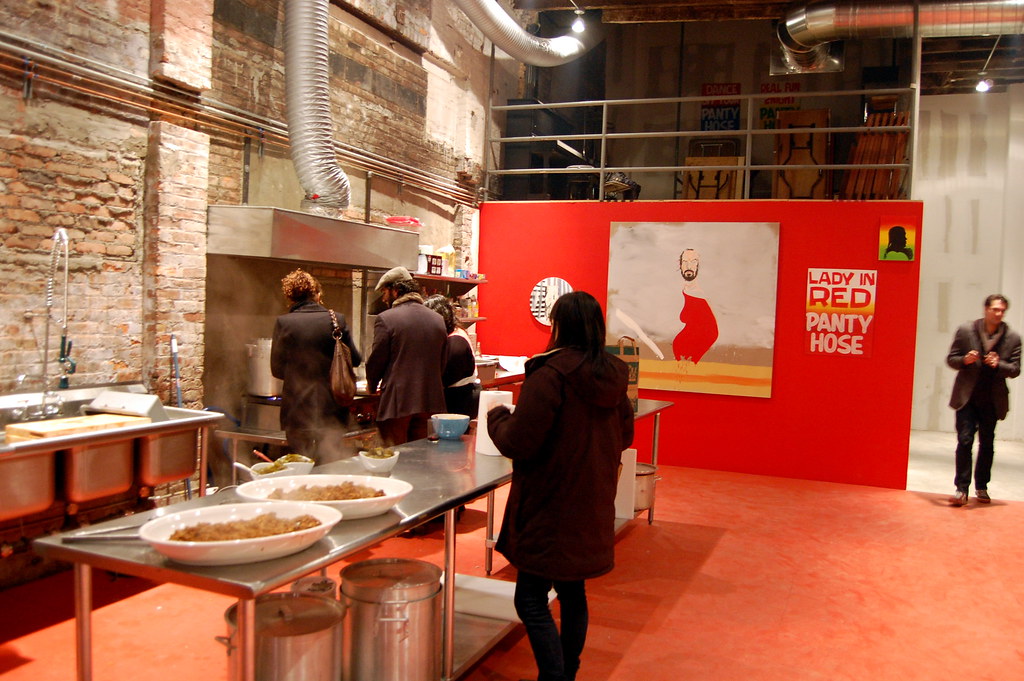
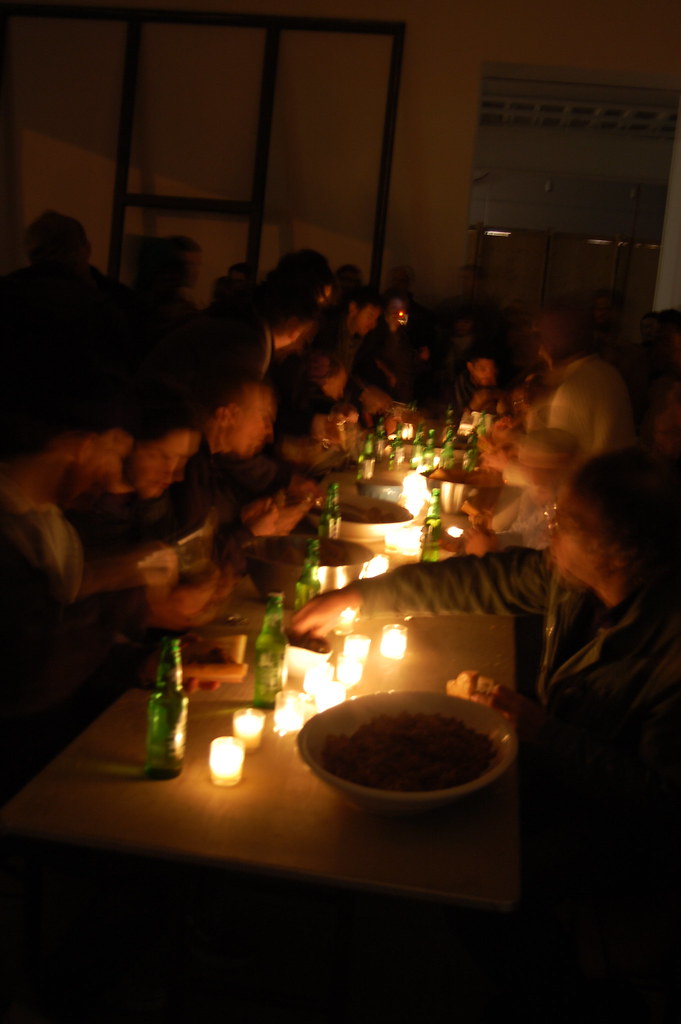
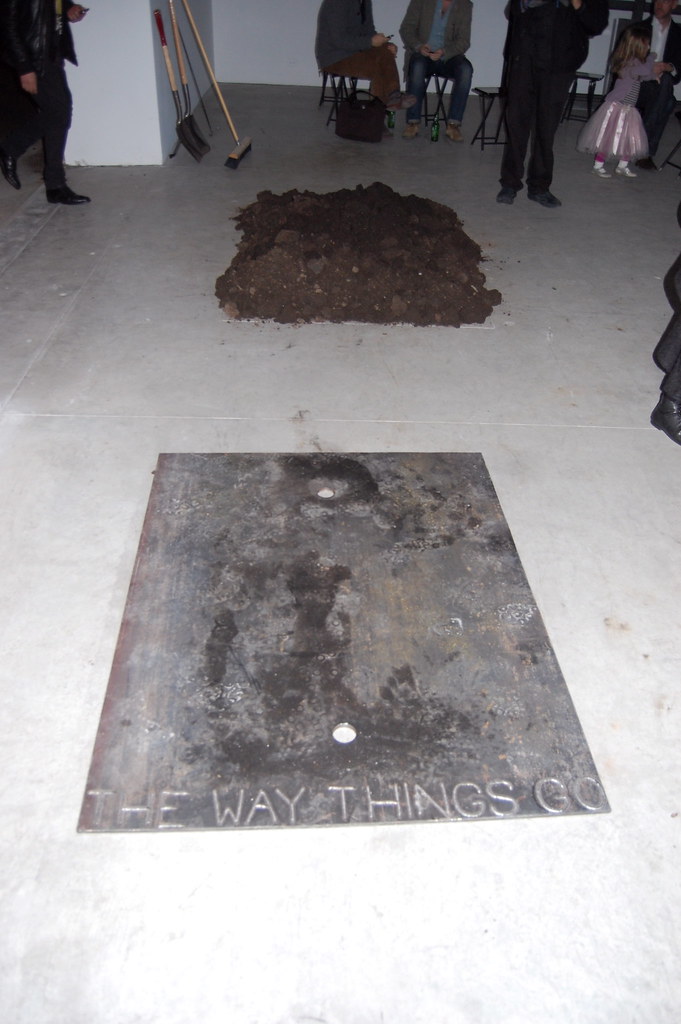
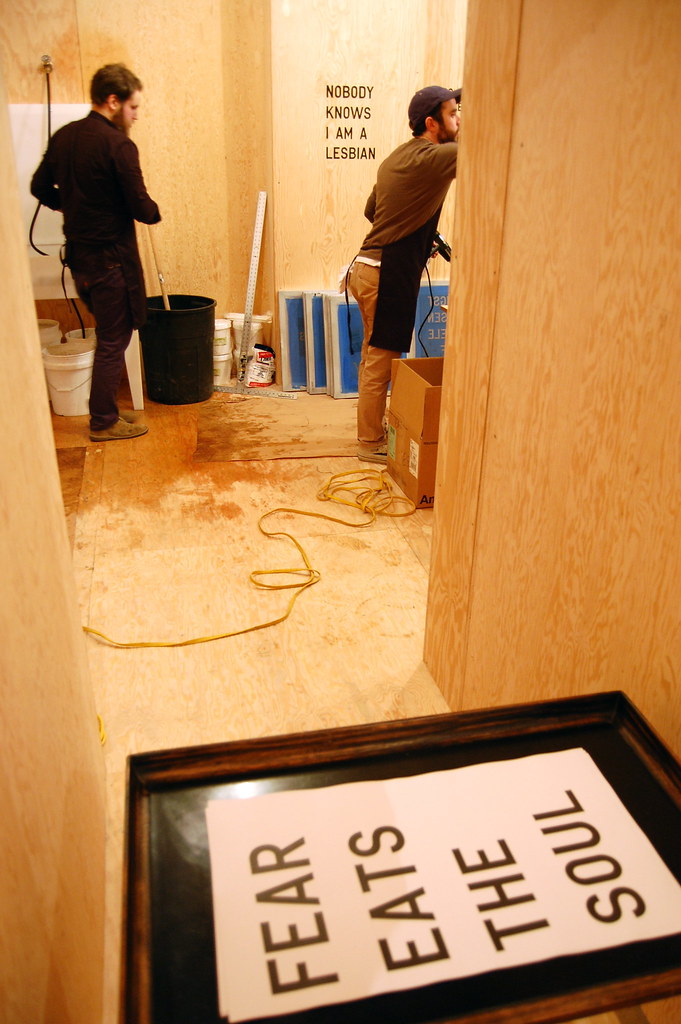
Installation views of Rirkrit Tiravanija, FEAR EATS THE SOUL, at Gavin Brown's enterprise, New York, March 5, 2011. Photos: 16 Miles [more]


The smell of leek soup wafted through the galleries. The crowd waited. What would be served?

"Whatever this is, it isn't relational aesthetics," a friend said to me in a giddy tone at the opening of Rirkrit Tiravanija's new show at Gavin Brown's enterprise on March 5. She was sipping warm soup — a hearty chicken base blessed with a trove of butter-soft leeks — from one hand and holding an ice-cold bottle of Rolling Rock in the other. Many of the few hundred other people gathered inside the cavernous gallery were doing the same, and the luckiest ones, who had arrived early, were finishing off hearty sandwiches, thick baguette slices filled with pulled pork and sweet pickles.


Cock-a-leekie soup cooking on the enterprise stove, sweet pickles at the ready. Tiravanija's weekly soup recipes are available at soupnosoup.com.

It has been more than two decades since Tiravanija first served food for free in an art gallery (at the Paula Allen Gallery in New York, which also offered Rolling Rock, because the gallerist happened to be able to get a discount on it) and roughly 15 years since French curator Nicolas Bourriaud coined the term relational aesthetics to categorize art practices like Tiravanija's. As my friend's comment indicated, Bourriaud's theory has come to seem quaint and outmoded since then. Artworks encompassed by — or, in the worst cases, designed to illustrate — the theory have proved boring, as Joe Scanlan has argued, and their supposed political efficacy has been disputed by art historian Claire Bishop in her 2004 essay "Antagonism and Relational Aesthetics."

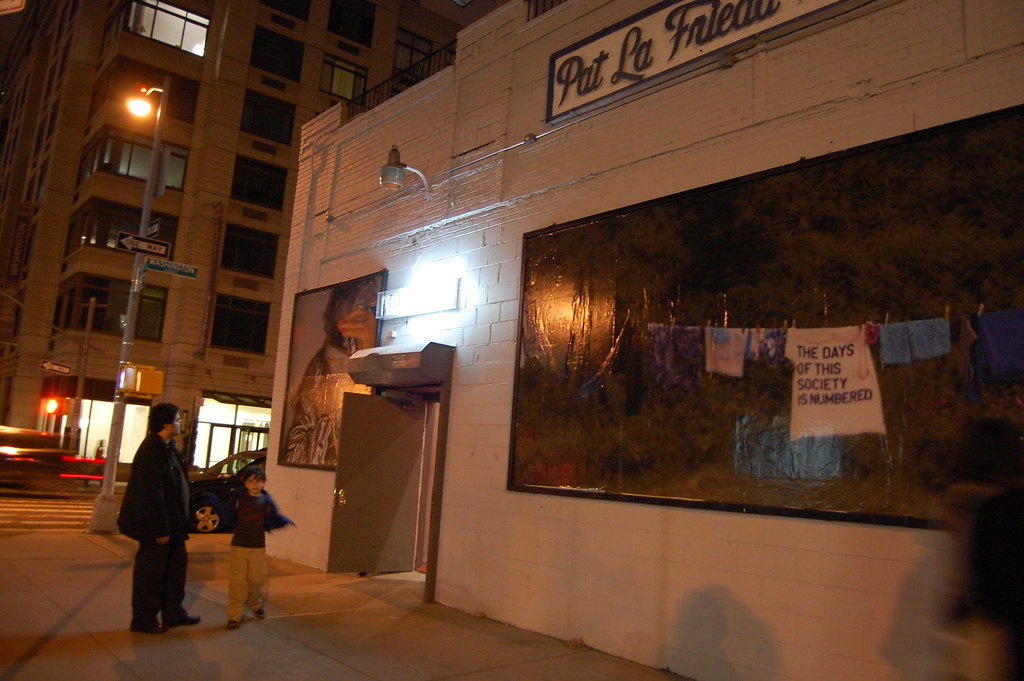
Nevertheless, there was an unmistakable thrill in the air on opening night. Tiravanija, sporting his trademark rose–colored glasses, wandered back and forth between the gallery and the kitchen, supervising the production of the soup, which was addictive and delicious. Each time he changed locations, he had to wander back out onto the street, since the doors from the kitchen to the gallery (and from the front reception area to the gallery) are walled off with thick cinder blocks. The exhibition space's doors and windows have been removed, leaving it completely open to the street. On the gallery walls, a message has been spray–painted in black: "FEAR EATS THE SOUL."


Meat, pickles, baguettes: the feast begins.


The transformed space looks like an abandoned warehouse, not so different from those that once existed along the Hudson River just a few years away, which Gordon Matta-Clark documented and detourned in the 1970s. Tiravanija has been more welcoming in past exhibitions, offering continuous access to a model of his East Village apartment at a 1999 exhibition at the enterprise (people are rumored to have had group sex there, Jerry Saltz reported later) and presenting a reconstruction of his home in Thailand for a 2009 show in Madrid. This time he has built a life-size replica of Brown's former gallery space on Broome Street and a fully operational T-shirt shop, in which employees screen shirts on-demand. The shirts are available in three sizes, printed with one of 24 different slogans (e.g. "NOBODY KNOWS I AM A LESBIAN" or "NO NO AMERICA"), for $20.


Tiravanija's T-shirt factory: 24 slogans available at $20 a pop

The shared "microtopian" communities that Bourriaud believed were created in Tiravanija's works, which Bishop characterizes in her essay as "feel-good" constructions, are perversely and joyfully parodied in "FEAR EATS THE SOUL." The only two enclosed, hospitable spaces, after all, are a model of a commercial art gallery and what amounts to a souvenir shop. The gallery may be open to the public 24 hours a day, but the only places you will want to spend time are where something is available for consumption. (The T-shirt shop and soup kitchen are open Thursday through Saturday, 10 am to 6 pm, through April 16.) There are other uncomfortable truths embedded in Tiravanija's practice, like the fact that the hearty bowl of soup arrives only due to the munificence of an established art dealer, and that those who actually need a bowl of soup will almost certainly not happen upon, or even hear about the exhibition, as Bishop has emphasized.

Tiravanija is surely aware of these issues, which give lend his works a fragile sense of existence dashed with melancholy, a feeling that is underscored by the sheer transience of the event: the reality that, while we can return to our favorite painting at the Met again and again for hours at a time, the few minutes shared with friends over a bowl of soup will happen only once, and then exist only as a memory. Tiravanija has organized a Trojan horse of an exhibition, an ostensibly celebratory meal that morphs into something darker, or at least sadder, once he gets you thinking.


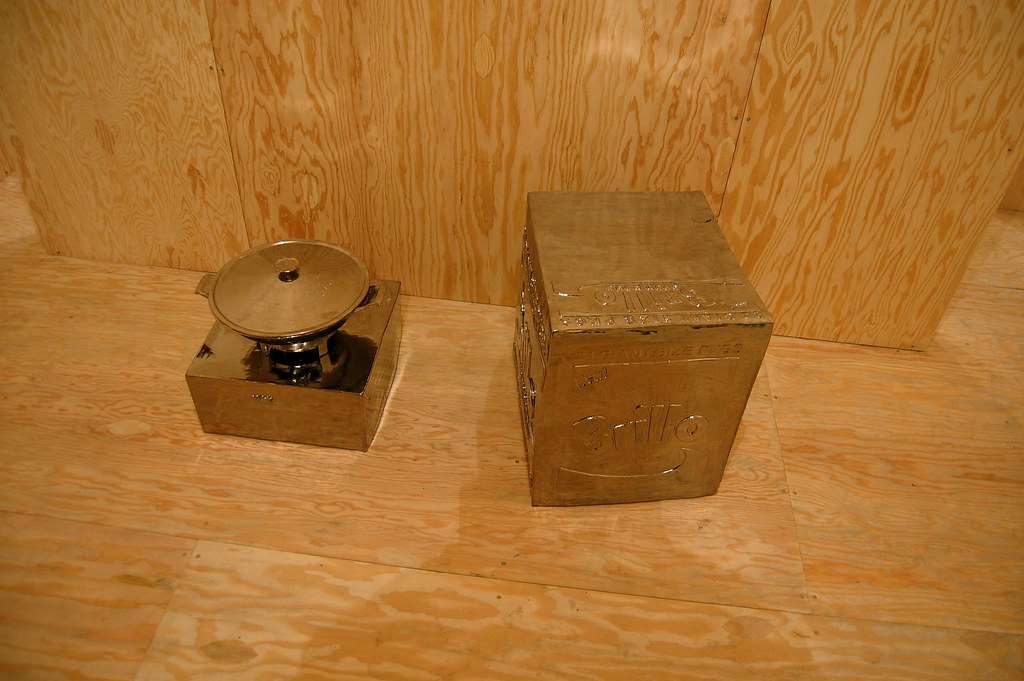
Outside the plywood T-shirt studio and art gallery, people gazed in at the chrome


The full neon sign, not legible here, reads "NOSOUP." Only the last four letters were illuminated once the soup started flowing.


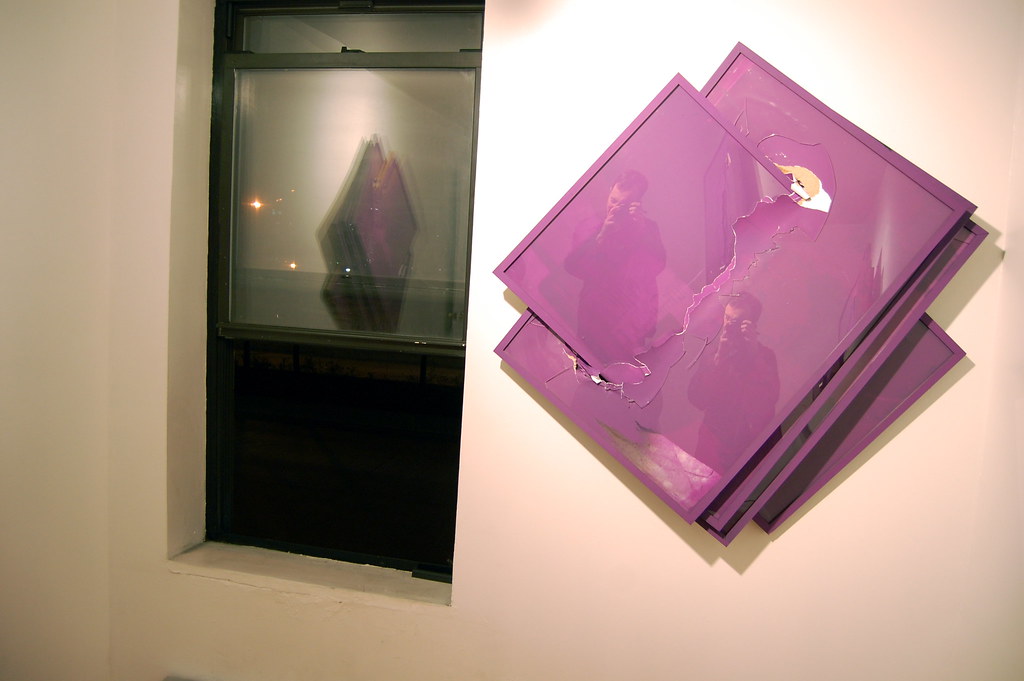
Brendan Fowler in the Spare Room at West Street Gallery

A few blocks away, Brendan Fowler unveiled new works from his already-classic frame-through-frame series in West Street Gallery's Spare Room. Instead of his typical subjects — concert posters and photographs — he's hung purple monochromes, and they are the best of the bunch.


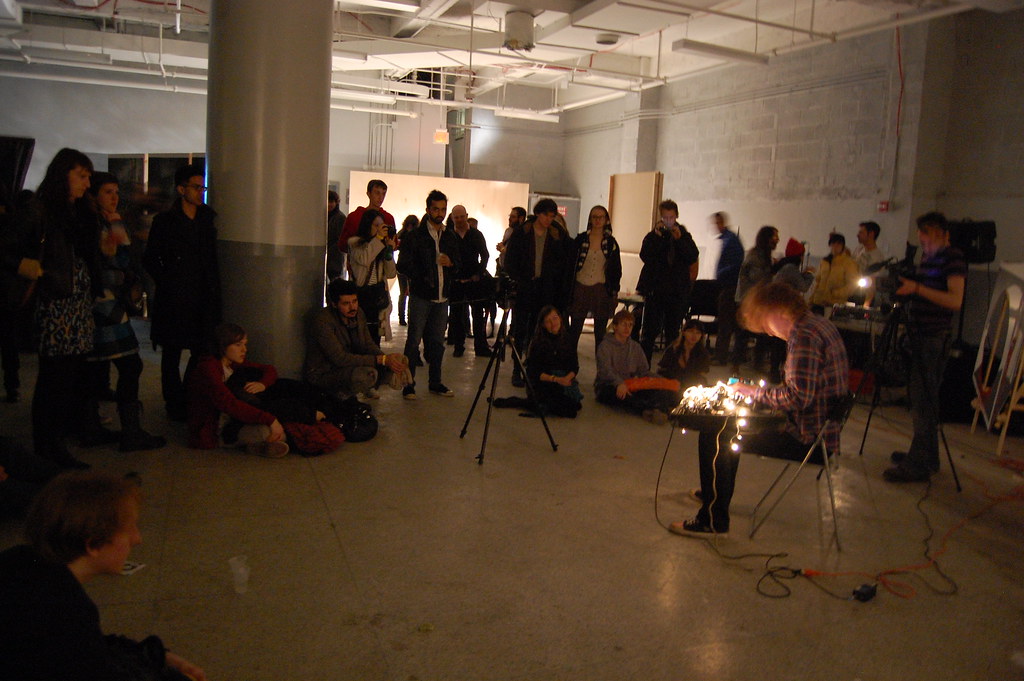
Dan Friel performing at the Calder Foundation's "Maybe I should have called it 'My Life in Nineteen Minutes,'" 74 Pine Street, New York, March 5, 2011. [more]

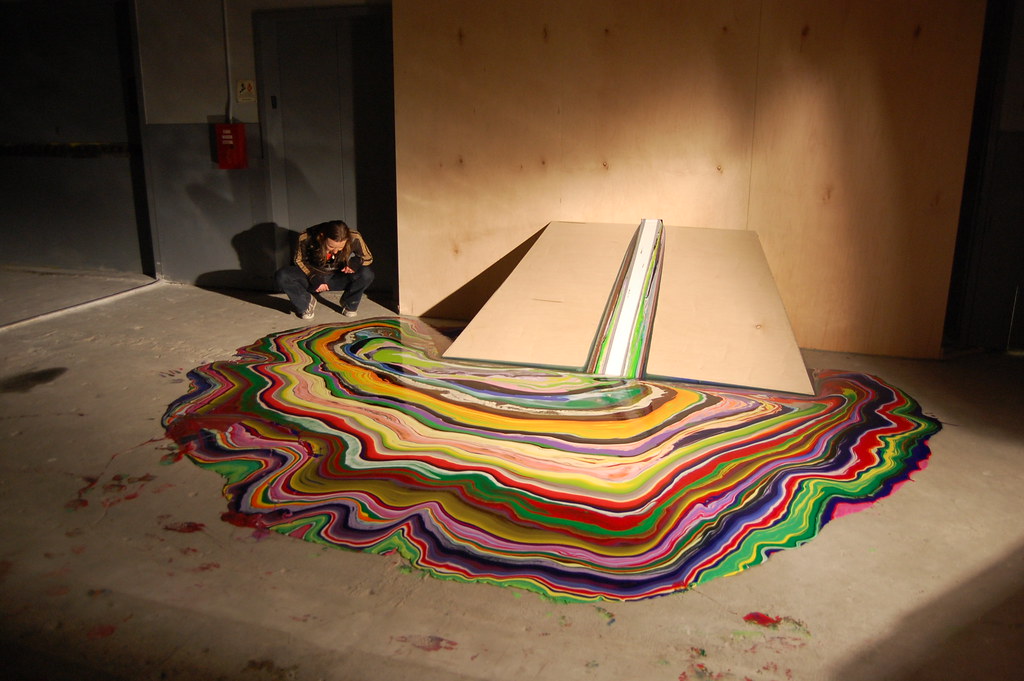
Later that evening, at 74 Pine Street, some visitors had the chance to see Courtney Love wandering around another abandoned warehouse space (she dashed past me as I entered), this one commandeered by the Calder Foundation for a 12-hour exhibition conceived by Victoria Brooks that was titled "Maybe I should have called it 'My Life in Nineteen Minutes,'" which featured a formidable lineup of performances and films, including works by Mika Tajima, Hans Richter, Yves Klein, Dara Birnbaum, and Calder. There were art objects, too, like a luscious Holton Rower floor piece, below — thin waves of paint piling up into a pitch-perfect mash-up of Jim Lambie and Lynda Benglis. Parts & Labor member Dan Friel was playing a solo set when I arrived, carefully leading a gigantic noise-orchestra — actually a large bank of controls perched on his lap — through a series of static–laced pop instrumentals.


Holton Rower, Pour 03052011, 2011, at the Calder Foundation's "Maybe I should have called it 'My Life in Nineteen Minutes,'" 74 Pine Street, New York, March 5, 2011. [more]


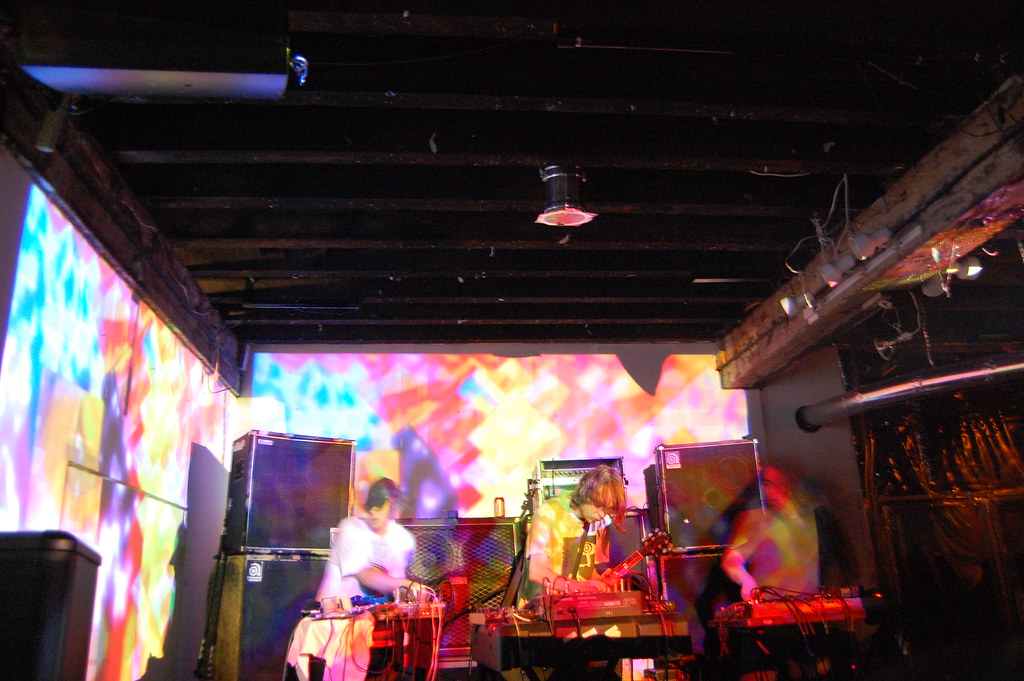
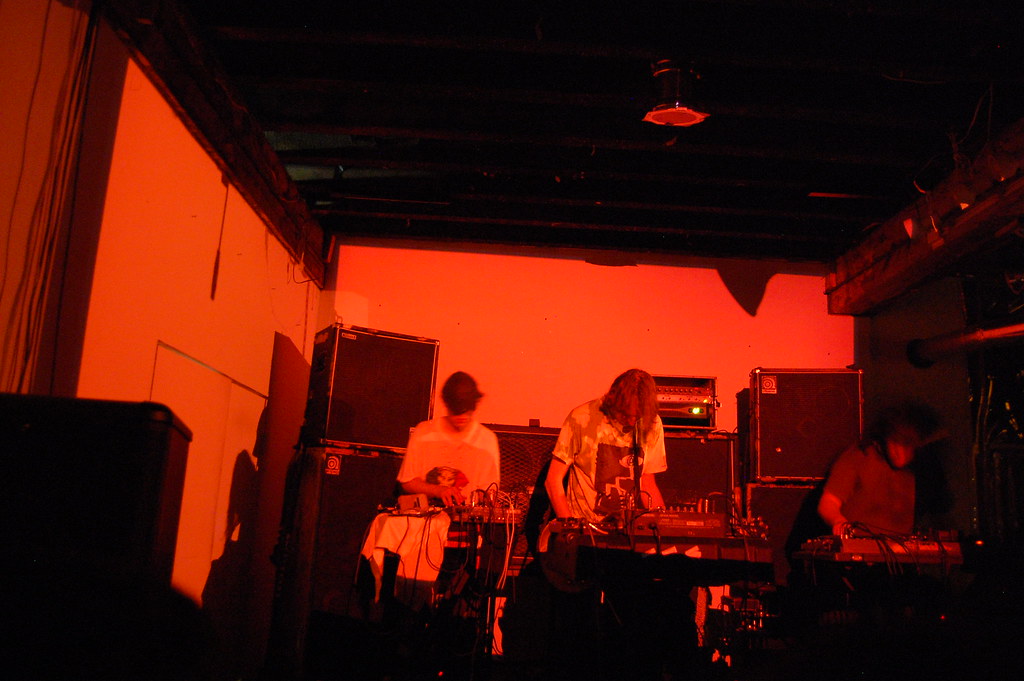
Black Dice performing as part of their residency at Secret Project Robot, Brooklyn, New York, morning of March 6, 2011.

Across the East River, at the performance space/gallery/residence Secret Project Robot in Williamsburg, Brooklyn, Black Dice concluded their week-long miniature residency with a barn-burner of a set that was even louder than Friel's cacophonous display had been an hour earlier. In 2002, curator Bob Nickas described the group as "the New York art world's favorite band at the moment." (Who holds that title now? Kalup Linzy and James Franco? Patti Smith?) The fickle crowd may have moved on to other bands in the past nine years, but the group has lost none of its brio, playing new, vaguely funky noise songs from behind their tables of equipment for a solid hour, as gorgeous abstract projections by Danny Perez spilled over them.

Wednesday, May 13, 2009

Contemporary Art in Madrid [Part 1 of 3: Around the Reina Sofía]


The House the Cat Built [installation view], at Galería Salvador Díaz. Photo: 16 miles [more]

Most contemporary art spaces in Madrid are clustered in a few main areas, packed fairly closely together in each.  We'll start today with some galleries located in the southern section of the city near the Reina Sofía. This isn't even close to an exhaustive guide (Artforum provides a thorough listing in their international section), but here are a few places we enjoyed.

Galería Salvador Díaz
Sanchez Bustillo, 7
I can’t even begin to imagine the economics of running a gallery across the plaza from the Reina Sofía, but Galeria Salvador Díaz has been doing that in a massive space for over a decade.  They predominantly show Spanish artists, but they also host some ambitious programs curated by outsiders.  We arrived to see a Rirkrit Tiravanija-organized show that featured some of the people you’d expect (Liam Gillick, Gabriel Kuri) and some surprises (Martha Rosler, Jakob Kolding) assembled in a plywood recreation of his home in Thailand.  


Shimabuku, Heart for Rirkrit, 2009, at Galería Salvador Díaz.   Photo: 16 miles [more]


The House the Cat Built [installation view], at Galería Salvador Díaz. Photo: 16 miles [more]


Angela Bulloch, Smoked, Formed, & Quartered, 2009, at Galería Helga de Alvear.  Photo: 16 Miles   [more]

Galería Helga de Alvear
Doctor Fourquet, 12
Housed in an elegant two-story space, Helga de Alvear usually does two shows at a time just down the street from the Reina Sofia.  Angela Bulloch and Jorge Queiroz were showing work when we visited, part of a group of about twenty-five largely well-established artists in their roster, including Elmgreen & Dragset, Isaac Julien, Imi Knoebel, and Santiago Sierra, who recently had his “Los penetrados” show here.


Outside La Casa Encendida.  Photo: 16 Miles. [more]

La Casa Encendida
Ronda Valencia, 2
The closest New York parallel to La Casa Encendida may be the Brooklyn Academy of Music. The selection of films, theatrical productions (housed in their massive, enclosed courtyard), and workshops that they run certainly seemed as impressive and varied as BAM’s.  In addition, they throw in a huge visual arts component.  There was a show of photographs depicting New York on loan from the Museum of Modern Art when we visited.  Do I want to travel two thousand miles to look at photographs from the museum I have probably spent more time in than any other?  Yes, when it’s accompanied by some of the best guides to individual artists I’ve ever seen in a museum.


Installing works by Antonio Ballester Moreno at Maisterravalbuena.  Photo: 16 Miles.

Maisterravalbuena
Doctor Fourquet, 1
On the way to Galería Helga de Alvear we strolled into Maisterravalbeuna as the staff was hard at work hanging paintings by Antonio Ballester Moreno (who has shown with Peres Projects) for his opening.  Only later did we learn that the wonderful Kate Gilmore is part of their eight-artist team.  Choice work.


CaixaForum Madrid. Photo: 16 Miles. [more]

CaixaForum Madrid
Paseo Prado, 36
Due to the magic of Spanish law, the country’s banking industry is non-profit, its earnings earmarked for public projects like lavish museums and epic exhibitions.  Hence the Herzog & de Meuron-designed CaixaForum Madrid, which is housed in an old, brick power plant.  The first floor has been sliced away and appears to float on a cube of glass.  Inside, there’s plenty of steel, wood, and more glass, as well as a bookstore with an impressive selection of art books.  It amounts to an umbilical cord of gold that seems to function relatively well. 


CaixaForum Madrid. Photo: 16 Miles. [more]

Wednesday, March 4, 2009

Kurimanzutto, Inaugural Exhibition [Review]


Dr. Lakra. Photo courtesy of citoyenmag; more photographs available.

[Part 2 of our ongoing feature on contemporary art in Mexico City]

In the interest of full disclosure, I should mention that the staff members at Kurimanzutto are among the nicest I have ever met inside an art gallery. We first visited them about a year ago when they were without a permanent spaces, showing work out of their offices in Condesa. Equipped with only an address and a recommendation, we buzzed a random number on the side of an apartment building, walked up the stairs, and were warmly shown around the apartment (our nonexistent Spanish completely excused). A Gabriel Orozco painting hung on one wall, a sign of their centrality in the Mexican contemporary art world.

The venue’s latest show inaugurates their new space in the San Miguel Chapultepec neighborhood, a quiet, largely residential area with a handful of auto repair shops along their block. On the location of a former timber yard, Kurimanzutto (the name is a portmanteau of its founders, José Kuri and Mónica Manzutto) has constructed a warehouse that is, in scale and design, equivalent to the largest, more luxurious Chelsea showrooms. It’s an apt setting for their ambitious roster of well-known Latin American and international artists (Damián Ortega, Daniel Guzmán, Monika Sosnowska, and Tiravanija, who continues to be everywhere).


Installation view of Kurimanzutto, Inaugural Exhibiton. Photo courtesy of B.G.D.

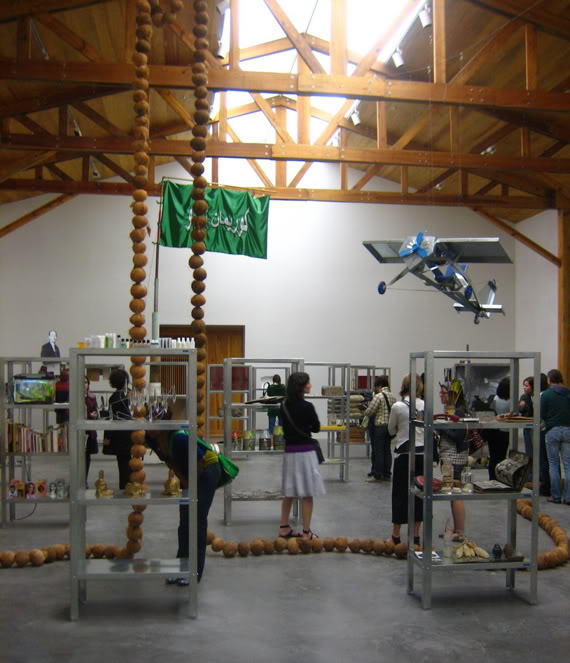
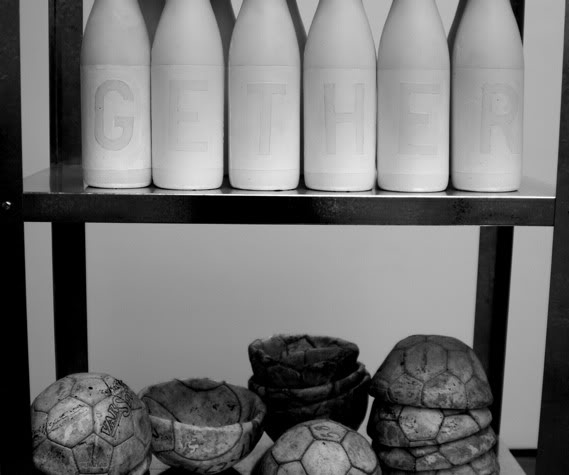
The conceit of the exhibition is to give each Kurimanzutto artist (and six guest artists, including Thomas Hirschhorn and Allora & Calzadilla) space on a series of metal bookshelves, letting them present to the public a selection of their work. The artist’s bookshelf, the press release argues, “… is confidant and witness of the working processes of its owner, neatly reflecting his/her interests, obsessions, references, and current ideas.” There is a lot of possibility in that and, perhaps not surprisingly, the quality of the work varies considerably.

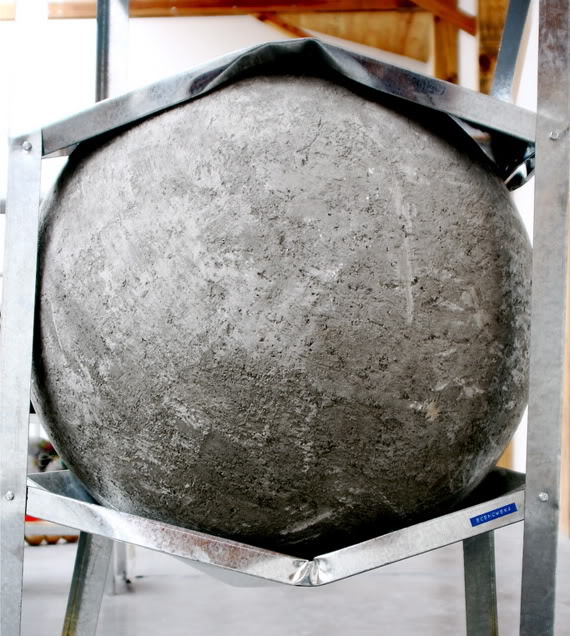
Most of the trademarks one would expect are here. Guzmán presents a skull sitting on a turntable, a summation of his twin interests that almost seems like caricature. Dr. Lakra has a series of his intricate drawings on paper, sculpture, and on top of vintage pinups, whom he’s delicately tattooed. They oscillate beautifully between irony and pure pleasure. First entering the gallery, I had no idea the metal shelves were supposed to represent artists’ bookshelves. They appeared to be simple, spare display cases for products, each artist rendered as a brand. Your détourned hair product boxes (Ortega) could be purchased from one shelf, your pinup photograph on another.


Rirkrit Tiravanija. Photo courtesy of citoyenmag.

This wasn’t quite a store, though. One shelf contained nothing but compact discs, Sosnowska had jammed a boulder between two others. No one was trying to ingratiate him or herself. (In fact, that generosity extended into the gallery's operations: the space was completely empty of employees when we visited, a show of trust that tends to be rare when tiny art pieces are sitting around.) Placing all their work on tiny, spare shelves, Kurimanzutto and the twenty-two artists invite a real critique of the quality of their practice. Ignore the fancy new surroundings, they seem to say: we don’t need charisma to succeed. They’re right.


Monika Sosnowska. Photo courtesy of citoyenmag.

Inaugural Exhibiton
Kurimanzutto
Gob. Rafael Rebollar 94, Col. San Miguel Chapultepec, Mexico City
Through March 21, 2009

Thursday, January 29, 2009

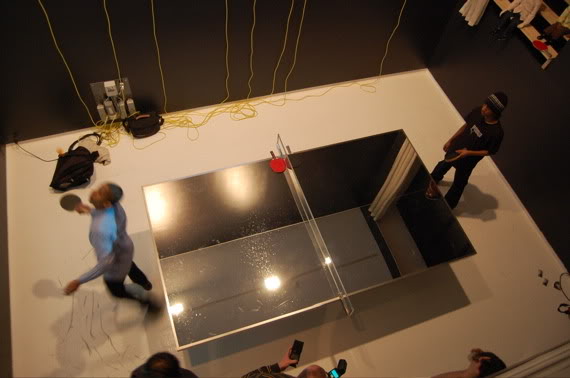
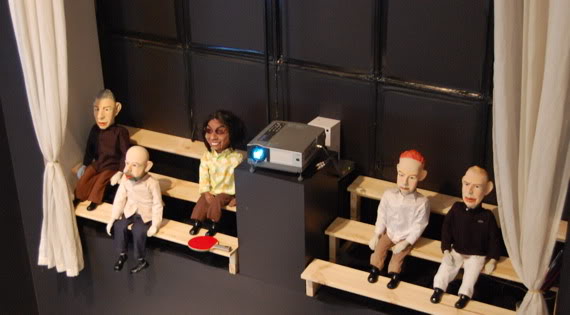
Rirkrit Tiravanija, Reflection, at NYEHAUS: Steel Ping Pong Tables and Burning Candles


Rirkrit Tiravanija, Untitled, 2005.  


Rirkrit Tiravanija, Untitled (The Future will be Chrome) (Ping Pong Ball Table), 2008.


Rirkrit Tiravanija and Philippe Parreno, Untitled, 2005.


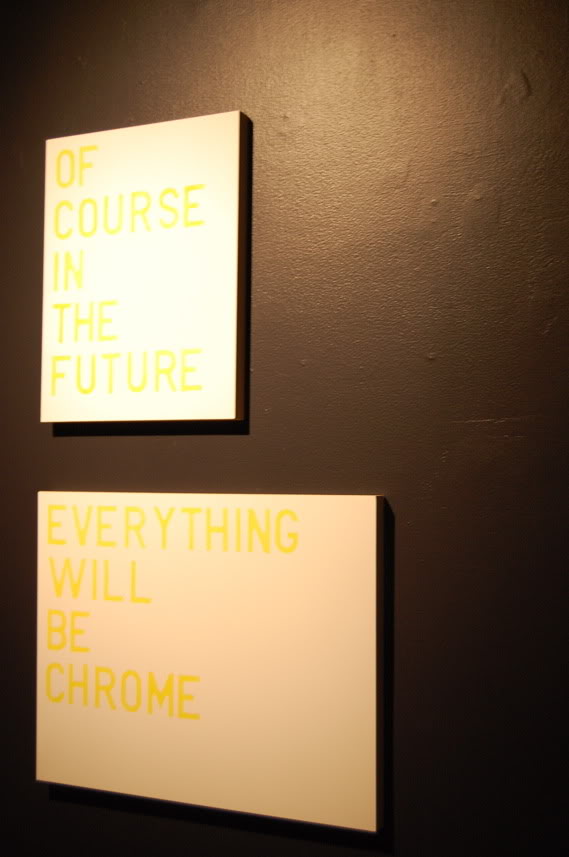
Rirkrit Tiravanija, Untitled (Of Course in the Future Everything will be Chrome), 2003.

Tuesday, May 27, 2008

Hans Haacke, Cultural Production, and Tishman Speyer in Stuyvesant Town

The previous quarter's issue of October addressed the question "In what ways have artists, academics, and cultural institutions responded to the U.S.-led invasion and occupation of Iraq?" to a series of thinkers.  The variety of answers is pretty remarkable.  Hans Haacke, in one of the more straightforward answers offered in response, discussed the Peace Tower of Mark di Suvero and Rirkrit Tiravanija at the 2006 Whitney Bienniel and some of the work at the Storr-curated 2007 Venice Biennale before concluding:


Cultural production should indeed be a "socially and politically communicative, transgressive, or critical activity." It requires professionalism of the highest level.

Haacke's most recent show was at Paula Cooper at the beginning of this year. It featured some recent work and one of his best older pieces, Sol Goldman and Alex DiLorenzo Manhattan Real Estate Holdings, which looks more terrifyingly prescient each day and lives up to the polemic he wrote for October. 

The New York Times is reporting today that Tishman Speyer has been using a private investigations service and three law firms to find residents in Stuyvesant Town, who are breaking the terms of their rent-stabilized leases, falsely accusing a large percentage of them in the process. In effect, they're reversing the direction of the research that Hans Haacke completed on Manhattan real estate in the 1970's - which famously led him into a showdown with the Guggenheim in 1971 (of which Sol Goldman... is a part).  Tishman Speyer's behavior in Stuyvesant Town is, of course, just one part of a much larger picture, and - I'm more pessimistic than Haacke (and Chomsky, apparently) - it's troubling to survey the lack of any sort of critical resistance within the American (or international) academy or art world on foreign and domestic issues in this election year.


Works cited: Hans Haacke, "[Untitled Response]," October 123 (Winter 2008), p.82
Photo: Paula Cooper Gallery

Sunday, April 6, 2008

Eduardo Sarabia's Bar Aleman at the Whitney Biennial

Photographs by Lauren K.


With Nicolas Bourriaud's notion of "relational aesthetics" now being embraced by curators at major museums thirteen years after its formulation, it was perhaps inevitable that visitors to the 2008 Whitney Biennial would be greeted with quite a few social events presented as art: among them, an interactive music performance (Lucky Dragons), an artist-curated dinner party (Rita Ackermann & Agathe Snow), a slumber party (DJ Olive), and a series of dance marathons (Agathe Snow, again).


Among these, though, none was probably more warmly received - and rightfully so - than Eduardo Sarabia's drinking establishment Bar Aleman. For a series of three nights Sarbaia served his homemade tequilas (available in three varieties) atop his ceramic and rosewood bar at the Park Avenue Armory. The night I was there (March 14, the final evening), my friends and I were served the delicious, smooth tequila by his friends, while he provided jams from a set of turntables. People were (pleasantly) packed into one of the main floor rooms, dancing as gigantic stuffed moose and oil portraits of long-passed general stared down on us.

There's not necessarily anything radically new here; contemporary artists have, of course, been playing the role of restauranteur and club promoter for some time now. Three examples: Gordon Matta-Clark running the pioneering SoHo establishment Food in the early 70's, Damien Hirst providing the decor and conceptual underpinnings for London's Pharmacy in the late 90's, Rirkrit Tiravanija opening a Thai food stand in New York's 303 Gallery in 1996. Matta-Clark and Hirst were establishing legitimate businesses (even if it's doubtful that Food ever pulled much of a profit), while Tiravanija was aiming for the opening of some sort of utopian framework for interaction within the gallery.


Sarabia's twist on the game is a lot more fun: three nights, some extra money via the Art Production Fund for full liquor licenses, and a massive sound system. It might be an allegory for the post-millennial art market (Though Sarabia claims his pure tequila leaves no hangover! No comment on that.) or a commentary on first-third world relations filtered through a meditation on agave production (as the Whitney's curators would somewhat bizarrely prefer you have it), but at its core it seems like an attempt to subvert the museum's standard operation, if only for a few moments. In place of the institution's bourgeois obsession with conservation, one experiences unrestrained expenditure, a give away (destruction) not unlike the potlatch ritual.

Art costs money, and Sarabia - to everyone's obvious delight - chooses to burn both in the service of a party. In one sense, it's an immense celebration of a change in status (a common occasion for the potlatch): he's made it into the Biennial. But Georges Bataille has noted that the potlatch is not purely celebratory: it also contains an inherent provocation, "... constituted by a considerable gift of riches, offered openly and with the goal of humiliating, defying, and obligating a rival." In other words, Bar Aleman, proffering endless glasses of tequila and blasting dance music, positions itself apart from Tiravanija's (and the Whitney's) purported desire for democratic discourse. In its place, it posits two things better-aligned with the moment: pure revelry and a bold challenge.