Showing posts with label Relational Aesthetics. Show all posts

Monday, January 5, 2009

Corin Hewitt at the Whitney Museum of American Art [Review]


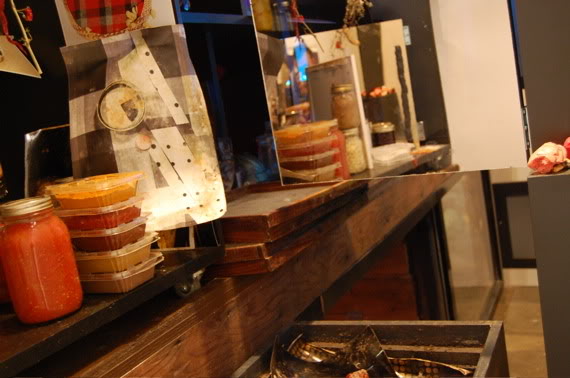
Corin Hewitt, Seed Stage [installation view], 2008-2009.

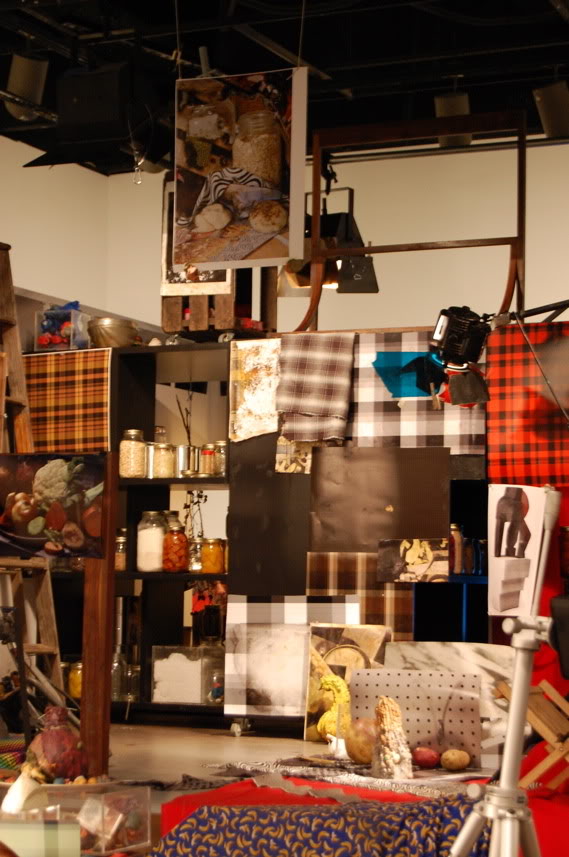
Corin Hewitt's residency inside his Seed Stage installation at the Whitney ended yesterday. Hewitt's project involved "cooking, sculpting, heating and cooling, casting, canning, eating, and photographing both organic and inorganic materials," as the press release elegantly put it.

Standing on the first floor of the museum, the space smelled even more delicious than normal. (The Whitney's restaurant, Sarabeth's, is right underneath the floor there.)  An artist and food in a gallery space immediately recalls Tiravanija and Sarabia, but there's nothing relational or service-oriented here.

Housed inside four white walls with openings at each corner (only two of which allowed you fully to see Hewitt at work), the work suggested a two-way Étant donnés. The viewer's ability to see the art production was continually frustrated by the limited viewing spaces and lines of sight.  How long was it acceptable to block the viewing area and stare at the artist?  Sustained voyeurism became slightly uncomfortable, though I may just be more uptight than most.

The Whitney should do more of these brief projects: visitors seemed to be enjoying it and the web site for the show is pure class, containing quite a few of Hewitt's still-life photographs along with other documentation.  Taxter & Spengemann wins again.

Two more installation photographs: Photo 3     Photo 4 [featuring Hewitt]


Corin Hewitt, Seed Stage [installation view], 2008-2009.

Monday, December 29, 2008

The Exclusionary Aesthetics of Claes Oldenburg's Store


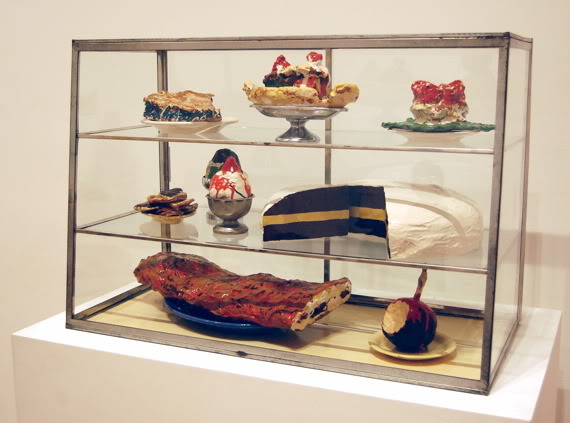
Claes Oldenburg, Pastry Case, I, 1961-62, painted plaster sculptures on ceramic plates, metal platter and cups in glass-and-metal case, 52.7 x 76.5 x 37.3 cm, at the Museum of Modern Art, New York.

It was wonderful to stumble upon pieces of Claes Oldenburg's Store at MoMA recently, not only because his food sculptures are still so hilarious, delicious, and good (which they are, besides being suddenly fashionable: they also seem to have informed Nathalie Djurberg's latest work at Zach Feuer, which I wrote about earlier this week) but also, as theanyspacewhatever show closes at the Guggenheim, his work is looking increasingly prescient. 

Discussing his December 1961 - January 1962 project (in which he opened up a storefront on the Lower East Side selling his food sculptures to visitors) with Harvard professor Benjamin Buchloh in 1985, Oldenburg seems to anticipate some of the language regarding production that would surround Bourriaud's relational aesthetics in the 1990's:
Benjamin Buchloh: The Store was meant to function potentially like a store. People from the street were allowed to come in, weren't they?
Claes Oldenburg: Yes, they were. But realistically speaking, it was stacked against that because people in that neighborhood just aren't going to come in when they see something as strange as this. If people came in from the street, it was kids, or just curious people. I would see them at the window-they'd look in, but nobody would come in.
Buchloh: So it was more conceived as a private studio that could be open on certain occasions to art world people and friends.
Oldenburg: It was open-anybody could come in at any time-and I worked there more or less in view of the people who looked in. Even at night I would be visible.
Buchloh: But wasn't there an inherent assault on esoteric qualities of high art, in every aspect of The Store?
Oldenburg: Yes, but I think it was a matter of two things. One thing was to admit the commercial nature of art production by comparing it to ordinary production...
Oldenburg, in other words, was attempting to highlight the essentially "commercial nature of art production", while still taking part in it.  Relational aesthetics, the argument goes, attempts to escape the enterprise entirely, proffering participatory, ephemeral events in place of such naked commerce: cooking Thai food for visitors, most famously.  

Claire Bishop has argued, though, that the promise of relational aesthetics is largely illusory, cloaking the financial underpinnings of art with feel-good rhetoric about democracy and participation, serving it up to a self-selective, elite group.  

Even back in the 1960's, Oldenburg seems to have realized this inherent contradiction, the false, hermetic radicalism of such a project, proposing a counterpoint to the artists of the 1990's thirty years in advance.  Even in his project, which hardly attempted any of the participatory gestures undertaken by Tiravanija or Gillick, his audience was limited: "...[P]eople in that neighborhood just aren't going to come in when they see something as strange as this," he writes.  In doing so, he would presage a point that Jerry Saltz would make in 1996 on viewing Tiravanija's work, which Bishop quotes:

“... [T]heoretically anyone can come in [to an art gallery]. How come they don’t? Somehow the art world seems to secrete an invisible enzyme that repels outsiders. What would happen if the next time Tiravanija set up a kitchen in an art gallery, a bunch of homeless people turned up daily for lunch? What would the Walker Art Center do if a certain homeless man scraped up the price of admission to the museum, and chose to sleep on Tiravanija’s cot all day, every day?"
Works Cited
Claire Bishop, "Antagonism and Relational Aesthetics," October 110 (Fall 2004), p. 51-79.

Benjamin Buchloh, "Three Conversations in 1985: Claes Oldenburg, Andy Warhol, Robert Morris," October 70 (Fall 1994), p. 33-54.

Sunday, December 14, 2008

[Top 10 of 2008] #9 - The Whitney Biennial at the Park Avenue Armory

If this was the year that relational aesthetics formally entered art’s leading institutions and their canon, it was the Biennial at the Park Avenue Armory that did it best. Lucky Dragons (Dan Fishback) won the show, bringing videos, a laptop, and electronic sensors to the floor of the massive chamber and allowing audience members to guide the music by holding hands or wielding rocks. Three other highlights: Visitors slept over (with DJ Olive), got drunk (with Eduardo Sarabia), and underwent psychoanalysis (with Bert Rodriguez).

Sunday, April 6, 2008

Eduardo Sarabia's Bar Aleman at the Whitney Biennial

Photographs by Lauren K.


With Nicolas Bourriaud's notion of "relational aesthetics" now being embraced by curators at major museums thirteen years after its formulation, it was perhaps inevitable that visitors to the 2008 Whitney Biennial would be greeted with quite a few social events presented as art: among them, an interactive music performance (Lucky Dragons), an artist-curated dinner party (Rita Ackermann & Agathe Snow), a slumber party (DJ Olive), and a series of dance marathons (Agathe Snow, again).


Among these, though, none was probably more warmly received - and rightfully so - than Eduardo Sarabia's drinking establishment Bar Aleman. For a series of three nights Sarbaia served his homemade tequilas (available in three varieties) atop his ceramic and rosewood bar at the Park Avenue Armory. The night I was there (March 14, the final evening), my friends and I were served the delicious, smooth tequila by his friends, while he provided jams from a set of turntables. People were (pleasantly) packed into one of the main floor rooms, dancing as gigantic stuffed moose and oil portraits of long-passed general stared down on us.

There's not necessarily anything radically new here; contemporary artists have, of course, been playing the role of restauranteur and club promoter for some time now. Three examples: Gordon Matta-Clark running the pioneering SoHo establishment Food in the early 70's, Damien Hirst providing the decor and conceptual underpinnings for London's Pharmacy in the late 90's, Rirkrit Tiravanija opening a Thai food stand in New York's 303 Gallery in 1996. Matta-Clark and Hirst were establishing legitimate businesses (even if it's doubtful that Food ever pulled much of a profit), while Tiravanija was aiming for the opening of some sort of utopian framework for interaction within the gallery.


Sarabia's twist on the game is a lot more fun: three nights, some extra money via the Art Production Fund for full liquor licenses, and a massive sound system. It might be an allegory for the post-millennial art market (Though Sarabia claims his pure tequila leaves no hangover! No comment on that.) or a commentary on first-third world relations filtered through a meditation on agave production (as the Whitney's curators would somewhat bizarrely prefer you have it), but at its core it seems like an attempt to subvert the museum's standard operation, if only for a few moments. In place of the institution's bourgeois obsession with conservation, one experiences unrestrained expenditure, a give away (destruction) not unlike the potlatch ritual.

Art costs money, and Sarabia - to everyone's obvious delight - chooses to burn both in the service of a party. In one sense, it's an immense celebration of a change in status (a common occasion for the potlatch): he's made it into the Biennial. But Georges Bataille has noted that the potlatch is not purely celebratory: it also contains an inherent provocation, "... constituted by a considerable gift of riches, offered openly and with the goal of humiliating, defying, and obligating a rival." In other words, Bar Aleman, proffering endless glasses of tequila and blasting dance music, positions itself apart from Tiravanija's (and the Whitney's) purported desire for democratic discourse. In its place, it posits two things better-aligned with the moment: pure revelry and a bold challenge.