Showing posts with label Oldenburg. Show all posts

Wednesday, March 23, 2011

A Surprise Steinbach, Michael E. Smith's Sublimity, Lucy Lippard, etc. [Collected]


Installation view of Haim Steinbach's Mothers, Daughters, Children (with 37 Stories About Leaving Home by Shelly Silver), 1997-2011. Metal shelving, sand, wood and metal tables, wood and metal chairs, LCD TV, galvanized bucket, and latex balloon, dimensions variable. In "Entertainment" at Greene Naftali, New York, March 3, 2011.Photos: 16 Miles [more]
  • "His first exhibition was with André Breton ... and his last years were spent with Keith Haring and George Condo," curator Laura Hoptman says of "idea machine" Brion Gysin in a conversation with Marina Cashdan in a new La Revue Blanche-inspired publication. [The White Review]
  • "We can't help but be impressed by the three shows produced thus far by the former Citibank art advisor and freelance curator Jeffrey Deitch in his closely watched new space on Grand Street," John Good writes in "Nari Ward at Jeffrey Deitch Projects," an Artnet review published in 1996. [Artnet via Edward Winkleman]

  • Four hours at the Armory. "You can drink champagne from nine in the morning until four at night," says one gentleman. Adds a lady, "The contemporary is very fresh, very alive." [Paper Monument]

  • Chris Sharp on Michael E. Smith's recent exhibition at Clifton Benevento, one of my favorite shows of past last year: "It seemed as if the entire exhibition had issued from some defunct civilization whose resources had been entirely exhausted, and the artist, sifting through the rubble, had taken it upon himself to experimentally explore potential alternative resources. [K A L E I D O S C O P E]

  • William Powhida, An Incomplete and Biased Guide to Some Critics, 2011. [Hyperallergic]

  • Paddy Johnson points out that the two artists who took Gavin Brown's car for a spin, mistaking it for part of Rirkrit Tiravanija's current show at GBE, do not seem to have been too apologetic about the mistake. Writes Johnson, "... I’d make sure my apology was front and center..." [Art Fag City]

  • Greg Allen reads Richard Prince's deposition from Cariou v. Prince, which stems from his 2008 "Canal Zone" show at Gagosian. In it, the artist mentions to Cariou's lawyer that he gave a copy of Spiritual America IV (2005) to Brooke Shields because "I'm a, you know, agreeable guy." [Greg.org]

  • Here is a really nice style guide from the Association of Arts Editors. Dropping articles in titles to preserve syntax still terrifies me, but I'm going to do it in the item below. [AAE Style Guide via Image Conscious]

  • In case you haven't heard, which is doubtful: Tyler Green's Art Madness has begun. I'm voting frequently for Claes Oldenburg's Store (1961), which is seeded number 39. [Modern Art Notes]

  • Lucy Lippard is presenting a lecture on the evening of Thursday, April 7, at the School of Visual Arts. Its title is "Ghosts, the Daily News and Prophecy: Critical Landscape Photography." [SVA]

Monday, August 2, 2010

Eleven Sculptures in the Minneapolis Sculpture Garden


Claes Oldenburg and Coosje van Bruggen, Spoonbridge and Cherry, 1985-1988. Photos: 16 Miles [more]

Until this weekend I had not been in Minneapolis in the summer for almost a decade. The Minneapolis Sculpture Garden and its restored Spoonbridge and Cherry look quite a bit different in July than it does in December, when I normally visit. (It is right across the street from the Walker Art Center and well worth a visit.)


Martin Puryear, Ampersand, 1987-1988. Granite, 167 x 36 x 38 in. and 163 x 36 x 36 in.


Sol LeWitt, X with Columns, 1996. Cinder block, concrete, 168 x 312 x 312 in.


Frank Gehry, Standing Glass Fish, 1986. Wood, glass, steel, silicone, Plexiglas, rubber, 264 x 168 x 102 in.


Jackie Winsor, Paul Walter's Piece, 1975. Copper, creosoted wood, 24 x 32 x 32 in.


The Walker also owns a video by Jackie Winsor and Liza Béar documenting the creation of Paul Walter's Piece, 1975.


Alexander Calder, The Spinner, 1966. Aluminum, steel, paint, 235 x 351 x 351 in.


Mark di Suvero, Arikidea, 1977-1982. Cor-Ten steel, steel, wood, 316 1/2 x 510 x 450 in.


Visitors can ride on the small platform that is attached to the sculpture: an interactive Mark di Suvero! Said di Suvero, "Wouldn't a rusty brown spider standing on a bed of fresh snow be great to behold?"


Dan Graham, Two-way Mirror Punched Steel Hedge Labyrinth, 1994-1996.


Jackie Ferrara, Belvedere, 1988. Cedar, 126 x 506 x 407 in.


George Segal, Walking Man, 1988. Bronze, 72 x 36 x 30 in.


Detail view of Jenny Holzer, Selections From the Living Series, 1989. Granite, 28 elements: 17 1/4 x 36 x 18 in. each.


Installation view of Jenny Holzer, Selections From the Living Series, 1989.


Siouxland cottonwood tree and basalt stone


"The planting of seven thousand oak trees is thus only a symbolic beginning. And such a symbolic beginning requires a marker, in this instance a basalt column. The intention of such a tree-planting event is to point up the transformation of all of life, of society, and of the whole ecological system..."

— Joseph Beuys

More trees inspired by Joseph Beuys' 7,000 Eichen ("7,000 Oaks"), originally conceived for Kassel, Germany, are on view, thanks to Dia, on 22nd Street in Chelsea.

Monday, August 3, 2009

Remembering Tony Rosenthal, Remembering "Sculpture in Environment"

A very grainy image from the Times of Claes Oldenburg working on Hole on October 1, 1967.

The sculptor Tony Rosenthal, responsible for the much-loved spinning cube
Alamo at Astor Place in New York, passed away on Tuesday. As is often the case with Times obituaries, there was a gem hiding inside: Alamo was supposed to remain at its current home for the month of October 1967, but neighborhood residents petitioned to keep the sculpture, and they got it.

Alamo had been installed as part of the Sculpture in Environment exhibition run by Samuel Adams Green and the New York City Office of Cultural Affairs, which placed twenty-five works around the city by well-known names like Alexander Calder, Barnett Newman, and David Smith (whose Zig IV, installed at Lincoln Center, is the only piece still in its original location) and some less-remembered names like Preston McClanahan and Richard Stankiewicz.

Seven years before Creative Time and a decade before the Public Art Fund, New York's city government was tackling some fairly radical art and organizing what Hilton Kramer declared was "probably the most extensive temporary display of new sculpture ever sponsored by a municipality." Olafur Eliasson's New York City Waterfalls, PLOT09, Chicago's Cow Parade, and every other public art event all owe some bit of their success to Sculpture in Environment.

Triangle with Ears, 1966. One of the two Calder sculptures shown in Harlem.

Each artist was allowed to pick their place in and contribution to the show. Alexander Calder picked Harlem, showing two sculptures outside the Lenox Terrace Apartments at 10 West 135th Street. "It's just that I feel sympathy for the Negro, and would like to make a gesture of friendship, if they would accept it," he told the Times, offering to donate his works to the Harlem community. (The artists included were almost uniformly white males, excepting Louise Nevelson, further complicating his wince-inducing - but certainly well-intentioned - remark.)

After being told by Green that he would not be allowed to create a traffic jam, declare New York a sculpture, create a free food machine, play a recurring, recorded scream, or craft a whimsical "silly subway" as his contribution to the show, Claes Oldenburg decided to dig a 6 x 6 x 3 foot ditch northwest of Cleopatra's Needle, just behind the Metropolitan Museum of Art. Aided by two gravediggers he paid $50 (working well before Chris Burden and Urs Fischer), Oldenburg excavated the ground and proceeded to refill it. Suzaan Boettger published a brilliant summary and analysis of the event in Artforum.


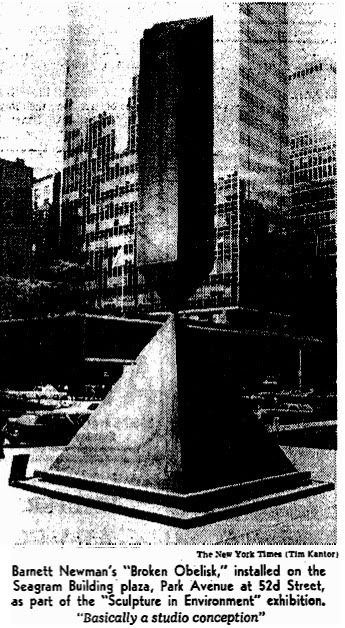
Broken Obelisk, 1963, in the Times. Hilton Kramer, generally displeased, provided the quotation.

Along with Calder, there were other more traditional sculptures. Barnett Newman's Broken Obelisk, 1963, for example, showed up outside the Seagram Building, just a few blocks from the Museum of Modern Art new atrium, which it would inaugurate in 2004. Hilton Kramer was harsh in his appraisal of the affair, noting that Green had been "thoroughly democratic in choosing good and bad sculptors alike." "Much of the work," he wrote, "violates rather than adorns the urban environment," establishing the line of critique on which shows of public art are largely judged up to this day.

Thursday, June 18, 2009

Lost Art of New York Map [Last Update: March 17, 2020]


View complete list and larger map.

Where was Claes Oldenburg's Store located? Where did Duchamp patrons the Arensbergs live? Where did Gordon Matta-Clark shoot his Day's End film in 1975? 107 East 2nd Street. 33 West 67th Street. Pier 52, west of Gansevoort Street. The newest addition to our site will be a continuously updated, unending project, documenting the sites of performances, studios, public art installations, residences, and galleries that once existed in New York and now do not.

E-mail if you have additional locations. We'll be doing at least one major update to the map each week.

Monday, December 29, 2008

The Exclusionary Aesthetics of Claes Oldenburg's Store


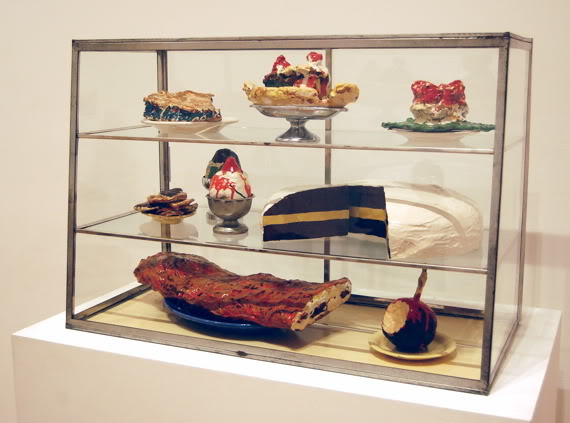
Claes Oldenburg, Pastry Case, I, 1961-62, painted plaster sculptures on ceramic plates, metal platter and cups in glass-and-metal case, 52.7 x 76.5 x 37.3 cm, at the Museum of Modern Art, New York.

It was wonderful to stumble upon pieces of Claes Oldenburg's Store at MoMA recently, not only because his food sculptures are still so hilarious, delicious, and good (which they are, besides being suddenly fashionable: they also seem to have informed Nathalie Djurberg's latest work at Zach Feuer, which I wrote about earlier this week) but also, as theanyspacewhatever show closes at the Guggenheim, his work is looking increasingly prescient. 

Discussing his December 1961 - January 1962 project (in which he opened up a storefront on the Lower East Side selling his food sculptures to visitors) with Harvard professor Benjamin Buchloh in 1985, Oldenburg seems to anticipate some of the language regarding production that would surround Bourriaud's relational aesthetics in the 1990's:
Benjamin Buchloh: The Store was meant to function potentially like a store. People from the street were allowed to come in, weren't they?
Claes Oldenburg: Yes, they were. But realistically speaking, it was stacked against that because people in that neighborhood just aren't going to come in when they see something as strange as this. If people came in from the street, it was kids, or just curious people. I would see them at the window-they'd look in, but nobody would come in.
Buchloh: So it was more conceived as a private studio that could be open on certain occasions to art world people and friends.
Oldenburg: It was open-anybody could come in at any time-and I worked there more or less in view of the people who looked in. Even at night I would be visible.
Buchloh: But wasn't there an inherent assault on esoteric qualities of high art, in every aspect of The Store?
Oldenburg: Yes, but I think it was a matter of two things. One thing was to admit the commercial nature of art production by comparing it to ordinary production...
Oldenburg, in other words, was attempting to highlight the essentially "commercial nature of art production", while still taking part in it.  Relational aesthetics, the argument goes, attempts to escape the enterprise entirely, proffering participatory, ephemeral events in place of such naked commerce: cooking Thai food for visitors, most famously.  

Claire Bishop has argued, though, that the promise of relational aesthetics is largely illusory, cloaking the financial underpinnings of art with feel-good rhetoric about democracy and participation, serving it up to a self-selective, elite group.  

Even back in the 1960's, Oldenburg seems to have realized this inherent contradiction, the false, hermetic radicalism of such a project, proposing a counterpoint to the artists of the 1990's thirty years in advance.  Even in his project, which hardly attempted any of the participatory gestures undertaken by Tiravanija or Gillick, his audience was limited: "...[P]eople in that neighborhood just aren't going to come in when they see something as strange as this," he writes.  In doing so, he would presage a point that Jerry Saltz would make in 1996 on viewing Tiravanija's work, which Bishop quotes:

“... [T]heoretically anyone can come in [to an art gallery]. How come they don’t? Somehow the art world seems to secrete an invisible enzyme that repels outsiders. What would happen if the next time Tiravanija set up a kitchen in an art gallery, a bunch of homeless people turned up daily for lunch? What would the Walker Art Center do if a certain homeless man scraped up the price of admission to the museum, and chose to sleep on Tiravanija’s cot all day, every day?"
Works Cited
Claire Bishop, "Antagonism and Relational Aesthetics," October 110 (Fall 2004), p. 51-79.

Benjamin Buchloh, "Three Conversations in 1985: Claes Oldenburg, Andy Warhol, Robert Morris," October 70 (Fall 1994), p. 33-54.