Showing posts with label Performance Art. Show all posts

Wednesday, July 13, 2011

The Outsider: Rachel Mason and Little Band of Sailors at Asia Song Society


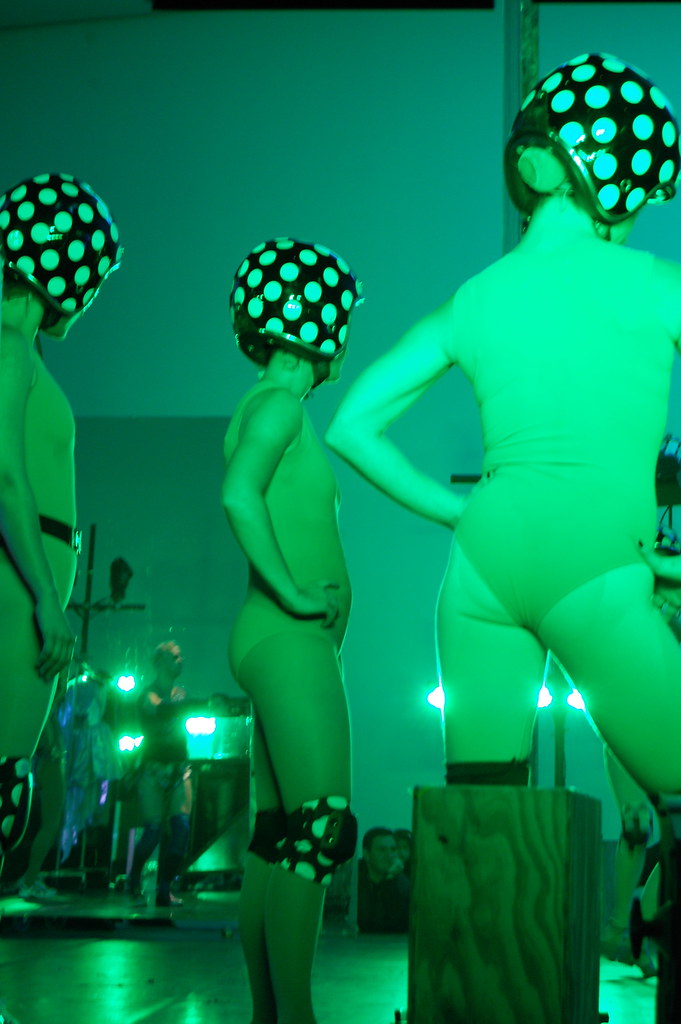
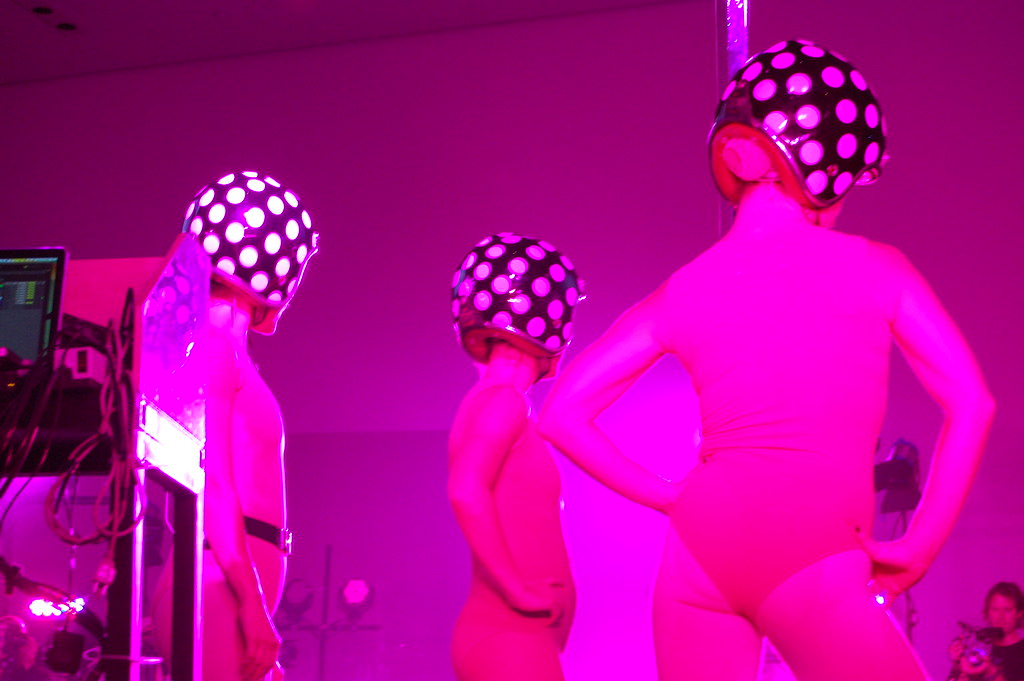
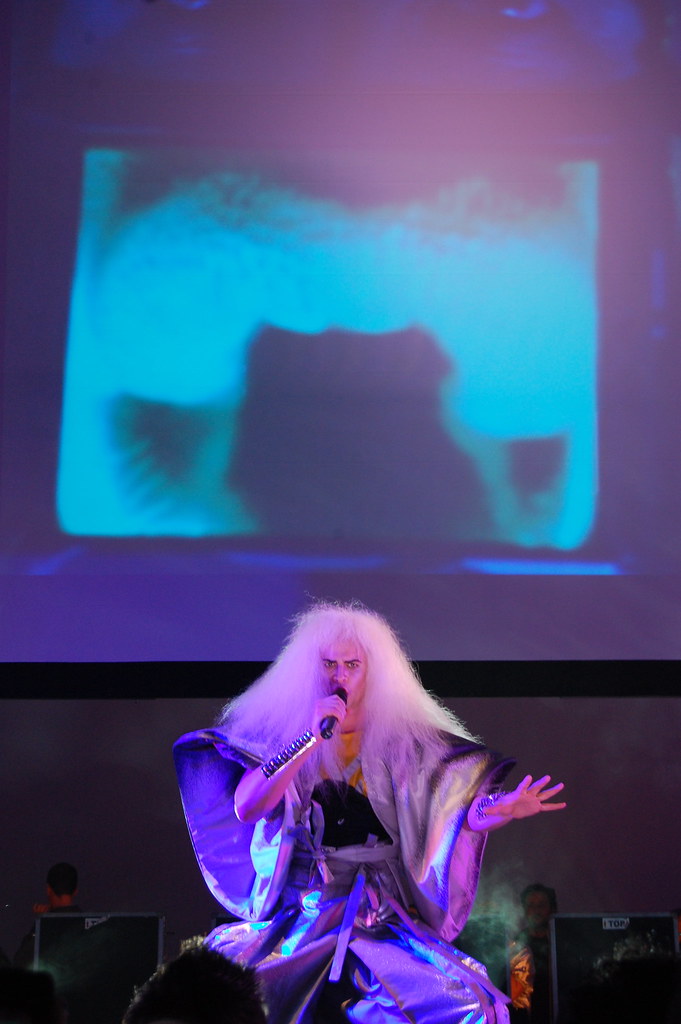
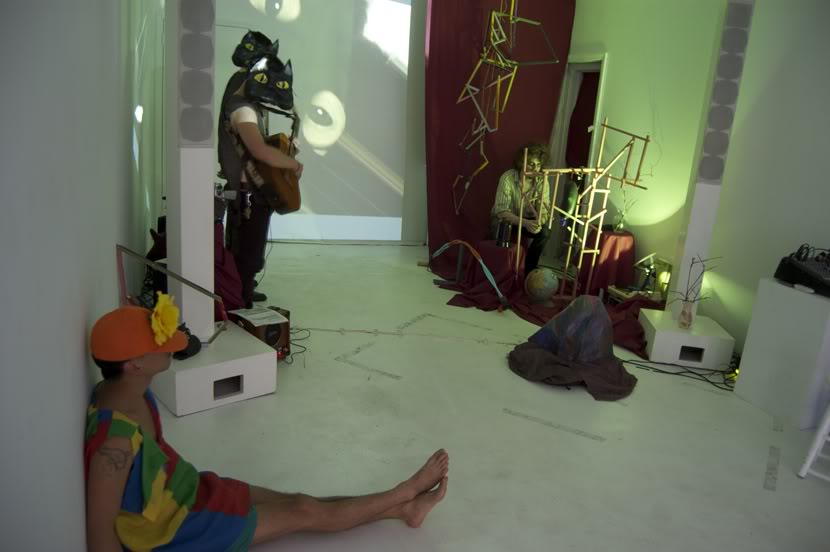
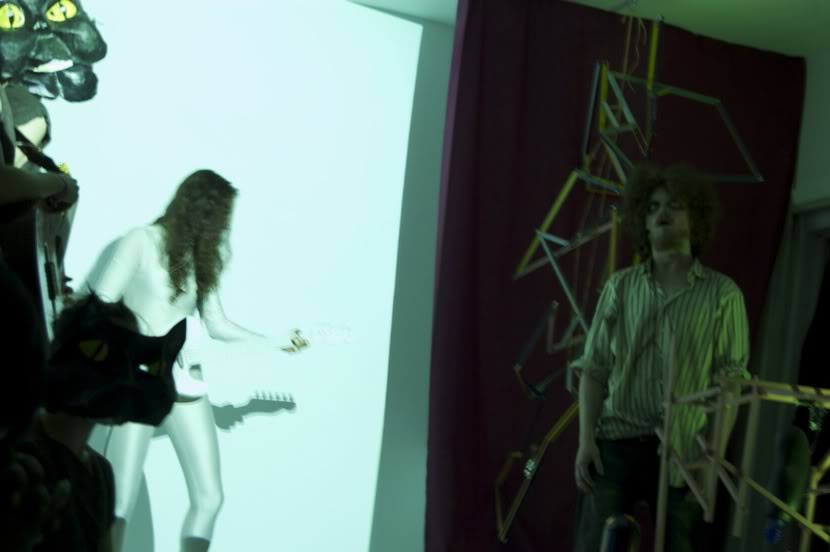
Performance stills of Rachel Mason and Little Band of Sailors, The Outsider, at Asia Song Society, New York, July 12, 2011.

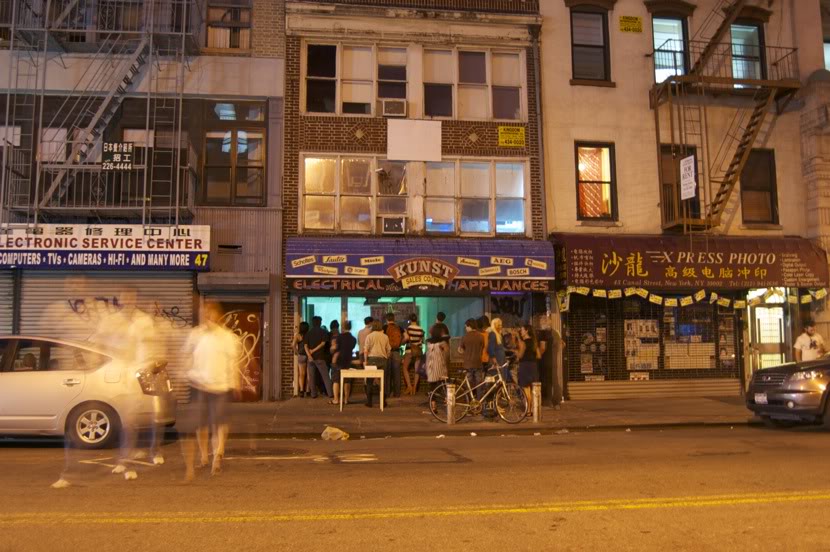
"The breeze is actually quite pleasant," an Asia Song Society employee advised me by email yesterday, letting me know that if I arrived at ASS after all the seats for Rachel Mason's performance were filled, I'd still be able to see through the front window from the street. I made it just in time to find a spot, and discovered members of Mason's backing band, Little Band of Sailors, already in position, bravely waiting to begin the performance in the scorchingly hot gallery. (Those who chose to watch from the outside had made a more prudent choice.)


Performance excerpts of Rachel Mason and Little Band of Sailors, The Outsider, at ASS, July 12, 2011. Video: 16 Miles
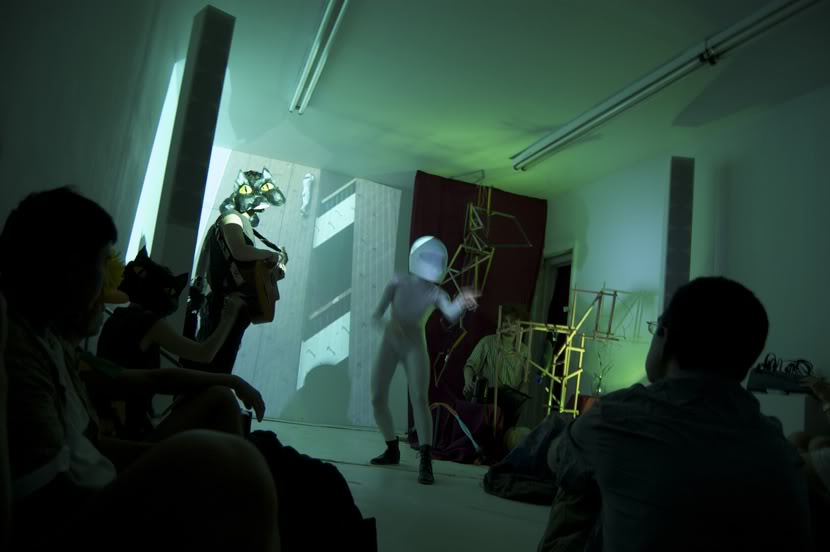

Mason and Little Band of Outsiders also performed the work at the Terence Koh-backed gallery on Monday night.

Just before 8:30, a man near the back of the stage, wearing thick makeup around his eyes, intoned the opening lines of H. P. Lovecraft's 1926 short story "The Outsider": "Unhappy is he to whom the memories of childhood bring only fear and sadness…" Two guitarists wearing cat masks, their huge yellow eyes pointed at the audience, accompanied him, lending an ominous, albeit vaguely corny, prog-rock touch to the affair. It seemed clear that things were going to get weird. They did.

Mason and her crew proceeded to enact Lovecraft's story, a tale about a man escaping from a deserted castle in search of life, with films, costume changes, and songs, a gesamtkunstwerk that veered wildly from bracingly literal moments from the story (a video of the main character, somewhat mysteriously clad in a white Spandex suit and white motorcycle helmet, climbing the side of a building), to more bizarre, abstract passages in the form of musical interludes sung by Mason.

Lovecraft's character eventually escapes his prison and finds another castle, where he encounters a spectral presence, "a compound of all that is unclean, uncanny, unwelcome, abnormal, and detestable." Mayhem ensues, as it did in the gallery, with a large group of people (visible in one of the video excerpts) screaming and dancing wildly about a tall, ghastly looking creature, who later sang a haunting, chant-like song.

There was much more. The Venezuelan punk musician Yva Las Vegas provided a surprise entr'acte, singing and madly strumming an acoustic guitar from a stool at the back of the gallery. A limber woman in another cat mask crawled around the stage, twisting her body into a bridge. Mason, song after song, costume after costume, dominated the audience like a ghostly, contemporary Patti Smith. (She has also been described as "Alice Cooper meets Carol King in another dimension," which is a fine description.)
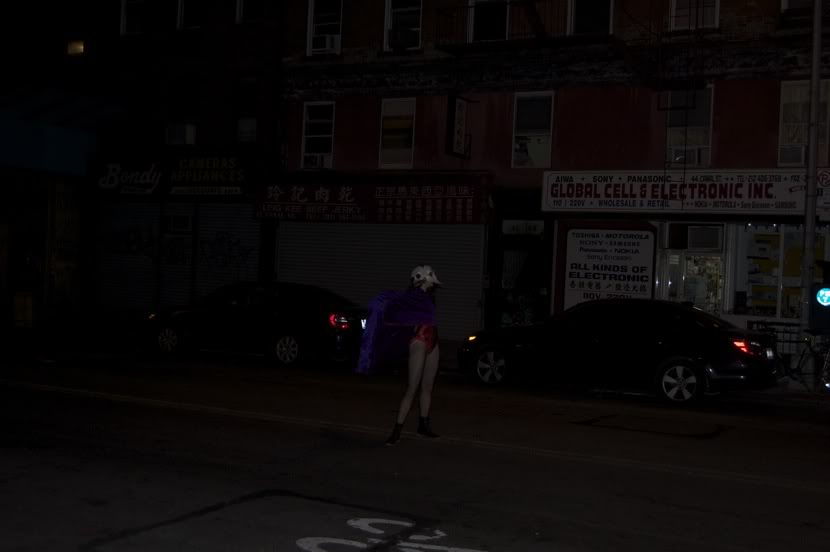


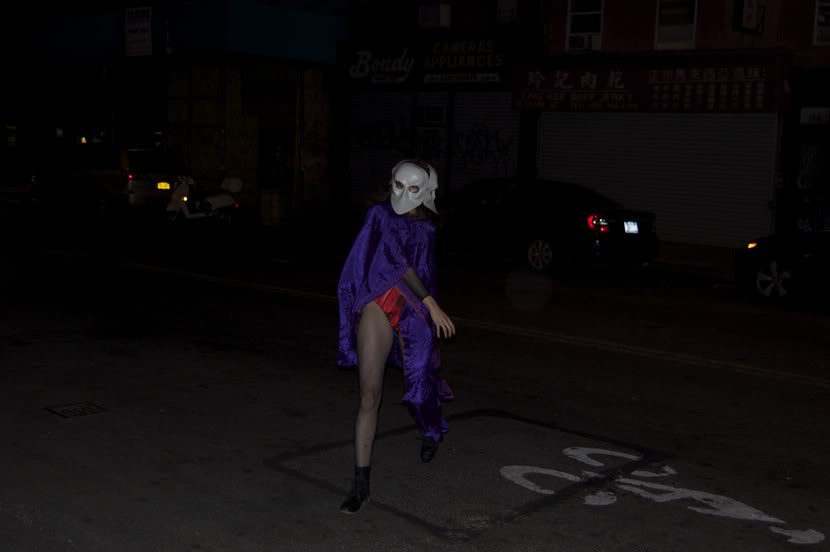
A three-masked chanteuse dashed out onto Canal Street, and sang into ASS via a wireless microphone.

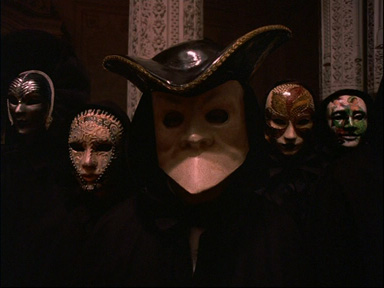
And near the end of the show, a performer wearing three Eyes Wide Shut-style masks, a red leotard, and a purple cape — it appeared to be Mason again — burst through the open door of the gallery and dashed out to the center of Canal Street, spinning in place and singing into the gallery via a wireless microphone. She moved gracefully from one side of the road to the other when a car approached, and then retreated inside.

At the end of Lovecraft's story, his protagonist returns to his castle and attempts to resume his life as a hermit. He fails and becomes a wanderer in the world, "an outsider; a stranger in this century and among those who are still men." That line could very well apply to Mason's sublime and strange work, for which she has melded the intricate stagecraft and high drama of theater with the raw, apparently improvisational nature of performance art.

Wednesday, May 11, 2011

Liz Magic Laser's "Flight" in Times Square


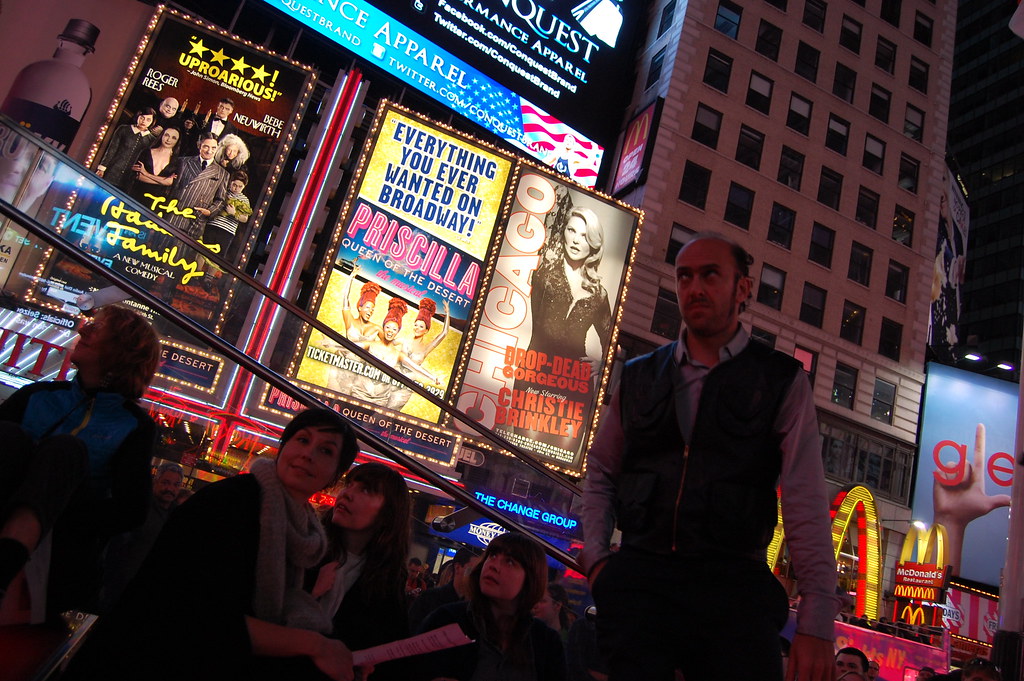
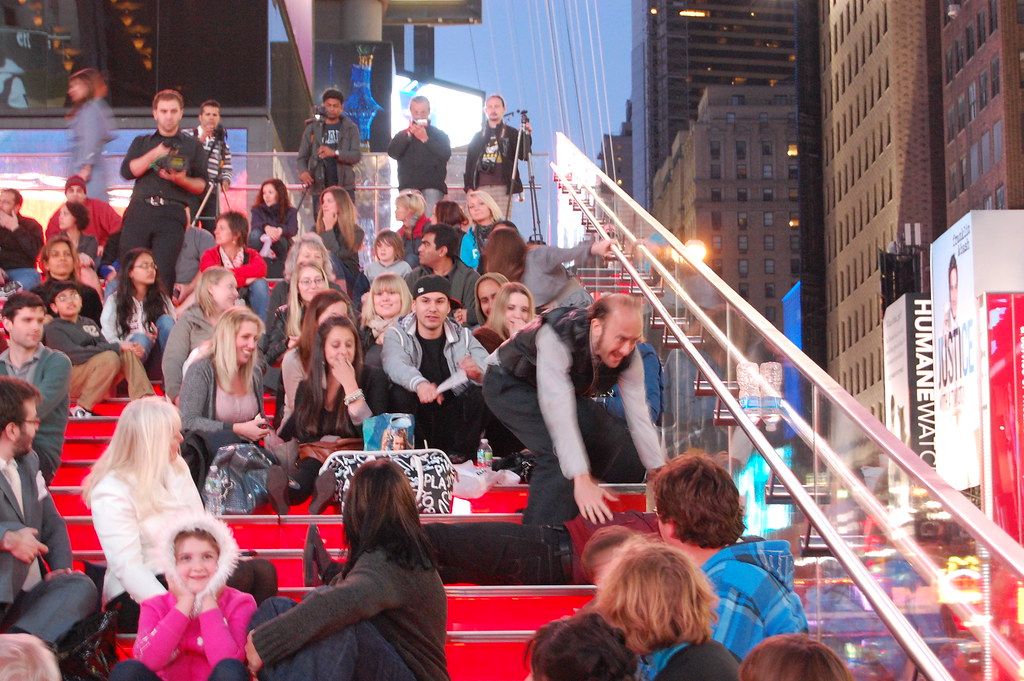
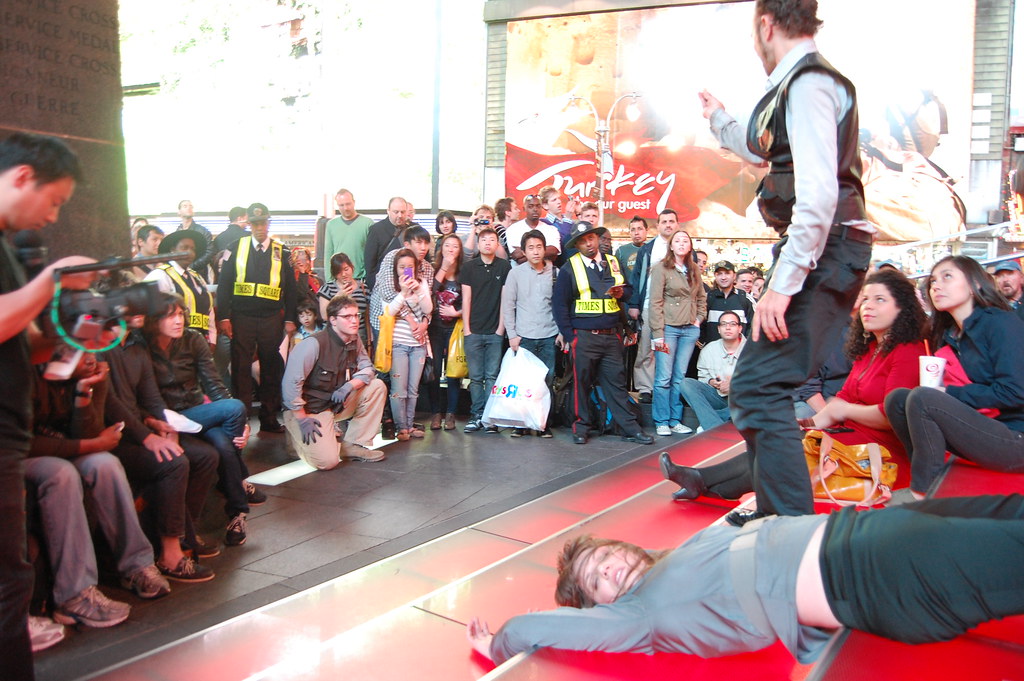
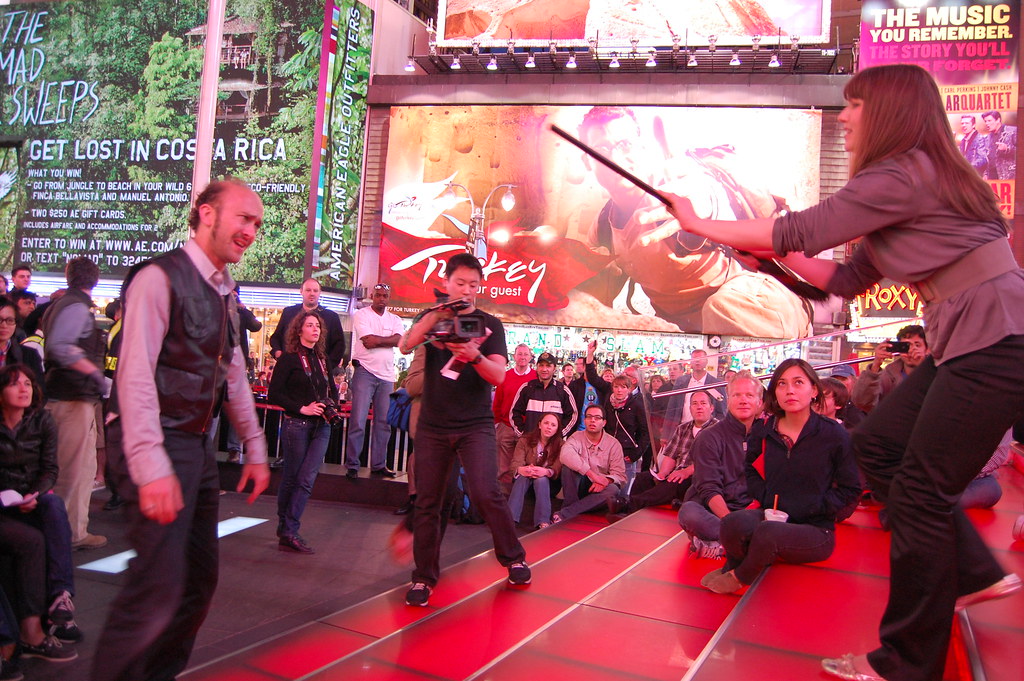
Performance stills of Flight (2010–) on May 7, 2011, 8 pm performance, the eighth of the week's nine performances. Video: 16 Miles of String


Performance stills of Flight.It was previously performed at MoMA P.S.1. Photos: 16 Miles [more]

It was difficult to tell when it happened, but a few minutes after 8 pm on Saturday a performance of Liz Magic Laser's Flight (2010–) began on the iconic, red TKTS stairs in Times Square. Tour groups were climbing the steps, couples were posing for photographs, families were lounging, and people were waving off into the distance. After a few moments, you realized that those wavers — six of them — were really waving, flailing their arms from side to side, standing on the tips of their toes and letting loose. And then they stopped waving and started sprinting down the crowded steps, dodging the seated tourists. Viewers who had been handed a single-page "table of scenes" for Laser's piece by a Times Square public safety officer could consult it to learn that we were watching a scene from Battleship Potemkin (1925), the famous Odessa Steps sequence, in which czarist soldiers gun down civilians. The actors were running for their lives.


One very angry performer heads toward the stairs.

Twenty-two more classic film scenes, most involving epic chases, were staged over the following 30 minutes, including snippets of The Wizard of Oz (1939), Cinderella (1950), and Vertigo (1958). "I'm so sorry I dropped you. I had to save the Declaration," one man told a woman, as they enacted part of National Treasure (2004). "I would have done exactly the same to you," she replied, earning laughter from the audience. This took place low on the stairs, not far from where I was standing at the bottom, but other scenes took place far above the street, almost out of sight. A man strangled a woman at the top of the stairs. Another crept slowly up the far side, quietly stalking a woman at the top who was frantically dialing for help on her cell phone. One moment an actor would be screaming or falling in front of you; the next, he or she would be off in the distance. Terror and excitement came and went, growing rapidly and then receding just as quickly.


A fight on the top deck of the bleachers. Viewers watch as a woman is strangled.

For Laser fans, there were familiar figures among the cast, namely Liz Micek, Michael Wiener, and Max Woertendyke, who all appeared in the artist's chase (2010) video, which was shown at Derek Eller Gallery last year. That work had a theatrical foundation as well, being a contemporary version of Bertolt Brecht's 1926 play Man Equals Man that shot inside the ATM vestibules of various New York banks. It ran for almost two and a half hours, and many complained that it was too long, though that seems more Brecht's fault that Laser's. Regardless, Flight felt perfectly paced. Some people left the stairs during the show, no doubt moving on to other affairs (How were they supposed to know that a performance piece would break out during their evening in Times Square?), but others stuck it out, and most of them looked thrilled.


A tragedy unfolds.

When people did leave, Laser's trusty stage manager Boman Modine directed those waiting below up onto the stairs one or two at a time, leading them into the action as if he was orchestrating a delicate military operation. "You two, head halfway up to the far right," he whispered. Then, "I need one. One right there," pointing to a spot that would almost immediately after be the site of the next showdown. The public safety officers also looked excited, and one grinned wildly as he just barely dodged an actor dashing past him.


Looking south from the bottom of the steps as the action unfolds.

Laser had ripped a tiny hole in reality and then grafted on tiny slices of popular culture in its place. (The Shining (1980), The Fugitive (1993), and Titanic (1997)!) Delightfully, there was no clear censorship in this most public of places. A performer smoked a cigarette and others tossed off an occasional expletive, leading one mother to hastily cover her daughter's ears. Earmuffs! In other words, it looked in many ways like an ordinary day on the streets of New York, albeit one in which a young woman's screams for the police go unanswered and a man is stabbed in the neck in the middle of one of the city's most densely trafficked areas.

After about half an hour, every actor that I could see was sprawled out dead on the stairs. No one was moving. I consulted my table of scenes. "Is this really how Final Destination 4 ends?" I wondered. Finally a middle–aged man reached out and tapped one of the female performers on her shoulders. "Thank you!" she shouted happily, suddenly coming to life and leaping to her feet. "Are you a doctor?" Other members of the audience followed the man's lead, and within moments the whole cast was jaunting down the steps as the crowd applauded.

Monday, April 4, 2011

The Headlines: Elizabeth McAlpine's "Words and Music" at Laurel Gitlen

Performance excerpt of Elizabeth McAlpine's Words & Music (Headlines)," 2010, at Laurel Gitlen, New York, April 3, 2011. Video: 16 Miles

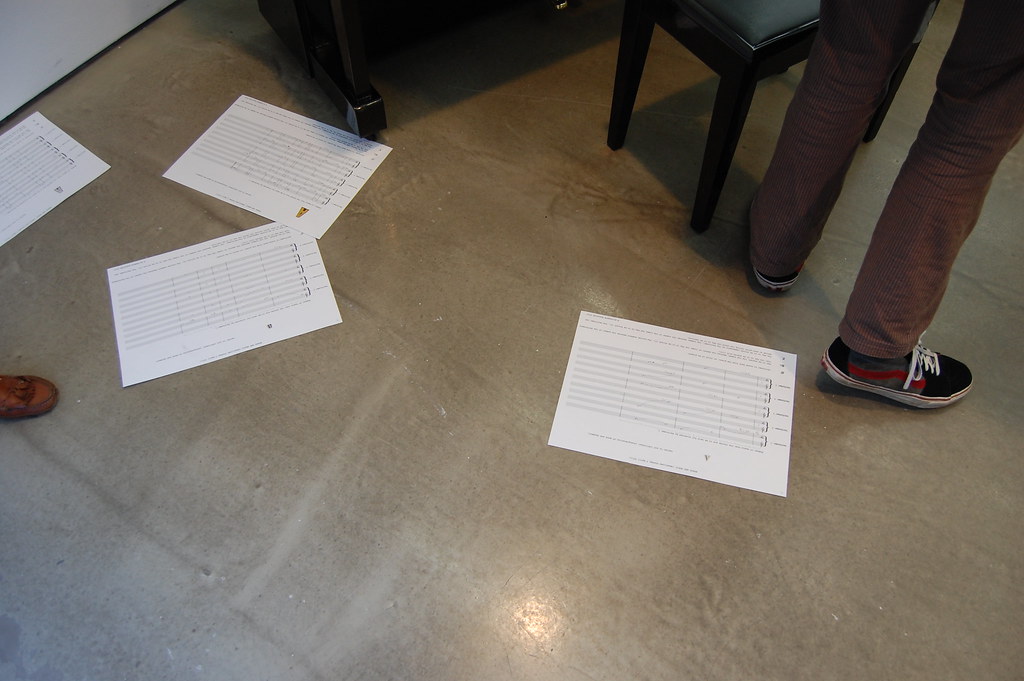
Elizabeth McAlpine's Words and Music (Headlines) (2010) sounds like a straightforward enough piece of piano music when you're listening to it, hearing mostly-dissonant chords come and go, one at a time. Seeing it in person, though, as I did last night at Laurel Gitlen, reveals a work with a complicated conceptual structure and tricky technical requirements, with five performers playing the work on a single piano, navigating the gallery and the keyboard as they move through the piece.

The instructional text for Words and Music, hung on a wall, provides an outline of the work's intricate framework. It notes that 26 uppercase letters, 26 lowercase letters, 10 numbers, and 26 punctuation marks and symbols equal 88 total signs, which happens to be the same number of keys that are found on a standard piano. Why is this arbitrary equivalence relevant, you ask? McAlpine has set each letter, number, or mark to a different piano key, and used that system to transliterate the headlines of the day's newspapers into a series of chords, with each headline filling a page of the score. (The work has been presented previously in London; the instructional text for a July 15, 2010, performance is available on the artist's web site.)

The headlines for Sunday, April 3, 2011, as you can hear, yielded disquieting, sometimes lonely sounding music, but also some moments of unusual beauty and hard-won consonance. The work will be performed again on the final day of the show, May 1, using that day's headlines. Certain words will no doubt reappear, like prepositions, articles, and perhaps even some proper nouns — Yemen, Bachmann, Obama? — and they will generate a familiar cascade of notes. But others names, other sounds, will be new. What will they sound like? How much will the news change over the course of one month?


Post-performance installation view of Elizabeth McAlpine, Words and Music (Headlines), 2010. Performance(s), two instruction texts, and one drawing, installation dimensions variable, instruction texts: 30 x 60 cm each, drawing: 60 x 150 cm. Photo: 16 Miles

On a tangentially note, McAlpine's piece reminds me of the joyous video of Sonic Youth performing George Maciunas's Piano Piece #13 (for Nam June Paik) (1964).

Sunday, March 27, 2011

Kenya (Robinson) Eats a Cracker in The Kitchen


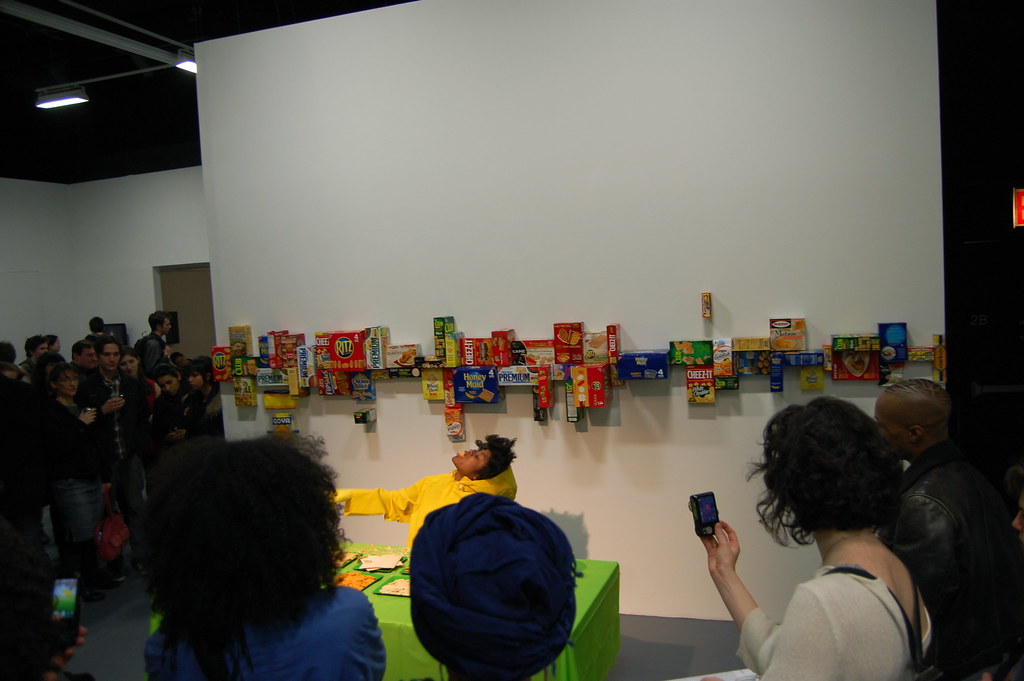
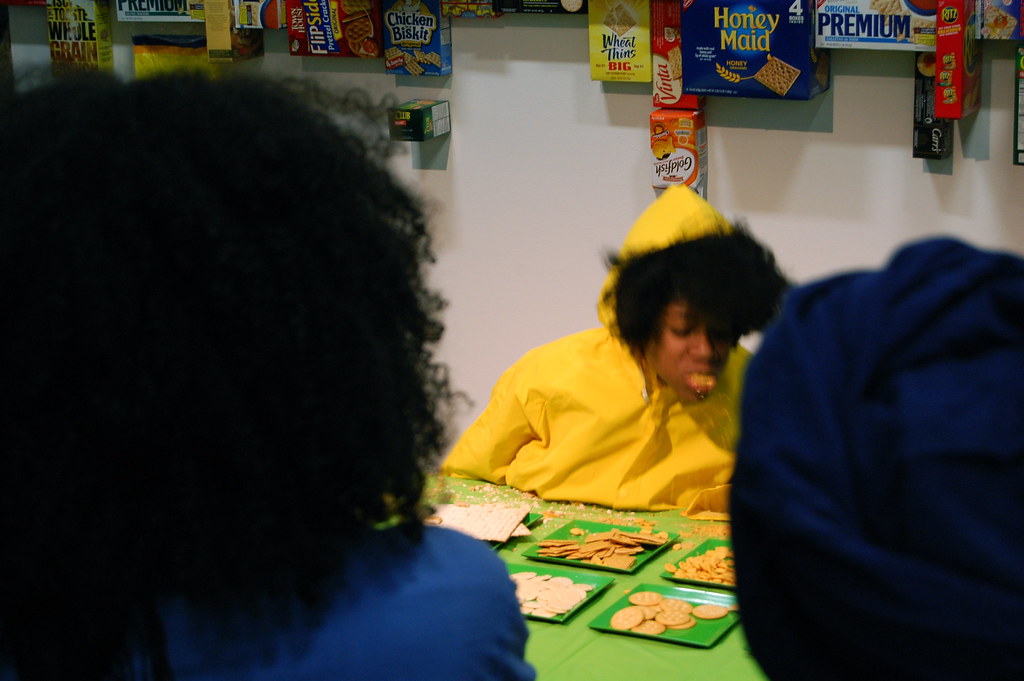
Performance still of Kenya (Robinson), Kenya Eats a Cracker, 2010. Cracker boxes and audio. The Kitchen, New York, March 17, 2011. Photos: 16 Miles


There were Ritz crackers, Club crackers, Triscuits, Chicken in a Biskits, Honey Maid graham crackers, and even Premium Saltines (those great objects of desire in Ed Ruscha's 1970 film Premium) sitting on plates on a table at the opening of The Kitchen's latest show, "Shame the Devil," on March 17th. Very much ready to eat, I was sad to learn that the fine spread was not for the visiting public, though my pain subsided somewhat when I learned that they were to be used for a performance by artist Kenya (Robinson). At least someone would be enjoying the tasty snacks.

(Robinson) last popped up at the Dependent Art Fair, where she occupied Recess Activities' bed as part of a long-term performance piece, The Inflatable Mattress, which involves serving as a house guest for 13 weeks, spending seven days at each location. (The Dependent was a special one-night stay.) This time, at The Kitchen, she shifted her attention from sleeping to eating, offering up Kenya Eats a Cracker. Wearing a yellow raincoat, she walked up to the cracker–covered table, sat down, and started eating. A crowd formed around her as she grabbed crackers by the handful, stuffing them in her mouth, staring up at the crowd, and chewing in rapid bursts as crumbs fell from her lips.

A voice came from nearby speakers as (Robinson) enacted her feasting. "At Triscuit, we believe less is more," the affectless narrator intoned. "That's why we bake our crackers with quality ingredients like Soft White Winter Wheat." (All quotes come from a paper available at The Kitchen, where (Robinson)'s cracker boxes are still on view.) The narrative traveled from the production of Triscuits to the history of Carr's Crackers ("Jonathan Dodgson Carr created the first table water cracker in 1890…") to the Israelites' exodus from Egypt. (Robinson) kept eating. She took rapid-fire bites, then slow, languorous chews, and then steady open-mouthed munches, offering a full compendium of eating options.

"It's best when used by January 29, 2011, or better still on January 29, 1954, when Oprah Winfrey was born," the voice continued. "Open here. Made with smiles and a product of the USA." (Robinson) continued her dining. "Open other end. Lift tab to open. Push to open. Open here." And then the voiceover ended. (Robinson) got up from her chair and walked off. There was some light applause. (Does anyone really know what to do at the end of a performance piece?)

(Robinson) seems wonderfully out of touch with the times. Much of the most acclaimed (or at least most visible) performative art recently has involved the glorification of long-term suffering (Marina Abramovic's The Artist Is Present (2010) at MoMA and Terence Koh's nothingtoodoo (2011) at Mary Boone, for instance) or the celebration of middlebrow interactivity (Tino Seghal at the Guggenheim — see Joe Scanlan's "Fair Use" in the May 2010 Artforum for more on that — and perhaps even Rirkrit Tiravanija's current show at Gavin Brown's enterprise).

In contrast, (Robinson) — while very much present in her work — engineers for herself a great and pleasurable time: she enjoys the hospitality of friends and acquaintances in The Inflatable Mattress or the bounty of an unusual buffet in Kenya Eats a Cracker. All the while, she twists the codes that govern our basic needs — shelter and food — in ambiguous ways and pushes them toward the precarious point when they may break, when the house guest outstays her welcome or when the woman munching maniacally on crackers moves from a representative of freewheeling fun to an object of ridicule. And then there are the racial overtones in Cracker's title and text. What are we to make of them? "Open other end. Lift tab to open. Push to open. Open here."

Sunday, February 27, 2011

Dr. Lakra at the Drawing Center


Installation views of "Dr. Lakra" at the Drawing Center, New York, February 24, 2011. Photos: 16 Miles [more]


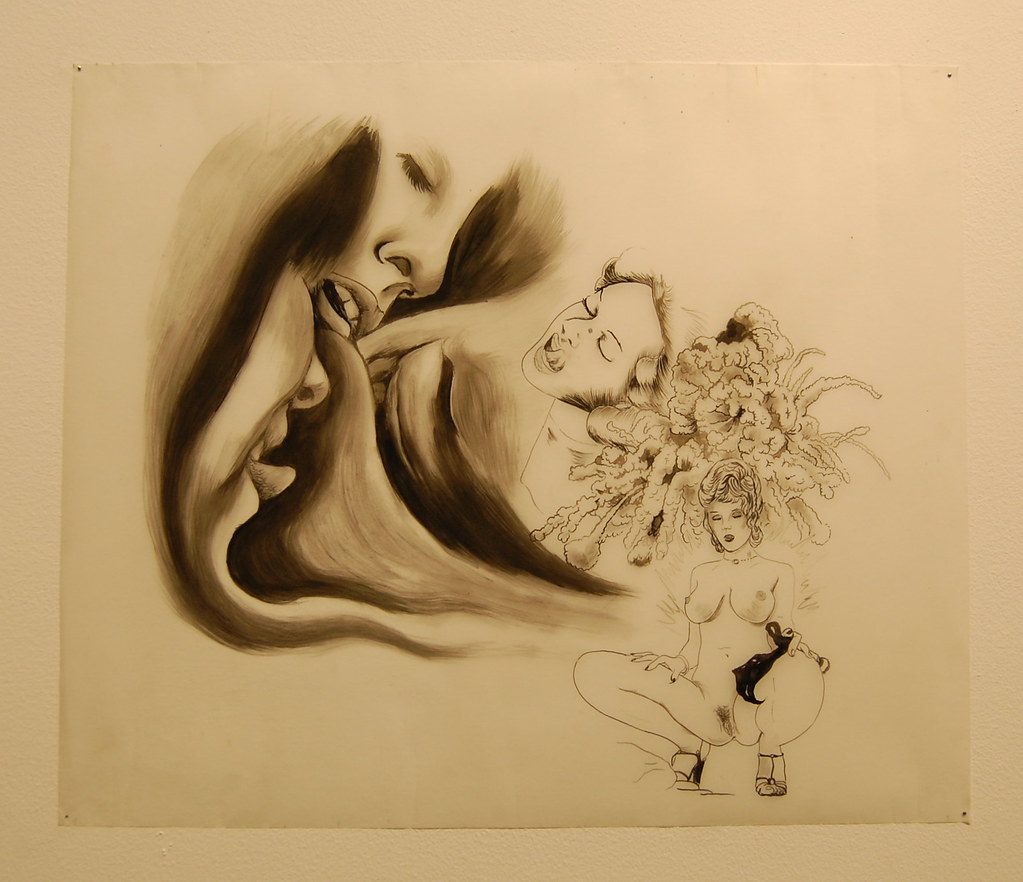
How is it possible that Dr. Lakra has never had a one-person show in New York? The Mexico City–based artist is one of contemporary art's most reliable, unrelenting showmen, and his work has been rampaging around the international circuit for more than a decade. Moreover, his drawings — which are often vintage pinups precisely détourned with elaborate tattoos — have a tendency to eviscerate neighboring works in group shows. It rarely seems to be a fair fight.

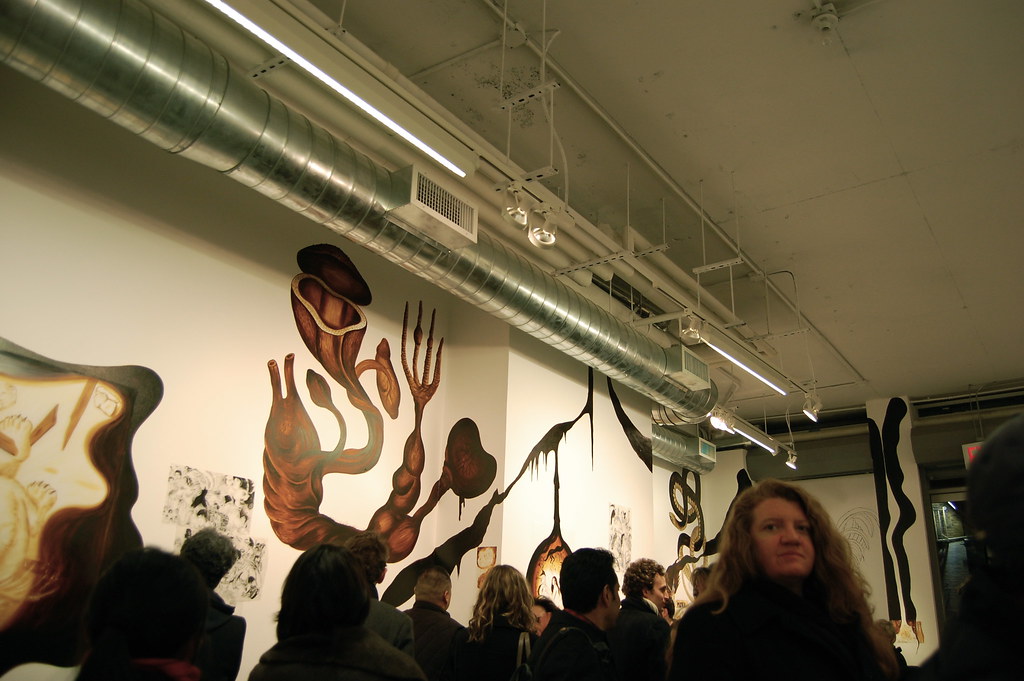
Regardless of the reason, that long-overdue Lakra exhibition arrived on Thursday, thanks to the Drawing Center, which also happens to have been the first institution to show his work in New York, back in 1995. Currently at the start of an admirably ambitious expansion project, the museum has handed over to the artist the Spencer Brownstone Gallery, at 3 Wooster Street, and he has responded with a tantalizing, trippy site-specific stunner that makes his wild 2010 outing at the Institute of Contemporary Art, Boston, look comparatively restrained.

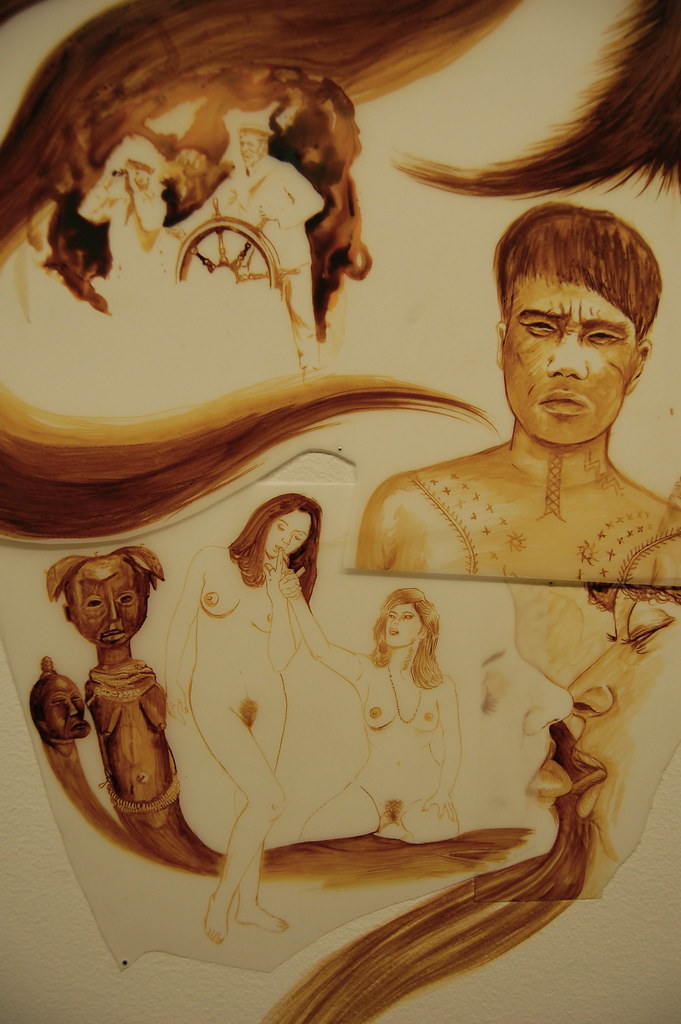
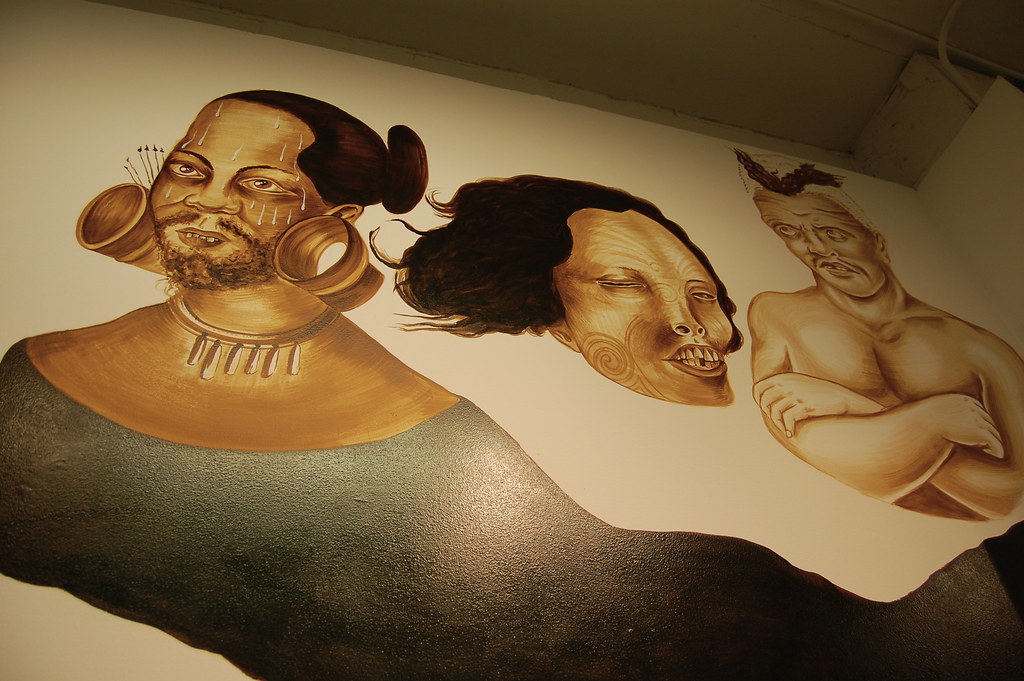
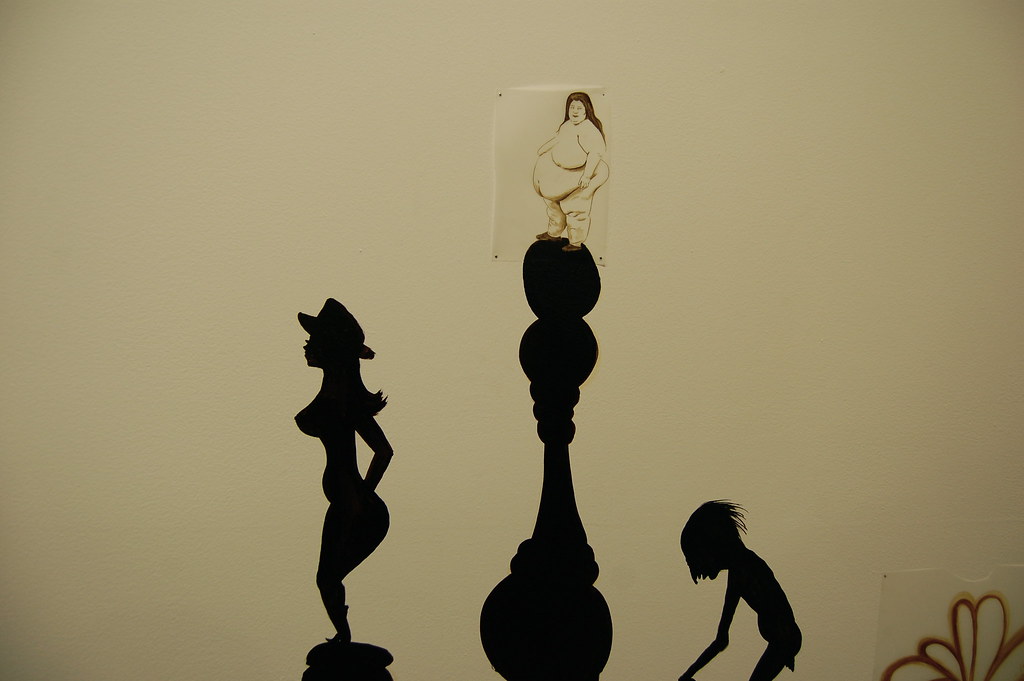
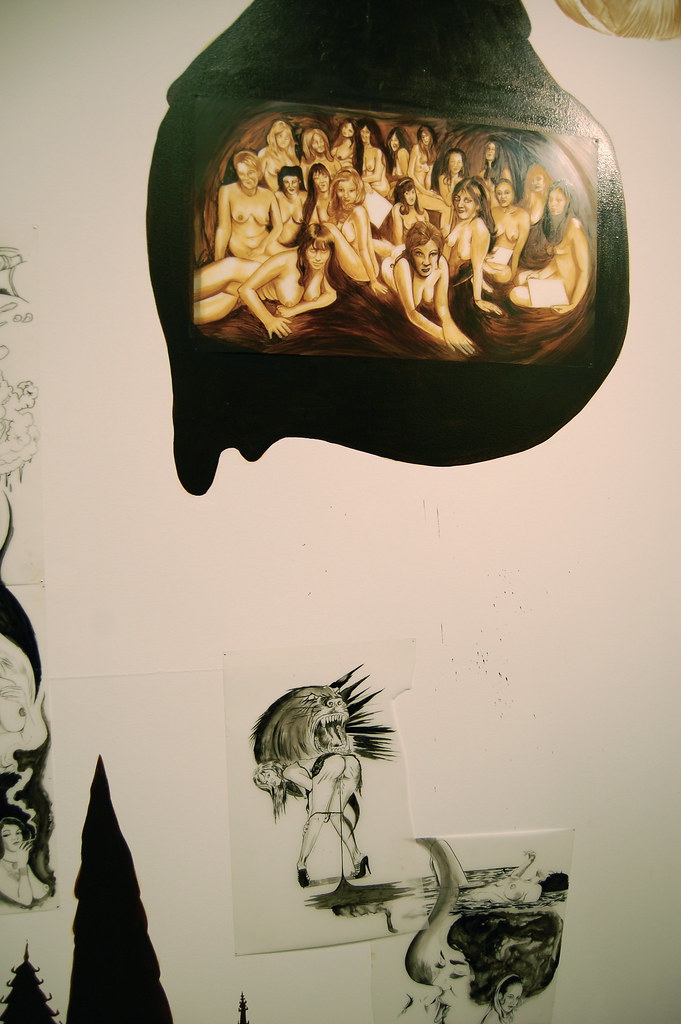
Black and brown blobs ooze around the gallery's walls and billow up into large clouds in some places, serving as frames for drawings on paper that present various indulgences: a glass of liquor and a hulking tribal artifact, for instance, or nineteen (I counted) naked young women staring out of a swirling chocolate fog. Elsewhere, Lakra's black and brown smoke morphs into subtle and supple portraits of androgynous figures or monochromatic silhouette cartoons of naked women or masses of unidentifiable organs that almost pulse and undulate on the walls.


Under the previous New York City mayor, Lakra's drawings may have provoked at least a moment of political grandstanding. They show a naked woman bending over and urinating, a topless woman smoking a long cigarette, and various women kissing. Admittedly, the taboos and private fantasies they deal in are largely those of straight males, but they can never be quite reduced to those interests. Lakra's work literally represents not only art's inherent erotic potential but also its use as a guard again death. There are plenty of pornographic elements, sure, but long shadows, snakes, and skulls are always just a drawing away.


Wednesday, February 16, 2011

Terence Koh with "nothingtoodoo" at Mary Boone


Terence Koh, performance still of nothingtoodoo, February 12, 2011, at the Mary Boone Gallery, New York. Photos: 16 Miles


Outside of Koh's gallery, Asia Song Society, 45 Canal Street, February 13, 2011


Terence Koh, performance still of nothingtoodoo, February 16, 2011, at the Mary Boone Gallery, New York

Sadly, there are no white-chocolate mountains on view in Terence Koh's one-person debut at Mary Boone. Koh has, at least for now, excised such easy, giddy pleasures from his work. Instead, there is a massive pile of salt sitting in the center of the gallery. There is also Koh himself, clad all in white, slowly working his way around the sculpture on his knees. This looks painful, though Koh gave no hint of discomfort on Saturday evening at his opening reception.

When I returned this afternoon, slipping through the white curtains that obscure the entrance to the main gallery, I was momentarily startled — first, to discover that Koh was still at it, and, second, that I was all alone with him. His back was faced away from me at that moment, as he went about his labor, which reads as a more masochistic, isolated version of Marina Abramović's recent MoMA performance, The Artist Is Present (2010). He performs for one more hour each day than she did, though he gets two days off to her one.

During one of those days off, Sunday, I walked from Reena Spauling Fine Arts and its charmingly low-key Matias Faldbakken show (more on that later) to Canada's divisive Joe Bradley affair, passing on the way the Asia Song Society, Koh's gallery and residence at 45 Canal. There were two white shoes sitting outside, one filled with flowers. Yesterday, I realized that he has been performing without shoes.

On Saturday evening, the gallery had been nearly still, as the crowd somberly watched Koh, silently rooting him on. Today, though, the silence was the result of emptiness. I felt guilty standing and watching as he went about his unending crawl, and I felt worse as I got ready to walk away. (Abramović had no shortage of supporters at MoMA.) I stayed for a few more minutes, and then, turning to go, quickly indulged an involuntary (and perhaps selfish) urge to pass in front of him, to let him know that someone had been staring.

Previously:
Terence Koh, Silent March, November 21, 2009

Thursday, March 11, 2010

Marina Abramović at the Museum of Modern Art


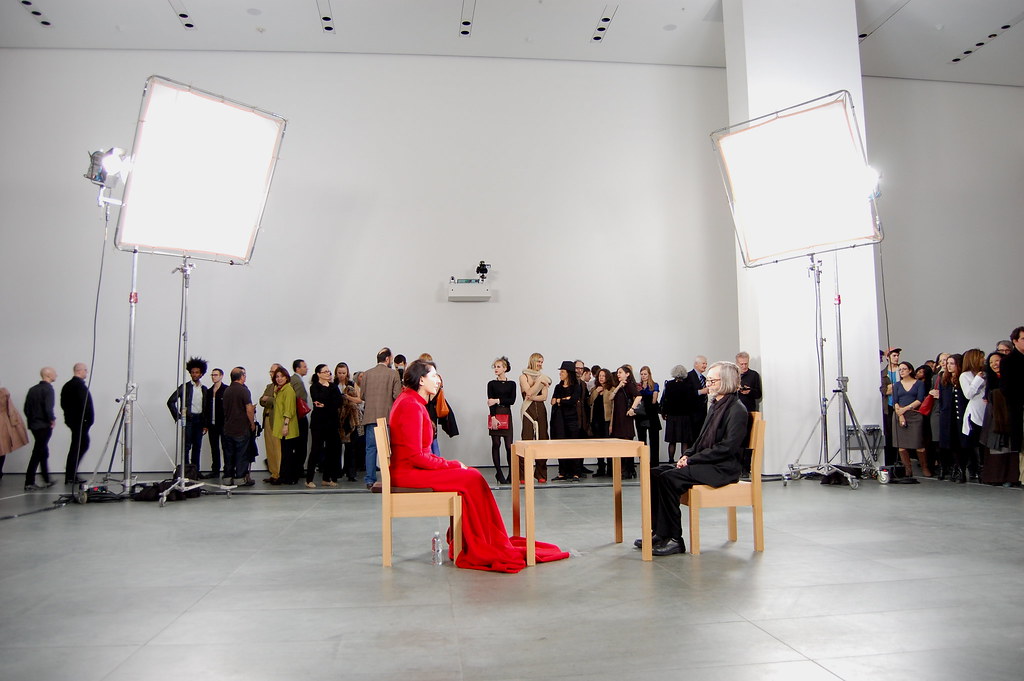
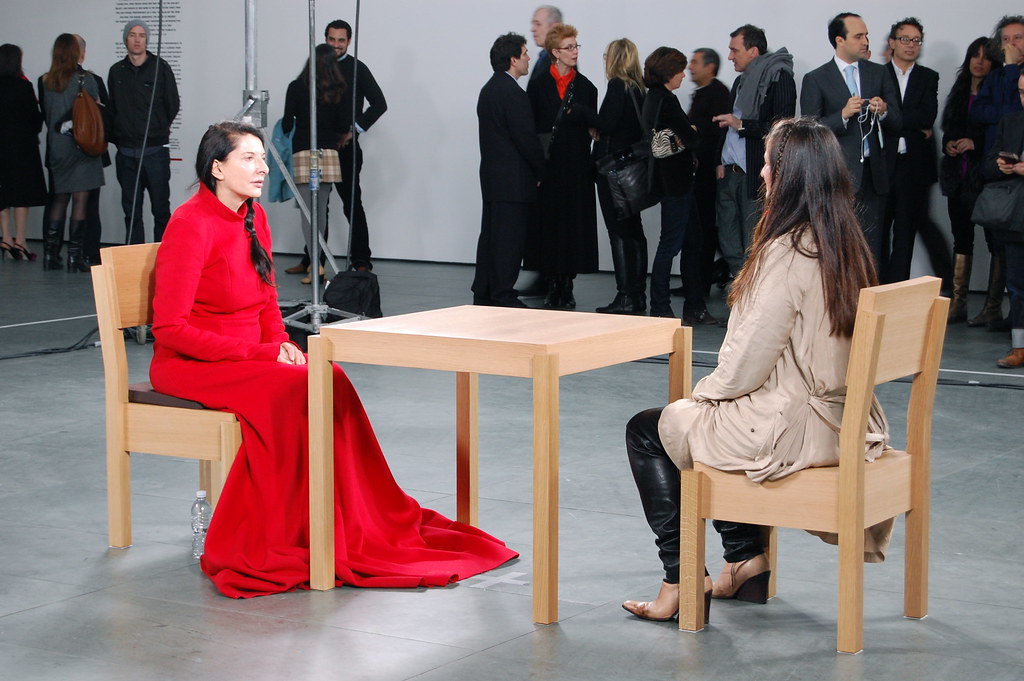
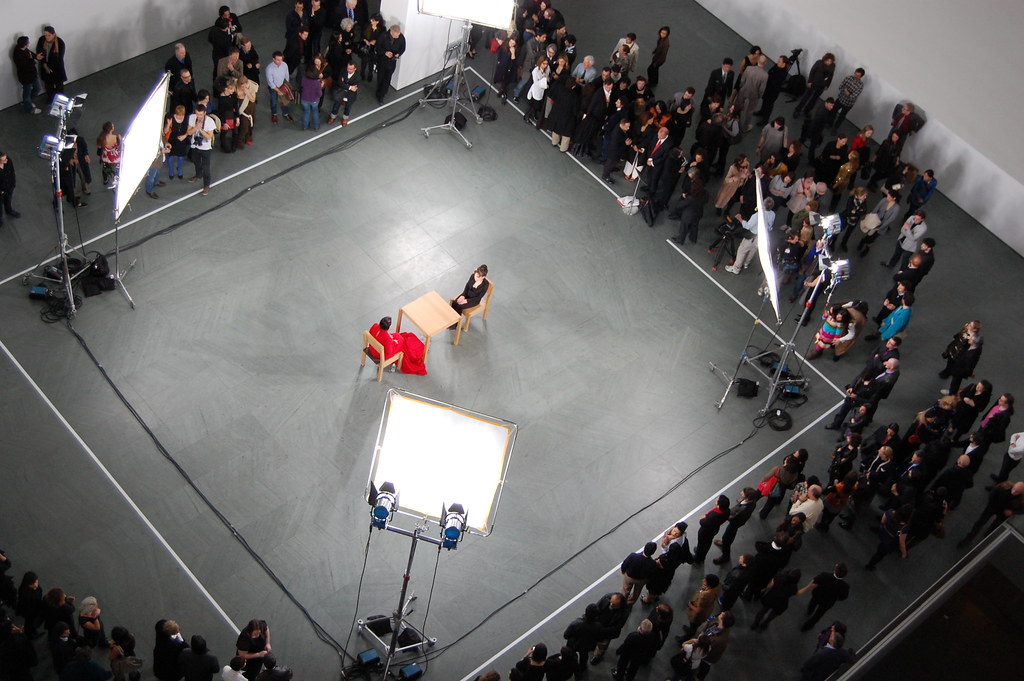
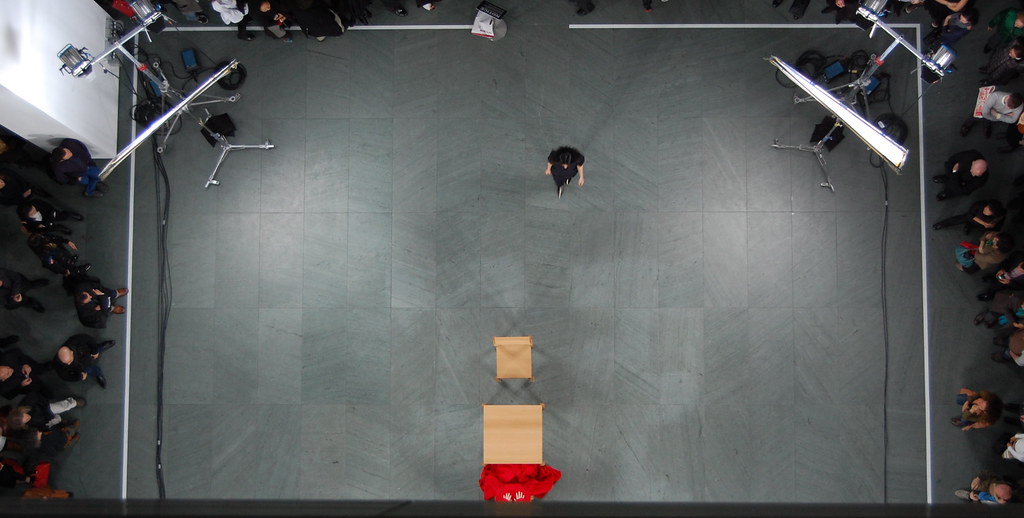
Marina Abramović, stills of The Artist is Present, 2010, at the Museum of Modern Art, March 9, 2010. Photos: 16 Miles [more]

Seeing Marina Abramović’s performance at the Museum of Modern Art on Saturday afternoon and Tuesday evening made me think back to a great story that art historian Rosalind Krauss told in Artforum, back in 1972, about a visit to the Fogg Art Museum to see “Three American Painters,” which included work by Kenneth Noland, Jules Olitski, and Frank Stella. Krauss said that, while visiting there with Harvard professor Michael Fried, an angry Harvard student approached the two of them, demanding answers. She wrote:
With his left arm raised and his finger pointing to the Stella, he confronted Michael Fried. 'What's so good about that?' he demanded. Fried looked back at him. "Look," he said slowly, "there are days when Stella goes to the Metropolitan Museum. And he sits for hours looking at the Velázquez, utterly knocked out by them and then he goes back to his studio. What he would like more than anything else is to paint like Velázquez. But what he knows is that is an option that is not open to him. So he paints stripes." Fried’s voice had risen. "He wants to be Velázquez so he paints stripes."


In James Westcott’s new biography on the artist, When Marina Abramović Dies, he argues that Abramović’s performances have become increasingly minimal over her career. In her earliest pieces, in works like Rhythm 0, 1974 — in which she invited audience members to take a host of props, including a knife, scissors, and lip stick to her passive, naked body — she relied heavily on props and theatrics, but by the late-1970s, working with her then-lover Ulay, she had shed some of that dramatic bent. Later, Light/Dark, 1977, involved Abramovic and Ulay slapping each other repeatedly for 20 minutes. Night Sea Cross, performed dozens of times over many years, saw the two of them sitting at the table, staring at each other. Their final piece, The Lovers, had them simply walking from either end of the Great Wall of China, meeting in the middle. And by 2002, in The House with the Ocean View (the performance lampooned in an episode of Sex and the City), she simply lived on a platform in the Sean Kelly Gallery for twelve days.


Now Abramovic has embarked on The Artist Is Present, in which she will sit at a table, across from an open chair for 716 hours and 30 minutes (thank you to Holland Cotter for the exact calculation) on the floor of MoMA’s atrium. Sharp, bright lights tower over her from each corner of her spare set, stripping away the much of the baroque glamour that one has come to associate with Abramovic. MoMA’s retrospective on its sixth-floor is a reliquary, presenting artifacts from and documentation of Abramovic’s earlier performances, but down below, the show’s saint sits motionless, under harsh light and the stares of museum patrons, resolutely human.

To follow Fried’s logic, it is as if she knows that she is capable of self-inflicted beatings, violence, and psychological turmoil in pursuit of art, and yet is aware “that is an option that is not open” to her. She has completed those trials and been championed as a hero and a martyr. Here, she chooses to suffer silently, almost invisibly, rather than resort to the shock and melodrama that marked some of her past work. She is clearly in pain as she sits in the atrium for hours each day — a grimace will pass over her face, a tear will stream down her cheek while sharing a look with someone — but it is almost imperceptible.


Tyler Green has recently explored the references to torture in Bruce Nauman’s audio work, Days, and it is shockingly present here, too, as Abramovic locks herself in a seemingly commonplace posture that will grow brutally painful over time, a stress position not unlike those used by interrogators within certain elements of the United States military and intelligence services. But beyond this element of suffering, Abramovic’s piece is also notable within her body of work for its remarkable generosity. Any person is invited to sit across from her, and they are welcome to stay as long as they choose. Rather than act as the distant stunt-woman, whipping or starving herself for the admiring crowd (or serving as the passive body for the mob to act on), she positions herself as level with her audience as she endures.

Abramovic, of course, is not a Modernist like Fried, marching ahead in pursuit of aesthetic progress. She will no doubt perform again after this work, and that future performance may see her adopt again one of her previous roles as daredevil or martyr. No matter. This is her masterpiece.


More: "Present and Past" at Artinfo

Saturday, November 21, 2009

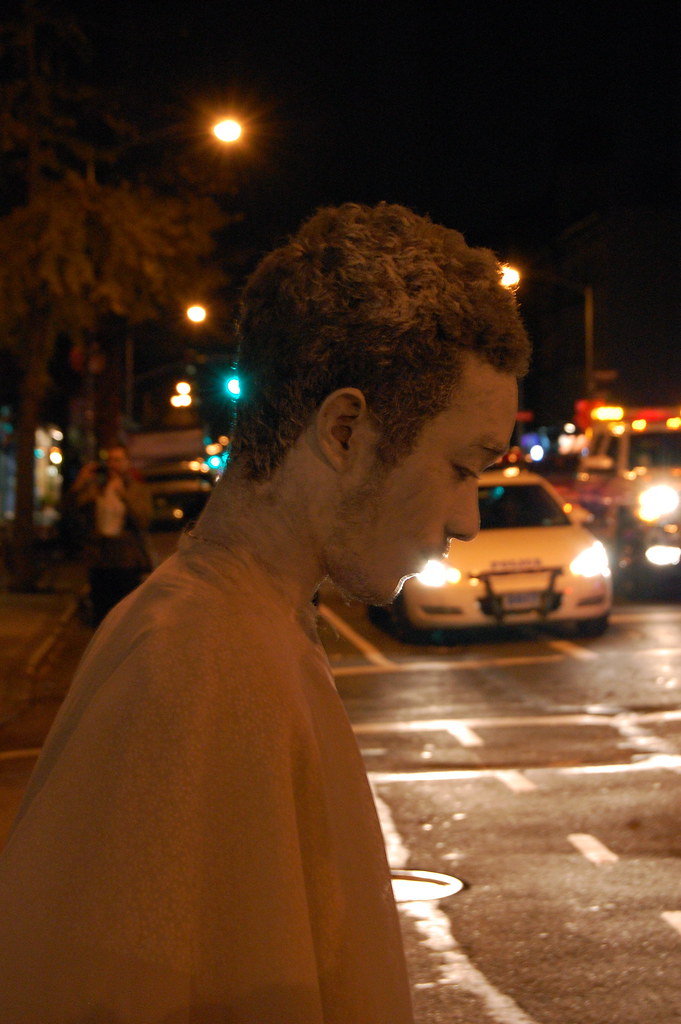
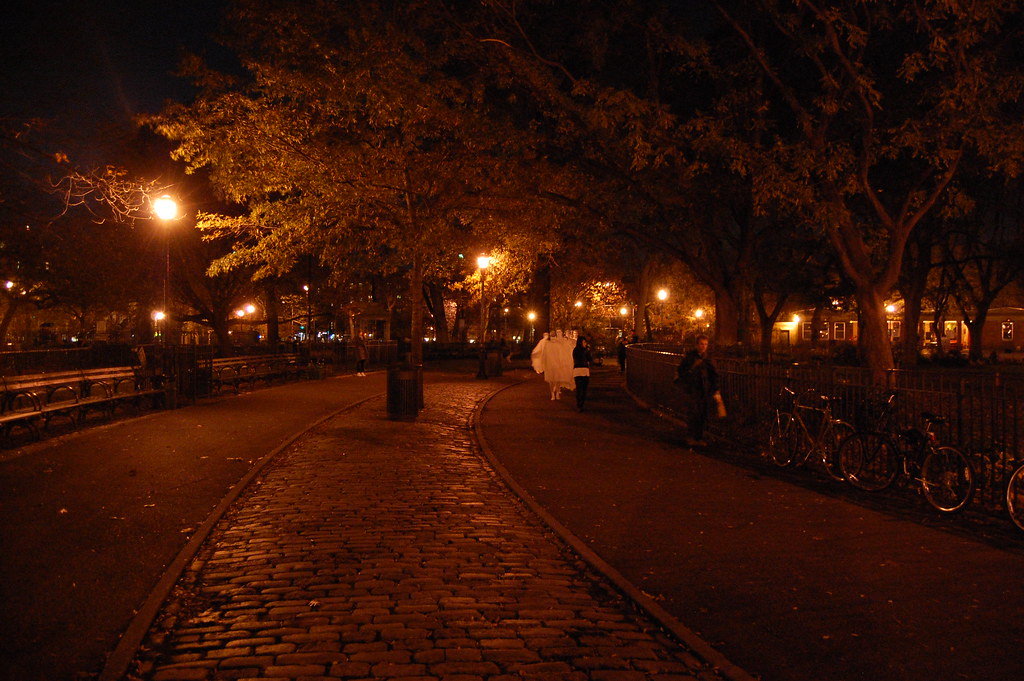
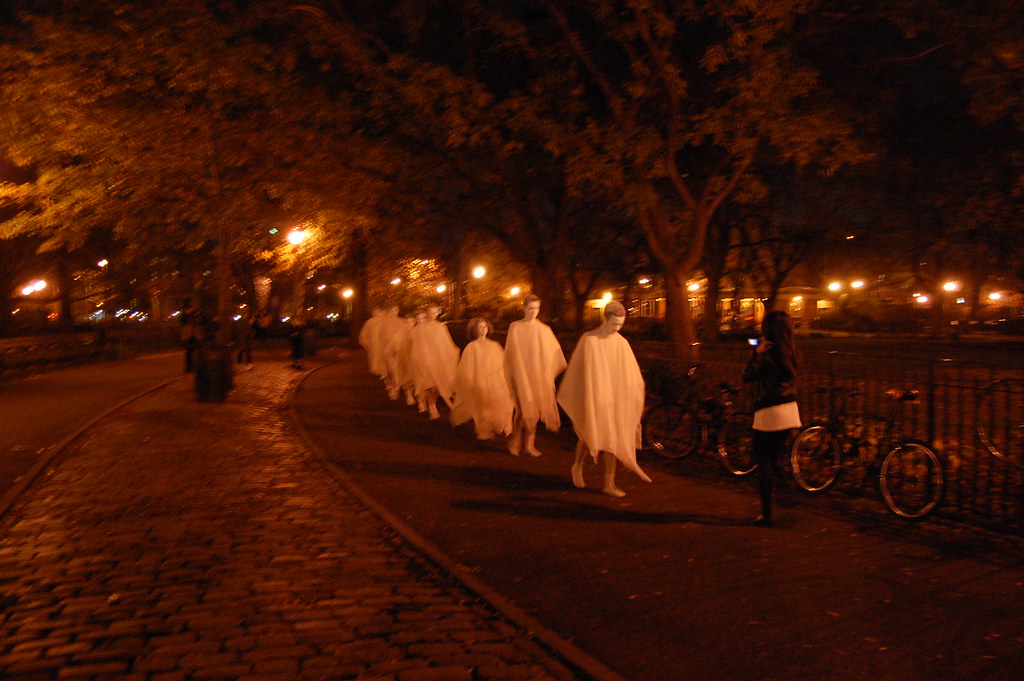
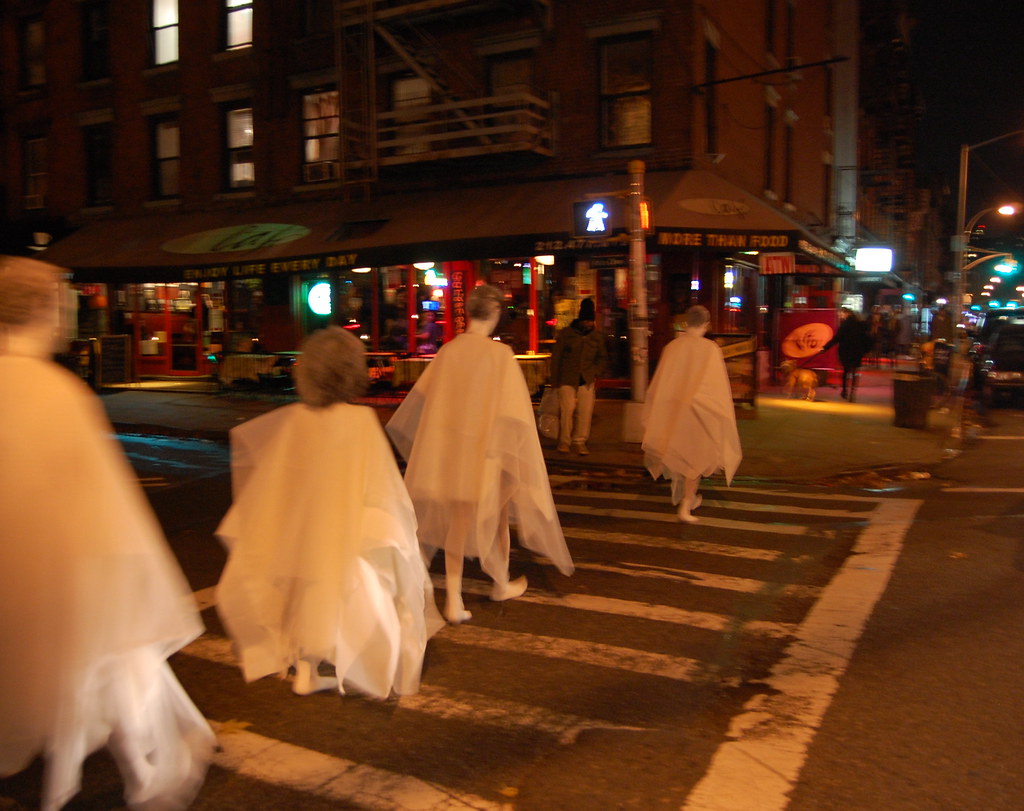
Terence Koh, Silent March, November 21, 2009, at Tompkins Square Park


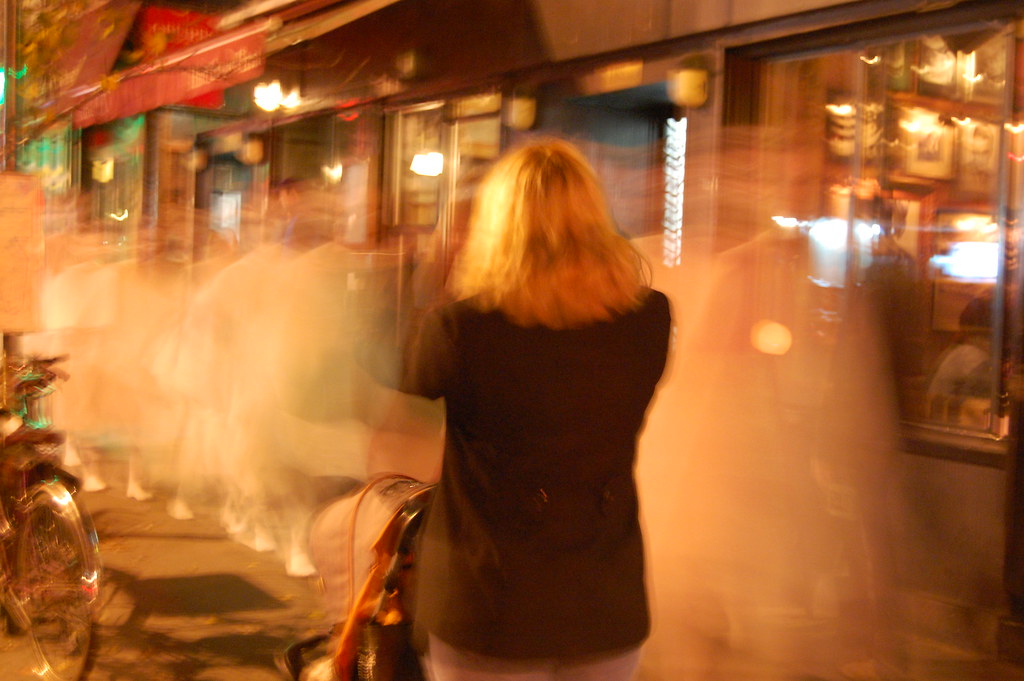
Terence Koh, Silent March, beginning at Tompkins Square Park, November 21, 2009 for Performa 09. Photos: 16 Miles [more]


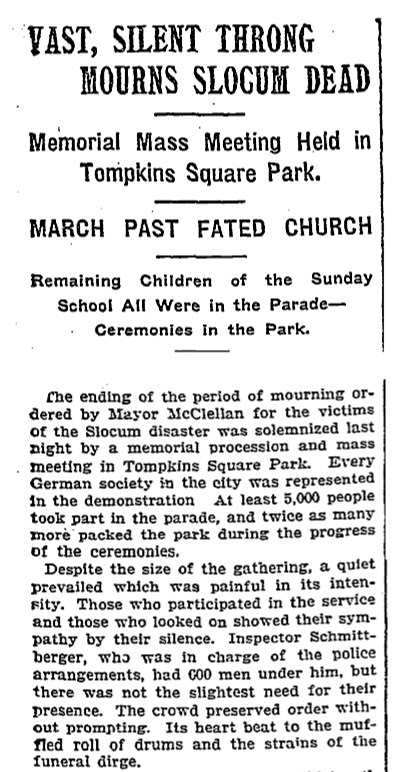
The New York Times, July 15, 1904


“Despite the size of the gathering, a quiet prevailed which was painful in its intensity.”
- The New York Times, “Vast, Silent Throng Mourns Slocum Dead,” July 15, 1904

By 7:00 pm last night, most of Tompkins Square Park had been deserted, though about 100 people had congregated at its center “in the middle bye [sic] the two trees,” just as a note circulated by Terence Koh had requested. New Yorkers wandering through the park, many walking dogs, seemed surprised to find the gathering. Hearing that the crowd was waiting for some sort of art performance, many decided to wait, and the mass slowly grew.

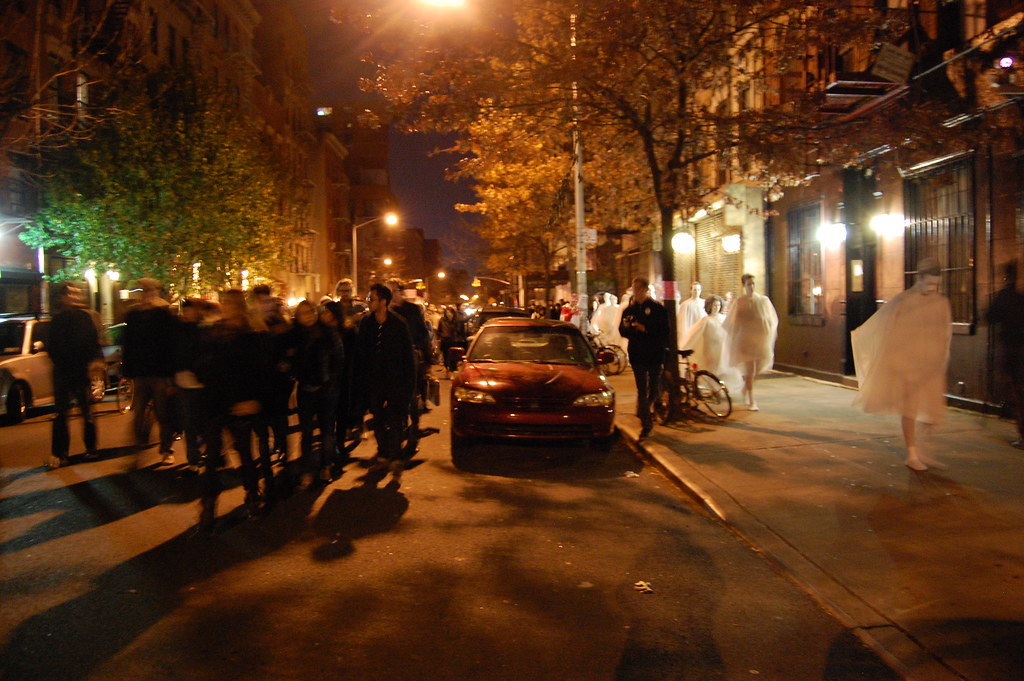
Many of those waiting scanned the park’s perimeter, apparently wondering where the event would begin. As 7:30 approached, some wondered aloud if Koh had perhaps created a Godotian situation, or if he had possibly been nabbed by police who had been tipped off to some unimaginably obscene aspect of the piece. But then they appeared — 10 figures clad in layers of buoyant fabric, tights, and face paint, all white, sans shoes — marching quietly in a line. Koh did not appear to be among the group.

Two neighborhood kids, maybe 10 or 11 years old, ran along with the group, shouting questions at them. “Are you zombies? Are you dead?” They jumped, waving their hands in front of the walkers’ faces, then trotted jokingly behind them, as line curved its way through the otherwise empty park. The kids turned to the spectators, “Why are they doing this?” We, of course, were equally baffled and couldn’t answer with much more than “It’s art,” or “It’s a performance.”

The 10 marchers exited the park onto Avenue B and headed north, walking slowly enough that the crowd could easily walk past them and view the spectacle from every side. The audience flooded into the street, letting the sidewalk serve as a makeshift stage. It felt wrong to get too close. Diners and drinkers in bars and restaurants stopped to stare. Smokers out on the street shouted questions and asked audience members. “Where are they protesting?” “Why are you doing this?” Drivers seemed understanding of the mass, laughing or simply pausing and gazing as the walkers passed.

A few audience members fell away as the walkers turned left onto East 13th Street. How long could they walk? It was cold. Finally, crossing Avenue A, after a brief pause for a traffic light to change, the group ventured into the Phoenix bar, whose patrons looked largely nonplussed. Many of the white-cloaked performers, who eyed each other somewhat nervously, also looked confused. Did they know where they were going, or were they just following along, as well?

After a few minutes, the leader exited the bar and led the group back across Avenue A and into an apartment building. “That’s it. The performance is over,” the man holding the door for them informed the crowd, before swinging it shut. People loitered for a bit, waiting to confirm his statement. Then they walked off in every direction.


Sunday, November 8, 2009

Fischerspooner at MoMA / "100 Years..." at P.S.1 [Review]


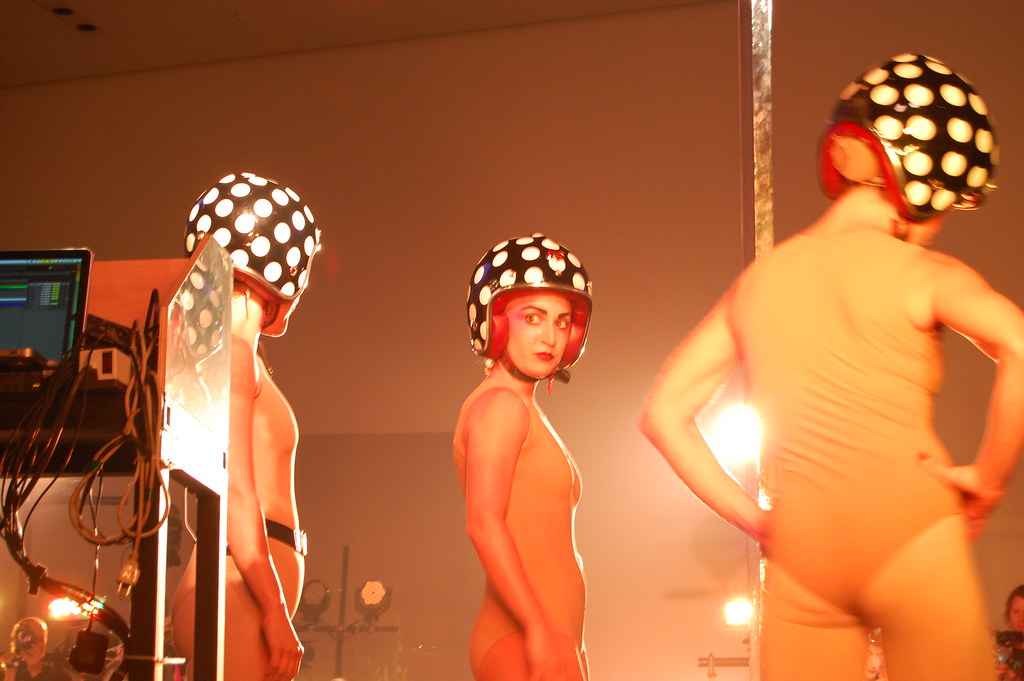
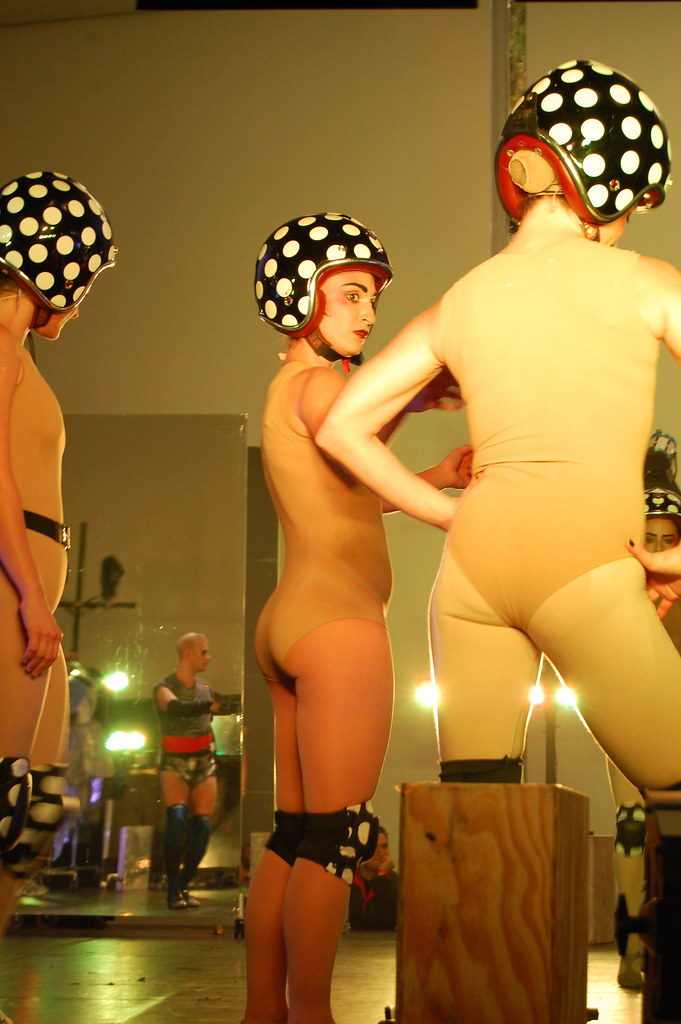
Fischerspooner, Between Worlds, Nov. 1, 2009 at the Museum of Modern Art, New York, for "Performance" 6. Photos: 16 Miles [more]

The first third of Performa 09, New York's performance biennial, has finished. The Museum of Modern Art staged a Fischerspooner show as part of the festivities (and as part of its performance series), while P.S.1 is hosting a short-term performance art exhibition curated by RoseLee Goldberg (Performa's founder) and P.S.1 director Klaus Biesenbach. Here's a review:
Midway through a Sunday night performance in the Museum of Modern Art’s atrium, Casey Spooner signaled his band Fischerspooner to a sudden halt. “I’m going to die!” he screamed to the young, fashion-conscious crowd, apparently displeased with their level of enthusiasm. “I’m a showbiz disaster. This is your last chance to show your love!” The crowd cheered, trying to oblige their fated star, and the noise appeared to be sufficient. Spooner who takes the role of a rampaging showman on stage — equal parts Boy George and Roman gladiator — motioned to his team, and the group’s raucous club music started again.


Tuesday, September 29, 2009

Misremembering Allan Kaprow's Courtyard


Lawrence N. Shustak,
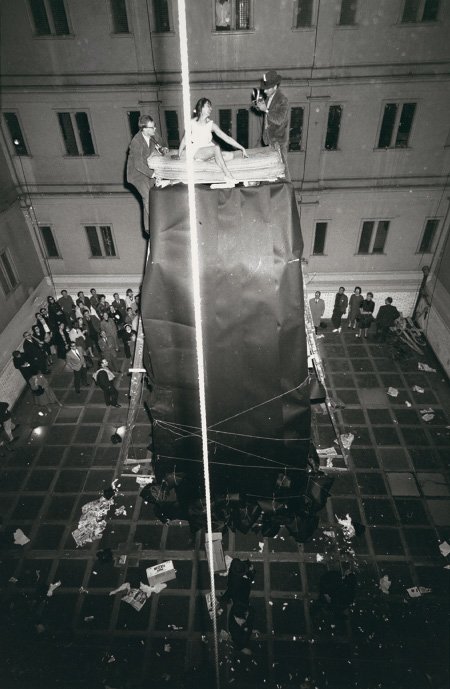
William Mahin, Lette Eisenhauer, and Charles Simon Atop Giant "Mountain" Construction in The Courtyard, a Happening by Allan Kaprow, New York City, 1962, from the Heilbrunn Timeline of Art History at the Metropolitan Museum of Art. [more]
Hauser & Wirth is creating three editions of Allan Kaprow's Yard happening to celebrate the gallery's arrival in the United States. At 32 East 69th Street — where Kaprow first installed the work, when Martha Jackson Gallery was housed at that address — they've teamed with William Pope.L, who has piled tires on the floor and recorded a monologue that drones from speakers around the space.

It's an epic event, though it's tame compared to some of Kaprow's more baroque performances, such as Courtyard, which he staged in 1962 in Greenwich Village at a rundown hotel. Onlookers were provided with brooms to move debris about as a woman (swaying to rock and roll jams on a transistor radio) climbed a massive mountain, was photographed by two faux-paparazzi, and was then consumed by another mountain that descended from a neighboring building. Those, at least, are the details on which most people that claim to be there (or claim to have known people who were there) agree.

Performance — existing only for fleeting moments and surviving only in secondary forms (photographs, memories, recordings) — almost inevitably invites the creation of legends, mistakes, and fabrications. Looking into Courtyard, it's amazing to see Susan Sontag, Hans Richter, and numerous art historians being unable to agree on one of the most rudimentary details of the event: where it happened.

First, Sontag in "Happenings: An Art of Radical Juxtaposition":
When the Happening is more purely spectacle, and the audience simply spectators, as in Allan Kaprow's The Courtyard, presented in November, 1962, at the Renaissance House, the event is considerably less dense and compelling.
It was at the Renaissance house, she says. Dadaist Hans Richter, who must be considered the Henry Clay of the avant-garde for his longevity and sheer omnipresence in his field, was living in New York at the time and disagreed with Sontag:
The "Happening" I went to see took place in the enormous courtyard of a skyscraper, the Mills Hotel in the Village. This is the biggest "flophouse" in the world, twelve hundred little rooms for the poorest people, who still have to pay 50 cents a night.
Richter is sure it happened at the Mills Hotel. Art historian Jeff Kelly, meanwhile, shares a belief cited by quite a few people who study Kaprow, writing something completely different:
Fittingly, the final Happening of 1962, Courtyard, took place over Thanksgiving weekend in one of the inner courtyards of the Greenwich Hotel, at the time a transient hotel in Greenwich Village.
As performance art continues to enter the canon in the form of the Performa biennials in New York, MoMA's new focus on collecting and showing work in the field (with all of the wonderfully tricky legal issues that entails), and the upcoming retrospective at P.S.1, it's fun to remember just how intensely some of these works resist easy preservation, how — as time passes — our understanding of these is events is becoming foggier, more complicated, and more a product of our collective imaginations.

Thursday, May 15, 2008

Performance 1 - Carolee Schneeman, Meat Joy (1964) [Excerpt]


Compendium of performances in Paris, London, and New York filmed by Pierre Dominik Gaisseau.

Schneeman, in a letter to Jean-Jacques Lebel:
There are now several works moving in mindseye. ... Meat Joy shifting now, relating to Artaud, McClure, and French butcher shops - carcass as paint (it dripped right through Soutine's floor) ... flesh jubilation ... extremes of this sense. ... Smell, feel of meat ... chickens, fish, sausages?

Sunday, April 6, 2008

Eduardo Sarabia's Bar Aleman at the Whitney Biennial

Photographs by Lauren K.


With Nicolas Bourriaud's notion of "relational aesthetics" now being embraced by curators at major museums thirteen years after its formulation, it was perhaps inevitable that visitors to the 2008 Whitney Biennial would be greeted with quite a few social events presented as art: among them, an interactive music performance (Lucky Dragons), an artist-curated dinner party (Rita Ackermann & Agathe Snow), a slumber party (DJ Olive), and a series of dance marathons (Agathe Snow, again).


Among these, though, none was probably more warmly received - and rightfully so - than Eduardo Sarabia's drinking establishment Bar Aleman. For a series of three nights Sarbaia served his homemade tequilas (available in three varieties) atop his ceramic and rosewood bar at the Park Avenue Armory. The night I was there (March 14, the final evening), my friends and I were served the delicious, smooth tequila by his friends, while he provided jams from a set of turntables. People were (pleasantly) packed into one of the main floor rooms, dancing as gigantic stuffed moose and oil portraits of long-passed general stared down on us.

There's not necessarily anything radically new here; contemporary artists have, of course, been playing the role of restauranteur and club promoter for some time now. Three examples: Gordon Matta-Clark running the pioneering SoHo establishment Food in the early 70's, Damien Hirst providing the decor and conceptual underpinnings for London's Pharmacy in the late 90's, Rirkrit Tiravanija opening a Thai food stand in New York's 303 Gallery in 1996. Matta-Clark and Hirst were establishing legitimate businesses (even if it's doubtful that Food ever pulled much of a profit), while Tiravanija was aiming for the opening of some sort of utopian framework for interaction within the gallery.


Sarabia's twist on the game is a lot more fun: three nights, some extra money via the Art Production Fund for full liquor licenses, and a massive sound system. It might be an allegory for the post-millennial art market (Though Sarabia claims his pure tequila leaves no hangover! No comment on that.) or a commentary on first-third world relations filtered through a meditation on agave production (as the Whitney's curators would somewhat bizarrely prefer you have it), but at its core it seems like an attempt to subvert the museum's standard operation, if only for a few moments. In place of the institution's bourgeois obsession with conservation, one experiences unrestrained expenditure, a give away (destruction) not unlike the potlatch ritual.

Art costs money, and Sarabia - to everyone's obvious delight - chooses to burn both in the service of a party. In one sense, it's an immense celebration of a change in status (a common occasion for the potlatch): he's made it into the Biennial. But Georges Bataille has noted that the potlatch is not purely celebratory: it also contains an inherent provocation, "... constituted by a considerable gift of riches, offered openly and with the goal of humiliating, defying, and obligating a rival." In other words, Bar Aleman, proffering endless glasses of tequila and blasting dance music, positions itself apart from Tiravanija's (and the Whitney's) purported desire for democratic discourse. In its place, it posits two things better-aligned with the moment: pure revelry and a bold challenge.