Showing posts with label East Village. Show all posts

Sunday, May 1, 2011

Art Books on the Runway: Publication Studio in the East Village

Performance excerpts from "The Spring Line: Publication Studio in New York," at Heathers, April 28, 2011. Video: 16 Miles

Collaborations between the art and fashion worlds have become de rigueur in recent years, but I was nevertheless surprised to read an email from the scrappy Portland imprint Publication Studio that announced its plan to have authors and artists "walk the Spring Line runway" at a book celebration last Thursday at the East Village bar Heathers to celebrate the company's newest publications. Murakami joyfully designing Vuitton bags is one thing, but asking writers to take to the catwalk sounded inhuman, a bizarre and disconcerting embrace of a fashion ritual.

Thankfully, instead of seeing an exploitative spectacle, an audience of a few dozen people watched a bewildering art-book fashion show, with Publication Studio founder Matthew Stadler announcing brief synopses of the new books as each respective author (or a surrogate) walked along the length of the bar, brandishing the bound volume in his or her hand and showing it to the crowd. A baby, held in his mother's arms, carried proudly above his head a new art book by the fast-rising Ruby Sky Stiler. A young man held a blinking red light in front of Joseph Redwood-Martinez's event statements as he walked the improvised runway, showing the book, which was produced from, as Stadler put it, "utterly riveting [e-flux] emails." A photo-illustrated work of fiction by artist Colter Jacobsen and Berkeley Art Museum director (not to mention 2002 Whitney Biennial curator) Lawrence Rinder was paraded through, as was a photo book by Ari Marcopoulos.
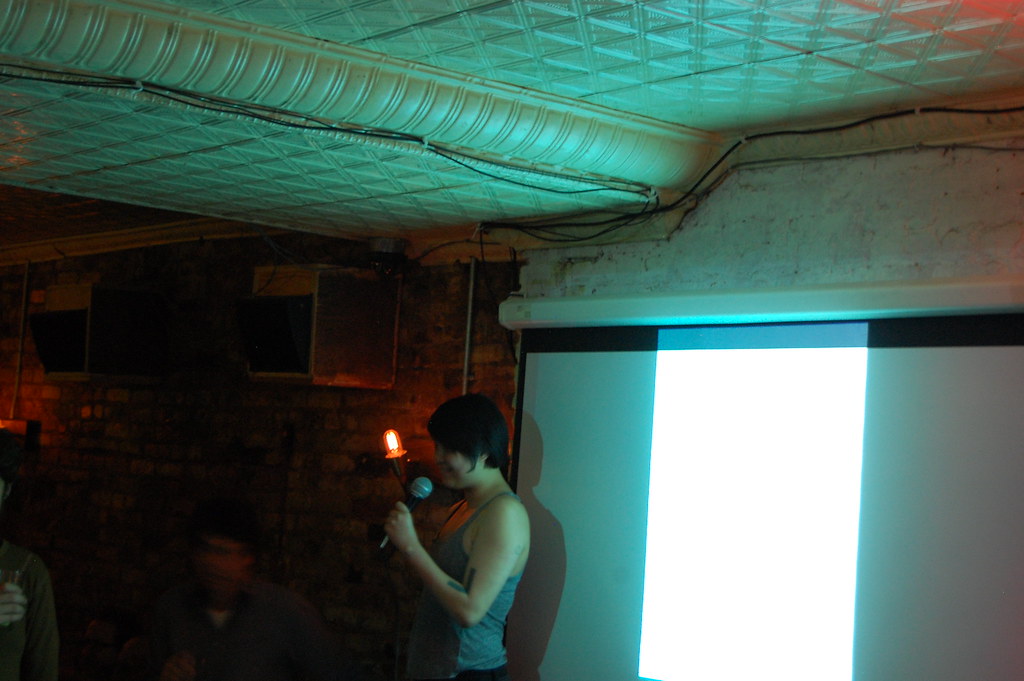

Matt Keegan discussed his book, A History of New York, which was inspired by Ric Burns's PBS documentary, New York.

There would be no strutting for artist Matt Keegan, who instead took to the stage to present a slide show about his new 365-page tome A History of New York, which contains images that have culled from Ric Burns's documentary film New York and stripped of their identifying captions, left to viewers to identify. (Keegan currently has a — sort of — New York–themed show up at D'Amelio Terras, which sports a press release that includes an interview that he conducted with graphic designer Milton Glaser: well worth a read.) Publication Studio had been "a pleasure to work with," Keegan told the crowd. "They weren't concerned with image copyright." He then added quickly, "I hope I didn't just get anyone into trouble."

Stadler returned to the stage. "The circulation of new material is the best response of artists and writers," he said, articulating his company's copyright ethos. He emphasized that he always aims to work "ethically and effectively," and that he asks that anyone who has an intellectual property claim with one of his company's books to notify him. Burns has apparently not yet made that call.
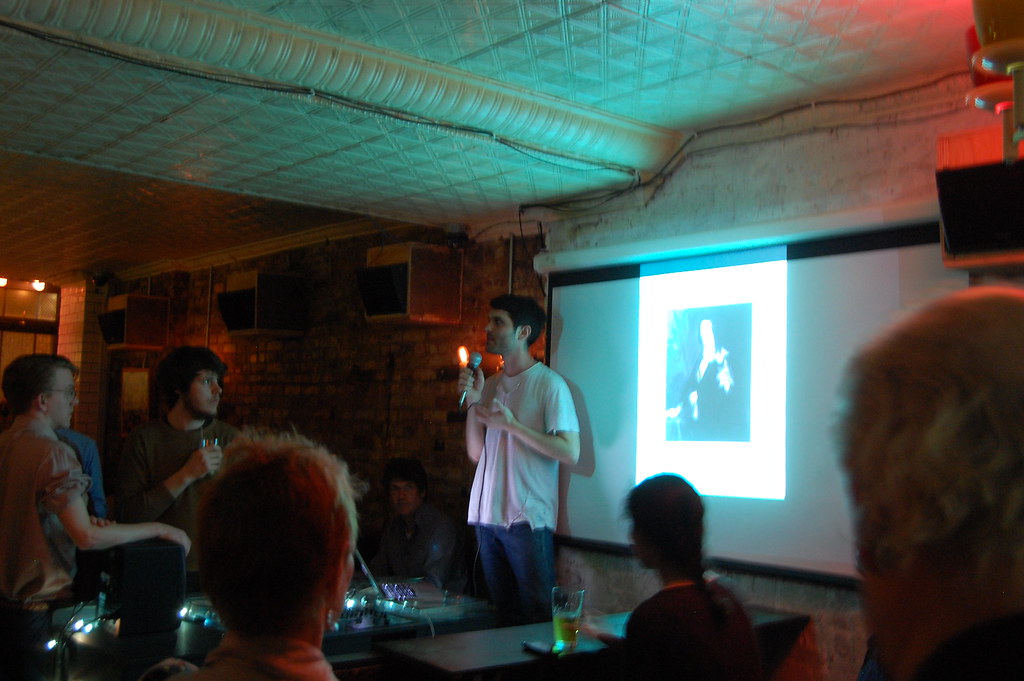

Christine Shan Shan Hou read an excerpt from her poetry book, Accumulations.

There would be no such concerns for writer Christine Shan Shan Hou, who concluded the evening's festivities by reading aloud excerpts from her first book of poetry, Accumulations, which includes drawings by Hannah Rawe. People sat and stood quietly, as she spoke, closing with a new piece. It was the first and only time that it felt like a book reading was taking place.

Tuesday, March 29, 2011

Every Single Day: Joachim 'YoYo' Friedrich at Second Guest Projects


Installation views of Joachim 'YoYo' Friedrich, "Everydays," at Second Guest Projects, New York. Photos: 16 Miles [more]


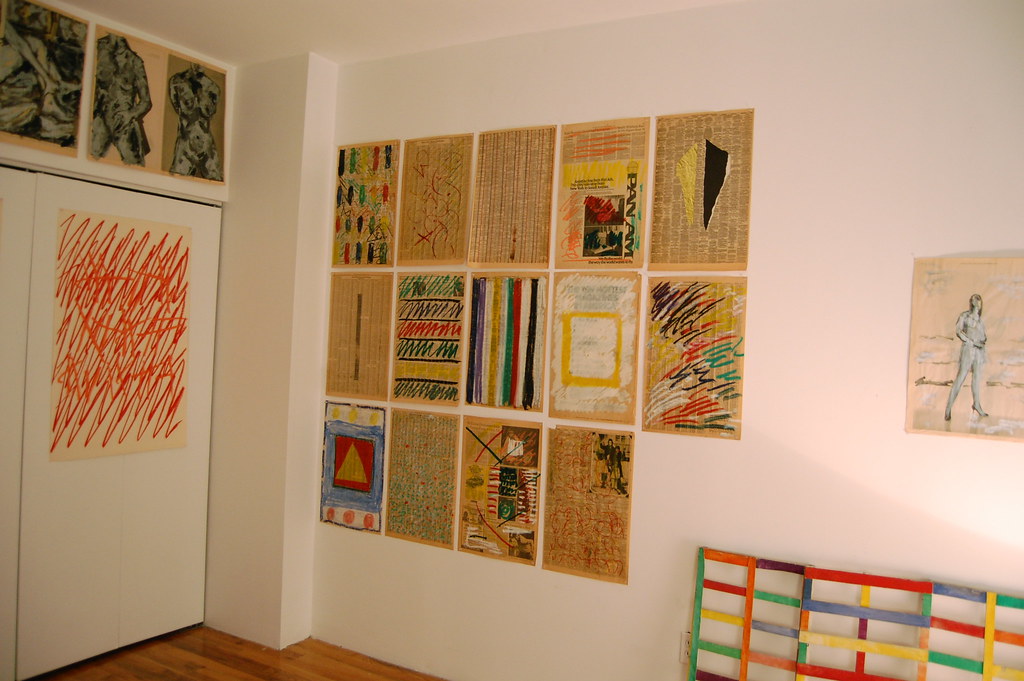
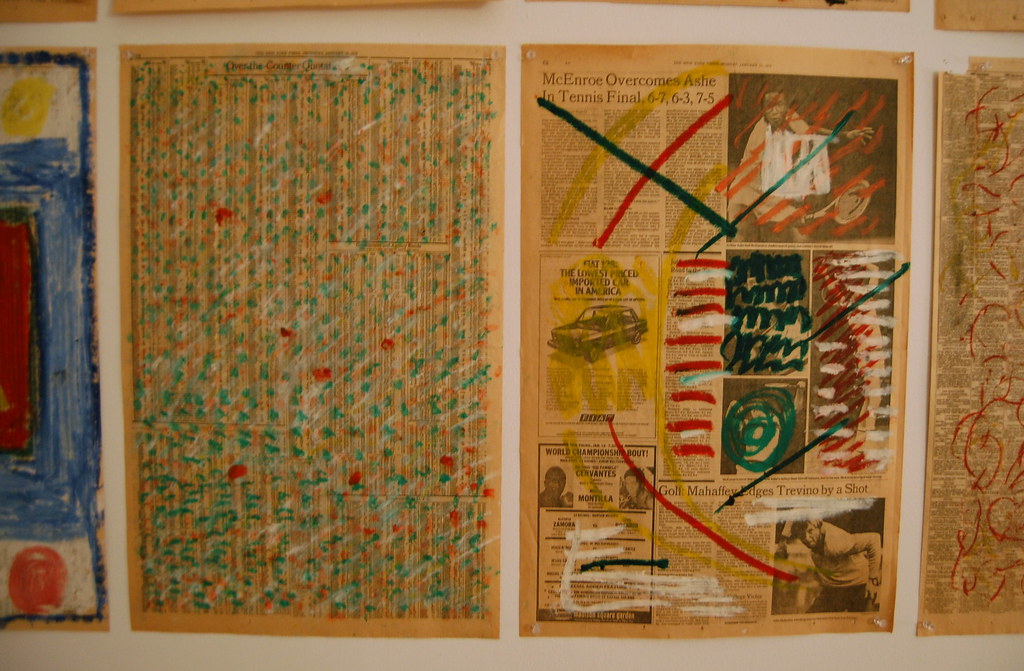
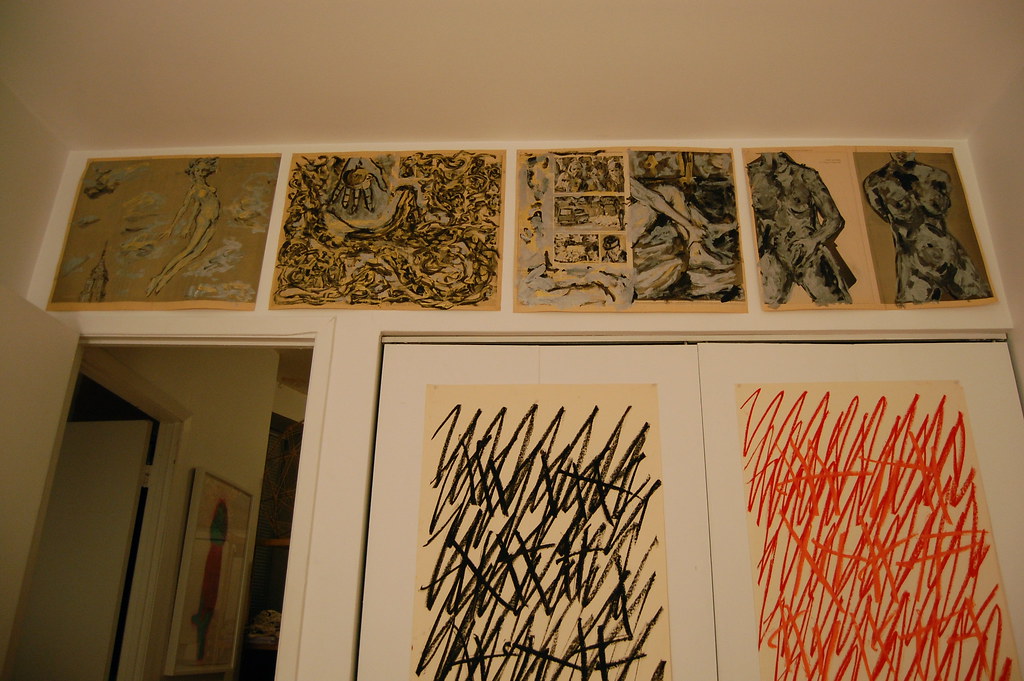
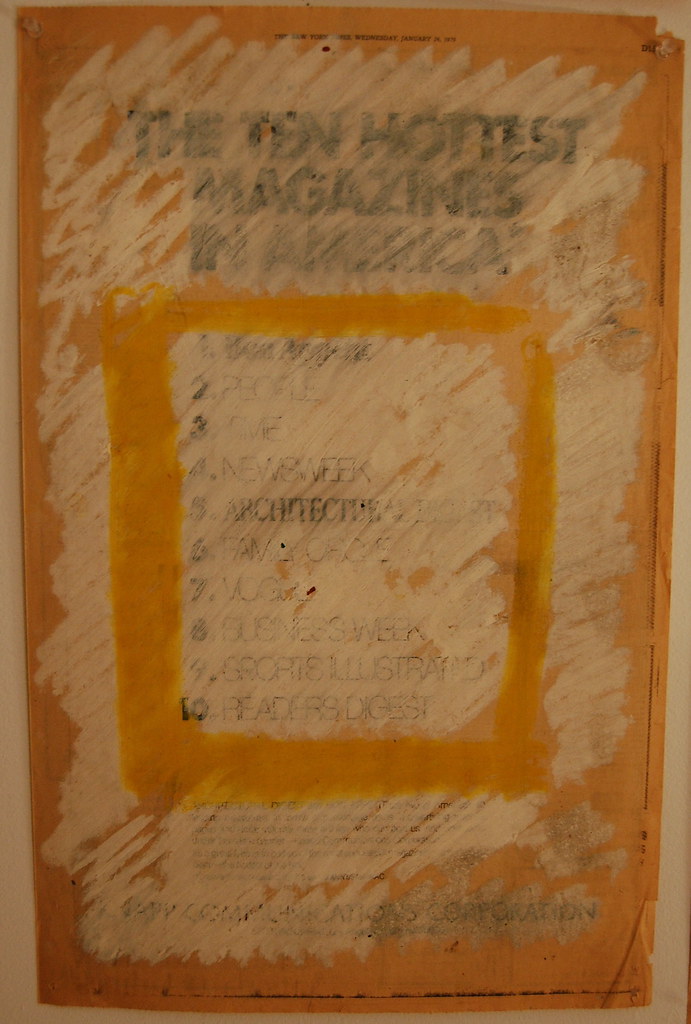
Every day that On Kawara completes a new painting in his "Today" series, he stores it in a box with a clipping from that day's newspaper, placing art and artifact side by side. Berlin-born artist Joachim "YoYo" Friedrich, in contrast, literally combines the two, working directly on pages from the paper. Friedrich, who was born in 1940, has been at it for years, using each day's layouts as the basis for humble, colorful drawings that together amount to a quirky compendium of the possibilities of abstraction. Rarely exhibited, some of these pieces are now on view at Second Guest Projects, an appointment-only space run by Quang Bao and Pau Atela out of what was once (and sometimes still is) the guest room in their East Village apartment.


"Another first from Pan Am," an advertisement on one newspaper page that is hanging in the space reads. "The only non-stop from New York to Saudi Arabia." Friedrich has covered various parts of the ad, sliced from the January 16, 1979, issue of the New York Times, with patches of yellow, peach, red, and two shades of green that recall Günther Förg or Imi Knoebel at their loosest. He has slashed the two articles above the ad — "Arab Boycott's Unwilling Participants" and "Israel's '78 Inflation Rate at 50%, Highest Since '74" — with just five peach lines. Elsewhere, he hews more closely to the paper's design, perfectly tracing the lines that separate the narrow columns of classified ads, or scrawling spiky passages along the length of articles that are stacked one on top of another. You may be reminded of the late Hanne Darboven. Friedrich does figuration, too, transforming the models wearing Marc Jacobs clothes in a 1994 ad into brushy black-and-white nude studies.


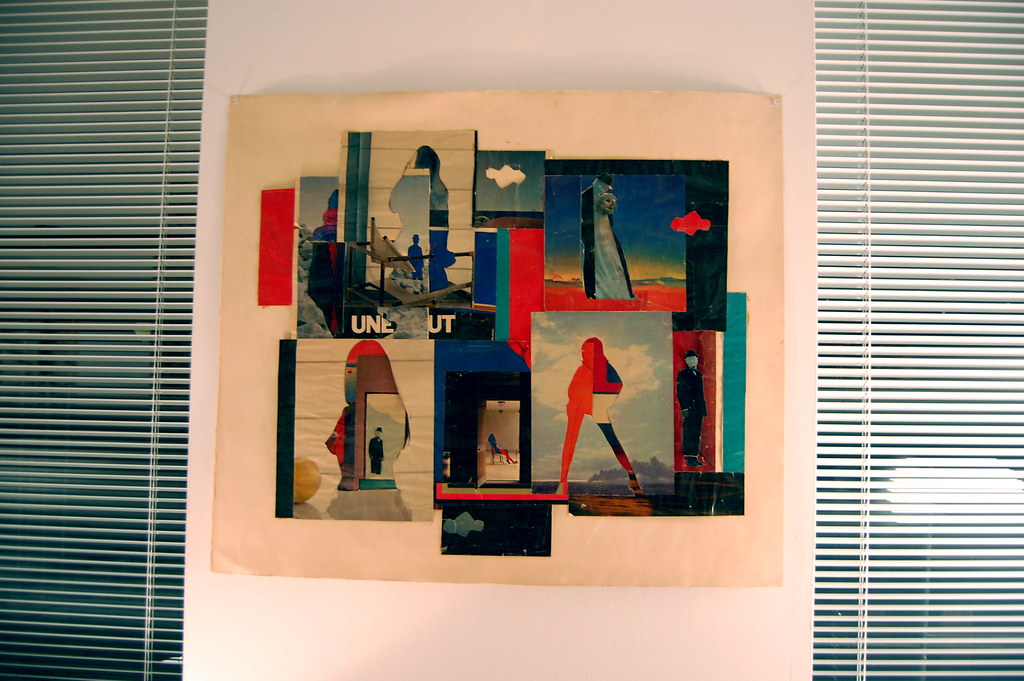
Second Guest Projects also has a handful of non-newspaper works by Friedrich on view, like a grid made with brightly colored thin wooden planks that could be the skeleton for a Stanley Whitney canvas and a square of canvas that he has covered with scores of garlic skins. It would slide easily into Luxembourg & Dayan's current "Unpainted Paintings" show, if only Friedrich was a more bankable name. Those garlic skins, like the pages of Friedrich's newspaper, are gradually wasting away. Even as that happens, they serve as records of the artist's quiet, personal responses to the steady passage of time, each day bringing a new artwork, a new paper, a new meal, or all three.


More information about Second Guest Projects is available by e-mailing secondguestprojects at gmail dot com.

Friday, August 13, 2010

Antony Gormley Is Drowning, or: It's a Small Art World


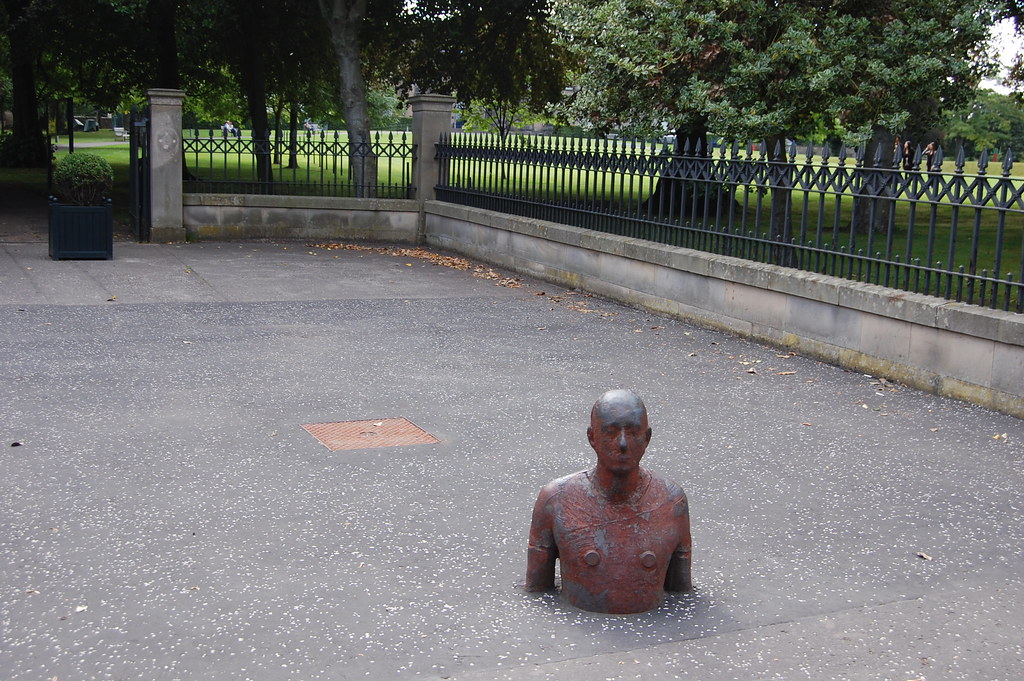
Installation view of Antony Gormley, 6 Times, 2010. Photos: 16 Miles

For the past few months New Yorkers in the vicinity of Madison Square Park have been busy calling the police to report that metal body casts of Antony Gormley are preparing to jump off the roofs of various skyscrapers. ("Art is on ledge of insanity," the New York Post put it.) Now it seems that there are more suicidal Gormley sculptures on the loose. In Edinburgh, six similar casts have been installed in various points between the Scottish National Gallery of Modern Art and the sea. With heavy rain falling in the area, two that were standing knee deep in the Water of Leith have even been knocked over and drowned. Thankfully, they have been not been lost and officials have stood them back up again. (Some really remarkable photographs are available through the National Gallery. I unfortunately only saw the one drowning in concrete, above.)


Unlike the New York installation, the six sculptures in Scotland are set to stay in place for 1,000 years. The New York piece, Event Horizon (2010), closes in two days, so this is the final weekend you will be able to go to Madison Square Park, pick up a Shackburger (and frozen custard), and view the ominous piece. If anyone has any doubts about how small (and pervasive) the art world is today, witness the advertisement I found at my local bus stop upon returning home, only a few hours after seeing the same sculptures more than 3,000 miles away.

Monday, June 21, 2010

Ninth Street: Allan D'Arcangelo, 1968/2010


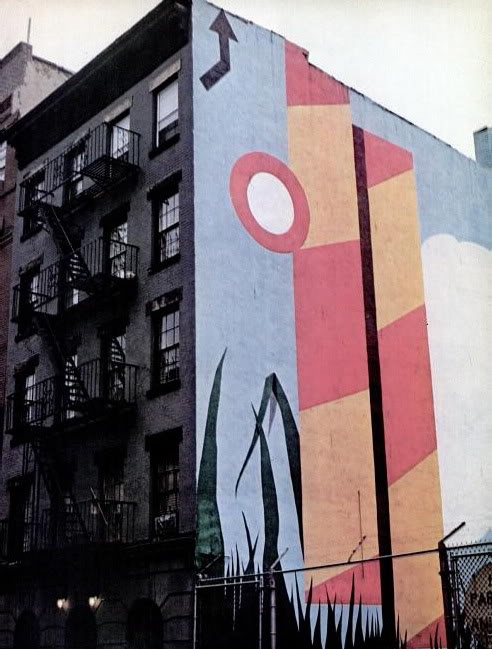
Mural by Allan D'Arcangelo, 340 East Ninth Street (between 1st and 2nd Avenue), in Peter Blake, "Graffiti Are Growing Up," New York, April 29, 1968. Photo: 16 Miles [more]


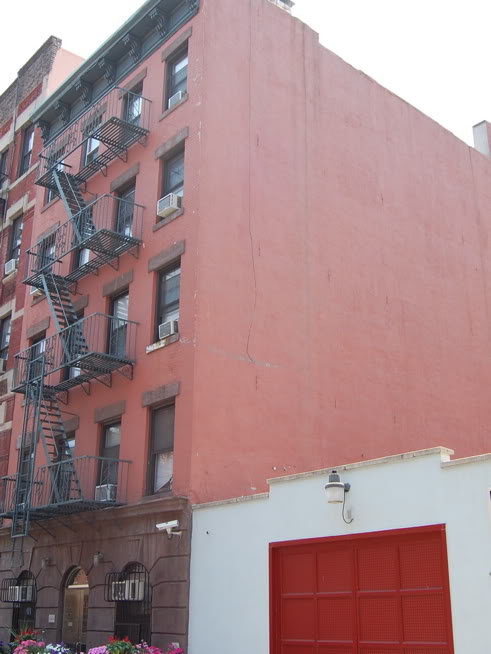
340 East Ninth Street, 2010

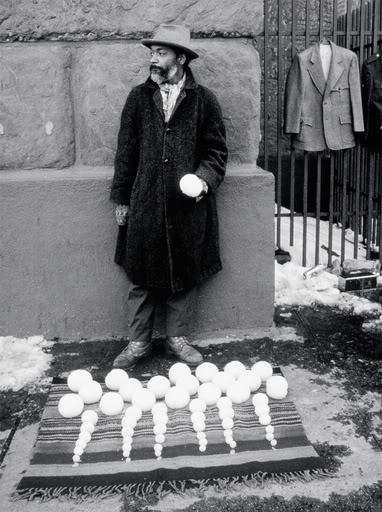
“Some blocks in New York are so polychrome they make Carnaby Street look like just another Saville Row,” Peter Blake proclaimed in New York, in 1968, the year of the magazine’s founding. Public art was popping up everywhere, Blake explained, thanks in part to a “determined urban designer” named David H. Bromberg, who was running around downtown Manhattan convincing landlords to let the exposed sides of their buildings be painted by contemporary artists. This “hard-edge roadscape with directional signs, clouds, abstract flora, and railroad crossings” by the underrated Pop artist Allan D’Arcangelo (whose estate is today represented by Mitchell-Innes & Nash) was Bromberg’s first project. It has since been painted over.


Peter Blake, "Graffiti Are Growing Up," New York, April 29, 1968

Related: Houston & Broadway: Joseph Kosuth, 1979/2010, Cooper Union: David Hammons, 1983/2010, and the Lost Art of New York Map

Saturday, November 21, 2009

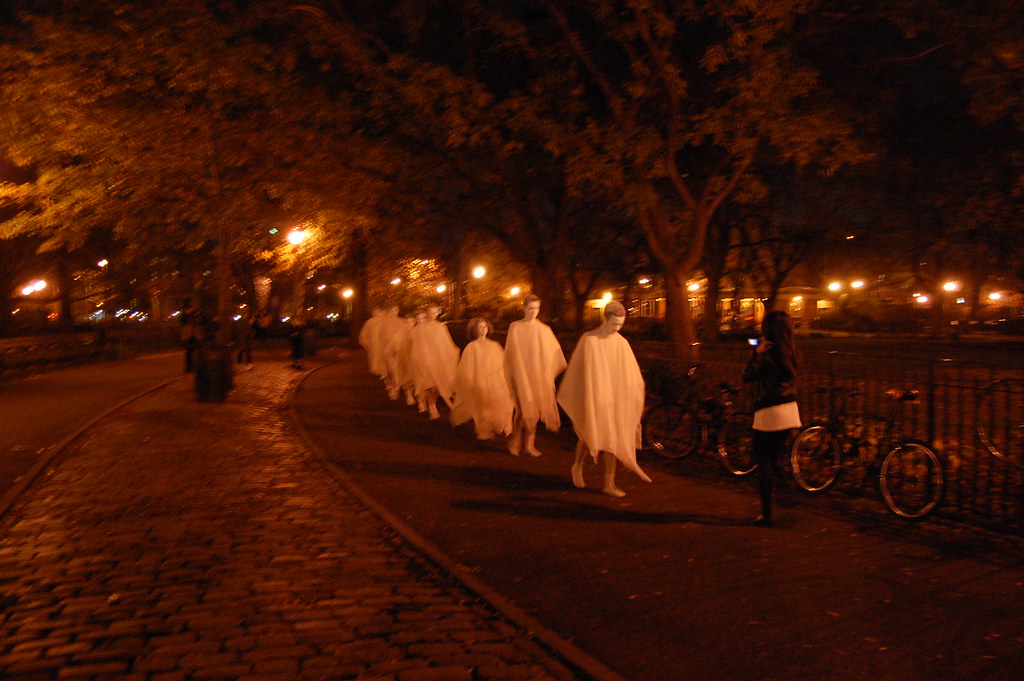
Terence Koh, Silent March, November 21, 2009, at Tompkins Square Park


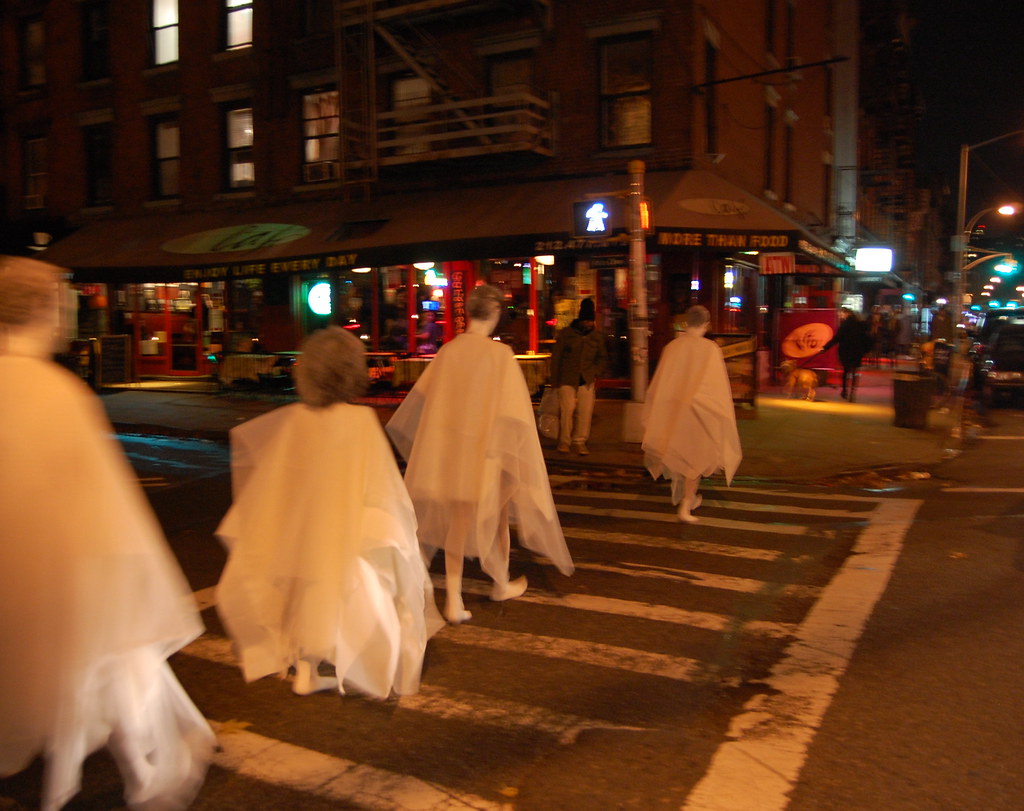
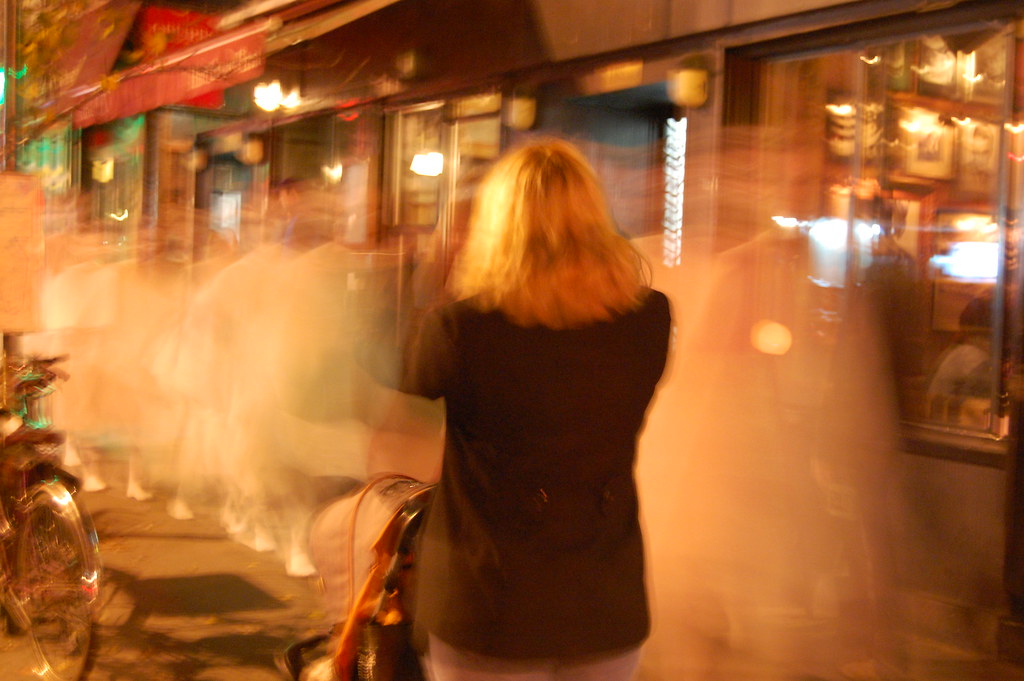
Terence Koh, Silent March, beginning at Tompkins Square Park, November 21, 2009 for Performa 09. Photos: 16 Miles [more]


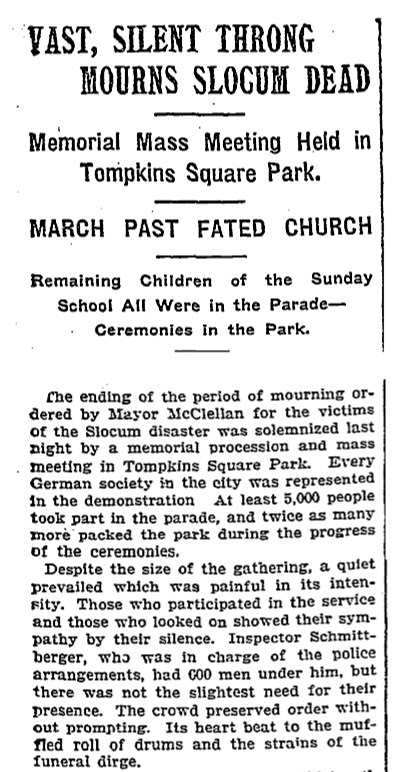
The New York Times, July 15, 1904


“Despite the size of the gathering, a quiet prevailed which was painful in its intensity.”
- The New York Times, “Vast, Silent Throng Mourns Slocum Dead,” July 15, 1904

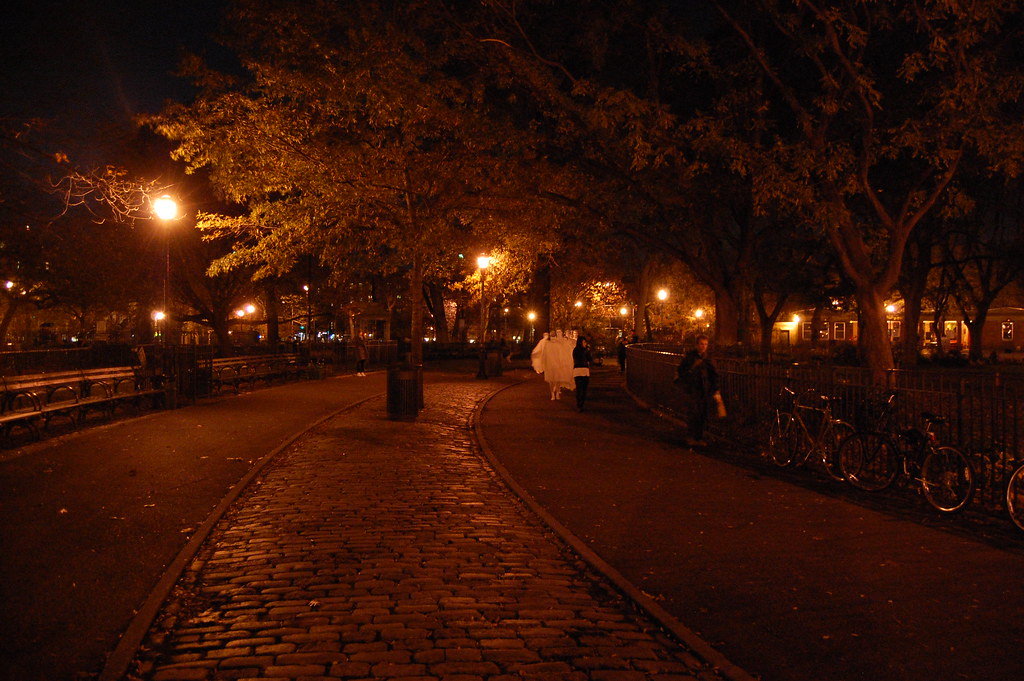
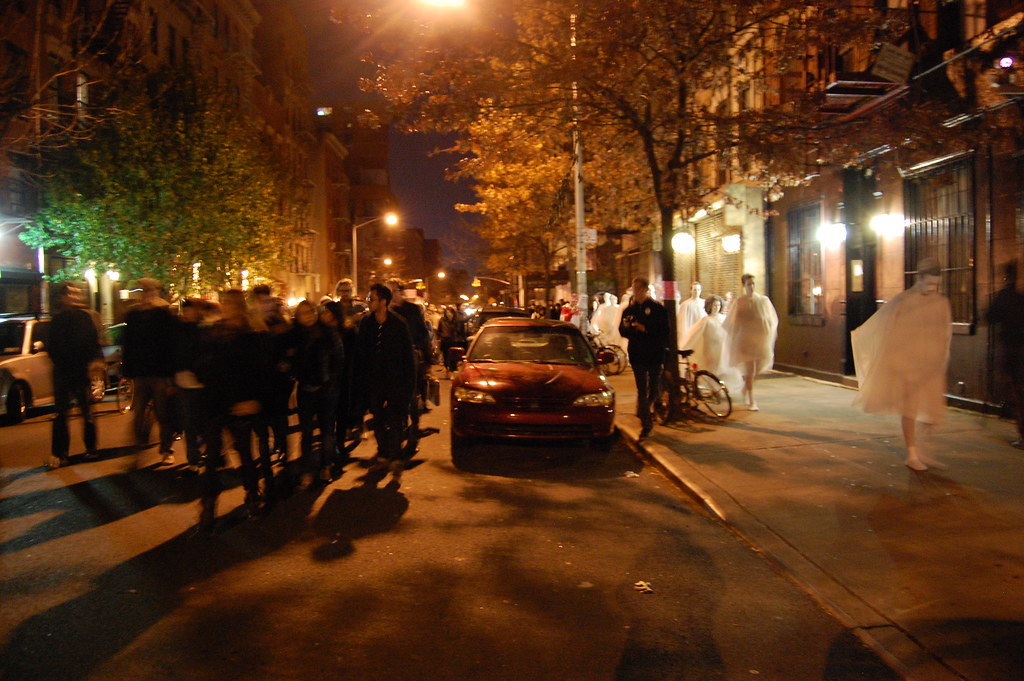
By 7:00 pm last night, most of Tompkins Square Park had been deserted, though about 100 people had congregated at its center “in the middle bye [sic] the two trees,” just as a note circulated by Terence Koh had requested. New Yorkers wandering through the park, many walking dogs, seemed surprised to find the gathering. Hearing that the crowd was waiting for some sort of art performance, many decided to wait, and the mass slowly grew.

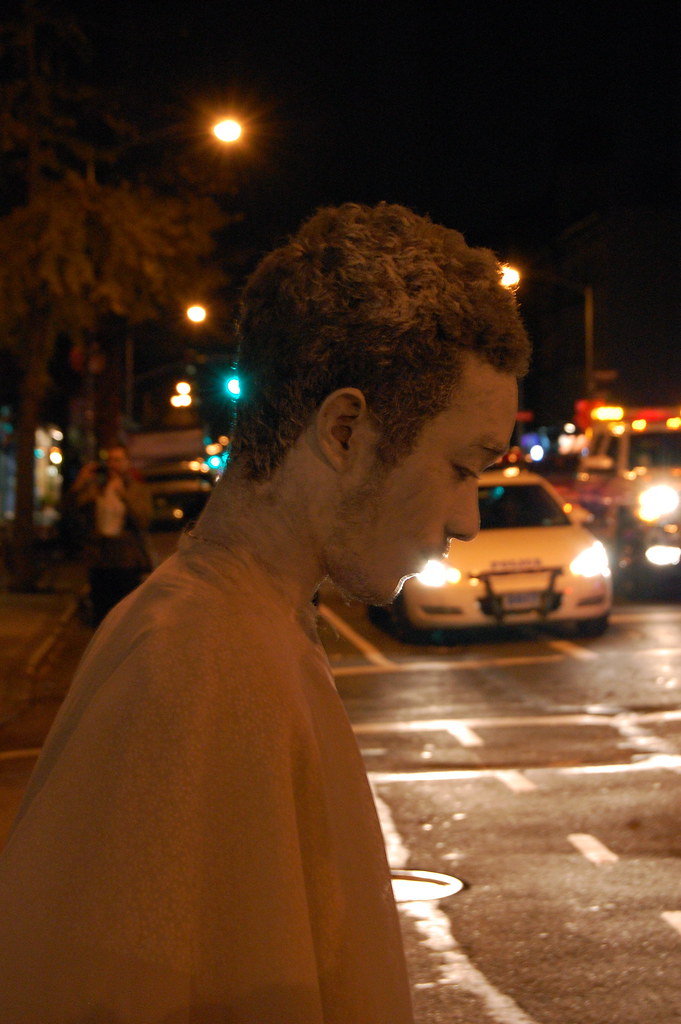
Many of those waiting scanned the park’s perimeter, apparently wondering where the event would begin. As 7:30 approached, some wondered aloud if Koh had perhaps created a Godotian situation, or if he had possibly been nabbed by police who had been tipped off to some unimaginably obscene aspect of the piece. But then they appeared — 10 figures clad in layers of buoyant fabric, tights, and face paint, all white, sans shoes — marching quietly in a line. Koh did not appear to be among the group.

Two neighborhood kids, maybe 10 or 11 years old, ran along with the group, shouting questions at them. “Are you zombies? Are you dead?” They jumped, waving their hands in front of the walkers’ faces, then trotted jokingly behind them, as line curved its way through the otherwise empty park. The kids turned to the spectators, “Why are they doing this?” We, of course, were equally baffled and couldn’t answer with much more than “It’s art,” or “It’s a performance.”

The 10 marchers exited the park onto Avenue B and headed north, walking slowly enough that the crowd could easily walk past them and view the spectacle from every side. The audience flooded into the street, letting the sidewalk serve as a makeshift stage. It felt wrong to get too close. Diners and drinkers in bars and restaurants stopped to stare. Smokers out on the street shouted questions and asked audience members. “Where are they protesting?” “Why are you doing this?” Drivers seemed understanding of the mass, laughing or simply pausing and gazing as the walkers passed.

A few audience members fell away as the walkers turned left onto East 13th Street. How long could they walk? It was cold. Finally, crossing Avenue A, after a brief pause for a traffic light to change, the group ventured into the Phoenix bar, whose patrons looked largely nonplussed. Many of the white-cloaked performers, who eyed each other somewhat nervously, also looked confused. Did they know where they were going, or were they just following along, as well?

After a few minutes, the leader exited the bar and led the group back across Avenue A and into an apartment building. “That’s it. The performance is over,” the man holding the door for them informed the crowd, before swinging it shut. People loitered for a bit, waiting to confirm his statement. Then they walked off in every direction.


Saturday, April 4, 2009

Andrew Kuo, I'm Dyin' Over Here, at Taxter & Spengemann [Photographs]


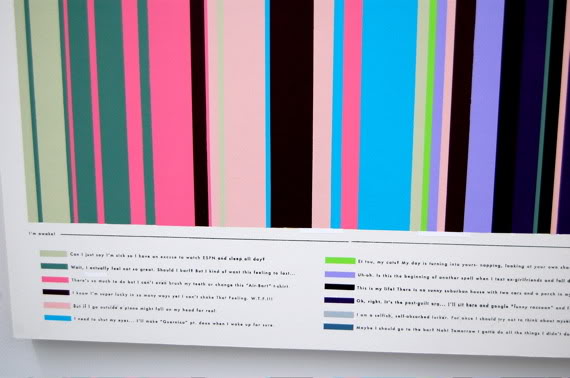
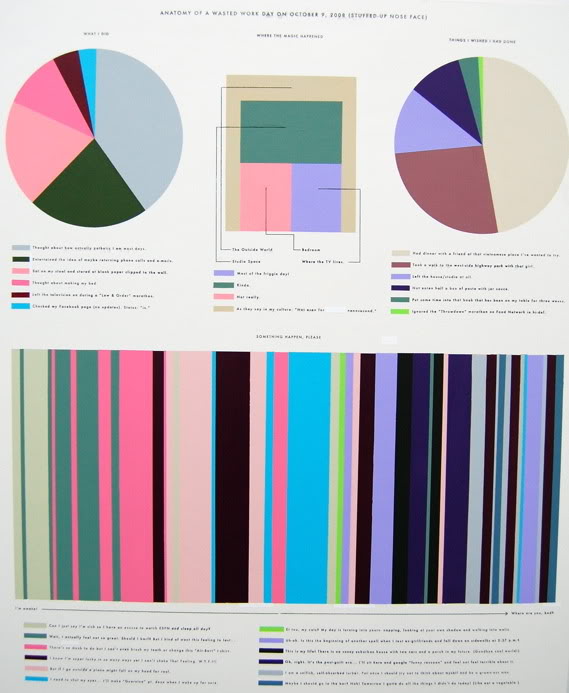
Andrew Kuo, Anatomy of a Wasted Work Day on October 9, 2008 (Stuffed-Up Nose Face), 2008. Photo: 16 Miles [more]

"I need to shut my eyes... I'll make "Guernica" pt. deux when I wake up for sure."


Andrew Kuo, Andrew Kuo, Anatomy of a Wasted Work Day on October 9, 2008 (Stuffed-Up Nose Face) [detail], 2008. Photo: 16 Miles [more]


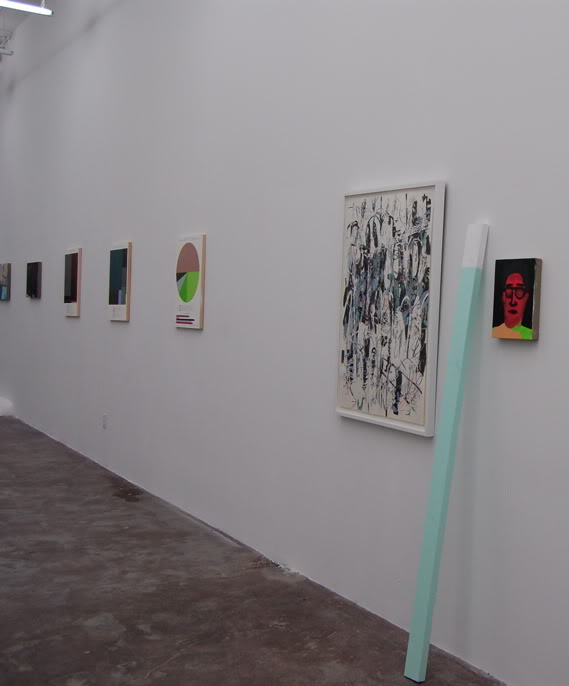
Andrew Kuo, I'm Dyin' Over Here [installation view]. Photo: 16 Miles [more]

Andrew Kuo, I'm Dyin' Over Here
Taxter & Spengemann
123 East 12th Street
New York, New York
Through May 9, 2009