Showing posts with label Edinburgh. Show all posts

Monday, August 16, 2010

"Work of Art" as Salon, Make Your Own Gerhard Richter, etc. [Collected]


Rachel Whiteread, Untitled (Pair), 1999. Bronze with cellulose paint. Scottish National Gallery of Modern Art. Photos: 16 Miles
  • "Work of Art = the Paris Salon," Brooklyn Museum curators argue in their reality-television-curated exhibition, making every other show in the world a salon des refusés. [LACMA on Fire]

  • Also, Work of Art is already casting for its second season. [Two Coats of Paint]

  • Make your own Gerhard Richter color chart painting. [Greg.org]

  • When and why did artists start signing their work? [Eyelevel]

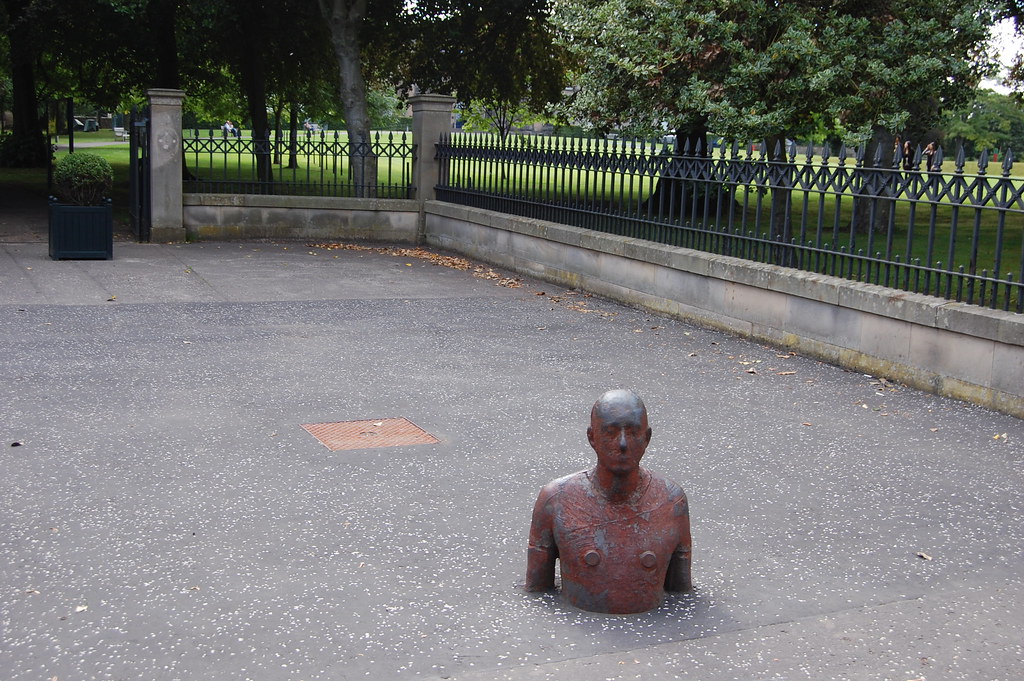
  • Antony Gormley's creepy body casts have been standing in New York and Edinburgh for a few months. Now there is a batch of 100 in Austrian Alps. [Art Observed]

  • In less than 50 years, artists have moved from wrapping a painting to wrapping a building and creating a lifelike sculpture that appear to leap off of it. [Strange Messenger]

  • This flan pâtissier looks like a Craig Kauffman wall piece. It also looks delicious. [Contemporary Confections]

  • "My [sic] mistake." [Murketing via Ms. Jen Bekman]

  • Karen Rosenberg on Lee Bontecou: "Those works resonate for much the same reasons Mad Men does. As Donald Judd once wrote, Ms. Bontecou 'linked something as social as war to something as private as sex, making one an aspect of the other.' [NYT]

Friday, August 13, 2010

Antony Gormley Is Drowning, or: It's a Small Art World


Installation view of Antony Gormley, 6 Times, 2010. Photos: 16 Miles

For the past few months New Yorkers in the vicinity of Madison Square Park have been busy calling the police to report that metal body casts of Antony Gormley are preparing to jump off the roofs of various skyscrapers. ("Art is on ledge of insanity," the New York Post put it.) Now it seems that there are more suicidal Gormley sculptures on the loose. In Edinburgh, six similar casts have been installed in various points between the Scottish National Gallery of Modern Art and the sea. With heavy rain falling in the area, two that were standing knee deep in the Water of Leith have even been knocked over and drowned. Thankfully, they have been not been lost and officials have stood them back up again. (Some really remarkable photographs are available through the National Gallery. I unfortunately only saw the one drowning in concrete, above.)


Unlike the New York installation, the six sculptures in Scotland are set to stay in place for 1,000 years. The New York piece, Event Horizon (2010), closes in two days, so this is the final weekend you will be able to go to Madison Square Park, pick up a Shackburger (and frozen custard), and view the ominous piece. If anyone has any doubts about how small (and pervasive) the art world is today, witness the advertisement I found at my local bus stop upon returning home, only a few hours after seeing the same sculptures more than 3,000 miles away.

Thursday, August 12, 2010

Susan Collis Makes a Mess


Susan Collis, Down to the Mother, 2008. Inlaid mother of pearl, dimensions variable. Photos: 16 Miles


Did someone spill milk on the floor of the Ingleby Gallery in Edinburgh? Has paint been splattered across the wooden boards with wanton disregard for the Iran do Espírito Santo on display in the room? Thankfully, no. Those marks are tiny slices of mother of pearl that have been worked into the panels of the floor. It's a permanent installation called Down to the Mother, 2008, a permanent installation by Susan Collis, who forges quotidian objects out of luxurious materials: she composed a 2007 sculpture that resembles a screw with coral, white gold, diamond, and silver, for instance. It's collector swag, certainly, but there's just enough mystery (and more than enough craftsmanship), to make it a smart piece — a bold move on the part of the gallery.

Wednesday, August 11, 2010

Edinburgh Gets Its Richard Wright Commission Half-Right


Installation views of Richard Wright, The Stairwell Project, 2010, at the Dean Gallery, Edinburgh. Photos: 16 Miles

It’s easy to miss Richard Wright’s new permanent installation at Edinburgh’s Dean Gallery. Titled The Stairwell Project (2010), the 2009 Turner Prize winner’s work is made of hundreds of flower-like shapes that are painted with black paint (from “two small pots,” according to the artist) in an undulating pattern on the ceiling of the museum’s west stairwell. Run up the stairs to see the Surrealism show on view on the first floor (as I did), and you will fly past the piece. However, if you do spot it (as I did eventually, after asking a staff member at the museum), you are likely to be entranced for a while. The repeating motif, which changes size and shape depending on its place on the ceiling, is based on the honeysuckle design of the stairwell’s centerpiece, created by architect Thomas Hamilton in 1830.


While Wright’s floating flowers may look like relatively straightforward — even innocuous — ornaments, Scottish National Gallery of Modern Art chief curator Keith Hartley convincingly argues in an essay available at the museum that they have a “menacing aspect.” For Hartley, they “make one mindful of the generations and generations of orphans who climbed and descended the stairs of the building when it used to be an orphanage, the Dean Orphan Hospital.” The abstract images also “take on more ominous connotations of disease, sickness and death,” he writes, noting that “[c]hild mortality in the nineteenth and twentieth centuries was much higher than it is today.” It’s an aggressive curatorial reading, but, given Wright’s stated interest in the site-specificity of his wall paintings, I’ll buy it.


What I won’t buy is Hartley’s claim that Wright’s move from canvas to wall and (by extension) the current commission represent successful responses to the fact that painting was “being traded so nakedly as a commodity” at the time that he was establishing himself as an artist in the 1980s and 1990s. Wright “felt alienated by the climate of greed and by the control of the marketplace,” Hartley reasons, apparently refusing to accept that the rarefied worlds of museum commissions and institutional awards (e.g. the Turner Prize) that Wright moved into involve markets and competition of their own. Wright, let’s be clear, was a Scottish artist who had won institutional approval by the time of the commission and was picked to create a ceiling painting that most people will read as a work of beautiful, tantalizing abstract art.


There’s nothing wrong with that: it’s a solid work of art, and Wright deserves his accolades. (Also, it seems worth noting that he’s represented by Gagosian, so one imagines he must also be competing in that tawdry commercial marketplace — and, one hopes, bringing in big money). However, Hartley shouldn’t be able to claim that the commission exists apart from the market. He can have his curatorial cake, but he can’t eat it too.

Tuesday, August 10, 2010

A Brief Guide to Cakes at Museums in the British Isles


Pastries at the Fruitmarket Gallery Café, Edinburgh, Scotland

Guards at many of the museums I visited on a recent swing through Edinburgh, Glasgow, and Dublin very kindly told me not to take pictures of the art on display. In place of tons of photographs of art (though some will be coming in the near future), here is a very short guide to some of the cakes that I saw and ate at various fine institutions around the British Isles. (This post owes a serious debt to C-Monster's delightful trip to El Bulli.)


Gingerbread cookie at the Fruitmarket Gallery Café

The redoubtable Fruitmarket Gallery in Edinburgh had a tantalizing selection of pastries, including these large, joyful gingerbread cookies that had been dipped in chocolate.


A slice or orange and almond polenta cake at Fruitmarket

Check out the zest on that frosting! There's a little bit of a Larry Poons or Cy Twombly feel in the way it has been elegantly scattered across the sweet, citrus-packed icing.


A slice of chocolate ginger root cake at the Gallery Café of the Scottish National Gallery of Modern Art, Edinburgh

Dense, rich chocolate with just a tiny hint of spice: a Richard Serra sculpture covered with snow.


Chocolate ginger root cake at the Scottish National Gallery of Modern Art


Carrot cake at the Scottish National Gallery of Modern Art

I couldn't handle a second slice of cake at the Scottish National Gallery, but this moist-looking nutmeg carrot cake looked particularly inviting.


Eduardo Paolozzi, Vulcan, 1998–99. Welded steel, 24 ft. tall. On display in the café of the Dean Gallery, Edinburgh

Because I was too busy staring at the a Boîte-en-valise on display at the Dean Gallery, the other modern art museum in Edinburgh, but this view into its café (which includes a fearsome sculpture by Eduardo Paolozzi) was visible from the museum's second floor. Note the café tables hiding behind Paolozzi's Vulcan.


Carrot cake at the café of the Irish Museum of Modern Art, itsa@imma, in Dublin, Ireland

Tucked away in the Irish Museum of Modern Art's basement was a kitchen serving a remarkable carrot cake, a clear rival to MoMA P.S.1's formidable entry in that category.


Baileys Irish Cream cake at Brambles Café at Dublin City Gallery, The Hugh Lane

The Dublin City Gallery, The Hugh Lane, named for its founding director (who died on the RMS Lusitania), has outsourced the operation of its café to the Brambles chain, which presented a strong selection of about a dozen different cakes. This Baileys Irish Cream cheesecake was surprisingly light and bracingly alcoholic.


Traditional Victoria jam sponge cake at the café at the National Gallery of Ireland, Dublin

Too exhausted and plump after so much cake eating, I could only look longingly at this traditional Victoria jam sponge cake, trying to convince myself that I was satiated by the Vermeer on view upstairs.

A Coloring Contest, a Secret Chapel, etc. [Collected]


Charles Jencks, Landform Ueda, 1999–2002, at the Scottish Gallery of Modern Art, Edinburgh. Photo: 16 Miles [more]

  • Only six days remain to force your child (or a child you know) to enter Jake and Dinos Chapman's coloring contest. The winner gets a coloring book signed by the artists. [Guardian]

  • Artist Dean Radinovsky discusses the impending demolition of the secret chapel he built in an old warehouse along the West Side Highway: "I think it's definitely going to live on — in a way." [Gallerina]

  • Jonathan Jones suggests that scientists hoping to study Stendhal syndrome, which causes people viewing beautiful art to pass out (or at least feel faint), may have picked the wrong location for their tests. [Guardian]

  • In addition, Jones sets up a rivalry between Richard Wright and Martin Creed, two prominent participants in this year's Edinburgh Art Festival, and picks a winner. [Guardian]

  • Roberta Smith endorses Artists Space director Stefan Kalmár's dramatic transformation of the "long-moribund" alternative gallery: "It occurred to me that if Alfred H. Barr Jr., founding director of the Museum of Modern Art, were dropped into Mr. Kalmár’s shoes, he would have come up with something similar." [NYT]

  • Gallerist John Connelly is closing his gallery and joining the Felix Gonzalez-Torres Foundation. Neighbor Edward Winkleman pens a tribute: "[H]he has always represented to me the very best of what a young art dealer could achieve..." [Edward Winkleman]

  • April 4: California's Proposition 8 is overturned in court. April 5: Pop artist Andy Warhol celebrates his 82nd birthday. [YHBHS]

  • Oliver Wunsch interviews MIT List Center curator João Ribas. Discussed: Clement Greenberg, T. S. Eliot, and the art world's obsession with 1968 and 1989. [Art21]

  • Holland Cotter files the best line of the past week, in an epic review of six shows at the Met: "Though you will have to admit — anyone would — that this intense concentration of imperial bling must have made for some pretty blinding parties." [NYT]

  • Jo Baer on the Elgin Marbles: "I thought they were really fussy and funky, and I didn’t like them." A great, 500-word interview: I have no idea how I missed this when it was published last month. [Artforum]

Monday, August 9, 2010

Martin Creed's Marble Floor to Become Marble Stairs. Maybe.


Installation view of Martin Creed's marble floor at Gavin Brown's enterprise, New York. Photos: 16 Miles [more]

When artist Martin Creed has an idea for a work of art, he reuses it for a long stretch. He has been making roughly the same painting for years, and has been installing a large neon piece, which reads “EVERYTHING IS GOING TO BE ALRIGHT,” in a number of different locations for more than a decade. (It’s installed on the façade of the Scottish Gallery of Modern Art right now.) This celebration of repetition is at the core of his process (he numbers all of his works and provides an ordered, albeit incomplete, list of them on his Web site). It is also one of the reasons that Creed is so easy to caricature and dislike.

The latest idea that Creed is milking vigorously is a marble floor-installation that he completed earlier this year at Gavin Brown’s enterprise in New York. The gallery’s floor was covered in thick sheets of marble in a variety of different colors, sourced from around the world. (I happened to be walking by the space on the day that workers were removing it: see below.)


Workers removing Martin Creed's marble floor at Gavin Brown's enterprise

Now, as part of the Edinburgh Art Festival, scores of types of marble will be applied to the Scotsman Steps — a tall, lengthy stairwell that connects Old Town and New Town in Edinburgh. The site-specific installation, financed in part by the Scottish government, had not been completed when I visited the city last week, reportedly because the steps are part of a larger reconstruction project that is behind schedule. (However, a very attractive rendering of Creed's steps is available.)


A sign at the top of the Scotsman Steps, Edinburgh

Writing in the Guardian last week about his own visit to Edinburgh, art critic Jonathan Jones shared: “As I walk up the Scotsman Steps, a neglected walkway rising from central Edinburgh to the Old Town, I notice a trickle of urine slowly heading in the opposite direction.” There were little puddles of urine when I visited as well, which leads to the question: How long will it be before someone urinates on Creed’s luxurious marble steps as a work of art, as when David Hammons urinated on Richard Serra’s T.W.U. (1980) in downtown Manhattan for a piece he titled Pissed Off (1981)? First, of course, the work will need to be completed.


The topmost set of stairs of the Scotsman Steps