Tuesday, March 31, 2009

Art 21 Comes Online and Other Links [Collected]


Art21: Art in the Twenty-First Century, Place (Season 1, Episode 1), 2002.

To the ridiculously well-stocked UbuWeb (which continues to add wonder new content), we can now add Art21 to the all-too-short list of sites offering video about contemporary art online.  The host of all sixteen episoes of Art21 is the biggest surprise, though: Hulu, better known for peddling episodes of Family Guy and The Daily Show.  The first episode (above) features Richard Serra, Sally Mann, Barry McGee & Margaret Kigallen, and Pepón Osorio. [via @TylerGreenDC of Modern Art Notes]

A compendium of other links and events:
  • Unbuilt Roads, a show based on the book of the same name by Hans Ulrich Obrist and Guy Tortosa that catalogues 107 unrealized art works is coming to e-flux.  Opens April 11, 6:00 - 8:00 pm.
  • Peter Schjeldahl spends a charming ten minutes over on The New Yorker discussing the Norton Simon Museum works on loan to the Frick.
  • John Waters lectured on Cy Twombly at the Smithsonian American Art Museum over the weekend.  He owns eighty-one books about the artist.  According to Waters, "Twombly makes such confident work it makes people mad."  To detractors, he says, "This kind of contemporary art hates you too, and you deserve it."  Eye Level, the official blog of the museum, has the full story.
  • 100 Abandoned Houses.  [via c-monster via Coudal Partners]

Tuesday, March 24, 2009

Monday, March 23, 2009

[Ending this Week] diCorcia, Borremans, Xylor Jane, Artist as Troublemaker


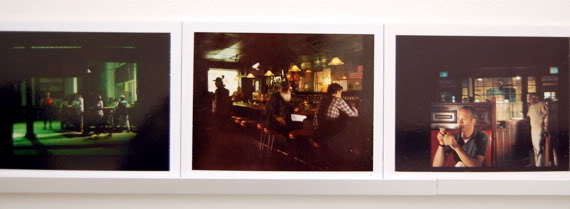
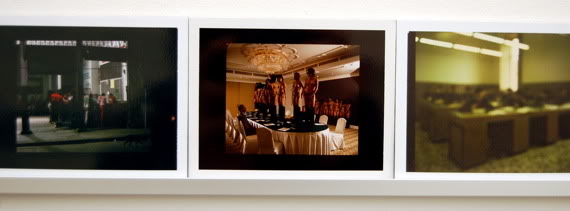
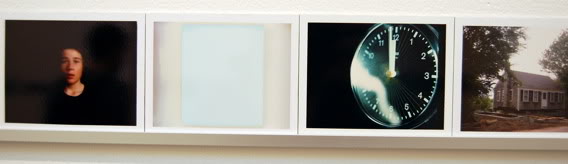
Philip-Lorca diCorcia, Untitled (Thousand) [selections from Thousand], 1980's-2007. Photo: 16 Miles [enlarged]

Here are ten of my favorite Polaroids from Philip-Lorca diCorcia's show, Thousand, at David Zwirner. There are 990 more sitting on a metal shelf that spirals in a continuous line around the gallery walls. They range from the mysterious to the bizarre, combining personal shots with preparatory work for some of diCorcia's most famous work. The results are strong enough to make you wonder why he even bothers with the elaborate sets and gigantic prints. It was packed with people this past Saturday and closes this Saturday, March 28.

Also closing in the next seven days: Xylor Jane's artisanal mathematics at Canada (March 29) [mentioned here last week], Michaël Borremans's thoroughly creepy show of Dogville-esque portraits and a sixty-seven second film (March 25), also at Zwirner, and the quirky, wonderful The Artist as Troublemaker at the Austrian Cultural Forum (March 28), perfect for those needing a bit more Kippenberger after a visit to MoMA.

Sunday, March 22, 2009

Almost Baroque, at Triple Candie [Review]


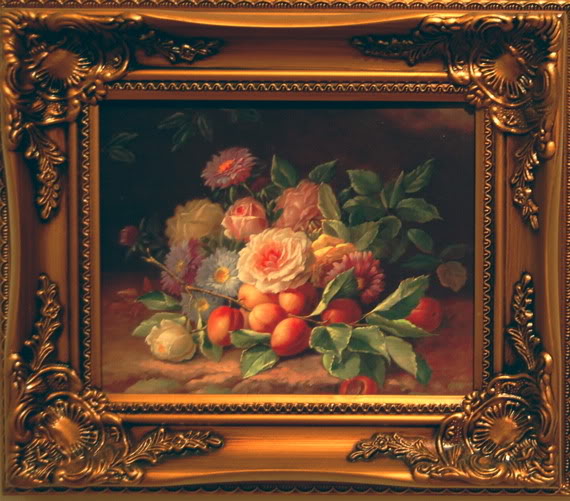
Unknown artists, [Peaches and Flowers], ca. 2008. Photo: 16 Miles

The social value of studying art history is dubious, but there are two basic arguments that people tend to make it its favor: (1) It teaches you in some vague way to look at visual culture more carefully, making you a more discerning, critical viewer, or (2) It gives you a more concrete understanding of the past that may have transferable value to the present; at the very least, it provides cocktail fodder. Rarely, of course, does the discipline actually pursue these two goals. There are usually two other, more vital issues involved: beauty and money.

It was a joy, then, to walk into Triple Candie’s new Harlem space and find a clever, concise exhibition that attempts to tackle both those bigger goals and pleasurable realities. Directors Shelley Bancroft and Peter Nesbett have purchased and hung nine floral still life paintings produced in China and sold at the El Mundo department in Harlem for the show. “Clearly, they must be copies of historic paintings,” they initially thought, they admit in the press release. The rigorous investigation they mounted, detailed on placards hung alongside the works, reveals that their backgrounds were not so straightforward.

Saying much more will ruin the surprises that their research uncovered. (If you first want to find out in person, stop here.) We learn that at least two of the paintings were based on an eighteenth century Jan van Huysum. Some of the other works, though, remained unidentified, even after consulting outside experts. Are they based on forgotten or stolen paintings, art that has slipping out of the historical record, or are these Chinese designers playing with the form and conjuring their own, original still lifes? Do the Chinese factory artists view Dutch still life as a supreme marker of taste, or do they believe that Westerners, particularly those in the working and lower middle class who would be shopping at El Mundo, view them this way? (They are sort of classy.)

The questions just keep getting weirder. Delving into the past and returning with curious, incomplete answers, Bancroft and Nesbett highlight the contingency and levels of mediation inherent in all art and art history. Everything you’ve bought to hang on your walls begins to look a little less familiar, a bit uncanny.

More
Top 10 of 2008, #2 - Triple Candie's Thank You for Coming [16 Miles] 


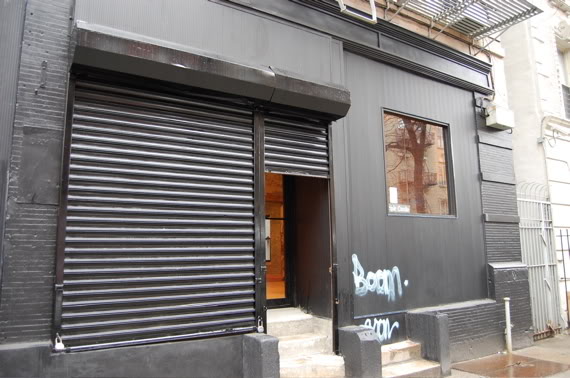
Outside the new Triple Candie space.  Photo: 16 Miles

Almost Baroque: An analysis of nine floral "paintings" from El Mundo
Triple Candie
500 West 148th Street, New York, NY
Through April 5, 2009

Friday, March 20, 2009

Saltz and Smith Agree on Xylor Jane. We Concur.


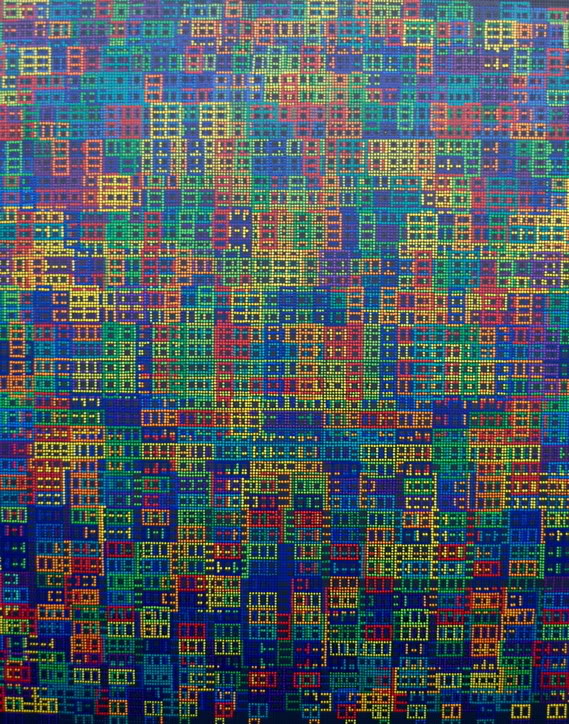
Xylor Jane, N.D.E., at Canada. Photo: 16 Miles.

A moment of critical and matrimonial agreement in New York art journalism arrived in print this week. Husband and wife Jerry Saltz and Roberta Smith championed Xylor Jane’s show at Canada, N.D.E. (which, we learn from Smith’s review, stands for Near Death Experience), in the pages of New York and The New York Times.

Saltz argues that Jane “combine[s] outsider art, secret code, channeling otherworldly spirits, and minimalist grids” to create paintings that are “mesmerizing, intelligent, and just this side of magical.” Smith, on the other hand, focuses on the work’s conceptual underpinnings: “Her systems add another wrinkle to the use of grids, progressions, and counting in modern art.” She has the longer review and seals the better closing: “[H]er work reveals the miracle and the drudgery of art-making as well as the wonders of the human mind and its needs.”

It’s a smart show, splicing together ideas from Sol LeWitt, Bridget Riley, and On Kawara. As Smith emphasizes, the handmade qualities – the imperfections and smudges – humanize the rigid geometry and rigorous systems and make the paintings work. Each little point becomes a distinct moment in time. Accumulated together, they’re signs of monumental concentration and commitment.

Monday, March 16, 2009

Jacob Kassay at Eleven Rivington [Review]


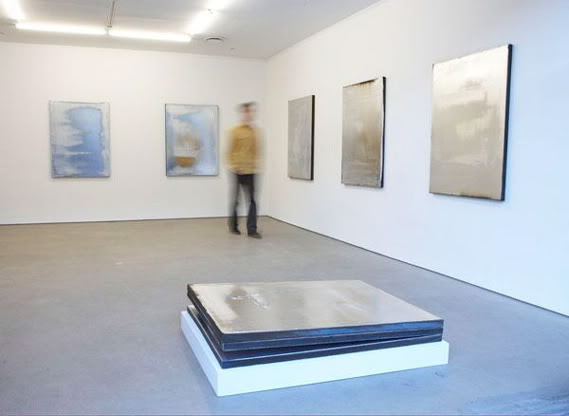
Jacob Kassay at Eleven Rivington [installation view]. Photo courtesy of Eleven Rivington.

“The point was to make people think you were faking when it was actually real gold,” Chris Burden declares in the latest New Yorker, explaining his decision to hire a security guard to protect a sculpture composed of four gold bars. Nothing surprises like sincerity.

At Eleven Rivington, Jacob Kassay has a handful of seemingly identical paintings hung on the walls; a few more are stacked on the floor, ready for buyers. Ignore that feint toward assembly line aesthetics: these pieces are smarter – more committed – than that.

Kassay builds up the thin layers of silver paint with a fair degree of uniformity, scattering thicker patches and scrawls in a few places. Then he sends them off for a run through a mirror plating process, which creates vaguely reflective surfaces. The primed, unpainted pieces of canvas burn.

This is the sort of show that we’ve been told the recession is supposed to vanquish: big, relatively expensive paintings from recent art school graduates. Kassay is only twenty-four. But let's be clear: you’d have to be that young to tackle Ryman, Stingel, Klein, Warhol, this aggressively and successfully in a single set of monochromes.

The works look like elegantly abused luxury goods.  There's the precious metal color, the sophisticated post-production, and some smoky, sexy burns. If you’re going to risk a few thousand dollars on a piece of art, why not buy something impossibly desirable? Unfortunately, it’s too late to grab one. Another contemporary anomaly: the show was sold out before the opening.

Jacob Kassay
Eleven Rivington
11 Rivington, New York, NY
Through March 29, 2009

Wednesday, March 11, 2009

This-Has-Been at On Stellar Rays [Review]


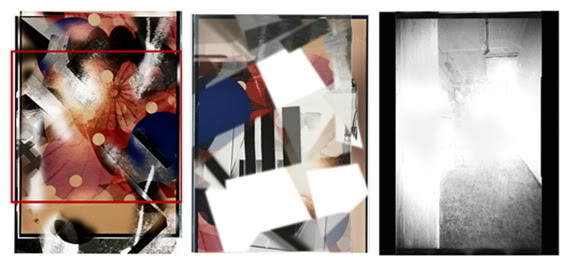
Tamar Halpern, Balcony Seats at a Murder (2008), Society Arrived Wearing Galoshes and Pearls (2009), Walker and 6th Ave. (2009).  Photo courtesy of On Stellar Rays.

The latest group show at On Stellar Rays, This-Has-Been, takes it title from Roland Barthes's Camera Lucida, in which the Frenchman discusses the elegy inherent in any photograph: the recognition of an indexical trace of someone that once was present and now is gone. Here, though, each medium’s normal function has been reconfigured. Photography is rendered mute, sculpture suddenly empowered with the power to haunt. Everything is wonderfully unstable.

Montreal artist Michel de Broin’s sculpture, Late Program (2008), composed of a charred wood-burning stove repurposed as a television, functions most like Barthes’s photographs. Its dilapidated, bruised body suggests a recent, violent past from which we have been excluded. Anne Deleporte construction achieves a similar inversion, repurposing the mass produced newspaper, for so long the definitive form of daily communication, as a pure abstraction.

Tamar Halpern, working against Barthes, takes photography and uses it for decidedly opaque ends. Scanning, editing, printing and rescanning photographs in a closed loop, she constructs bright abstractions that contain small glimpses of reality. Her titles come from classic Weegee images. Is that a bit of Weegee’s fire escape hidden beneath the bubbling roses and peaches of Balcony Seats at a Murder (2008)? Is that the sidewalk-crime scene in the corner? It’s impossible to say. Halpern only dangles the possibility of legibility in her images that seem to be growing increasingly lush.

If you’re looking to attract friends to the show, it might be worth mentioning that David Zwirner stalwart Marcel Dzama has a small, simple painting on display. Surprisingly, it’s one of the weaker pieces here. Set alongside Jenny Perlin’s quirky, faux-archival cartoon film Notes (2006), for example, it is only too familiar. The real mysteries are elsewhere. Roland Barthes in Camera Lucida once more: “What I can name cannot really prick me.”  This work can.

This-Has-Been
133 Orchard Street
Through March 29, 2009

Monday, March 9, 2009

Two Letters on Tehching Hsieh in the Times


Performance 1: Tehching Hsieh at the Museum of Modern Art. Photo courtesy of Michael.

There was a rare gem of a letter to the arts section of The New York Times over the weekend.  A gentleman wrote from Copenhagen to describe a conversation he had with Tehching Hsieh after calling him on a number he found in a New York phone book.  The artist's view on his legacy and lack of documentation: “If art good, people remember. If art bad, history clean up.”

Less of a gem was the letter from a New Yorker accusing Tehching Hsieh of "obvious mental illness."

Saturday, March 7, 2009

Galleries in Mexico City


Mauricio Guillén, Net No. 1, 2008, at OMR.  Photo: 16miles

[Part 3 of our ongoing  feature on contemporary art in Mexico City]

Contemporary art galleries cluster together in New York.  Moving quickly, one can burn through dozens of shows over the course of a day in Chelsea and still have time to see a score on the Lower East Side and a handful more in SoHo.  That's not quite the case in Mexico City, where they're spread out widely over the city.  The subway is super fast, cheap, and safe, but the stops are fairly spread out, meaning that you'll be doing a fair amount of walking if you choose that option.  Your best bet is probably to hire a car for a day and hit everywhere you want to go.  About $50US should set you up for a full day, and you won't have to worry about encountering some of the supposedly more questionable taxis on the street.  

Polanco, Roma, and Condesa are the three main art neighborhoods.  Speaking very, very approximately, Polanco resembles the Upper East Side.  Relatively staid galleries here show "modern masters" and more established contemporary artists.  Roma and Condesa tend to have the younger, more experimental shows and are routinely described as the SoHo's of Mexico City.  That said, just as many galleries are located on random blocks throughout the city, making New York analogies fairly useless.  Having discussed local powerhouse Kurimanzutto earlier, here are our five essential galleries to visit.

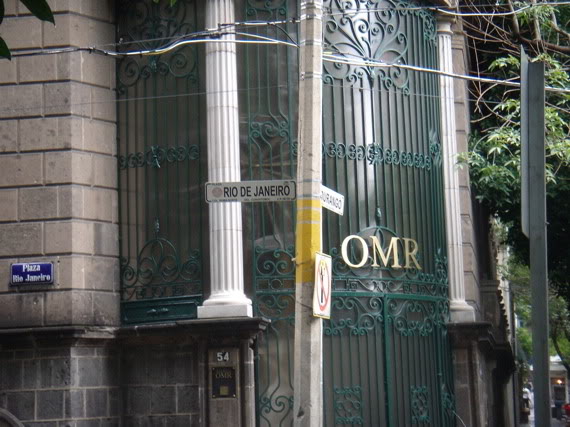
Plaza Río de Janeiro 54, Colonia Roma
They’ve been around for twenty-five years and are perhaps the second most active space internationally after Kurimanzutto.  They show Candida Höfer, Mauricio Alejo, Rafael Lozano-Hammer, and a dozen other mid-career Mexican artists at Art Basel, ARCO, etc.  This year they're the lone Mexico City group at The Armory Show.  Note: their floors are oddly-leveled, so you feel like you’re on a boat as you walk around the space, which is fun.

View of OMR from Plaza Rio Janeiro.  Photo courtesy of Zoecole

Zacatecas 93, Colonia Roma
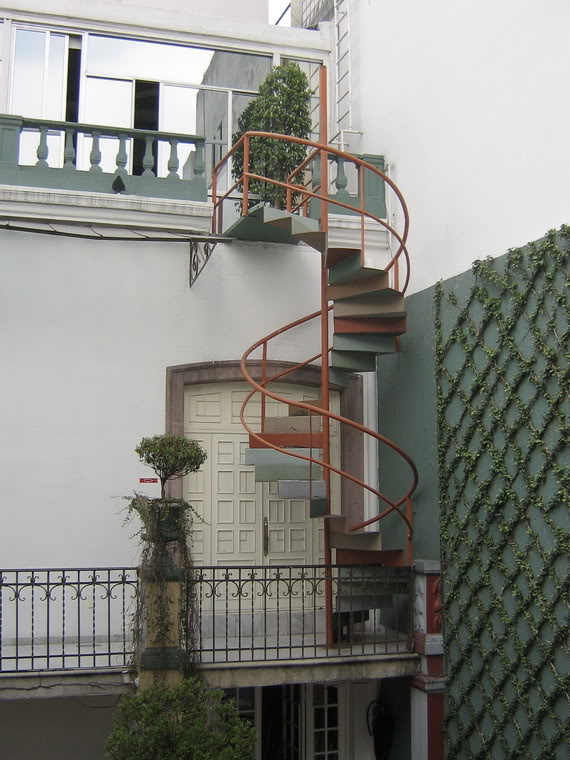
Their building is three stories, sports spiral staircases, and shows by Davis Birks (from Seattle), Ciler (Mexico City street artist), and Esau de Leon are there now: classy in every way.  Also, they’re at Pulse New York and run art-collecting trips to Havana.  That's about all I could want in a gallery.

Interior of Nina Menocal.  Photo courtesy of mamichan

Hilario Galguera
Francisco Pimental 3, San Rafael
They have a beautiful townhouse with a large courtyard in a sleepy part of town. They also somewhat randomly represent Damien Hirst in Mexico and have a nice rotting cow head of his in their office.  Their shows are somewhat infrequent, but they have a nice mix of people, and they have a sister space in Leipzig.  Both show mostly European and Mexican artists, early to midcareer.

Atlixco 32, Condesa
EDS has a super young roster that includes Daniel Joseph Martinez (those gold paintings with names of terrorist groups on them at the 2008 Whitney Biennial), Federico Solmi (who shows with LMAK in New York), Marcos Erre, Miguel Sepulveda, Emilio Chapela Perez, and Christopher K. Ho (part of Winkleman's cadre).  They were at Pulse New York this year.

Oizaba 92, Colonia Roma
Sadly, they were closed - between shows - both times we visited Mexico City.  They represent five artists, and their parties at their Roma townhouse are apparently great.  Also, their openings are sponsored by major alcohol companies, which I appreciate.

Friday, March 6, 2009

Guy Debord, Panegyric

"My method will be very simple. I will tell what I have loved; and, in this light, everything else will become evident and make itself well enough understood." (p. 5)

"At a critical moment in the troubles of the Fronde, Gondi, who had given such sterling proofs of his capacities in the handling of human affairs, notable in his favourite role of disturber of the public peace, improvised successfully before the Parlement de Paris a fine quotation attributed to a classical author, for whose name everyone vainly seached, but which could best be applied to his own panegyric: 'In difficillimis Reipublicae temporibus, urbem non deserui; in prosperis nihil de publico delibavi; in desperatis, nihil timui.' He himself translated it like this: 'In bad times I did not forsake the city; in prosperous times I had no private interests; in desperate times I feared nothing.'" (p. 17-18)

Guy Debord, Panegyric. Translated by James Brook and John McHale. London: Verso, 2004.

Wednesday, March 4, 2009

Kurimanzutto, Inaugural Exhibition [Review]


Dr. Lakra. Photo courtesy of citoyenmag; more photographs available.

[Part 2 of our ongoing feature on contemporary art in Mexico City]

In the interest of full disclosure, I should mention that the staff members at Kurimanzutto are among the nicest I have ever met inside an art gallery. We first visited them about a year ago when they were without a permanent spaces, showing work out of their offices in Condesa. Equipped with only an address and a recommendation, we buzzed a random number on the side of an apartment building, walked up the stairs, and were warmly shown around the apartment (our nonexistent Spanish completely excused). A Gabriel Orozco painting hung on one wall, a sign of their centrality in the Mexican contemporary art world.

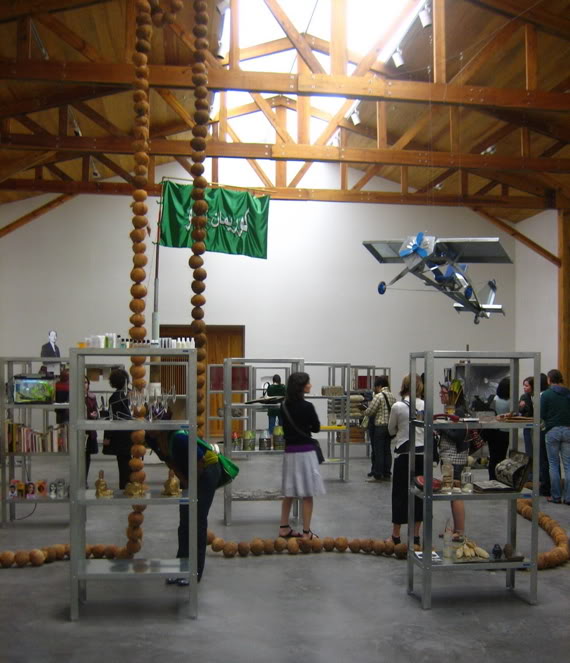
The venue’s latest show inaugurates their new space in the San Miguel Chapultepec neighborhood, a quiet, largely residential area with a handful of auto repair shops along their block. On the location of a former timber yard, Kurimanzutto (the name is a portmanteau of its founders, José Kuri and Mónica Manzutto) has constructed a warehouse that is, in scale and design, equivalent to the largest, more luxurious Chelsea showrooms. It’s an apt setting for their ambitious roster of well-known Latin American and international artists (Damián Ortega, Daniel Guzmán, Monika Sosnowska, and Tiravanija, who continues to be everywhere).


Installation view of Kurimanzutto, Inaugural Exhibiton. Photo courtesy of B.G.D.

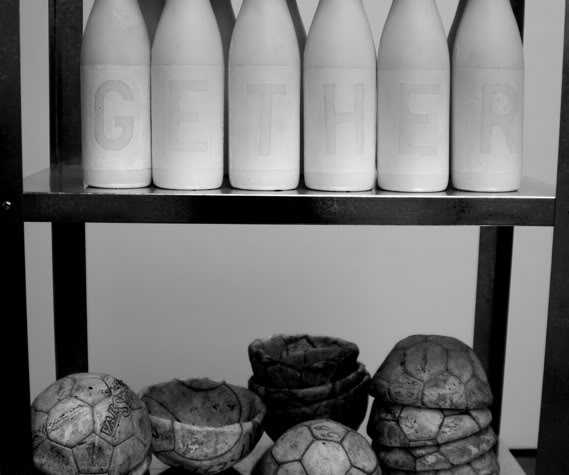
The conceit of the exhibition is to give each Kurimanzutto artist (and six guest artists, including Thomas Hirschhorn and Allora & Calzadilla) space on a series of metal bookshelves, letting them present to the public a selection of their work. The artist’s bookshelf, the press release argues, “… is confidant and witness of the working processes of its owner, neatly reflecting his/her interests, obsessions, references, and current ideas.” There is a lot of possibility in that and, perhaps not surprisingly, the quality of the work varies considerably.

Most of the trademarks one would expect are here. Guzmán presents a skull sitting on a turntable, a summation of his twin interests that almost seems like caricature. Dr. Lakra has a series of his intricate drawings on paper, sculpture, and on top of vintage pinups, whom he’s delicately tattooed. They oscillate beautifully between irony and pure pleasure. First entering the gallery, I had no idea the metal shelves were supposed to represent artists’ bookshelves. They appeared to be simple, spare display cases for products, each artist rendered as a brand. Your détourned hair product boxes (Ortega) could be purchased from one shelf, your pinup photograph on another.


Rirkrit Tiravanija. Photo courtesy of citoyenmag.

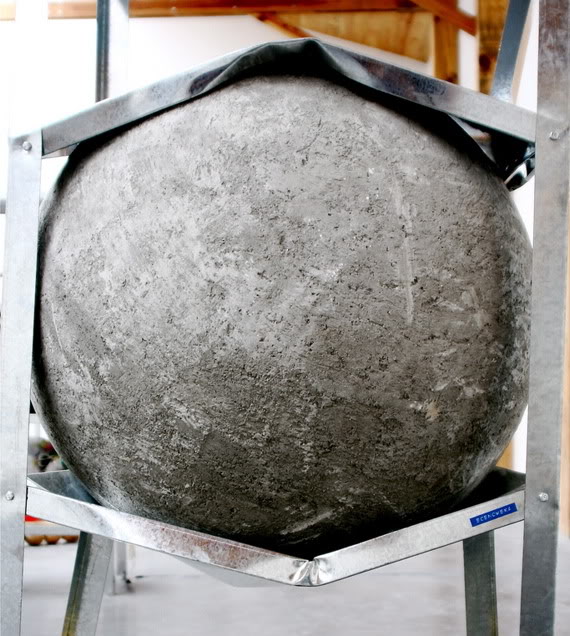
This wasn’t quite a store, though. One shelf contained nothing but compact discs, Sosnowska had jammed a boulder between two others. No one was trying to ingratiate him or herself. (In fact, that generosity extended into the gallery's operations: the space was completely empty of employees when we visited, a show of trust that tends to be rare when tiny art pieces are sitting around.) Placing all their work on tiny, spare shelves, Kurimanzutto and the twenty-two artists invite a real critique of the quality of their practice. Ignore the fancy new surroundings, they seem to say: we don’t need charisma to succeed. They’re right.


Monika Sosnowska. Photo courtesy of citoyenmag.

Inaugural Exhibiton
Kurimanzutto
Gob. Rafael Rebollar 94, Col. San Miguel Chapultepec, Mexico City
Through March 21, 2009

Monday, March 2, 2009

Upcoming Talks [Calendar]


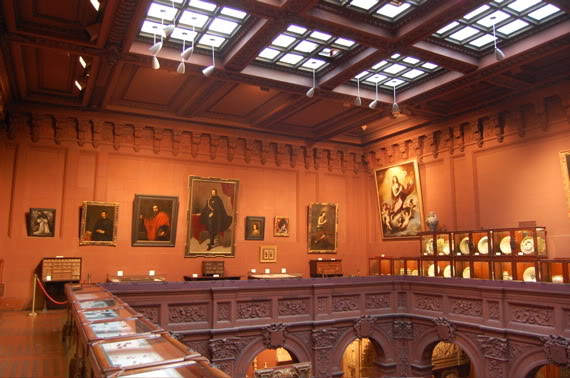
The Hispanic Society of America.  Photo: 16miles

The New York art fairs open up this week.  In the realm of academia, though, there are also big things happening this month.  Here are our picks for the best talks, listed chronologically and to be updated throughout the month.  They include former Guild & Greyshkul partner Sara VanDerBeek on her photography, two Dia events, another in the new Elizabeth Dee-initiated space, X, that used to belong to Dia, and a pair of talks featuring Hal Foster, who easily wins the award for best lecture titles.

International Center for Photography, 1114 Avenue of the America, New York, NY
Wednesday, March 4, 2009, 7:00 pm

Art in General, 79 Walker Street, New York, NY
Saturday, March 7, 2009, 3:00 pm

The Hispanic Society of America, 613 West 155th Street (entrance on Broadway), New York, NY
Saturday, March 14, 2009, 2:00 pm

Isaac Julien on Andy Warhol [$6 regular; $3 student]
Dia Art Foundation, 535 West 22nd Street, New York, NY
Sunday, March 22, 2009, 6:30 pm

X, 548 West 22nd Street, New York, NY
Thursday, March 26, 2009, 7:00 pm

Cooper Union, Wollman Auditorium, Cooper Square New York, NY
Monday, April 6, 2009, 6:00 pm