Thursday, February 26, 2009

An Unruly History of the Readymade at the Jumex Collection [Review]


Richard Pettibone. Photo courtesy of fishercott.

[Part 1 of our ongoing feature on contemporary art in Mexico City]

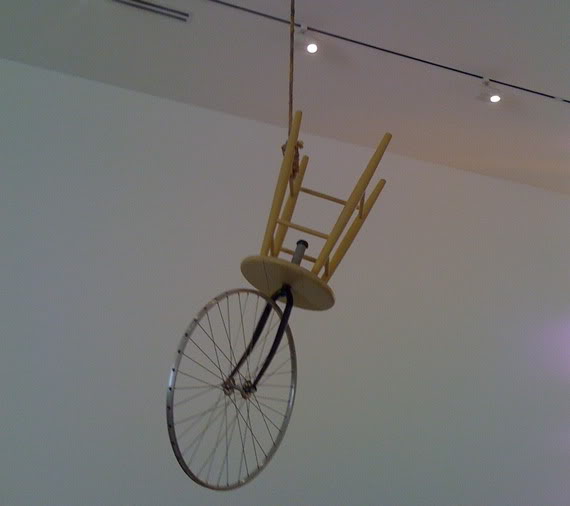
I had never witnessed a piece of art being put to death before. Walking into An Unruly History of the Readymade at the Jumex Collection, though, it’s the first thing one sees. Marcel Duchamp’s notorious Bicycle Wheel (1913) has been slid through a noose and hung from the ceiling of cavernous warehouse. Consulting my guide, I learned that it was actually a sculpture by serial reproducer Richard Pettibone.

Laid out on the floor as a gigantic chessboard that spirals chronologically toward the center of the room, the show (organized by Tate Modern curator Jessica Morgan) comprises about 100 works culled from the collection of juice scion Eugenio Lopez, presenting interpretations of Duchamp’s act of selection that range from the ludic to the staid, the hilarious to the banal.


Ugo Rondione, Love Invents Us, 1999.

Given the sheer abundance of ideas that have been attributed to his work, it’s no surprise that the breadth of artists included in the rambling survey is enormous. A Warhol Jackie (Pettibone’s miniature copy is in a vitrine a few feet away) is hung a few spaces from On Kawara date paintings (with Mexico City newspapers included, of course). Elsewhere, artists like Johns, Jonathan Horowitz, Kippenberger, Kelley Walker, Elmgreen & Dragset, and Jim Hodges are present. Damian Ortega, Abraham Cruzvillegas, Sofía Táboas, and Gabriel Kuri form a portion of the Mexican contingent. (Interestingly, they’re all represented by Kurimanzutto, for which Mr. Lopez seems to have a particular obsession.)
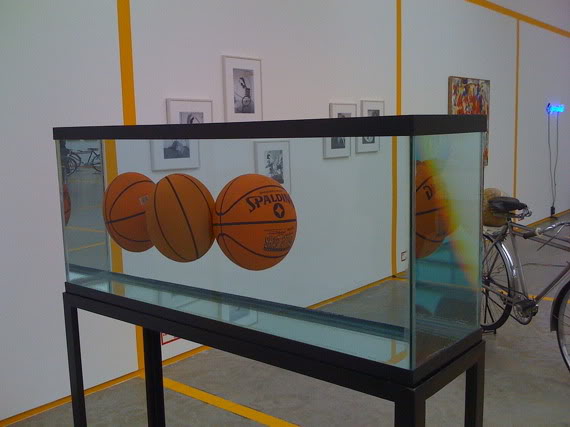

Jeff Koons, Three Ball Total Equilibrium Tank, 1985. Photo courtesy of fishercott.

Sturtevant’s meticulously replicated Johns painting represents the appropriation wing of the party, suggesting the choice of object could actually be another work of art. Warhol’s inclusion foregrounds the readymade as commercial image, Jackie Kennedy’s face plucked from a page in a newspaper. Rirkrit Tiravanija’s polished cooking equipment and its carrying case (shades of Boîte-en-valise) pursues the readymade into every day life, selecting a relational moment instead of a hat rack as the art. Cataloguing the complete set of readymade possibilities would yield scores of factions.

Maurizio Cattelan’s piece Dynamo Secession (1997) is where I paused for the first time, suddenly shaken out of my art history reverie. Twin bikes that can be pedaled to power a light bulb, he reanimates the bicycle wheel, as Duchamp did originally (“In 1913 I had the happy idea to fasten a bicycle wheel to a kitchen stool and watch it turn,” “Apropos of Readymades,” 1951.) It’s cute but also sinister. Simply lighting a bulb in a gallery already flooded with light, it uncomfortably highlights the self-referential (self-reverential) discourse at play. For a lot of people outside the hermetic seal of contemporary art, the readymade represents the moment that modern art became incomprehensible.
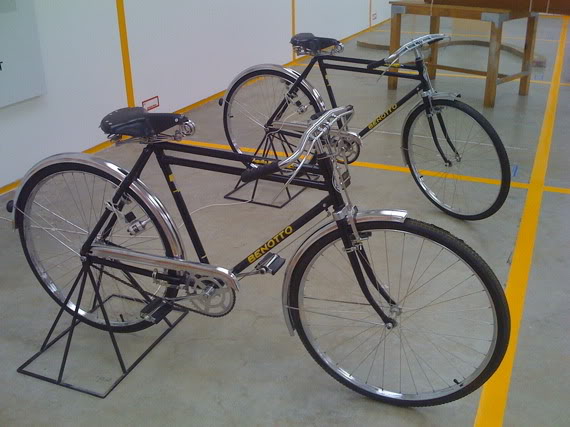

Maurizio Cattelan, Dynamo Secession, 1997. Photo courtesy of fishercott.

At the very center of the space, the final work is a banana skin tossed on the ground. Authored by Adriana Lara, the peel is replaced every day after someone from the museum consumes a banana. We can spot the references (to Warhol’s Velvet Underground & Nico cover and the food happenings of relational aesthetics) and get the joke. It may be too easy. The obsessive repetition of its production mirrors Cattelan’s piece. Put another way, we’re just spinning our wheels. There’s a tremendous amount of great, sublime, perplexing work here, and the show is generally crisply edited. There’s also a real danger of falling into a theoretical mise en abyme.

Overhead is a sculpture by Cerith Wyn Evans, a neon text (In Girum Imus Nocte et Consumimur Igni, “We enter the circle at night and are consumed by fire”) spun into a halo. It’s an ancient Latin palindrome, used by Guy Debord for the title of his final film. One thinks of one of the final lines from that film of 1978: “This civilization is on fire; the whole thing is capsizing and sinking.” It will take more than banana peels to confront that.
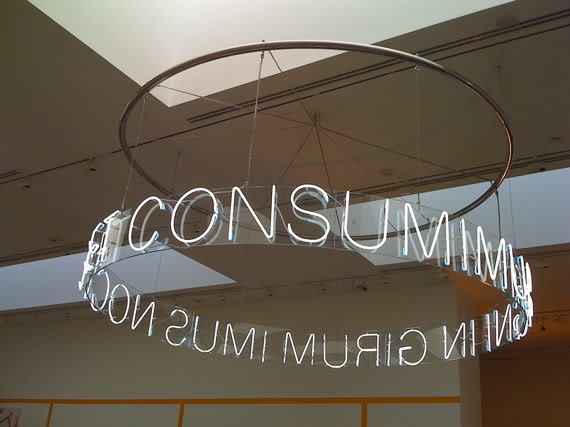

Cerith Wyn Evans, In Girum Imus Nocte et Consumimur Igni, 2006. Photo courtesy of fishercott.

An Unruly History of the Readymade
Via Morelos 272, Col. Sta. Maria Tulpetlac, Ecatepec
Through February 2009

Wednesday, February 25, 2009

Contemporary Art in Mexico City

For the rest of the week and through the weekend, I'll be running articles about art spaces in Mexico City. I've included a map showing some of the main venues below. First up: the Fundación/Colección Jumex.


View complete list and larger map.

Sunday, February 22, 2009

Cage in the Kitchen: John Cage's Cookie Recipe

"When you're with friends, you can have a potato."

Matta-Clark, Hirst, Tiravanija, Sarabia: quite a few contemporary artists have played a part in culinary, contemporary art experiments. Now, posthumously, we can add John Cage, who, we learn from the video above, discovered alternative diets from John Lennon and Yoko Ono.

The John Cage Trust has transformed the Dia:Beacon cafe, always the site of delicious food, into a macrobiotic eatery from February 20 through 23. (Catch a train up to Beacon tomorrow to enjoy it.) I was up there for the Merce Cunningham performance today (around the Flavin section and wonderful) and enjoyed the cookies made from Cage's recipe.

Generally, I like my desserts filled with sugar, chocolate, or cream, preferably all three.  Cage rejected all three of those sweet mainstays but still managed to concoct a delicious cookie. Here's the recipe from the informative pamphlet that accompanied the installation, performance, restaurant transformation:
  • 1 cup wheat flour
  • 1 cup ground oats
  • 1 cup almonds, ground into flour
  • 1 tablespoon cinnamon
  • Pinch of salt
  • 1/2 cup maple syrup
  • 1/2 cup almond (or hazelnut) oil
  • 1 tablespoon vanilla
  • 1 jar of unsweetened fruit spread of choice
Blend together all dry ingredients.  Mix together all wet and add to the dry ingredients.  Roll into small rounds and place on a greased cookie sheet.  Press the center of each with your thumb.  Put 1/2 teaspoon of unsweetened jam into the thumbprint of each, and bake in a 350 degree oven for about 14 minutes, reversing the cookie pans once during baking for even distribution of heat.  Cookies should be browned on the edges, but not throughout.

The complete list of recipes is available through Dia.

Sunday, February 15, 2009

Traveling


There will be a brief pause in posting until next Saturday, when I get back from traveling.  If you have any recommendations for galleries, museums, or eateries in Mexico City, drop me an e-mail.  I'd love to know.  I'll be twittering and building the Mexico City Art Spaces feature in the meantime. Thanks for reading.

Saturday, February 14, 2009

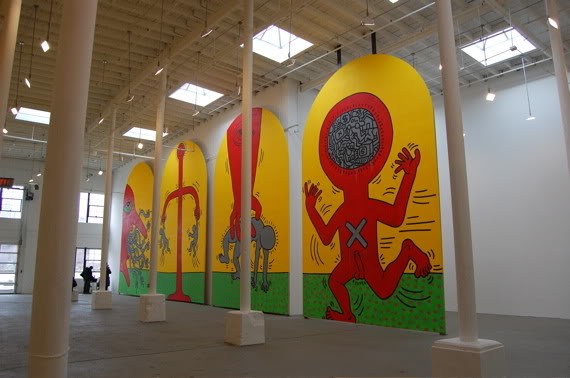
Keith Haring, The Ten Commandments, at Deitch Projects LIC [Review]


Keith Haring, The Ten Commandments [installation view], 1985

Long Island City is pretty much deserted on most Saturday afternoons.  You can walk from the Queensboro Plaza subway stop to Deitch Projects without seeing more than one or two other people walking the warehouse-lined streets.  Desolate and empty, the neighborhood is actually home to some of the city's most interesting art spaces: P.S.1, SculptureCenter, and the Fisher Landau Center.  Matthew Barney has a massive studio nearby.  You feel disconnected from Chelsea, but you're actually in the heart of the art world.

You might feel the same way looking at Keith Haring's work.  He looked like an outsider when he first became a star in the 1980's.  Though he never really got canonized or copied, most people with some interest in art can still spot a Haring today.  That said, I've never met anyone who claims to love his art.  Jeffrey Deitch does, though, and has recently decided to devote some of his considerable energy to the artist, releasing a luxurious book, reinstalling a mural on Houston and Bowery, and showing the largely unseen series of monumental canvases The Ten Commandments.

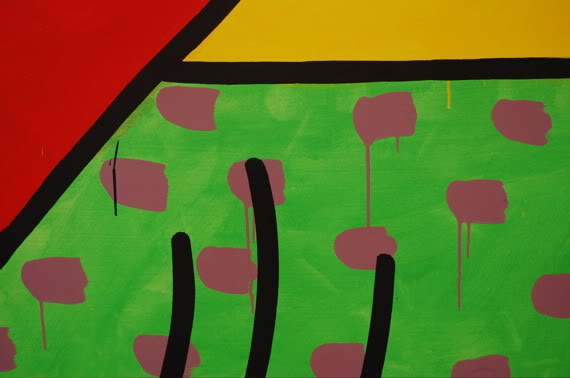
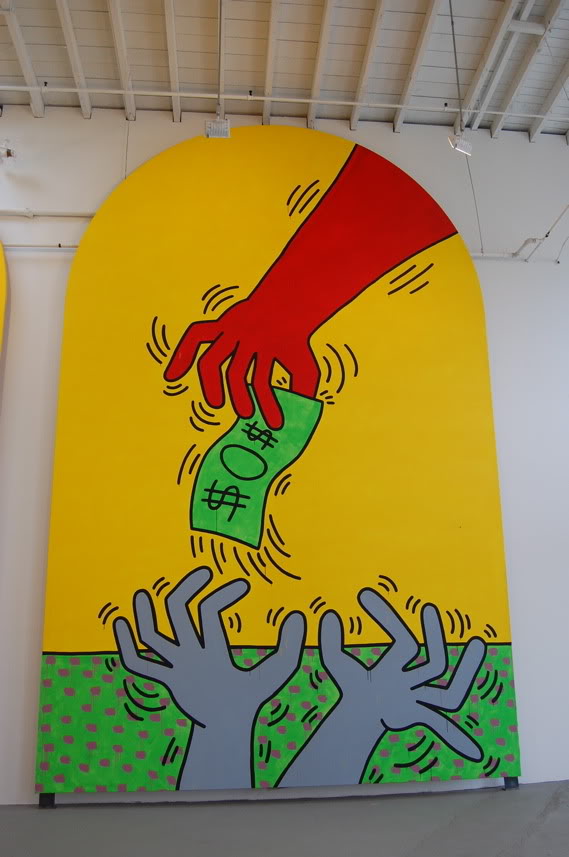
Originally painted for a 1985 show in Bordeaux, Deitch and company have taken good care of the works.  They're clean and crisp; the trademark bright paint looks fresh.  All the classic Haring figures are present in these visual depictions of their title: cartoon people, televisions, dollar signs.  Most of the constructions are pretty straightforward - a hand plucking a dollar bill from two other waving hands, two heads fellating a cross.  Haring has clever moments, but they're certainly not here.  Still, the show is worth seeing.  Unlike most the artist's work, the form here wins over the content.  It's fun looking at painting this massive and paint this bright.  They're simple, sugary curiosities, only barely cloying.


Keith Haring, The Ten Commandments [installation view] [detail], 1985


Keith Haring, The Ten Commandments [installation view], 1985

Keith Haring, The Ten Commandments
Deitch Projects
4-40 44th Drive
Long Island City, Queens, New York
Through February 15, 2009

Monday, February 9, 2009

Jane South at Spencer Brownstone


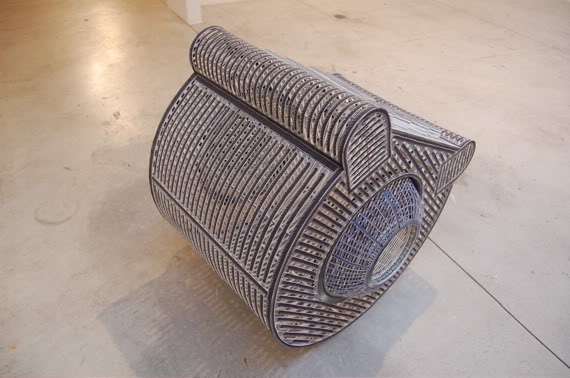
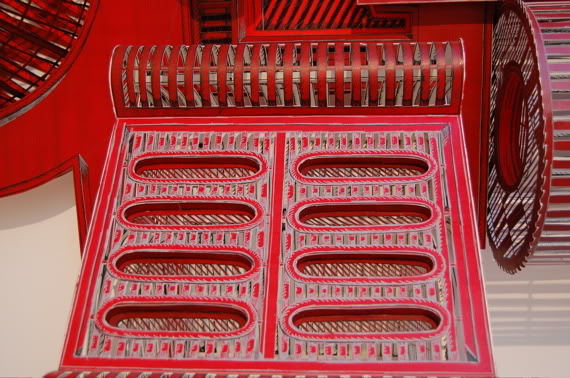
Jane South, Untitled (Drum), 2008


Jane South, Untitled (Irregular Ellipse) [detail], 2008


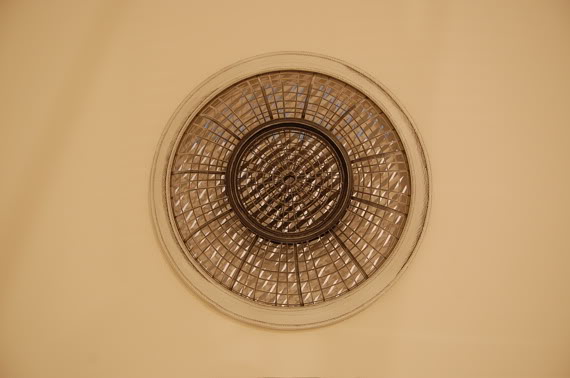
Jane South, Untitled (Oculus) [front room view], 2009


Jane South, Untitled (Oculus) [back room view], 2009


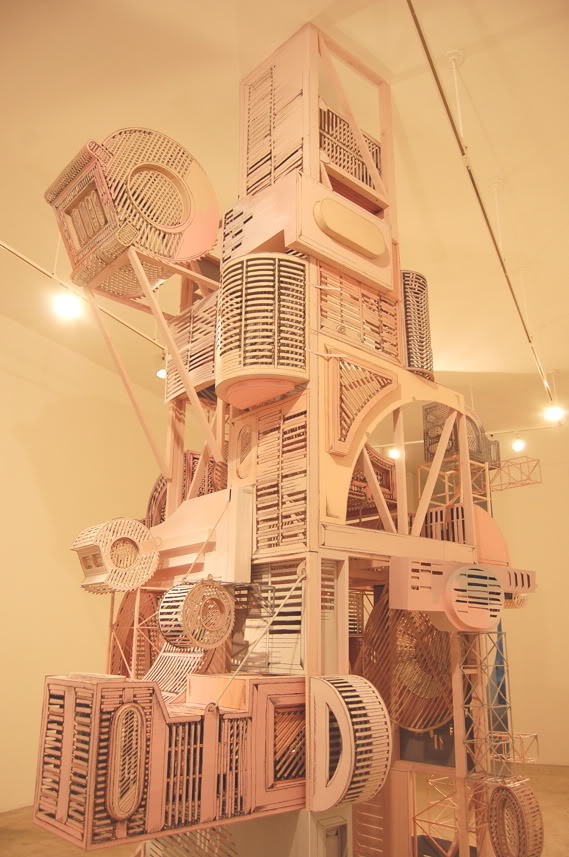
Jane South, Untitled (Tower), 2009

Sunday, February 8, 2009

Brian Lund, A Very Real and Very Dark Time, at Smith-Stewart [Review]


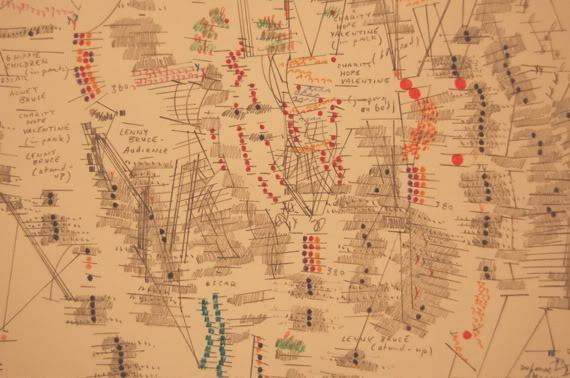
Brian Lund, Selected Edit Cuts from Sweet Charity and Lenny [detail], 2008

If you squint in front of Brian Lund’s latest series of drawings, his colorful, wiry masses of lines and shapes begin to look like Rorschach figures stripped of their flesh, rendered as angular skeletons. Eyes wide open, closer to the pieces, which are alternately tacked to and framed on the walls of Smith-Stewart, even more curious things appear in the form of text and notations: sequential numbers that snake around the paper, blocks of hatching, repeating patterns of circles, squares, and words. “Charity hope valentine” appears over and over again in one piece. “Lenny Bruce” is sprinkled liberally on the page.


Brian Lund, Selected Edit Cuts from Sweet Charity and Lenny, 2008

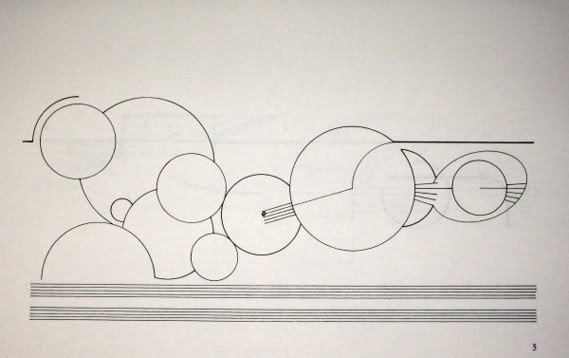
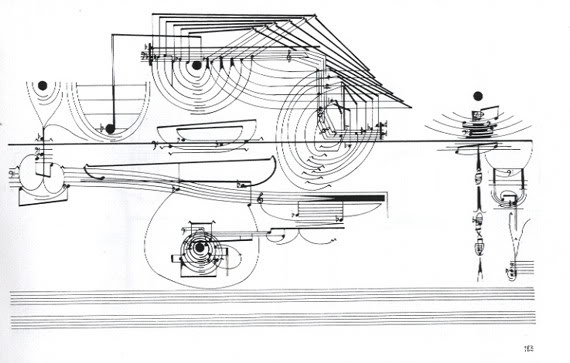
The drawings, one learns on consulting the press release, are the result of Lund translating the “vast editing systems of Hollywood films into abstract compositions” using his own system of notation. Here, he takes Bob Fosse’s films as his foundation. His impenetrable vocabulary suggests Cornelius Cardew’s musical scores from the 1960’s, which stretched and morphed the basic units of Western musical notation. Like Cardew’s Treatise, the viewer is left to make sense of a score littered with only barely recognizable figures. A few passages make sense; others yield only static.


Mark Lombardi

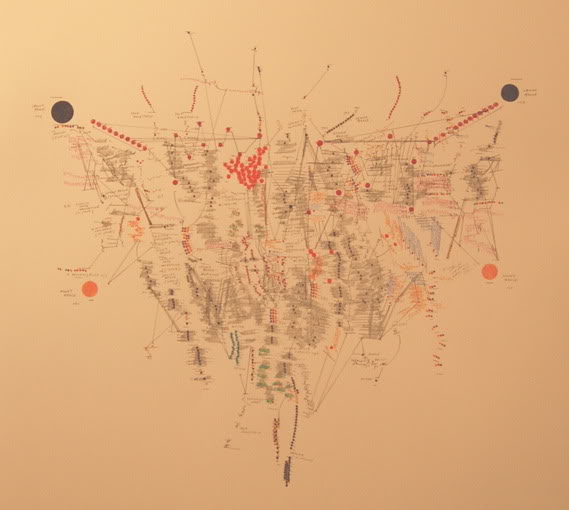
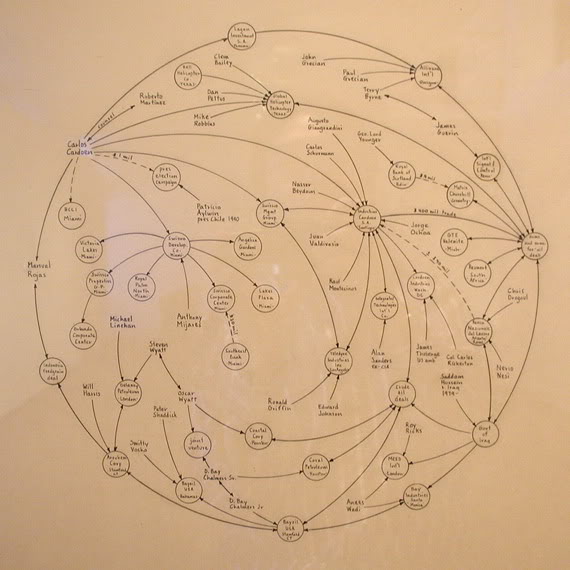
The key difference between Lund and Cardew, of course, is that the former is working after the fact, building a record of a completed work. Are we supposed to be able to piece together a narrative by looking at the work? (Could this be visual art’s Dark Side of the Moon / The Wizard of Oz moment?) By providing numbers (some marker of time, cuts, or frames?), Lund seems to be teasing a chance at legibility. Maybe we can work it out if we look a little closer. His work, then, sits somewhere near Marc Lombardi, whose overflowing schematics lead to a similarly fractured language and stifled relations.  Their drawings denote the boundaries of all closed, specialized languages.


Cornelius Cardew, Treatise [page 3], 1963-67

As rigorous as Lund’s conceptualism is, the controlled effervescence of his work (one thinks of Julie Mehretru) is what allows him to avoid crafting a vapid tribute to 1970’s systems art. Asked to diagram one of these films again, it is hard to believe that Lund would perfectly recreate every element of the complex network of signs and lines. Here, the artist mediates the system. Forced to toss out the foundational text, one gets the impression that he would still want to make exactly these types of drawings. If he gets bored with film, that’s good news.


Cornelius Cardew, Treatise [page 183], 1963-67

Brian Lund: A Very Real and Very Dark Time
53 Stanton Street
New York, NY
Through March 1, 2009

Saturday, February 7, 2009

Destroying Cars in the Work of Superflex and Arman


Superflex, Burning Car, 2008


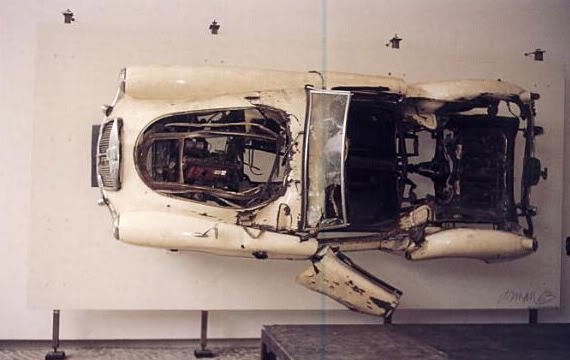
Arman, White Orchid, 1963. Photo courtesy of Archives Denyse Durand-Ruel.

Superflex is out with a new video (thank you, Rhizome), Flooded McDonald's (an excerpt), which very literally enacts its title.  The empty architecture recalls Thomas Demand, though this set is meticulously produced.  It's an amazingly tranquil piece.  In its odd production of calm, it recalls their previous video Burning Car (2008) (first fire, now water), which is similarly serene, a slow-motion version of Arman's White Orchid, in which he took advertising executive Charles Wilp's MG and blew it up with dynamite.  

In a recent interview, the collective makes the case for the subversive content of the videos: "If you don't challenge the system, then the machine just keeps on running and being happy."  At first, the incredible elegance of their videos seems to belie that stance.  On the contrary, after watching both a few times, the visual pleasure engendered by slow, violent destruction seems to prove that the opposite is true.

Tuesday, February 3, 2009

The High Modernism of Milton Babbitt and Marcel Duchamp


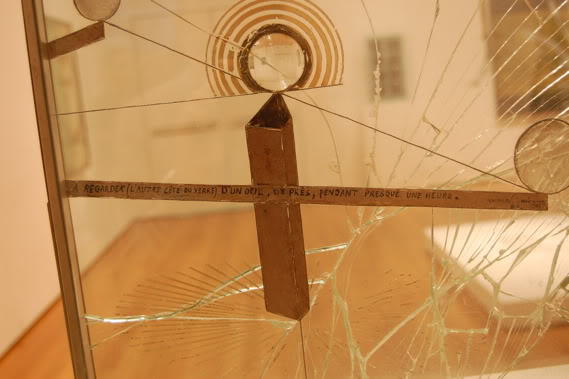
Marcel Duchamp, To Be Looked at (from the Other Side of the Glass) with One Eye, Close to, for Almost an Hour [detail], 1918 at the Museum of Modern Art, New York.

"Why refuse to recognize the possibility that contemporary music has reached a stage long since attained by other forms of activity? The time has passed when the normally well-educated man without special preparation could understand the most advanced work in, for example, mathematics, philosophy, and physics."   - Milton Babbitt, Who Cares if You Listen?, 1958

"When painting becomes so low that laymen talk about it, it doesn't interest me. Do we dare to talk about mathematics? No! Painting shouldn't become a fashionable thing. And money, money, money comes in and it becomes a Wall Street affair."    - Marcel Duchamp, The New Yorker, 1957

"I don't believe in the sacred mission of the painter. My attitude toward art is that of an atheist toward religion. I would rather be shot, kill myself, or kill somebody else, than paint again. Anyway, I quit long ago, and took up chess.   - Marcel Duchamp, The New Yorker, 1942

Monday, February 2, 2009

"From the Archives: 40 Years / 40 Projects" at White Columns [Review]

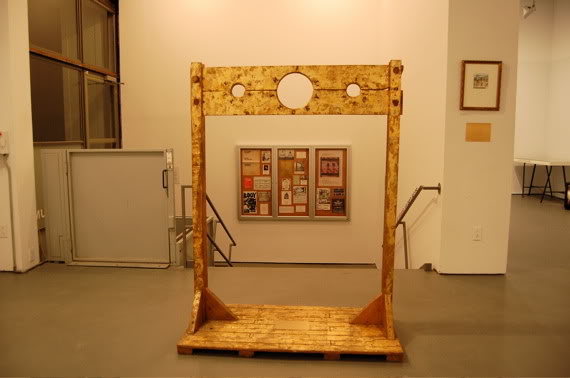
Kathe Burkhart, Pillory of History, 1993

The first object one sees on entering White Columns is a large, golden instrument of torture, Kathe Burkhart’s Pillory of History (1993). Looking closer, around the holes carved for a prisoner’s head and hands are three finely inscribed words: “History repeats itself.” It’s a daring piece to put at the beginning of a retrospective tasked with crafting an historical account of the oftentimes remarkable, consistently unusual path the storied alternative space has taken over the last forty years.

While Gordon Matta-Clark is probably the artist most readily associated today with the early years of 112 Greene Street (the original name of White Columns), the show begins by highlighting the underlying philosophy espoused by cofounder Jeffrey Lew, who, in a 1978 interview posted on the walls of the gallery, admits, “None of the doors in 112 were ever locked,” a fact that succinctly embodies the freewheeling atmosphere of the space’s early years, in which artists randomly installed and removed works without any curatorial oversight. “There wasn’t a first show because everybody just arrived,” Lew explains. “I never understood the difference between selection and eliteism [sic].” That anarchic aesthetic, the show makes clear, did not last long.

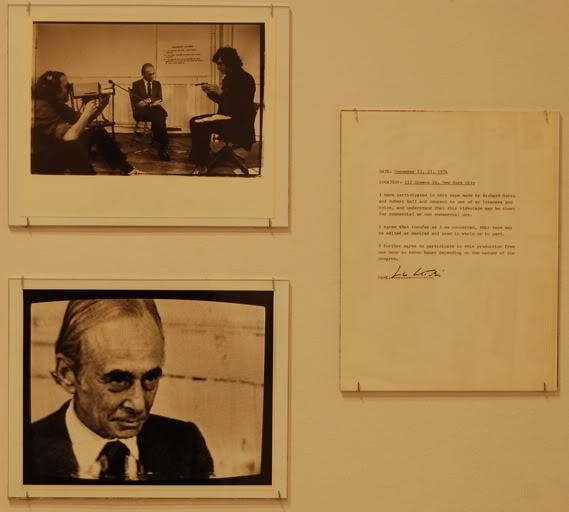
White Columns director Matthew Higgs and curator Amie Scally, after digging through the reportedly decrepit archives and combining their discoveries with material from artists’ holdings, selected a single exhibition for each year in the institution’s existence. Grouping this detritus with art from some of the shows, they have chronologically ordered the projects along the walls of the gallery in the form of a timeline, which abounds, especially in the first two decades, in surprises from a smaller, arguably more adventurous art world. Perhaps most remarkable is the 1974 entry, a contract signed by Leo Castelli agreeing to participate in Richard Serra’s game theory experiment and video Prisoner’s Dilemma, a sign of just how quickly and aggressively 112 Greene Street became a pivotal force in New York.


Richard Serra, Prisoner's Dilemma, 1974.

Other artifacts reveal a New York cultural world shifting throughout the 70’s and 80’s. A price list from 1988’s “Real World” offers Perfect Lovers, Felix Gonzalez-Torres’s twin clocks, for $350. (One set – of an edition of three – hangs over the front desk, ticking fifteen seconds apart on both days I visited.) Elsewhere, Allan McCollum submits a brief, typewritten proposal for a show in 1980. On the other side of the wall, remnants from Kim Gordon’s 1981 project, including a grainy photograph of the installation and a press release in which she quotes both Walter Benjamin and the Au Pairs, are on display. Her credibility is established through mention of her work with Glenn Branca and Rhys Chatham; Sonic Youth had yet to cut a record. It is these moments, when one witnesses artists on the verge of their breakthroughs, that are most pleasurable – and problematic.

There is, after all, a profound triumphalism inherent in the mode of selection on display. Far from Lew’s dream of an open utopia, the viewer bears witness largely to history’s winners and sees White Columns positioned as prophet. In the introductory text to the exhibition, though, Scally and Higgs are honest on this point, admitting that their undertaking is “celebratory” and “inevitably partial.” Hundreds of artists not in the exhibition also made use of the space and clout of White Columns, one is reminded. For an endless number of reasons their work didn’t last. Limiting their focus to a single work each year, the curators foreground this arbitrariness and, in their rigid chronological construction, reveal the contingency embedded in all art historical narratives. Entering the more contemporary end of the timeline and encountering works from less canonical names, this technique also allows for thrilling viewing: Where, one wonders, has White Columns bet correctly?

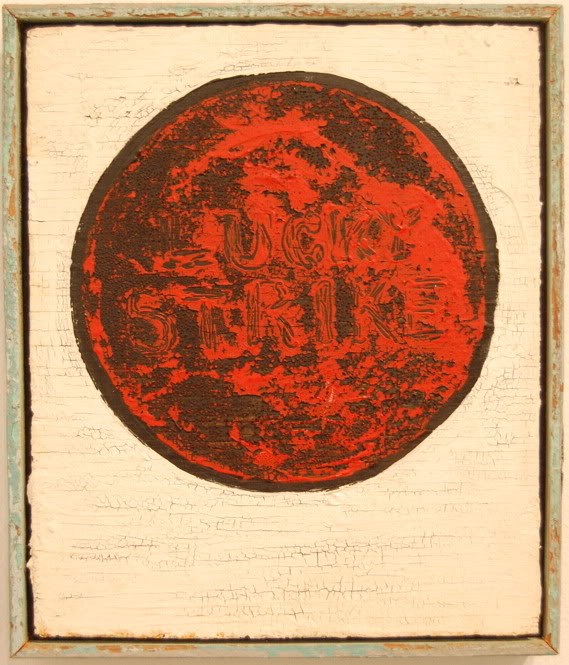
It is in inviting this glorification and questioning that “40 Years / 40 Projects” is at its best, outlining a thorough, persuasive advertisement for the importance of an active, engaged White Columns. The press releases, invitation cards, letters, and photographs come to function as non-sites, always pointing elsewhere: to installations disassembled (but present in the photographs of Matta-Clark projects), to political opportunities squandered (in the transcripts of Group Material discussions and the Silence = Death card on the entry bulletin board), and to art objects dispersed around the world. It is, for example, genuinely frustrating to squint at tiny photographs of Sarah Sze’s 1997 installation after reading Jerry Saltz describe it as a “Rimbaud-like vision of the abyss” in a page from Time Out New York torn out and tacked to the wall. Seeing the under-represented Jack Pierson’s rustic, elegant painting Lucky Strike (1986) provides only some temporary sense of relief.

Jack Pierson, Lucky Strike, 1986

Viewed from today’s frenetic, relatively prosperous art world, the early anarchic years of 112 Green Street at first appear tremendously liberating, but it’s also clear that there was very little at stake. By the mid-1980’s, in the midst of the AIDS crisis, continued urban decay, and the national dominance of conservative politics, White Columns would come to view itself as an essential space for the promulgation of oppositional political and aesthetic practice, a place where it was possible both for Judith Barry and Peter Halley to debate the efficacy of political art and for curators to stage a Sturtevant retrospective. A committed, discursive community had blossomed, the show argues.

In contrast to this rigor, some of the inclusions in the 1990’s and 2000’s seem less urgent and less interesting, products perhaps of their relatively halcyon times. Jessica Craig-Martin’s photograph from 1999 is alluring but almost flippant in its implied critique. The group show “What I Did on My Summer Vacation,” which invited artists and curators to take a disposable camera and document their idyll days (representing 1996) is novel but borders on being self-congratulatory, celebrating the hermetic networks of artists and curators that have dominated so much recent art.

Ultimately, though, as these rich, diverse fragments, these non-sites, inevitably point to the work they once promoted and supported, they also point to inspiring pasts, signaling how high a level of quality is required for today’s institutionalized White Columns to compete with its legendary history. In a new period of political crisis, then, Scally and Higgs seem to be welcoming a challenge.