Showing posts with label Brown. Show all posts

Friday, June 10, 2011

After 38 Years, Trisha Brown's "Roof Piece" Ventures from SoHo to the Meatpacking District


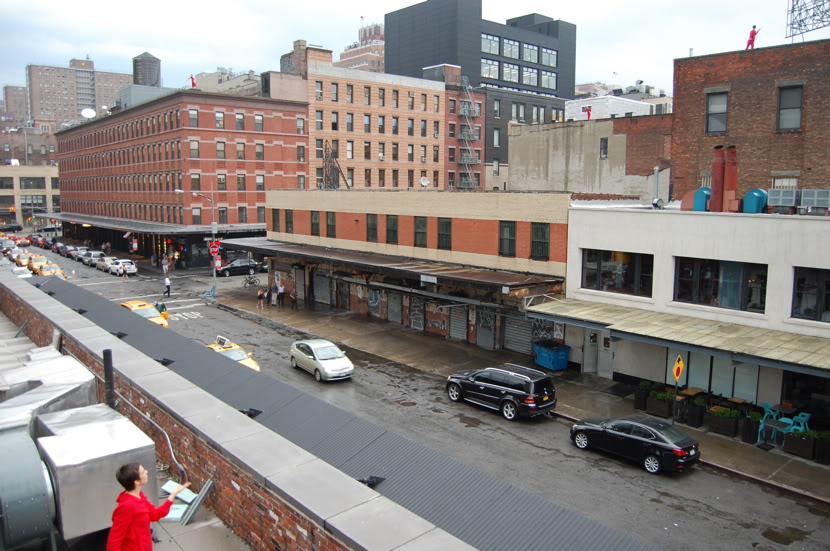
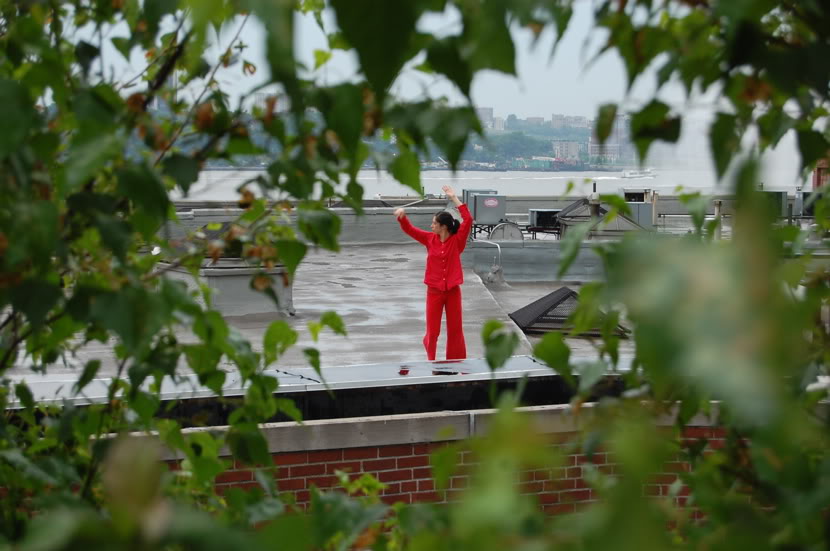
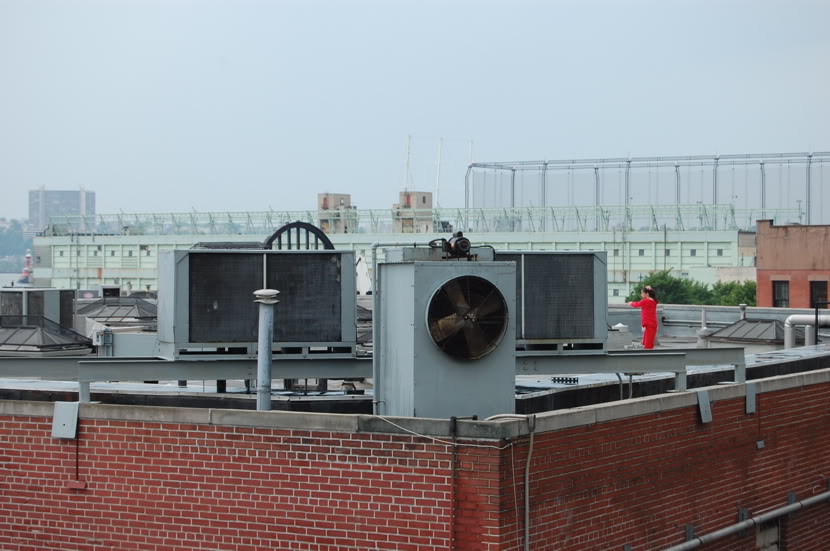
Performance views of Trisha Brown Dance Company performing Trisha Brown, Roof Piece, 1971/2011, on and around The High Line, New York, June 9, 2011.


Excerpts from Trisha Brown, Roof Piece, 1971/2011, on and around The High Line, New York, June 9, 2011. Video: 16 Miles.

The gods favor Trisha Brown and her dance company. That's the only conclusion I can draw after watching a devastating torrential thunderstorm suddenly clear just moments before 7 pm last night, right before the scheduled start of a performance of Brown's seminal 1971 Roof Piece along the southern stretch of The High Line. The piece was performed without a hitch, and the storms resumed within hours of its conclusion. Unbelievable.


It's hard to believe, but this is the first time that Roof Piece has been performed on outdoor rooftops since 1973, when it was staged in — or above — SoHo. Earlier this year, some New Yorkers saw a modified version of the piece, titled Roof Piece Re-Layed, at the Museum of Modern Art, with Brown's dancers sending choreographic signals around Yoshio Taniguchi's airy atrium. Each performer watches another in Roof Piece, miming the movements they see, creating a chain of slowly evolving dance over the course of about 30 minutes. Even in the austere environment of MoMA, it was a thrill to see. But a thought lingered: What would this look like outside, with a dancers transmitting the piece along an expanse of roofs?

We now know that it looks gloriously fresh — and wonderfully strange.
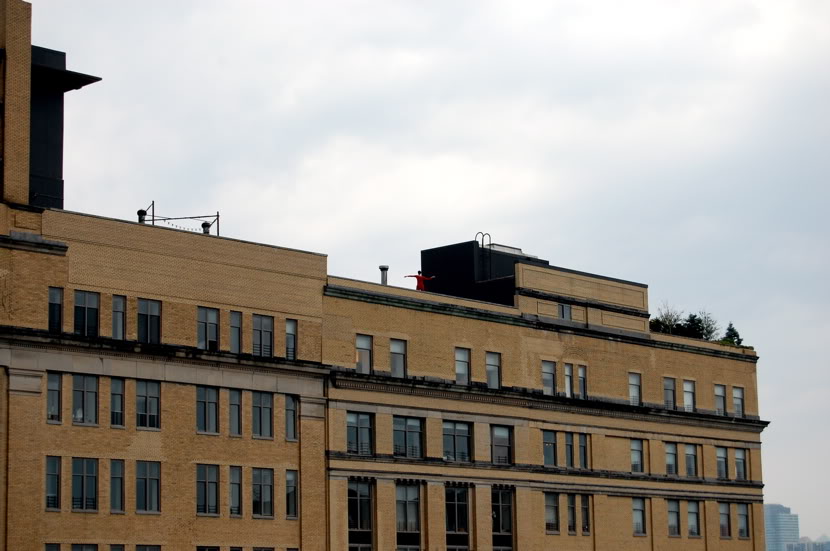


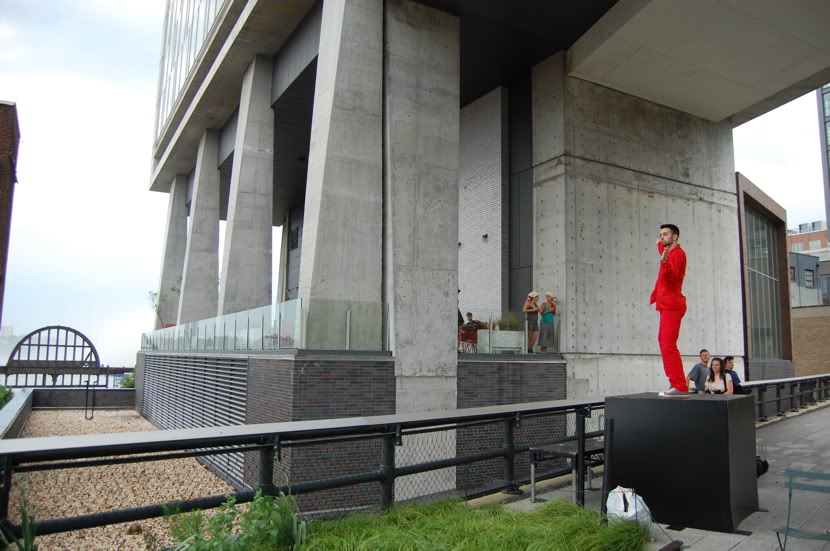
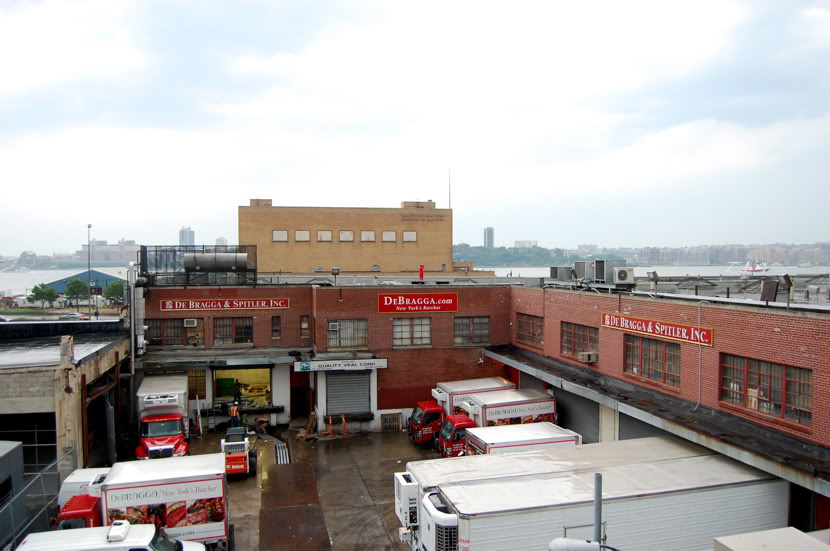
Brown's dancers, all sporting bright red outfits were positioned throughout the area. There was one high atop a building just south of Gansevoort Street, and two standing on the long, low roofs of the DeBragga warehouse (one of the last remaining meat companies in the Meatpacking District). They were secreted in semi-hidden positions along the elevated park and the base of the Standard Hotel — did passersby think the large crowd had gathered to watch one of its notorious displays of flashers? — and arrayed across the buildings to the east of the walkway, where Sperone Westwater once resided.

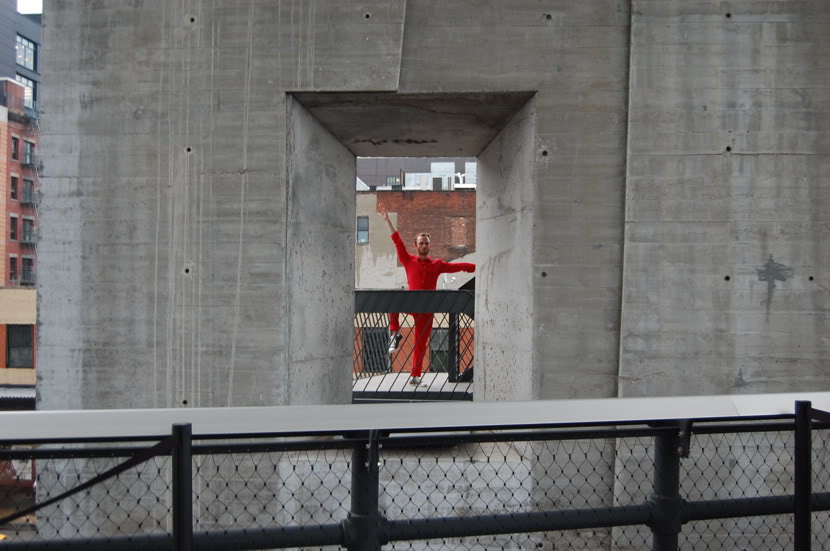
When Roof Piece was performed in 1973, viewers watched the string of dancers from the top of a building on Wooster Street. The High Ligh, though, allows for a more participatory spectacle. You can spot dancers through the leaves of the thick shrubbery along the bottom of the path — enjoying a personal show — and then wander up to the Standard, where the largest crowds gathered last night. If you go, walk back and forth between the sides of the park and follow the passage of the dance's movements. Seeing every dancer requires some work, but as you suddenly spot each one — shimmying, popping, and swaying away — you may feel a refreshing shock of recognition, a humane sense of alarm.


Another 7 pm show is scheduled for tonight, and 5 pm and 7 pm performances are to follow tomorrow. There are reports of incoming thunderstorms. Keep your fingers crossed.
Tuesday, January 18, 2011

Trisha Brown, from Manhattan's Roofs to MoMA's Atrium


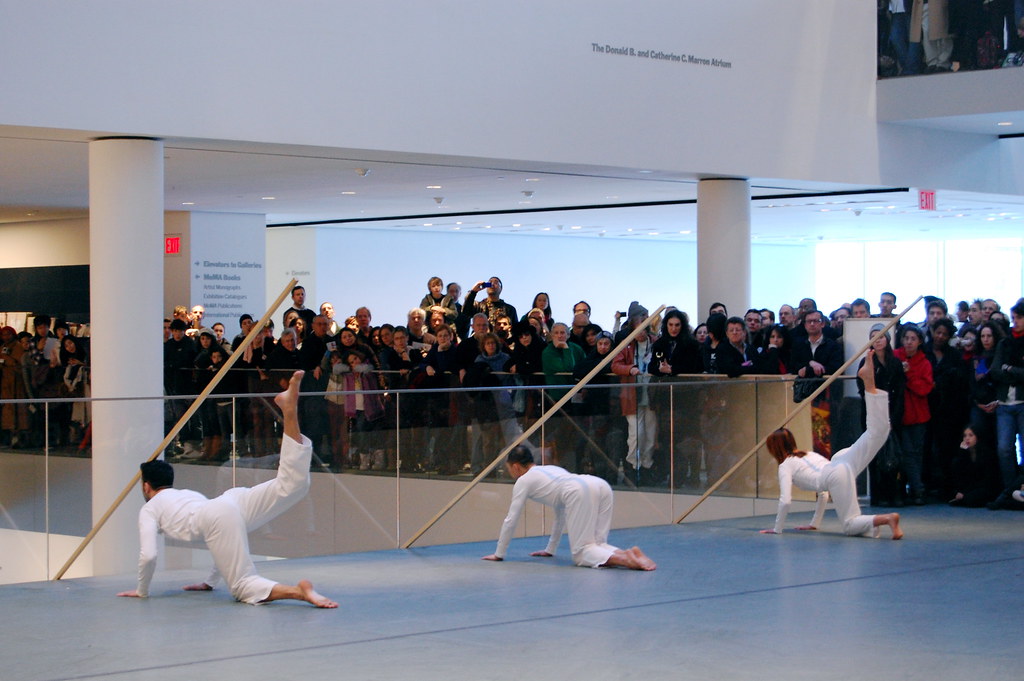
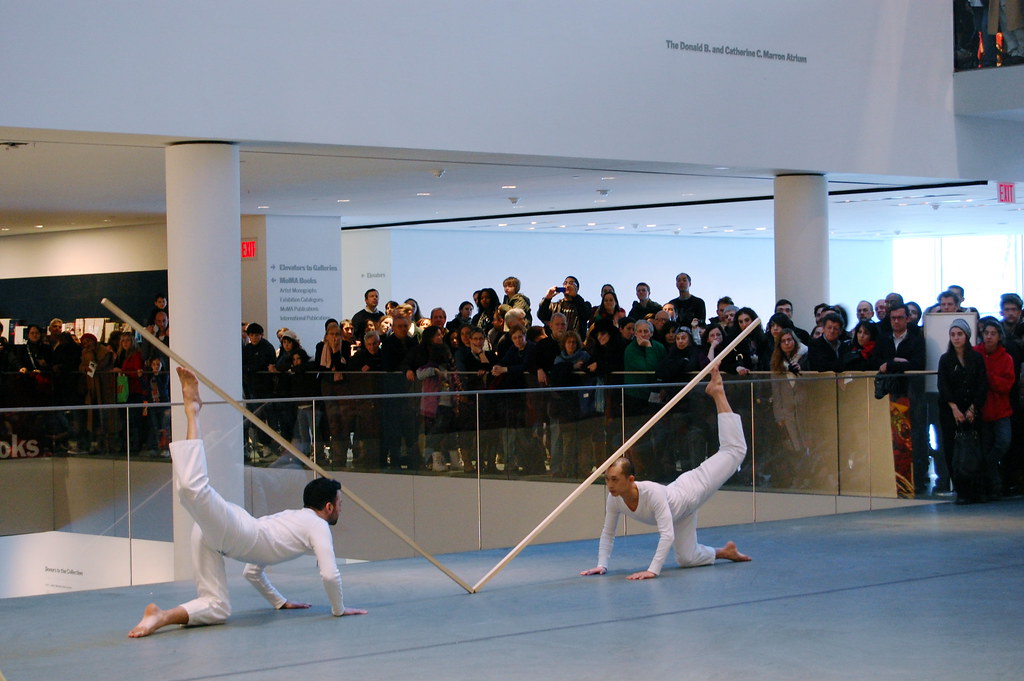
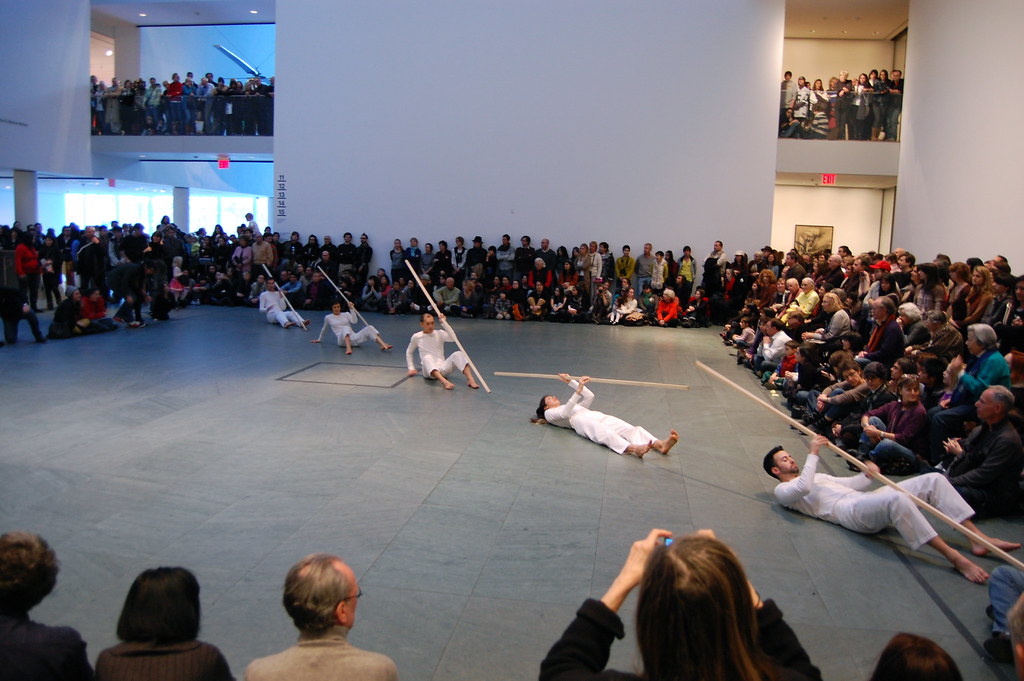
Trisha Brown Dance Company, Sticks, 1973, at the Museum of Modern Art, New York, January 16, 2011. Photos: 16 Miles [more]

“Raise a lot of money for me, I’ll give you good architecture," architect Yoshio Taniguchi supposedly told Museum of Modern Art trustees when he was pitching his plans for the museum's 2004 redesign. "Raise even more money, I’ll make the architecture disappear.” Like John Updike, who reported that quotation, I think Taniguchi largely succeeded. And yet, standing in the museum's atrium on Sunday afternoon, waiting for the Trisha Brown Dance Company to appear, as the latest installment of the museum's Performance series, I wished that he had dematerialized just a bit more architecture. Viewers packed tightly into the space and lined the walkways that overlook it on the four floors above: the typically airy atrium had became a crowded amphitheater.


Just after 2 p.m., four dancers entered, each carrying a long wooden beam, which they propped against glass panels overlooking the lobby. Hands at their sides, they nimbly slid their heads and bodies down underneath each plank, transferring it behind their back to their foot and then their shoulder, flawlessly each time. The work, titled Sticks (1973), ended on the floor, with five performers creating a single line with the five of those beams pushed end-to-end against one of the atrium's columns. Then, as they held their tenuous construction in place, they slowly circumnavigated it. The wobbling line broke apart in a few instances, but each time the dancers recovered, displaying a heartbreaking mixture of balance, control, and communication.

Scallops (1973), a witty journey around the edges of the square stage by five performers, came next, followed by Locus Solo (1973), a free-flowing one-person performance by longtime Brown dancer Diane Madden inside another square that was a fraction of the size of the main stage. (Claudia La Rocco's review of a previous performance is well worth a read for a more complete summary of the program.)


Trisha Brown Dance Company, Scallops, 1973


Trisha Brown Dance Company, Locus Solo, 1975

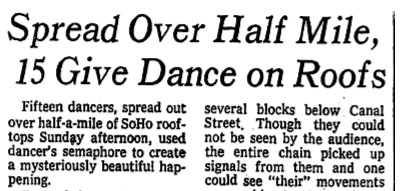
The afternoon ended with a new dance, Roof Piece Re-Layed (2011), Brown's reworking of her 1971 Roof Piece. That work was first performed in 1973, with dancers transmitting dance movements in a meandering line across the rooftops of downtown Manhattan on two summer days for more than a mile north to south (and then south to north), like a choreographic version of the classic children's game Telephone. "It was like receiving messages from outer space," dance critic Don McDonagh wrote in the Times after seeing the performance.


Excerpt from the New York Times, July 3, 1973

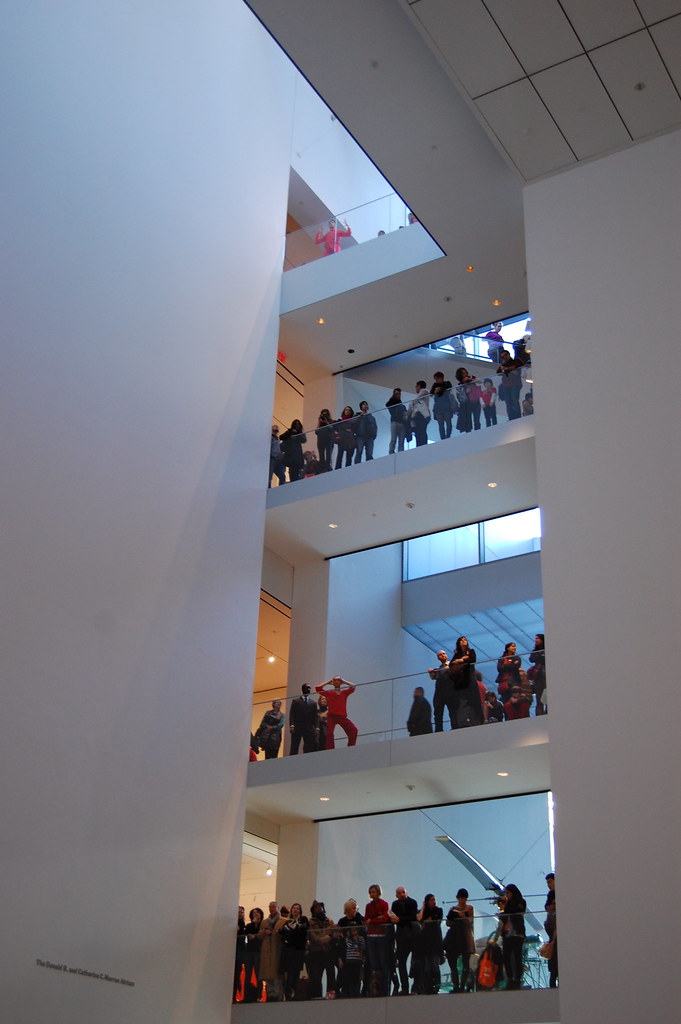
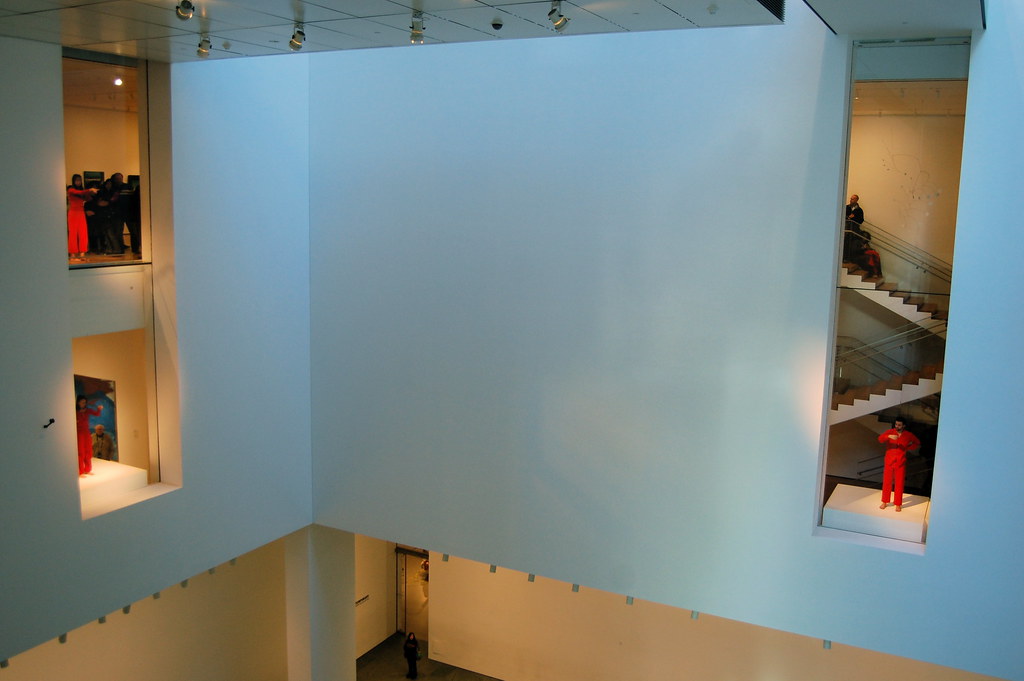
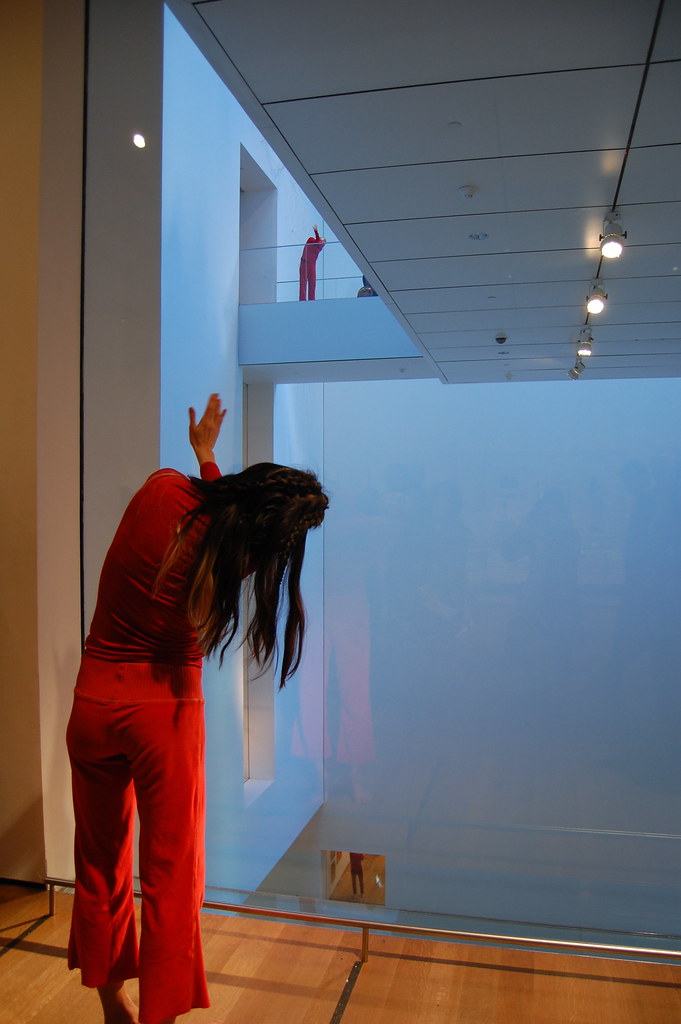
At MoMA, Brown's dancers appeared in nearly every space that opens onto the atrium, taking the positions once held by audience members as they worked to catch a glimpse of the action down below, where only a lone dancer stood now. They wore bright orange outfits, as in the original performance, and transmitted Brown's trademark broad, simple movements around the atrium, from one Taniguchi vantage point to another. A large crowd looked creating a scene markedly different from the original one described by McDonagh: "[O]ne of the eerie things was that you were up in a completely different world, totally removed, and there were people going around shopping down below."


Trisha Brown Dance Company, Roof Piece Re-Layed, 2011


McDonagh's eerie urban environment is confirmed by the best photograph of Brown's 1973 performance that I know of, shot by photographer and filmmaker Babette Mangolt. (One wonders if Barbara Probst has seen it.) Mangolte wrote of Roof Piece, more than three decades after she documented it, "It also was about revealing the majesty and privacy of downtown roofs and the sculptural effect of its water towers." (Even if contemporary MoMA's hushed architecture lacks the unwieldy pleasures of early-1970s downtown Manhattan, it at least has one of those iconic water towers in the form of Rachel Whiteread's translucent-resin Water Tower (1998), originally installed in SoHo.)

MoMA's "Performance" series has been hit or miss, but Sunday's hour-long event was, for me, a concise, thrilling multidisciplinary history lesson from a museum that has long been rigidly confined by medium-specific curatorial departments. (This is an art-world problem that is hardly confined to MoMA.) It is still relatively rare to see postwar shown with work in other mediums, even though it was often developed by choreographers in close dialogue with the visual artists, musicians, and filmmakers of the time. Artist Mary Miss, for instance, has cited Brown's work as a "strong impetus to this crossing of boundaries" between artistic fields that emerged in the New York cultural world of the 1970s. To state that point another way, with a fact: in the 1973 performances of Roof Piece, the northernmost dancer — Brown herself — was positioned atop the roof of 420 West Broadway, where Leo Castelli would open a gallery just a few months later.

Sunday, November 15, 2009

Spaced Out / On Time at Canada [Photographs]


Katherine Bernhardt. Photos: 16 Miles [more]


Installation view.


Otis Houston, Jr., Obama Book. Obama Cat, 2009.


Otis Houston Jr.

"Space Out / On Time"
Featuring Joan Brown, Sadie Laska, Chris Martin, Katherine Berhhardt, Otis Houston Jr., Dona Nelson, and Agathe Snow
Canada
55 Chrystie Street
New York, New York
[more photographs]