Showing posts with label Johns. Show all posts

Monday, July 19, 2010

Andy Warhol's Peculiar 100-Part Group Portrait


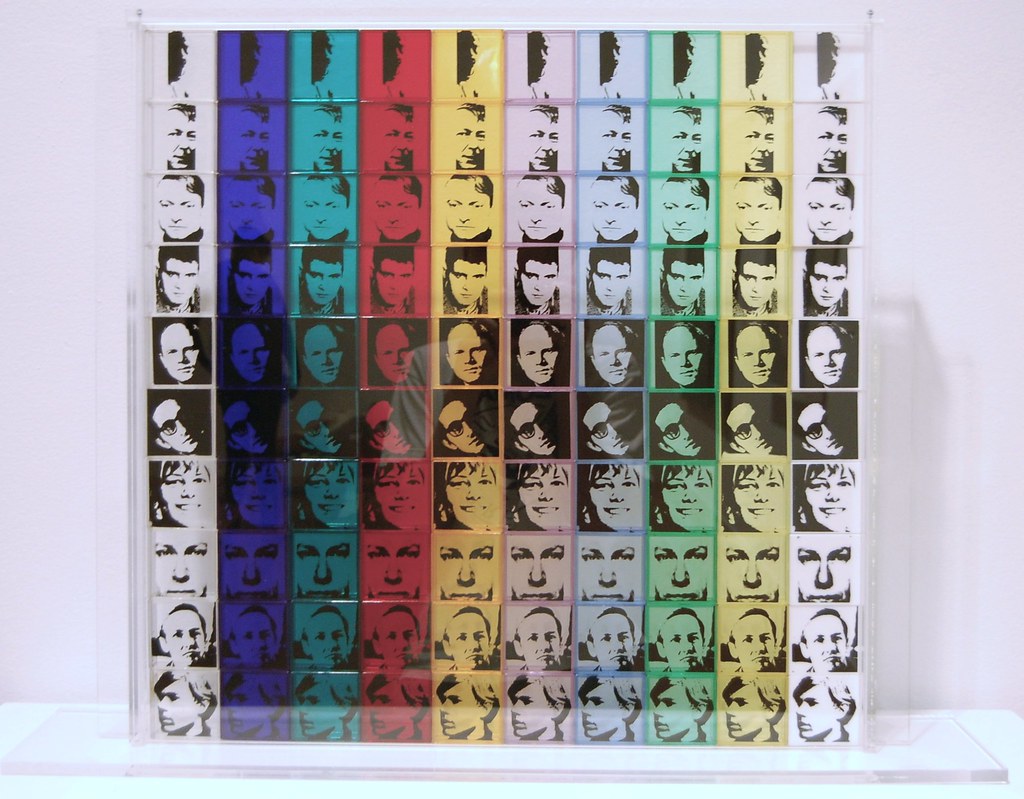
Andy Warhol, Portraits of the Artists, 1967. Screenprints on 100 polystyrene boxes, each box 50 x 50 mm, overall 696 x 696 mm including frame. On view at the Wadsworth Atheneum, gift of Mr. and Mrs. Burton Tremaine. Photo: 16 Miles

In 1967, New York dealer Leo Castelli hosted an exhibition to celebrate the 10th anniversary of his Upper East Side gallery. Each of his artists contributed work to the show, and Andy Warhol (who came to the gallery late, after having two shows at Eleanor Ward’s Stable Gallery), put together a series of portraits, in a variety of sizes, of 12 Castelli artists: Jasper Johns, Robert Rauschenberg, James Rosenquist, Frank Stella, Donald Judd, Roy Lichtenstein, Robert Morris, Cy Twombly, Lee Bontecou, Larry Poons, John Chamberlain, and Warhol himself.

Some of the works in the show were quite small, which turns out to have been an bit unfortunate. Explaining the works, Volume 2 of the Andy Warhol Catalogue RaisonnĂ© notes: “According to the Castelli inventory, several were stolen from the exhibit.” Thankfully for collectors, Warhol also made a rather unusual multiple of 10 of the portraits on polystyrene boxes. Each set of 100 boxes, featuring 10 portraits of each artist, were sold in a numbered edition of 200, plus 25 lettered copies.

I know that it’s been a bit Wadsworth Atheneum-heavy around here recently, but it turns out that it has one of the Portraits of the Artists multiples on display, which is easily one of the strangest pieces that Warhol ever produced and is worth a post. I'd never seen the work before, so when I returned home, I did a lot of Internet-searching and discovered something odd: every edition appeared to be configured differently. The Wadsworth's has the artists in horizontal rows; elsewhere, they are arranged vertically or even scattered about. Here are a sampling. (Note: If you want to try to identify each of the Castelli artists in the Wadsworth’s Atheneum piece, above, I have included the list, top to bottom, at the end of this post.)
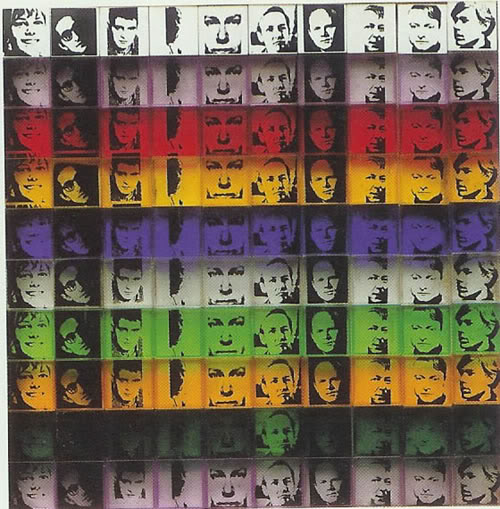

Photo: Alan Brown Gallery
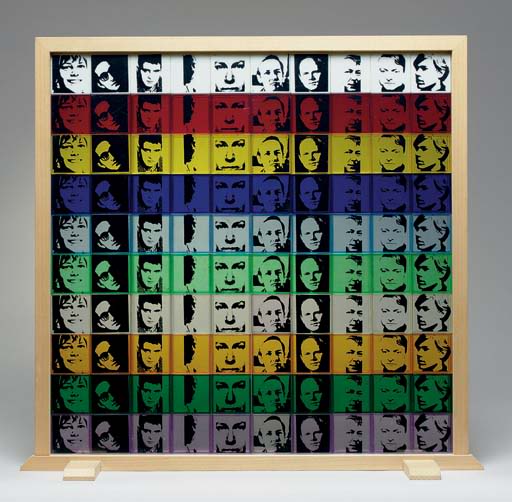

Photo: Christie's
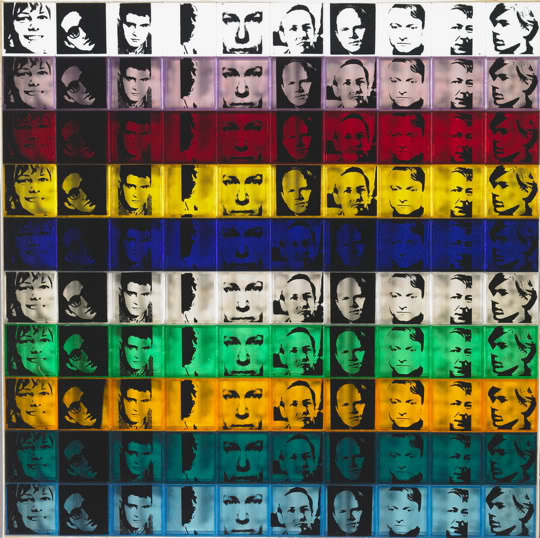

Photo: Honolulu Academy of Arts
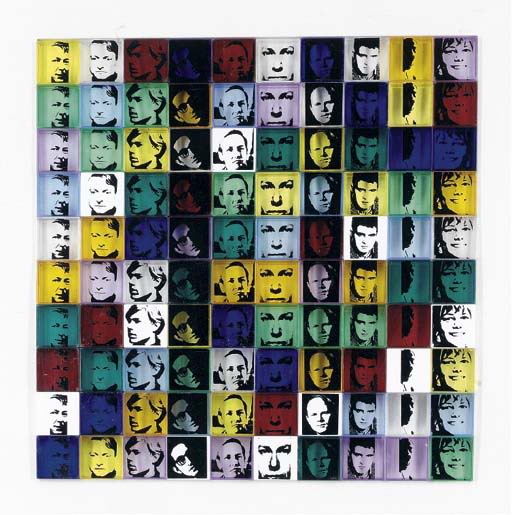

Photo: Christie's

Perplexed, I contacted Patricia Hickson, the Emily Hall Tremaine Curator of Contemporary Art at the Wadsworth Atheneum, who consulted the work's object file. One of the notes in the file read: "Curiously, although Portraits in part of an edition of 200, the order and direction of the artists' images and the color bands vary among the serigraphs in the edition." But here is where things get especially interesting. Hickson explained that the work's frame can be opened, and the boxes can be rearranged, accounting for the differences in all of the images online. The work at the Wadsworth, though, has not been reconfigured since it was donated by super collectors (and serious Castelli clients) Mr. and Mrs. Burton Tremaine in 1977.

Earlier this month, I was going on and on about the mutability of Warhol's sculptures, about the fact that, if you happen to own a set of Brillo boxes, you can arrange the pieces any way you like. Here, Warhol has taken that idea to the next level. When the Brillo boxes are sold or moved, they lose their previous arrangement. But in Portrait of the Artists, the work itself records how collectors chose to configure the work. Which leads to a few questions: did the Tremaines rearrange their copy, or does the work they donated to the Wadsworth show how Warhol originally displayed the work? (Or was was each copy sold in a different configuration?) Does it even matter what the original layout looked like?
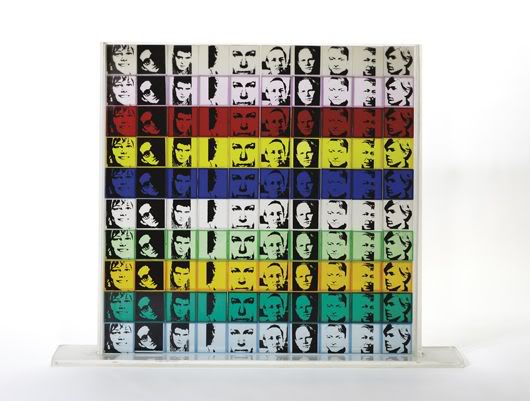

Photo: Phillips de Pury & Company

A final question: who was cut from the 12 artists whose portraits were featured in the Castelli anniversary show in order to make a group of 10 plastic boxes? This, at least, we have an answer to, thanks to the Catalogue. It turns out that Warhol removed Twombly and Chamberlain. Which is interesting: Chamberlain was one of his favorite artists (Warhol collected his work), but he may have been a bit tired of Chamberlian’s portrait, having traded 316 — yes, 316 — copies of it to Chamberlain in exchange for a metal sculpture called Jackpot. (Chamberlain assembled 315 of the portraits into a single rectangular work that he called 315 Johns.) As for what is going on with the wood frame of one of the examples sold at Christie's, I don't even want to think about it.

Key: The artists in the Wadsworth Atheneum’s piece (shown at top), in order from top to bottom: Robert Morris, Jasper Johns, Roy Lichtenstein, Larry Poons, James Rosenquist, Frank Stella, Lee Bontecou, Donald Judd, Robert Rauschenberg, Andy Warhol.

Monday, May 5, 2008

Dan Flavin - The 1964 Green Gallery Exhibition at Zwirner & Wirth [Review]

Noting the recent proliferation of galleries restaging entire, earlier exhibitions in their spaces (highlighted by Karen Bookatz in Art Critical, among others), it’s tempting to suggest that some form of collective historical crisis is motivating the phenomenon. Indeed, with the threat of an art market collapse seemingly eminent and the concomitant fear that some of the excesses of the past decade will be wiped away very much present in the minds of many, there’s a clear comfort in retreating into the past.

In Zwirner & Wirth’s replication of Dan Flavin’s 1964 Green Gallery show, one encounters everything necessary for such a project to be effective: a familiar name, acclaimed and accessible work, and a landmark event. It was here that Flavin abandoned paint to work solely with industrial lights for the first time, establishing the iconic brand that would define the rest of his career. Coming at a time when, as R. C. Baker puts it, “Gotham [was] both on edge and brilliantly edgy,” the Vietnam War and Andy Warhol in their ascendancy, the exhibition, for Flavin’s minimalist allies, then, was also a significant register of change.

Many Flavins that have become trademarks are here: the 45 degree-tilted Malevich-made-electric Diagonal of May 25, 1963, the effervescently pink Untitled (to Jasper Johns) glowing in the corner, and my favorite, The Nominal Three (to William of Ockham), composed, in sequence of sets of one, two, and three shining white lights. But there are also revelatory details: drawings by Flavin that show him working out the arrangements of the colors for Primary Picture and the works inside the gallery (configurations he would later change after seeing the pieces in the space).

Architecture, design, and art were being put effortlessly and instantly together. Shown all together, their power cords stretching along the walls and floor into visible outlets, Flavin’s works look a little less pure, a little more sexy than they tend to when sitting pristinely-installed inside museums.

Historical recreations (at least in the art world) are by their very nature triumphalist affairs. They applaud coherent narratives and, in a sense, function as kitsch, simulating for the viewer the experience of encountering genuinely revolutionary art. Entering the gallery, we already know we’re supposed to enjoy the work. Encountering Flavin’s pieces at the very start of a cloudy evening on the Upper East Side, though, as the warm color from the sculptures stretched further into the gallery’s shadows, one couldn’t help but ratify that judgment, even while hoping that some of the confidence and risk on display would spill over into the present.

Monday, February 4, 2008

Jasper Johns on Today's Artists, etc.

"To me, self-description is calamity." - Jasper Johns, in response to a question about his influence on contemporary artists. Carol Vogel, "The Gray Areas of Jasper Johns." The New York Times (February 3, 2008).

Review to come of his opening on Friday at Matthew Marks and Archive Fever over at the International Center for Photography; haven't seen the Gray show at the Met yet. Also just finished Sophie Calle's gorgeous Double Game (thank you); bought The Artist's Joke.

[At left: Hans Namuth, Jasper Johns (1988).]

Saturday, January 13, 2007

Quick Notes 2

A New Gursky Record: $2.48 million
[EV+/-] (via Modern Art Notes)
Surprising all but the most optimistic commentators, the record price of Gursky prints continues to rise. EV+/- briefly describes some of the digital alterations the artist has made to his most famous pieces. In light of such changes, defining records based on medium seems to be increasingly suspect. Is a digitally altered image really a photograph? Is it fair to put a vintage Man Ray (or, for that matter, a vintage daguerreotype) in the same category as a Gursky?

Jasper Johns Has Some Things to Say
[The Art News Paper] (via Art News Blog)
Johns has a tendency to be a bit quiet, though that holds for most of the artists of his generation. He decided to speak to the Art News Blog recently, though. No real news here, but it's nice to have a quick update on what's up. Things I didn't know: Johns is a major collector of Chris Burden's work, and he considers 1954 his greatest year (too bad the show at the National Gallery is from 1955 to 1965). (The photo is by Rauschenberg.)


CAPC Curators in Trouble with the Law
[Flash Art Online] (via Off Center)
I thought the French were supposed to be open-minded about art (and pornography). Maybe not. The director of Centre d’Arts Plastiques Contemporain (CAPC), Bordeaux's contemporary art museum, and two curators have been hit with pornography charges over, according to the Walker (whose coverage is superb), "Gary Gross painting of a girl taking a bath, an Elke Krystufek video showing a masturbating girl, and photos by Annette Messager of children with their eyes scratched out." (Ironically, the exhibition was entitled Presumed Innocent: Contemporary Art and Childhood.) Thomas Hirschorn has even weighed in, claiming this is the first time any such thing has happened in French history. They face five years in prison and a stiff fine.