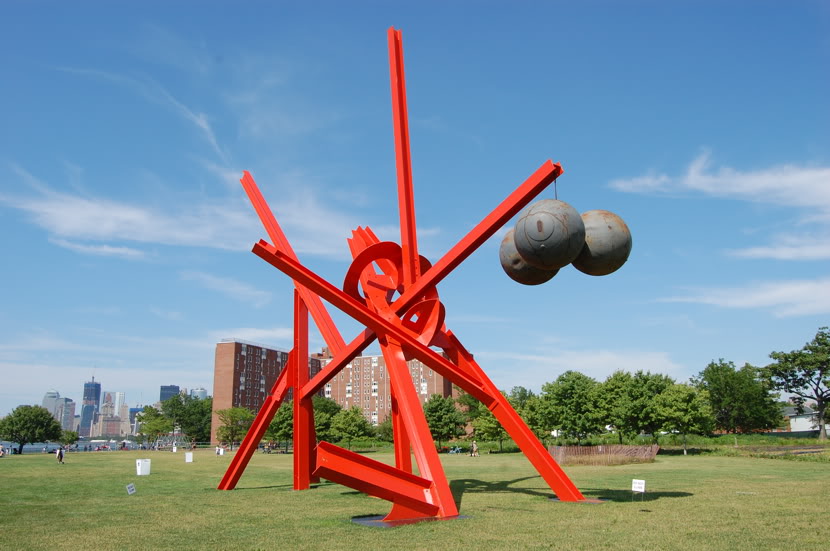
Mark di Suvero, Figolu, 2005-2011, in "Mark di Suvero on Governors Island," presented by Storm King Art Center, through September 25, 2011.
"He's a bit of a maverick, and he's not that much interested in gallery shows," dealer Richard Bellamy told Lee Rosenbaum of Marco Polo "Mark" di Suvero, trying to explain, in 1993, why the widely lauded artist was less visible in the art world than he had once been. There was also, of course, the issue that few spaces — even outdoor spaces — could accommodate di Suvero's largest sculptures at the time. And once your local metropolitan sculpture garden acquires a monumental di Suvero — the one I grew up with, the Walker, owned a huge, awesome one with a wooden swing — it's perhaps hard for its curators to justify buying another.
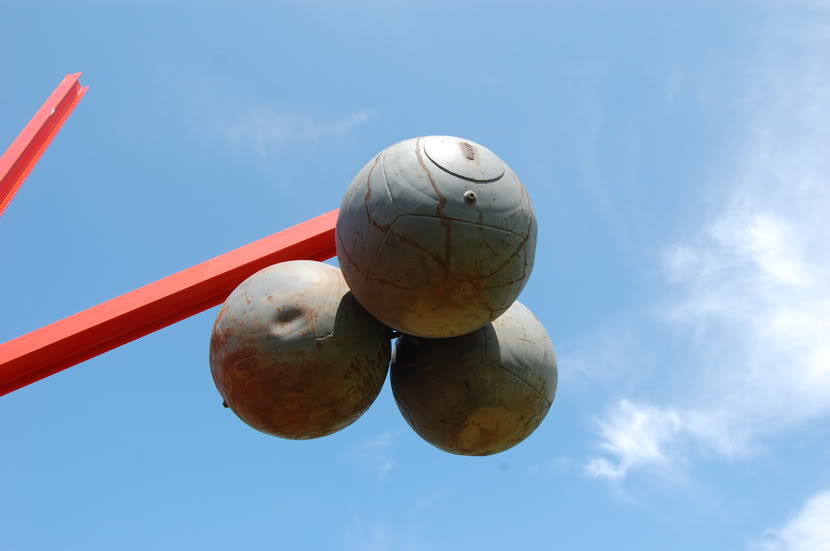
Detail of Figolu, 2005-2011
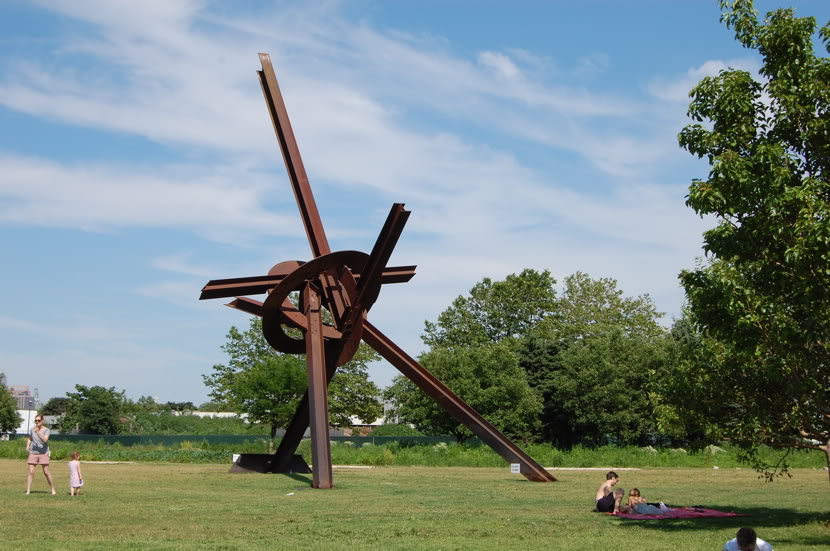
Will, 1994
With the recent proliferation of large-scale galleries and gardens, di Suveros have found plenty of new homes. The latest place to take on that role is Governors Island, the 172-acre former military base just off the coast of Manhattan that has been converted into a park over the past few years, where the Storm King Art Center has installed eleven of the artist's works in a show that runs through September 25. It is in an insanely gorgeous exhibition, and a perfect reason to wander around the island on bicycle. So far, the reviews have been resoundingly positive. Writes the New Yorker, "Di Suvero's steel abstractions are so playful that this plein-air installation suggests a game of jacks strewn across the park by a giant hand."
Rather than add to that unanimous, deserved praise, then, let's talk about Bellamy for a bit, whom I somehow didn't realize had played an instrumental role in di Suvero's career, extensively documenting the artist's work in photographs, organizing many of his shows around the world, and even moving his second gallery, the amazingly named Oil and Steel Gallery, into di Suvero's Queens studio, in Hallet's Cove, in 1985. (A year later, di Suvero helped found the nearby Socrates Sculpture Park.)
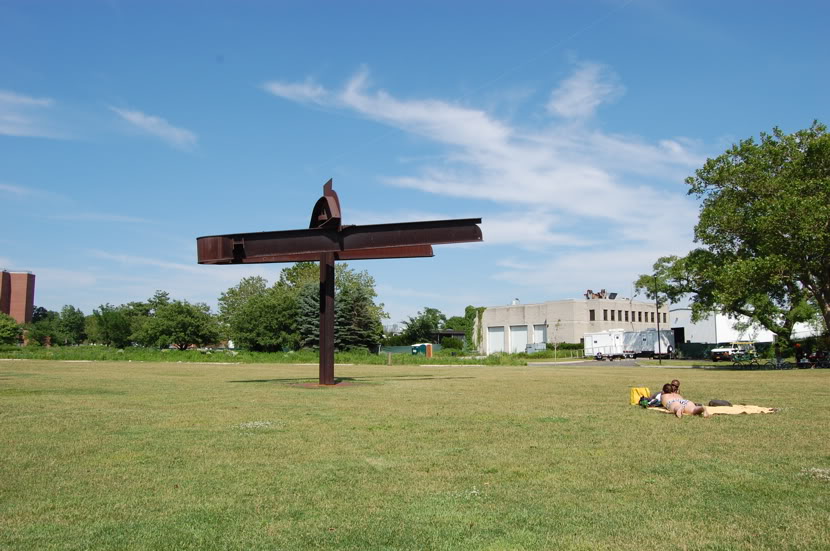
Mahatma, 1978-1979
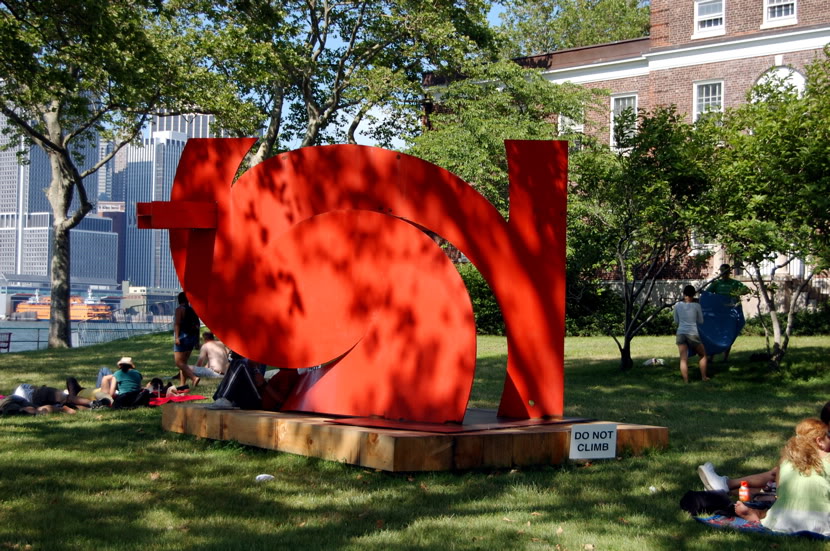
Rust Angel, 1995
Bellamy's involvement with di Suvero fascinates me since I've always thought of him solely as the radical proprietor of the Robert Scull-backed Green Gallery, which he ran from 1960 to 1965, showing Pop, Minimal, and Conceptual work by artists by Dan Flavin, George Segal, and Robert Morris, who writes in "Thinking Back About Him," a glorious tribute to Bellamy published in his book of collected writings, Have I Reasons: "A crooked taxi baron glitzed out real vulgar uptown and kept a stable of artists downtown. Dick [Richard Bellamy] floated somewhere between. Hovered mid-town maybe. Mediating. Plugged into other circuits. Listening for edges other never heard." ("A voice like a rich malted milk," Morris adds.) In my cursory conception of Bellamy, di Suvero and his resolutely extroverted sculptures didn't quite make sense.
Morris continues with a story from Bellamy: "'Philip Johnson was in,' he said, smiling that before-the-repaired-teeth smile. 'He saw your work and wanted to get a broom and kill it.'" This would be a great story by itself, but it's made even better by the fact that Johnson actually ended up buying works by Morris — first Litanies (1963), and then Statement of Aesthetic Withdrawl (aka Document) (1963), made by Morris to protest Johnson taking too long to pay for the first work — which speaks either to Bellamy's skills as a dealer, Johnson's willingness to buy art he hated, the overwhelming charisma of Morris's work, or some combination of those factors. Johnson donated both to MoMA in 1970.
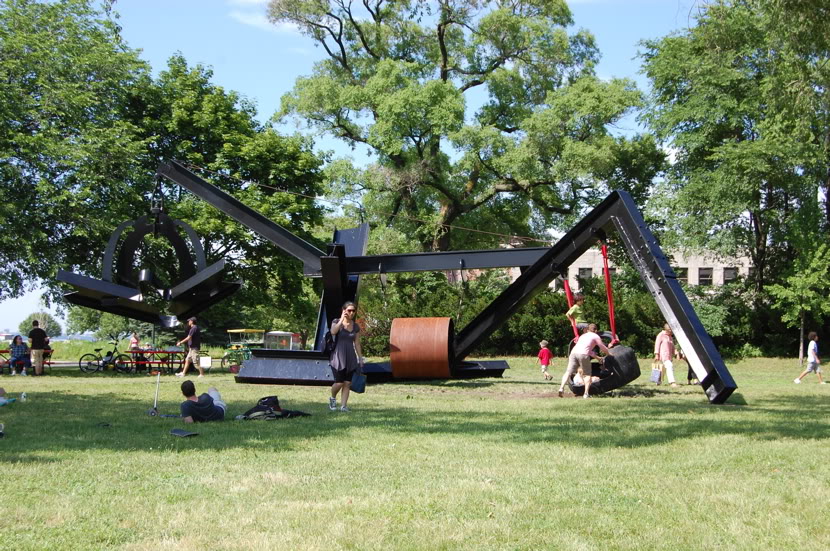
She, 1977-78. To view a vintage photograph of the work in di Suvero's studio, scroll to the bottom this MoMA feature on Bellamy, "The Dealer as Co-Conspirator."
It turns out that Bellamy first showed di Suvero at the Green Gallery all the way back in 1960, three years before Morris's first show there (his first in New York). The two men went on to become very different artists — di Suvero an ebullient crowd-pleaser, Morris a continually confounding shape-shifter, a trickster par excellence — and today Morris is something less than a proponent of di Suvero's work. Describing the state of contemporary sculpture in Have I Reasons, Morris writes: "Aggressively large-scale, grand spatial occupation, the buzz of spectacle. A long list could be drawn up. From Pollock and Newman on down to Stella, di Suvero, Heizer, Turrell, Kelly, Serra." Those descriptors sometimes fit di Suvero's work, but they don't here. Placed in one of New York's most daring experiments in pubic space, they look as comfortable, nuanced, and subtle as the masses of people marveling at — and playing on — them.