Showing posts with label 1968. Show all posts

Saturday, January 16, 2010

Ten U.S. Museum Exhibitions to See in 2010


John Baldessari, Exhibiting Paintings, 1967-68. Acrylic on canvas, 67 3/4 x 56 1/2 in., at the Hirshhorn Museum and Sculpture Garden, Washington, D.C. Photo: 16 Miles

As you may have heard, museums are going to be filled with great ideas this year: James Ensor and Georg Baselitz at the Seattle Art Museum, Yves Klein at the Hirshhorn and the Walker, and Marina Abramović dominating the Museum of Modern Art's atrium for 600 hours, to name just three examples. Artinfo's executive editor, Kris Wilton, and I decided to write about 10 of the exciting exhibitions opening in the United States over the next 12 months. There's also a fun slideshow, courtesy of the museums' press offices. Here's one entry I wrote, which previews the traveling Baldessari retrospective:
“John Baldessari: Pure Beauty” at LACMA, Los Angeles, June 27–Sept. 12, 2010
Last year, the British were spoiled with this massive retrospective; in June it will finally travel to Baldessari’s native California. None of his early paintings will be on display — he had them cremated — but just about every other period of his idiosyncratic career will be covered. His text-heavy early work looks like conceptual art, though it’s more waggish than that genre’s stereotype: One 1971 lithograph reads, “I will not make any more boring art.” We'd argue he’s fulfilled that promise since, mining found photographs (and eventually returning to painting) to create an inimitably bizarre vision of contemporary culture: America, as seen through the eyes of aliens

Wednesday, December 16, 2009

Hans Haacke's Condensation Cube at the Hirshhorn Museum


Hans Haacke, Condensation Cube, 1963-2008. Photos: 16 Miles [more]

Sadly, the Hirshhorn Museum and Sculpture Garden has decided to prohibit photography in its very wonderful "Anne Truitt: Perception and Reflection" show, which is up through Jan. 3, 2010. The Hirshhorn's choice Hans Haacke, Condensation Cube, will have to be the substitute. Haacke also has a solo show at X in Manhattan right now. Here are more photographs from the Hirshhorn.


Monday, June 8, 2009

Richard Serra's 2008 Commencement Address at Williams College

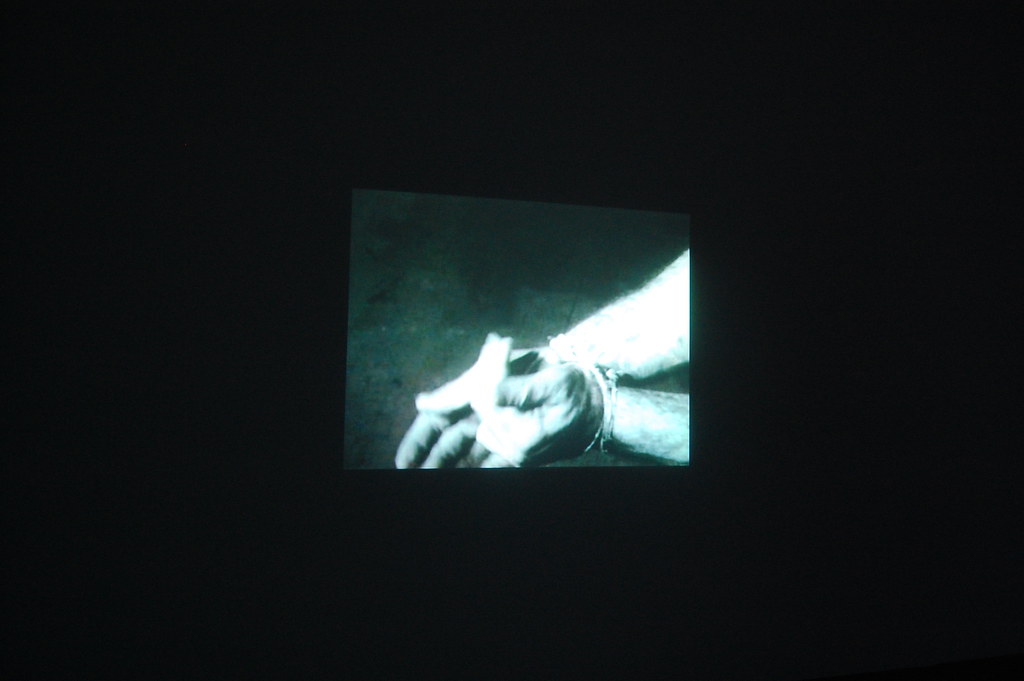
Richard Serra, Hands Tied [Still from film projection], 1968, at Kunste Werke Berlin e.V.  Photo: 16 Miles.

"It is difficult to think without obsession, and it is impossible to create something without a foundation that is rigorous, incontrovertible, and, in fact, to some degree repetitive. Repetition is the ritual of obsession. ... I cannot overemphasize the importance of play. The freedom of play and its transitional character encourage the suspension of beliefs whereby a shift in direction is possible; play ought to be part of the working process."

- Richard Serra, "If Not Now, When?" Commencement Address at Williams College, June 1, 2008.

Tuesday, December 16, 2008

[Top 10 of 2008] #7 - Richard Serra: Thinking on Your Feet at K.W. Berlin


Richard Serra, Hands Tied, 1968, film projection, dimensions variable.

Richard Serra, Thinking on Your Feet
Kunste-Werke Berlin e.V. - Institute for Contemporary Art
July 6 - September 7, 2008
Berlin, Germany

While MoMA made use of its floors that were purportedly designed to accommodate large Serra's largest pieces, K.W. Berlin went in exactly the opposite direction, showing us a handful of the artist’s too rarely shown early films. The works were presented together in various corners of a single room on loop, allowing visitors to wander between and glance among the pieces. In Hands Tied we watch a single, close-up shot of Serra’s bound hands as he struggles viciously to tear them free from some heavy rope, a succinct allegory for the machismo, virulence, and fight that would define his next four decades.

Serra also gave the commencement address at art history powerhouse Williams.

Wednesday, April 30, 2008

The Selling of France's May of 1968

Remembering May 1968 in France:
Even Fauchon, the expensive gourmet store whose color is hot pink, has lined up with the zeitgeist. The store is selling a metal box containing green tea from China called “le thé Mai 68” and adorned with slogans (including: “poetry is in the streets” and “imagination to power”). Described as “subtly perfumed with exotic fruits, grapefruit, bits of lemon peel and rose petals,” Fauchon calls it “the tea with the perfume of revolution.” Price: about $23.50.

Works Cited: Steven Erlander, "Barricades of May '68 Still Divide the French," The New York Times, April 30, 2008.

Friday, December 28, 2007

Paris, 1968

"... And then, in the Latin Quarter, the television was there, until midnight, that is. Then there was just the radio, Europe No. 1. And at about three in the morning -- in complete bedlam, there was noise from all directions -- a radio guy handed the microphone to Daniel Cohn-Bendit, who had the brilliant idea of simply saying: "General strike, general strike, general strike." And that was the decisive moment; it was then that there was action. That was what took the police by surprise. That students were making trouble, that there was a little violence, some wounded, tear gas, paving stones, barricades, and bombs -- that was all just the children of the bourgeoisie having a good time. But a general strike, well, that was no laughing matter."
- Henri Lefebvre, "Lefebvre on the Situationists: An Interview." October 79 (Winter 1997), p. 83.