Showing posts with label Whitman. Show all posts

Monday, April 25, 2011

There and Back Again: Robert Whitman's "Passport" in Beacon, New York


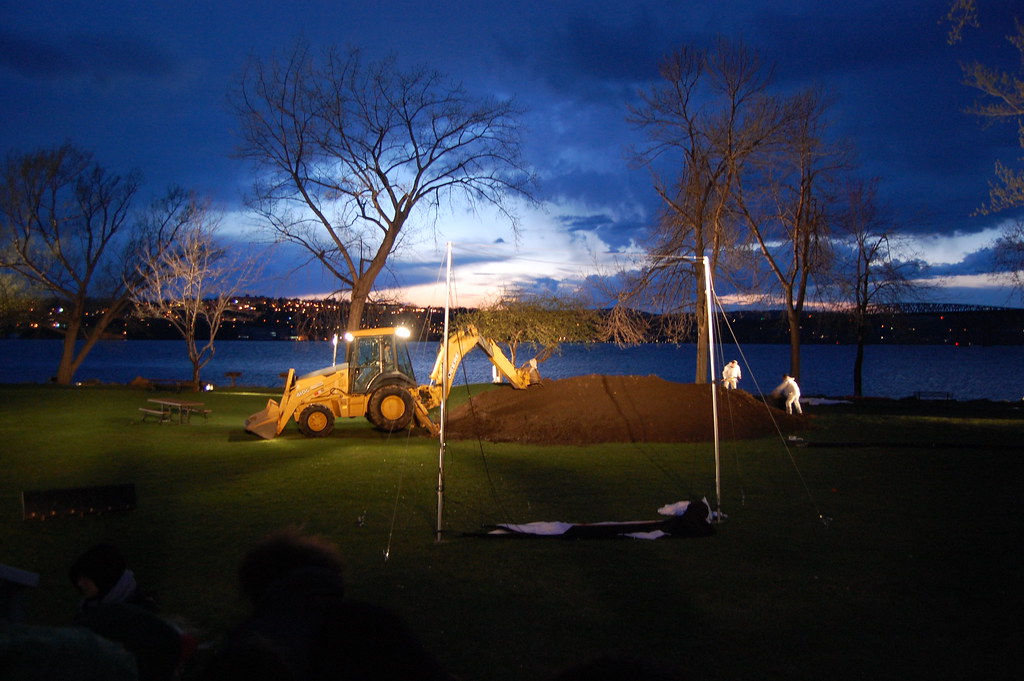
Pre-performance view of Robert Whitman's Passport, 2010, at Riverfront Park, Beacon, New York, April 17, 2011. Photos: 16 Miles [more]

"It’s not written in scripture that everyone has to see the same thing at the same time."

"Why am I here and not over there?"
– The Dirty Projectors, "Stillness Is the Move," 2009

"This is just like the opening of the final act of Hamlet," a woman said to a young boy as they sat together on bleachers awaiting the start of Robert Whitman's Passport (2010) on Sunday, April 17, in Beacon, New York. We were just a few yards from the Hudson River, not far from Dia:Beacon, and two poncho-clad men with shovels — gravediggers of a sort — moved about a dirt mound as a yellow backhoe stretched its limb and growled. Lightning had forced the cancellation of the previous night's performance, and it felt like thunderstorms could break out again at any moment, shuttering this second, final show. "What's Hamlet?" the boy asked. "It's a play by the English writer Shakespeare," his mother said. She didn't mention that it ends badly.

I arrived by bus from the city just before 8 pm and entered Beacon's Riverfront Park to find Dia director Philippe Vergne handing out ponchos and directing people toward the haunting scene along the water. Another contingent of Passport viewers was filing into the Alexander Kasser Theater, in Montclair, New Jersey, some 60 miles away, at the same time. Whitman planned to stage two different performances simultaneously, beaming video of the actions in between them. As the clouds grew darker and the temperature dropped, the New Jersey theatergoers seemed like the far smarter group, but we were in this together: if a storm started, both parts of the performance would be canceled.
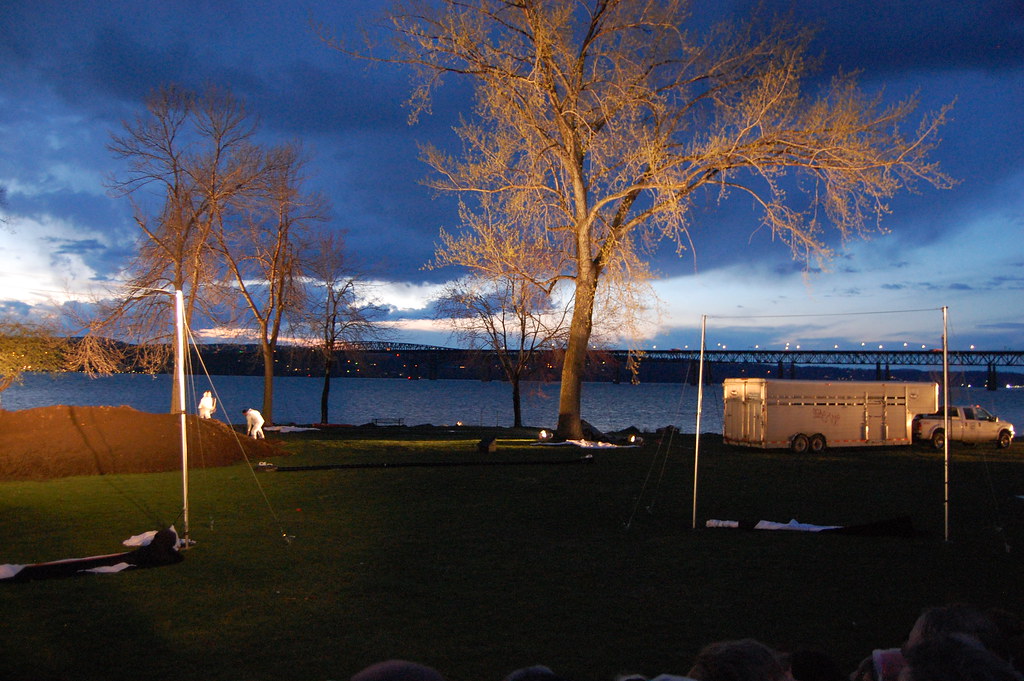

Another pre-performance view, with the diggers hard at work and the horse trailer at the ready.

"I like things that stay pretty abstract, even though you could put meaning," Whitman tells Joan Waltemath in this month's Brooklyn Rail, and Passport proved to be nothing if not abstract, a series of slow–moving, seemingly unrelated episodes floating through the space in front of us. A video projected on the side of a horse trailer showed fire spewing from a faucet, an image that Jonathan T. D. Neil explores in his take on Passport in ArtReview. Whitman's poncho-clad crew used rope to hang three gigantic white shirts from trees, which served as screens for video projections of rotating, flaming orbs. People ran up the dirt mound from behind, jumped over the top and rolled slowly down the other side, the soil sticking slightly to their plastic clothing. A man to the left of the audience shouted a lengthy definition of the word "word."

A man piloted a rowboat along the river from right to left (north to south). Its edges were limned with a roaring fire and another person — a woman, it seemed — sat still inside. "[A] boat on fire is probably one of the worst things in the world," Whitman tells Waltemath. Still burning, it returned later, heading in the opposite direction, a mirror image, a repetition undermining any traditional sense of narrative progression. Repeated, it seemed caught in a moment of perpetual destruction, a representation of terror. This doubling recurred throughout the piece. A white horse appeared twice carrying a young woman, once with her upright, the other time with her on her back, her eyes closed. Two screens made from white fabric served as a backdrop for video footage, close-ups of eyes and mouths that recalled Marilyn Minter.

The formal aspects of Whitman's work were filled with doubles as well: the two scheduled performances (Saturday and Sunday) and the two locations, Montclair and Beacon. Segments of the Montclair performance were beamed into the Beacon show onto the side of a horse trailer. We watched as white–clothed performers brought a brown mound on stage in the video. In front of us, our performers did the same. Both of the strange brown constructions spewed paint in a rainbow of colors, gushing down the sides like lava flowing from a volcano. The video footage was grainy and occasionally halting, the interruptions making the images seem more live, more real, underscoring our partial view and perhaps even carrying political connotations. "It has that look of cell phone reports that we are getting from these war zones," Whitman says to Waltemath, perfectly accurately, of the film stream.

The footage from Montclair was sparse and often closely cropped. We could not see the audience there or hear the sounds they were hearing, and one wondered what they were seeing of us, and our performance, on the video that they were receiving from our end. Could they see or hear the Metro-North trains shooting by behind us? Did they know that rain was beginning to fall up north? This devoutly non-programmatic pitch of Passport — with the mysteries that surround its content and form — sharply departs from the straightforward, rule–based structures of today's most popular performance works. Like our times, Whitman's work was instead provisional and fractured, literally — and generously — dispersed.

Tuesday, April 19, 2011

Robert Irwin and the Intersection of 42nd Street and 5th Avenue in Manhattan


42nd Street and 5th Avenue, New York, New York, April 17, 2011. Photo: 16 Miles

I am never one to turn down the breezy and beautiful train ride up to Dia:Beacon — unless, of course, a plush bus ride is available, as there was this weekend, thanks to Dia, which organized shuttle service to the performances of Robert Whitman's new piece, Passport, along the Hudson River, not far from the museum, on Saturday and Sunday. (The Saturday performance was canceled because of lightning.) The meeting point for the bus in Manhattan was the intersection of 42nd Street and 5th Avenue, which sounded oddly familiar to me, though it took a while for me to figure out exactly why that was.

That intersection, 42nd Street and 5th Avenue, is the exact spot where Robert Irwin produced Black Plane, which involved painting the entire intersection with blacktop sealer as part of his 1977 solo show at the Whitney. A very young Ian Frazier reports from the scene of the creation of the work, on the evening of May 2, 1977, in the June 6 issue of the New Yorker:
"He [Irwin] could not take part in the painting himself, having returned to his house in Los Angeles, but the other night, at about eleven o'clock, Richard Marshall, the curator of the Irwin show, three other members of the Whitney staff, and two friends of the artist arrived at Forty-second and Fifth to paint the intersection. They had with them a permit from the Department of Highways, four five-gallon cans of Peerlux Acrylic Latex Blacktop Sealer, and six rollers with long handles. … They began to apply the sealer in long roller strokes, being careful not to get any on the white crosswalk lines. A photographer for the Whitney recorded the event with a Nikon camera with a Vivitar Auto/Thyristor flash. He had the crew pose dipping their rollers in one of the five-gallon cans."

Robert Irwin, Black Plane, installation at 42nd Street and 5th Avenue, New York, May 2, 1977, reproduced in Art in America, July/August 1977. Photo: Warren Silverman

Unfortunately, I don't have that photograph, but I do have this beauty, pictured above, taken by Warren Silverman and printed in that year's summer issue of Art in America, which is conveniently accessible at the New York Public Library's Stephen A. Schwarzman Building, located mere feet from the intersection. You can see at least some of Irwin's freshly sealed blacktop in the image, but it looks to me — though is impossible to be certain — like this was taken before the entire square was done. Frazier says that workers could only paint one quarter of the road at a time, allowing traffic to continue in at least one lane of each street, and the foreground here looks a great deal shinier than any other part of the intersection.

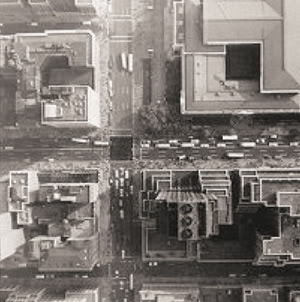
I imagined Black Plane as a classic example of Irwin's interest in the intimate details of minute perception: one black laid down on top of another, two different shades that are barely distinguishable, as in an Ad Reinhardt painting. But in a 2001 interview conducted at John Wesley's Greenwich Village apartment, Irwin tells then Chinati Foundation director Marianne Stockebrand, "I stepped outside the cherished frame of the museum and painted the graying plane of the intersection." It is black on gray, and definitively so, as this aerial photo provided to Chinati by the Whitney confirms, pictured below. It is a strange black square floating within Manhattan's grid. I never quite realized just how gray some stretches of New York's streets are. (The aerial shot is presented as a mirror image in the newsletter; I have reversed it so that it appears as it does in other official reproductions.)


Robert Irwin, Black Plane, May 2, 1977, reproduced in the Chinati Foundation newsletter, volume 6, December 2001, page 23. Photo: Whitney Museum of American Art

Few people actually saw the piece from the sky, of course. Breaking the institutional frame was the point of the work, as Irwin says above, and his biographer, Lawrence Weschler, concurs. "There are hundreds of shadow squares just as remarkable all up and down the block," Weschler imagines Irwin saying, in his brilliant biography of the artist, Seeing Is Forgetting the Name of the Thing One Sees (1982). "The point is to attend to them."

To return to the account in the New Yorker: Frazier registers one other strange parallel between that night in 1977 and the one this past Sunday, nearly 34 years later: a nearly full moon. Here's Frazier again:
"It was a balmy night with an almost full moon, and moonlight was reflected in the wet sealer. After the crew had painted a quarter of the intersection, they had to wait for it to dry before they could move the barricades, so they went to Pete Smith's Hall of Fame Bar, on Forty-second Street, for a while.

"What with painting the intersection a quarter at a time and waiting for the sealer to dry, 'Black Plane' was not finished until about three in the morning. At about one-thirty, a police car pulled up. A blond policewoman whose name tag said 'Petersen' got out. She walked over and looked at the barricades and the group with the rollers. 'What are you doing?' she said."

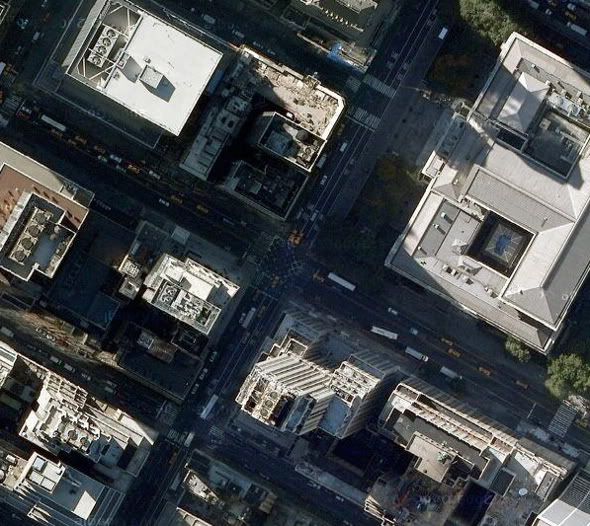
A more recent aerial view of 42nd Street and 5th Avenue, New York. The black square in the intersection was, for a time, lined with a diagonal white grid. Photo: Google Maps

Tuesday, April 5, 2011

Eisenhower at the Met, Lippard vs. Benglis, the Titanic, Dia, etc. [Collected]


Detail view of Glenn Ligon, Notes on the Margin of the Black Book, 1991–93. Off-set prints and text, 91 off-set prints, framed: 11 1/2 x 11 1/2 in. each; 78 text pages, framed: 5 1/4 x 7 1/4 in. each. In "Glenn Ligon: AMERICA" at the Whitney, New York. Photos: 16 Miles [more]
  • While doing research in the Metropolitan of Museum Art's archives, the director of the Monuments Men Foundation recently discovered a recording of the provocative speech about culture and war that General Dwight Eisenhower delivered at the museum in 1946. Laura Gilbert reports on the fascinating piece and shares the story of the Americans who advocated taking German–owned artworks as spoils of war. [Art Unwashed]
  • Tough choices on Thursday evening: Lucy Lippard is presenting a lecture called "Ghosts, the Daily News and Prophecy: Critical Landscape Photography" at the School of Visual Arts at 7:00 pm, while Lynda Benglis will speak on "Refiguring the Spiritual" up at Columbia at 6:30 pm. [SVA and Columbia]
  • From the museum-spectacle department: on April 14, the Guggenheim will be the site of two performances of Dominique Gonzalez-Foerster's Titanic–inspired T.1912. Tickets are $30, though you can spring for a $200 "First Class" ticket that will get you champagne and dessert. [Guggenheim]
  • Dia will stage simultaneous performances of Robert Whitman's Passport at Riverfront Park in Beacon, New York, and the Alexander Kasser Theater in Montclair, New Jersey, on April 16 and 17. [Dia]
  • Donald Judd's wood boxes at Dia:Beacon versus wood boxes "with some slutty heels on them" in SoHo. [C-Monster]
  • "Jorge Pardo -- recycles midcentury design to no account that I can see. Ruined the floors of the lobby of the old Dia building with 'colorful' tile-work." — Tweet-length descriptions of contemporary artists by John Perreault. [Artopia, via @gregorg]
  • Rainer Ganahl's Bicycling 51st Street and 8th Avenue (2001) is a bird's-eye video of the artist doing just that in a rather dangerous–looking manner. [Ganahl.info]
  • "Studio visits are cultural dates that have the anxieties of making good impressions but also have a specific decorum and sometimes objectives." — Jamie Sterns on the rules and rituals of the studio visit. [Ya Ya Ya]