Showing posts with label Rosen. Show all posts

Wednesday, January 26, 2011

Tom Sachs' "Hello Kitty" Leaves Lever House


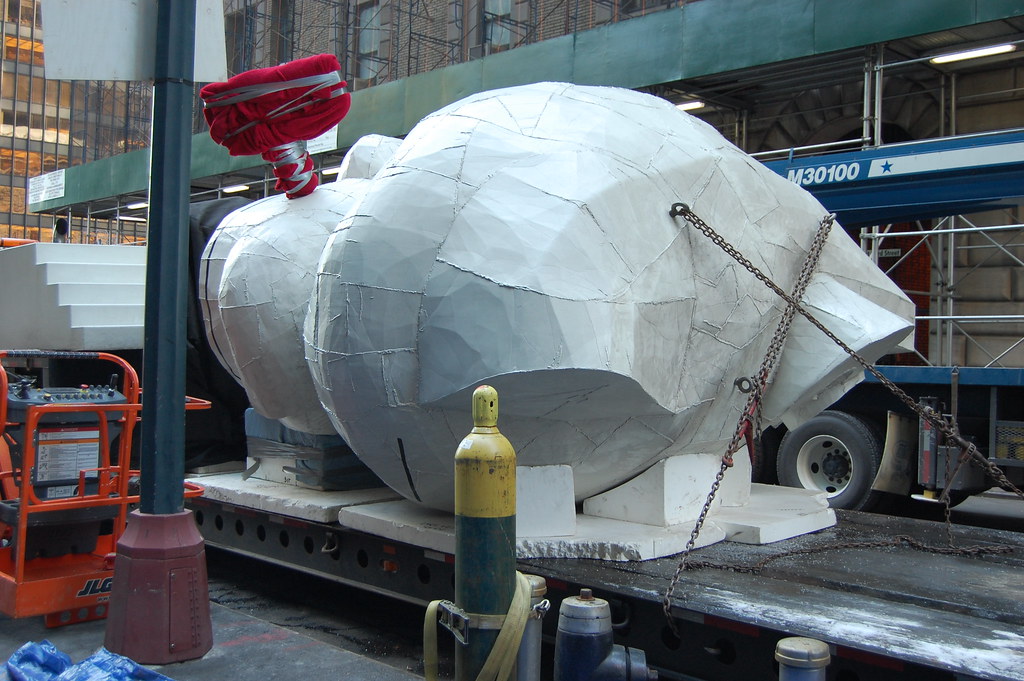
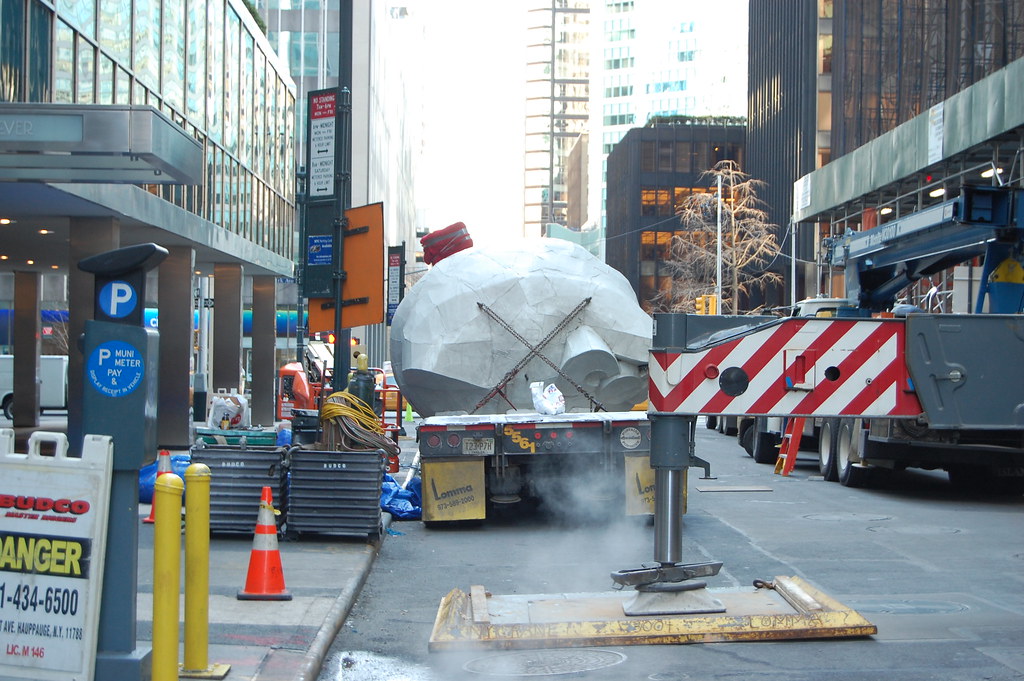
Tom Sachs, Wind-Up Hello Kitty, 2008, sitting on a flatbed truck on 53rd Street, between Park and Madison Avenues. Photos: 16 Miles [more]

Until I found myself on number thirteen of the Observer’s list of New York’s “Top 50 Art Collectors” earlier today and saw real-estate developer Aby Rosen perched on the pedestal of one of Tom Sachs’ “Bronze Collection” pieces (My Melody, 2008), I had forgotten about an encounter I recently had outside his Lever House building. I was walking to the Museum of Modern Art on a Sunday morning earlier this month and came across a gigantic crane parked in the middle of 53rd Street, just west of Park Avenue. A team of men was in the process of removing Sachs’ Wind-Up Hello Kitty, the last vestige of the artist’s mid-2008 show for Rosen's Lever House Art Collection.
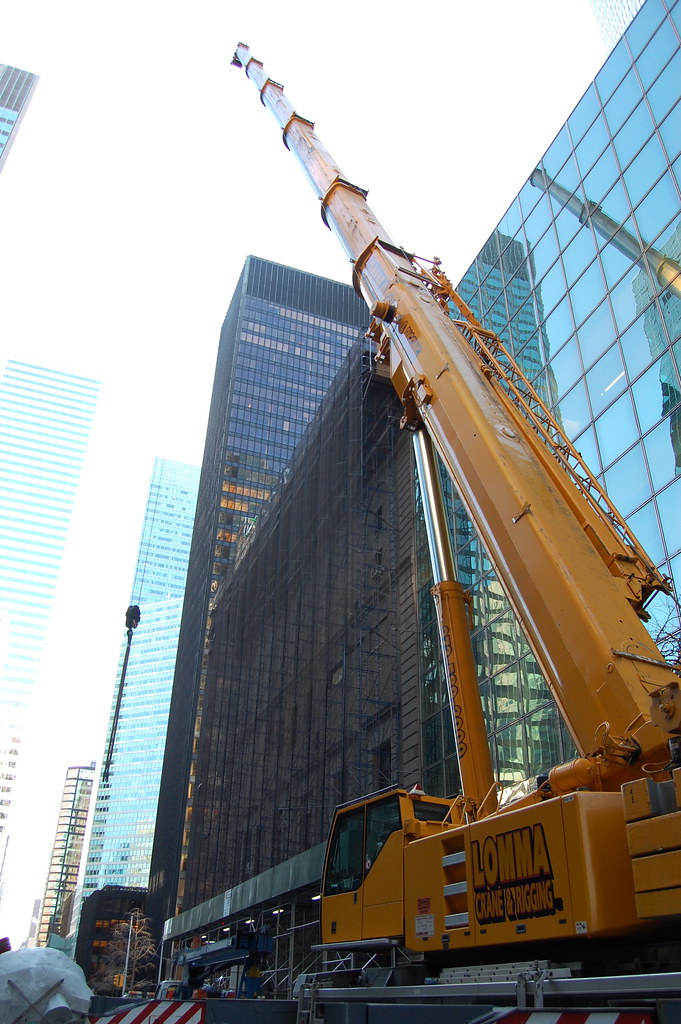
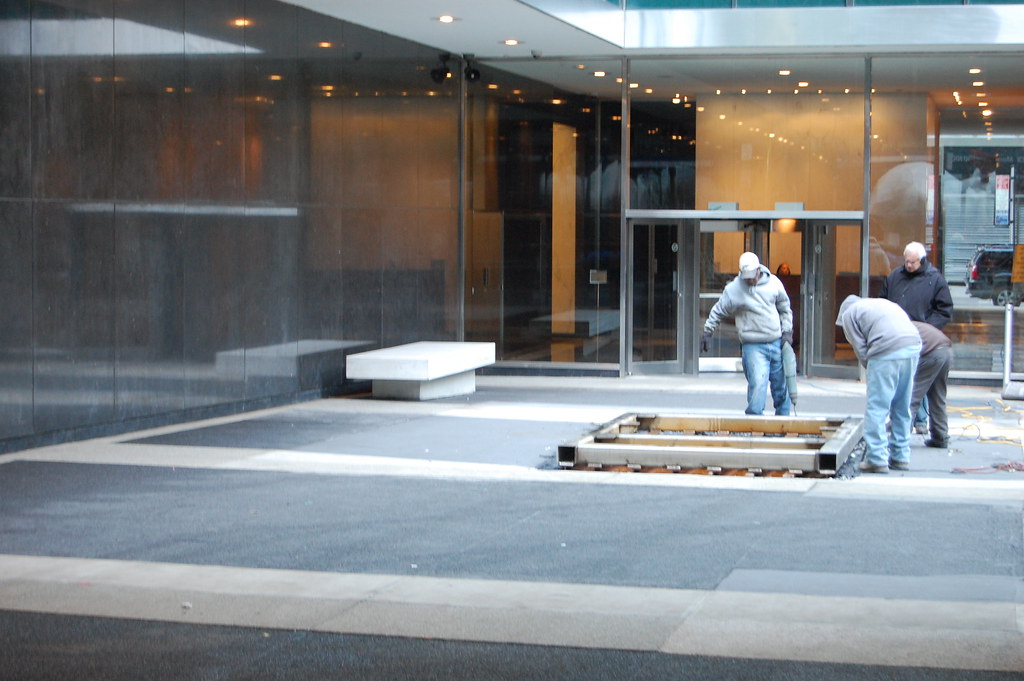


As Sachs’ web site explains, these sculptures were modeled with foamcore, which was “then cast in bronze, and ironically painted white to resemble the white foamcore surface.” Made of precious metals painted a generic color, they are big-money productions that very publicly advertise the transmutation of raw capital into high culture. And yet, even painted white, they are still, of course, enormous bronze sculptures. Moving one requires a massive crane, skilled movers, and at least one road closure. While they may not be much to look at as autonomous sculptures, they are thrilling to watch being moved: comical, infantile constructions that, despite their innocuous appearances, are unwieldy and potentially dangerous when set in motion.

Just as Franz West’s “Adaptives” (Paßtücke) are most pleasurable when being wielding by a user, Sachs’ works seem complete only when they are being set through a series of performative actions, carted about with the aid of heavy machinery or at least handled physically (I know I tapped on them when I visited), confirming their existences as decadent, barely disguised works made from expensive metal — which is why, I suspect, that many of the web sites about the works make a point of documenting their transport and installation.
Tuesday, September 21, 2010

Tetsumi Kudo's Cubes & Gardens, Paul Thek, and the Market


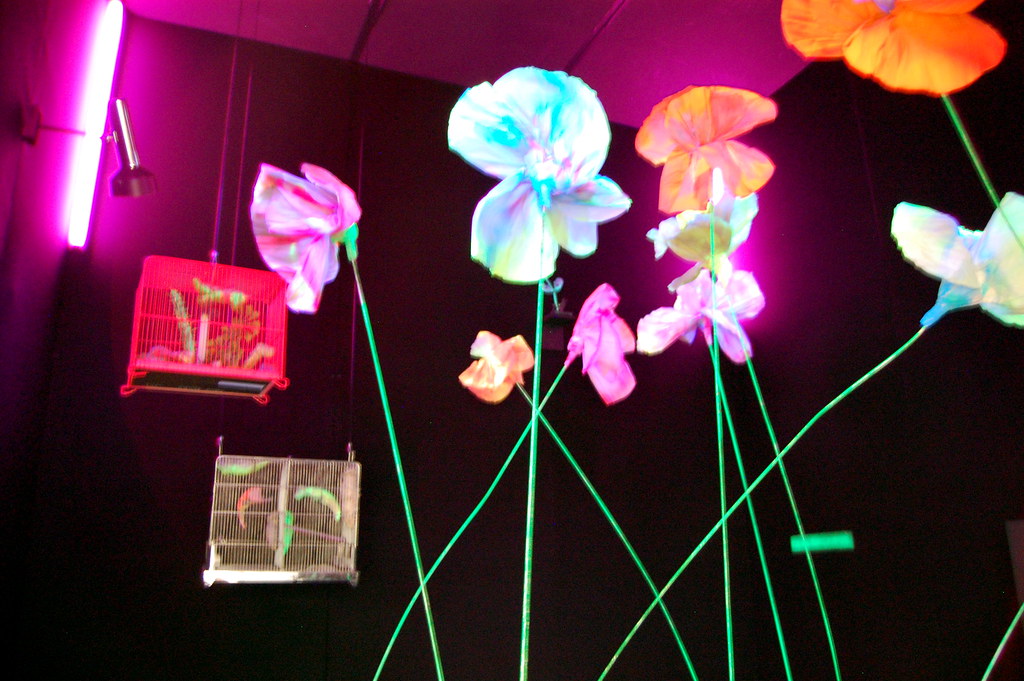
Installation view of Tetsumi Kudo, Garden of the Metamorphosis in the Space Capsule, 1968. Painted wood, artificial flowers, fabric, black light, 138 x 138 x 138 in. Courtesy Hiroko Kudo and Andrea Rosen Gallery, © ADAGP, Paris & ARS, New York


Interior view of Tetsumi Kudo, Garden of the Metamorphosis in the Space Capsule, 1968. Painted wood, artificial flowers, fabric, black light, 138 x 138 x 138 in. Courtesy Hiroko Kudo and Andrea Rosen Gallery, © ADAGP, Paris & ARS, New York
“Yet discussion of [Paul] Thek should obviously be grounded in his contexts in the 1960s and 1970s, not in 1990s art, and to label him as aberrant is willfully to forget a whole group of other artists (Lucas Samaras, Tetsumi Kudo, Ed Kienholz, Yayoi Kusama, Peter Saul, and others) whose work doesn’t match our current understanding of 1960s art. All these artists approached the trash heap of 1960s counterculture a little too closely, which is the real reason for their exclusion from art history, and the reason they are labeled as aberrant. They were made to disappear, dealt a critical death blow.”

Mike Kelley, “Death and Transfiguration,” 1992

Andrea Rosen is currently hosting her second show of work by the late Tetsumi Kudo, the sui generis Japanese artist whose stature has risen dramatically since the Walker Art Center organized a retrospective of his work in 2008. Kudo’s first major U.S. exhibition (at Andrea Rosen) opened only a few months before that Walker show, which is surprising, given the enormous influence Kudo has had on contemporary artists: The current show’s press release quotes Takashi Murakami declaring that Kudo is “the father of us all” (coyly adopting the line that is variously attributed to Picasso and Matisse describing Cézanne).


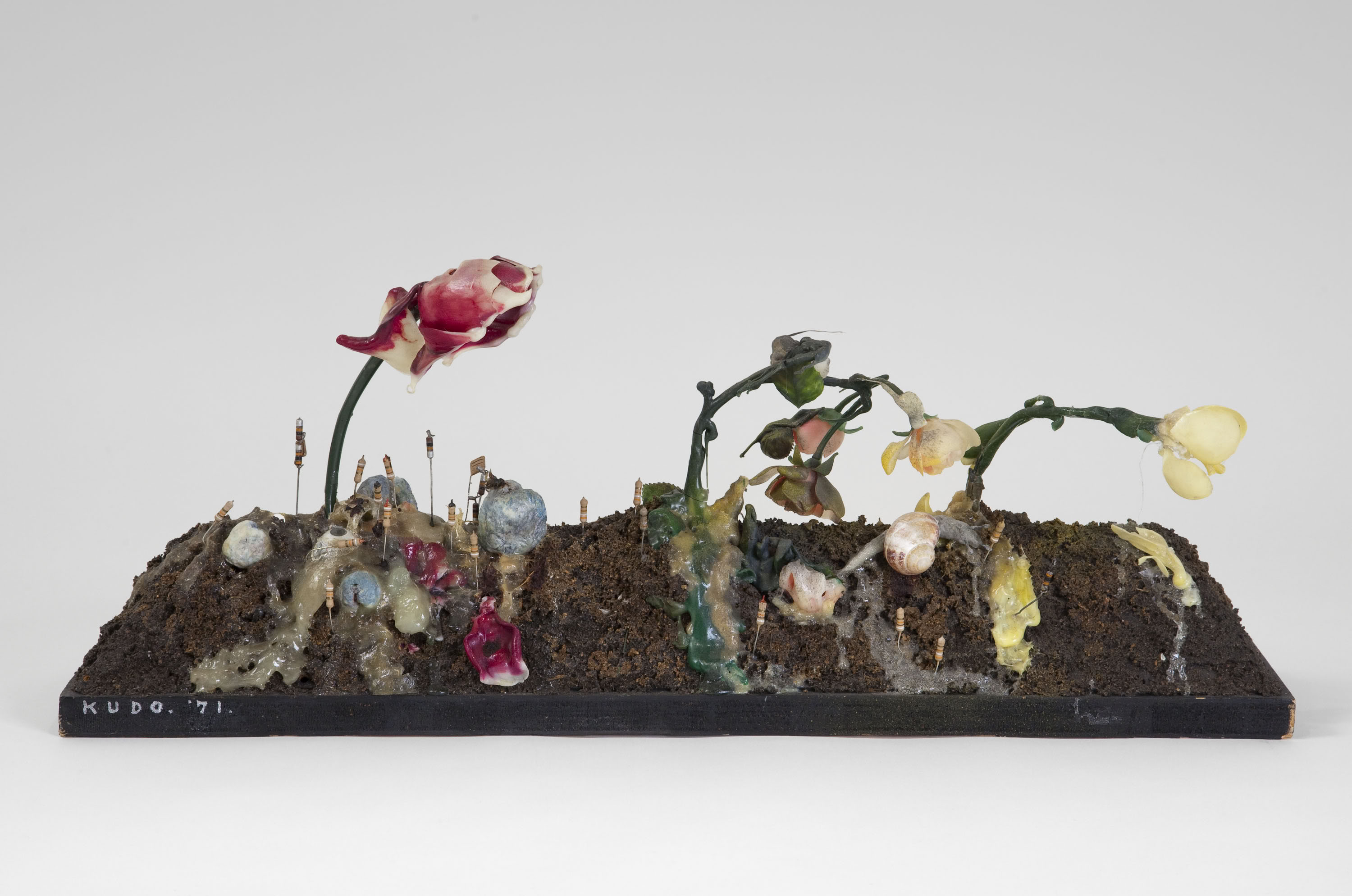
Tetsumi Kudo, Pollution Cultivation New Ecology, 1971. Wood, artificial flowers, artificial soil, cotton, plastic, polyester, resin, transistors, adhesive, paint, 9 x 22 5/8 x 6 7/8 in. Courtesy Hiroko Kudo and Andrea Rosen Gallery, © ADAGP, Paris & ARS, New York


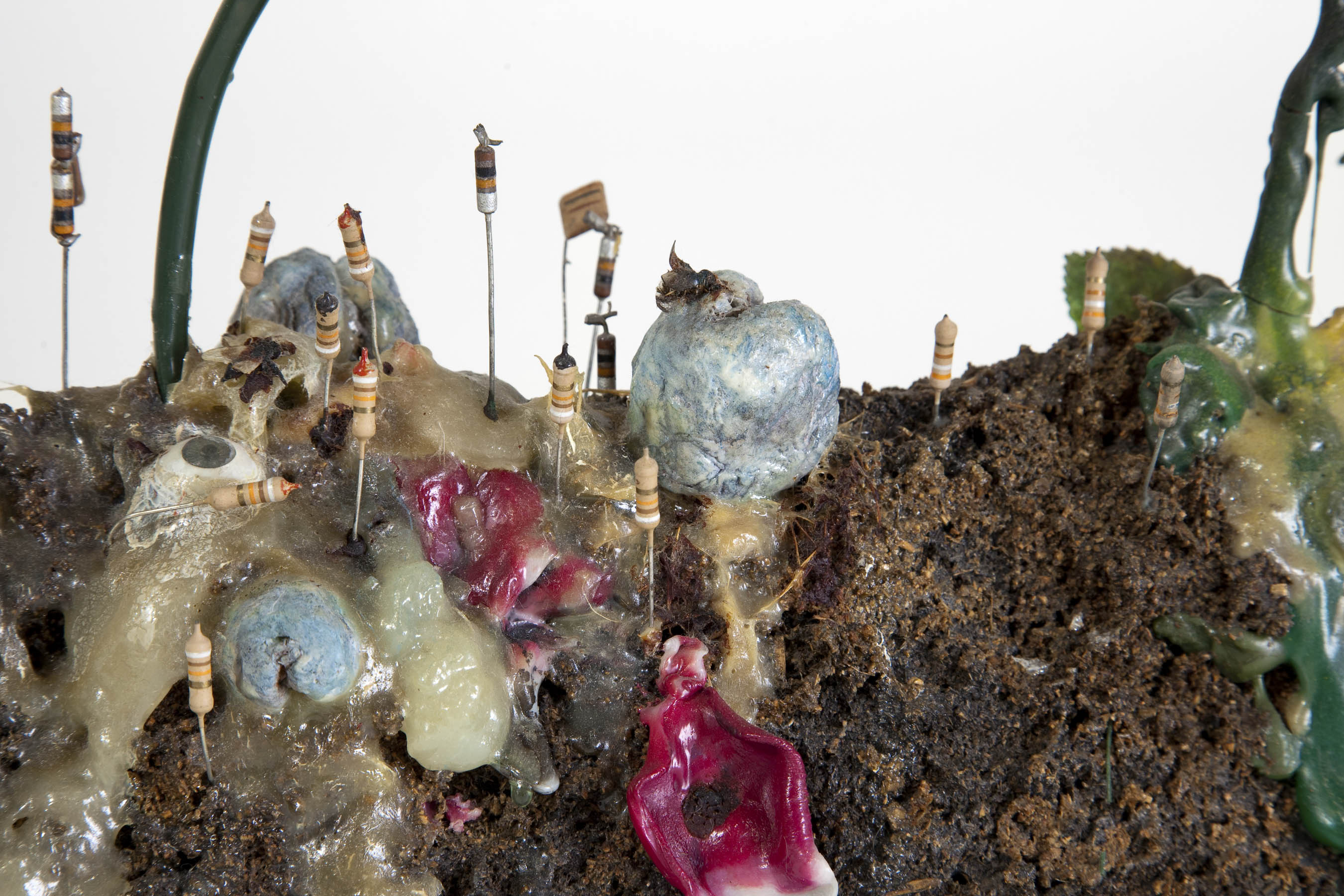
Detail view of Tetsumi Kudo, Pollution Cultivation New Ecology, 1971. Wood, artificial flowers, artificial soil, cotton, plastic, polyester, resin, transistors, adhesive, paint, 9 x 22 5/8 x 6 7/8 in. Courtesy Hiroko Kudo and Andrea Rosen Gallery, © ADAGP, Paris & ARS, New York

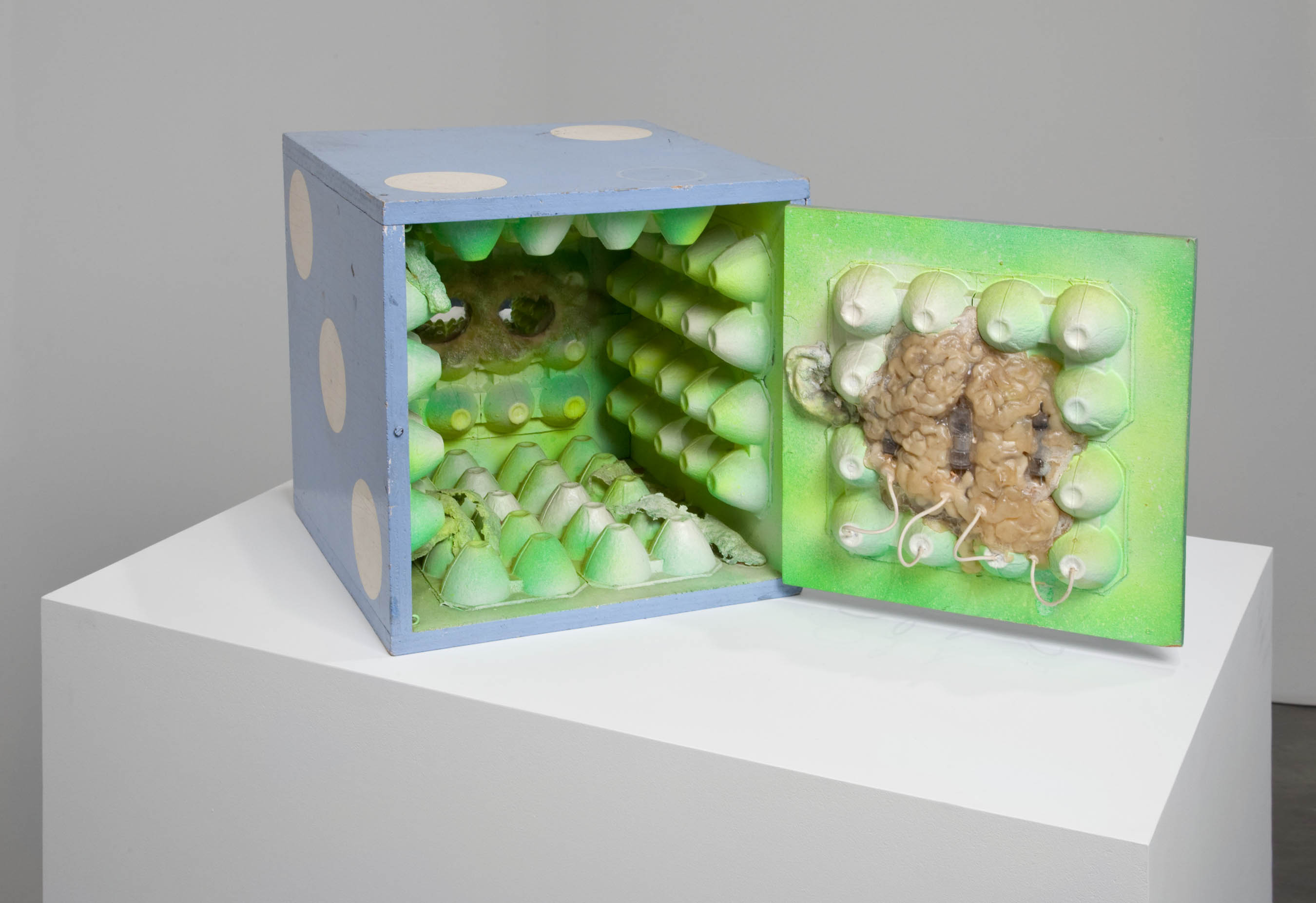
Rosen's show, “Cubes & Gardens,” is a pleasure, filled with Kudo's creepy, kitschy boxes, which are filled with clocks, egg cartons, and what look like wet, bubbling brains. The largest, Garden of the Metamorphosis in the Space Capsule (1968), stands in the center of the room, with one of its circular doors propped open, allowing visitors to peek at the flowers and birdcages bathing in black light inside. Elsewhere, strangely lifelike flowers pop out of Kudo's elegaic garden mounds.

Five or ten years ago, the Kudo show would have felt wildly out of place in Chelsea, and back when Kelley published “Death and Transfiguration,” it would have looked insane. However, there has been a dramatic cultural shift in the intervening 18 years, and the marginalized names that Kelley ticks off in his essay are now bankable stars, showing in the neighborhood’s most formidable galleries (and slowly sneaking into art history). Yayoi Kusama shows with Gagosian, who is financing her monumental polka dot-covered sculptures, and she is a winner at auction. Ed Kienholz had a well-received showcase at David Zwirner earlier this year. Opinion is even coming around on the sometimes-prickly Lucas Samaras, whose work is popping up in group shows with increasing regularity, and whose photos headlined the recent Polaroid auction.

All of which is to say that the Kudo show is worth a stop on your Chelsea rounds, and I absolutely cannot wait for the Whitney’s upcoming Paul Thek retrospective.


Tetsumi Kudo, Votre Portrait - T, 1965. Wood, paint, plastic, egg carton, wire, cotton, 11 6/8 x 11 6/8 x 11 11/16 in. Courtesy Hiroko Kudo and Andrea Rosen Gallery, © ADAGP, Paris & ARS, New York

Tetsumi Kudo, "Cubes & Gardens"
Andrea Rosen Gallery
525 West 24th Street
New York, New York
Through October 16, 2010

Wednesday, December 31, 2008

Kay Rosen, Scareful!, at Yvon Lambert - New York


Kay Rosen, Removal from Office, 2007-8.

Last chance: Kay Rosen, Scareful!, at Yvon Lambert closes January 3, 2009.

The last two parts of my Top 10 of 2008 are coming up, along with a compendium of year-end posts from other places, and a review of Barbara Probst at the Madison Museum of Contemporary Art.