Showing posts with label Beavers. Show all posts

Thursday, September 1, 2011

Gina Beavers, "Tapestry Embrace," at PACS Gallery


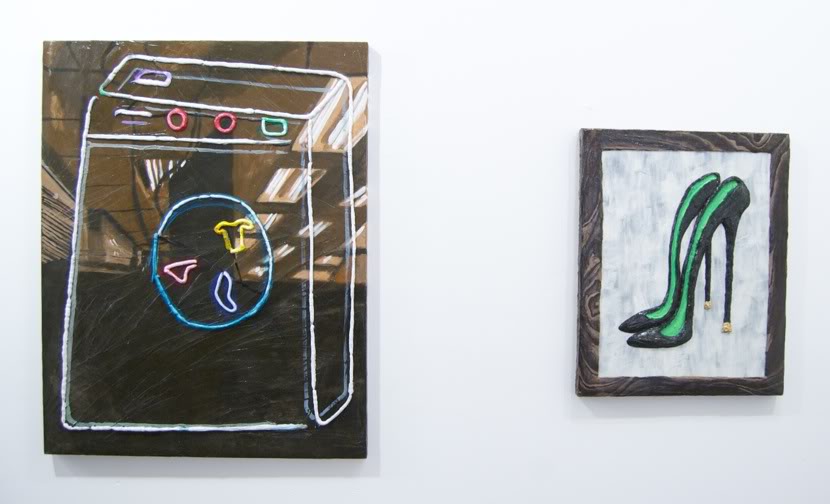
Left to right: Gina Beavers, Washer Flo-lite, 2011. Acrylic on canvas, 36 x 46 in.; Gina Beavers, She's Got Legs, 2011. Acrylic on canvas, 24 x 30 in., in Gina Beavers, "Tapestry Embrace," at PACS Gallery, August 22, 2011.

Ultra-slim, ultra-thin, gold-tipped high heels against a chalky white background. The white outline of a washing machine floating against the ceiling in a sterile, dimly lit corporate space. A white canvas, blank except for a paint palette and a paintbrush. Those are the contents of three different paintings, all by Gina Beavers, which were included in her recent one-night show at the PACS Gallery in Williamsburg. To put it reductively, Beavers' work is diverse.

In the show's press release, Beavers explains that its title, "Tapestry Embrace," is a dish at the Zen Palate restaurant in the Theater District (its slogan is "The Art of Eating Well"), and admits that, when she was first considering the name, she didn't actually know what was in it. "I could have sworn it said … something about a wrap, and the sides of the wrap enclosing the ingredients in an 'embrace,'" she writes.

But Beavers was wrong. "Tapestry Embrace," the dish, actually features, in her words, "grilled seitan (soy) steak and shiitake mushroom in teriyaki sauce, garnished with grilled zucchini, yellow squash and a banana-leaf filled rice cone." Nevertheless, she kept the title. "Oh well." (She notes that the phrase is actually twice borrowed, having also emblazoned it on one of the posters included in Price Good Market Inc., the endearing art store that Beavers and Denise Kupferschmidt staged at St. Cecilia's Convent earlier this year.)
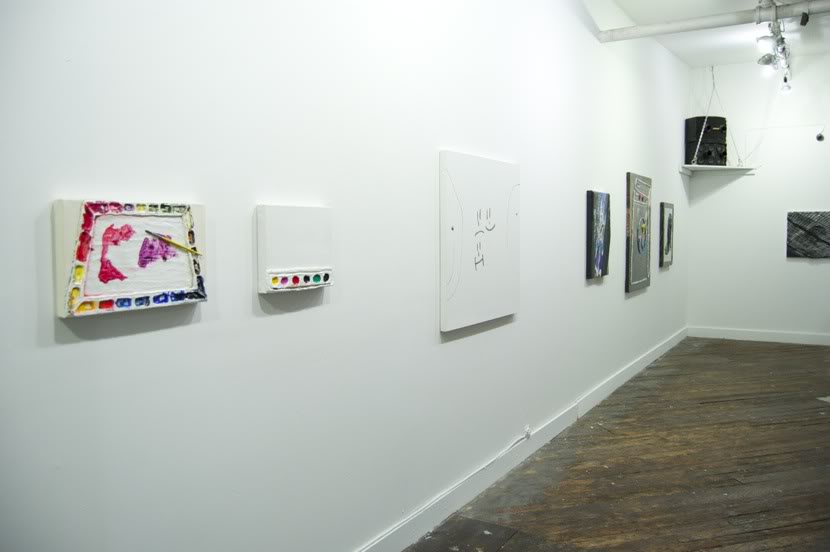

Installation view of Gina Beavers, "Tapestry Embrace," at PACS Gallery

A similarly curious, casual approach to appropriation operates in Beavers's paintings. In an earlier statement, she writes of her process, "I get an idea, which I either photograph or look up by typing key words into google images." Sometimes, when the internet fails, she constructs sketches of an image from memory. Regardless, she says, "I then paint as closely as I can, the original idea. If it's from a photo, I stick slavishly to the photo, in a submissive way." But Beavers is not quite as subservient as she claims; she has a definite, definable style, or at least certain notable interests. When she really wants to lay on the paint, she does so in controlled, heavy passages. Those ski-slope-steep black heels project well off the canvas, and the washing machine's outline has the solidity and thickness of a long Tootsie Roll.
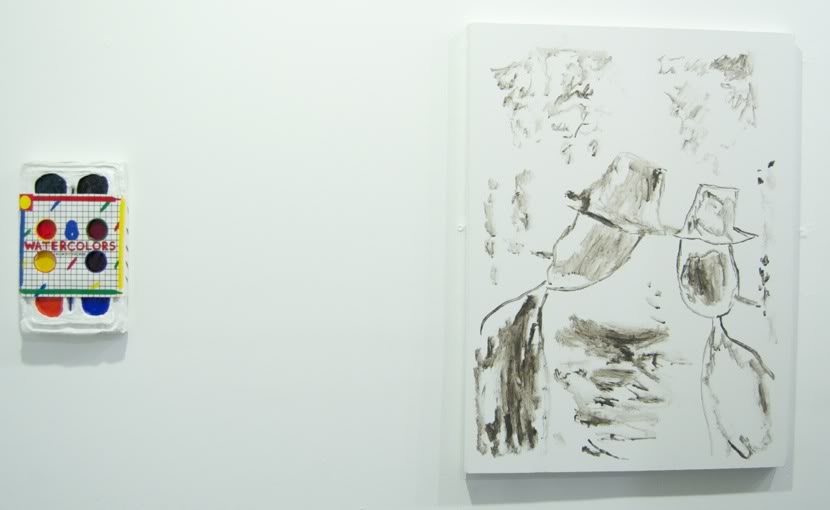

Left to right: Gina Beavers, 8 Watercolors, 2011. Acrylic and paintbrush on canvas, 9 x 15 in.; Gina Beavers, Kid drawing, Seline, 2011. Acrylic on canvas, 30 x 40 in.

When she paints people — and this is where things get most interesting — Beavers applies color in quick patches. Line and disparate colors collide and form angles, cheekbones, faces. There's a whiff of mid-to-late Picabia in a double portrait called Observe the intention of the pose (2011) and a feint toward Eric Fischl in the gray In this nude, the sculpturesque quality (2011). (Both works are below.) They're psychologically affecting portraits, staring out at us not quite impassively.

Where are these people coming from? That nude could be from any number of paintings or films or porn shoots. But churned through Beavers's process, and placed in that epic frame, its source is obscured, though never vanquished. We know that we've seen images like this before, but we can't quite place it. I know I've seen those heels before, perhaps as a drawing on the stand of a SoHo street vendor or sitting, just as shoes, in a friend's apartment. She has also copied some drawings that are, according to their titles, by children. (One is above.) They look like the work of Joe Bradley.
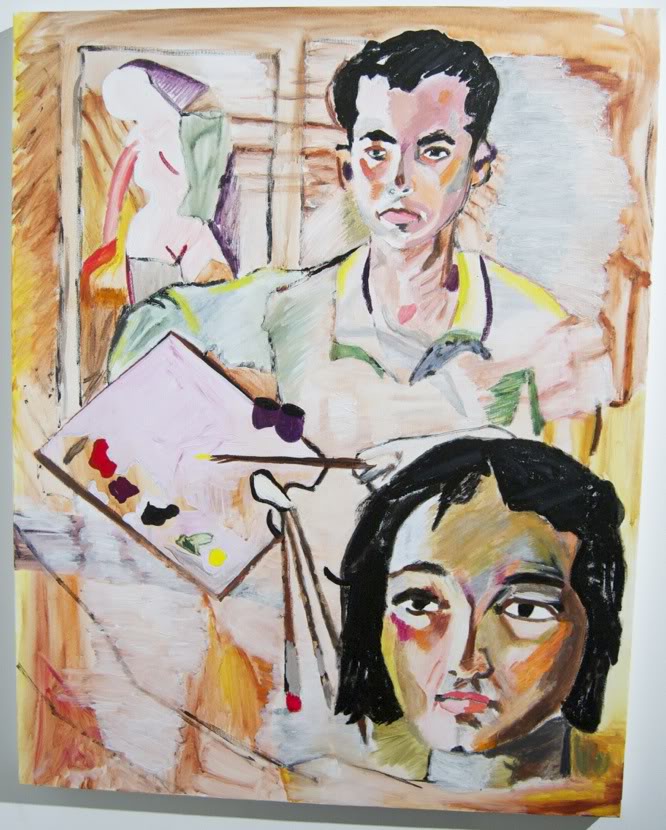

Gina Beavers, Observe the intention of the pose, 2011. Acrylic on canvas, 30 x 38 in.
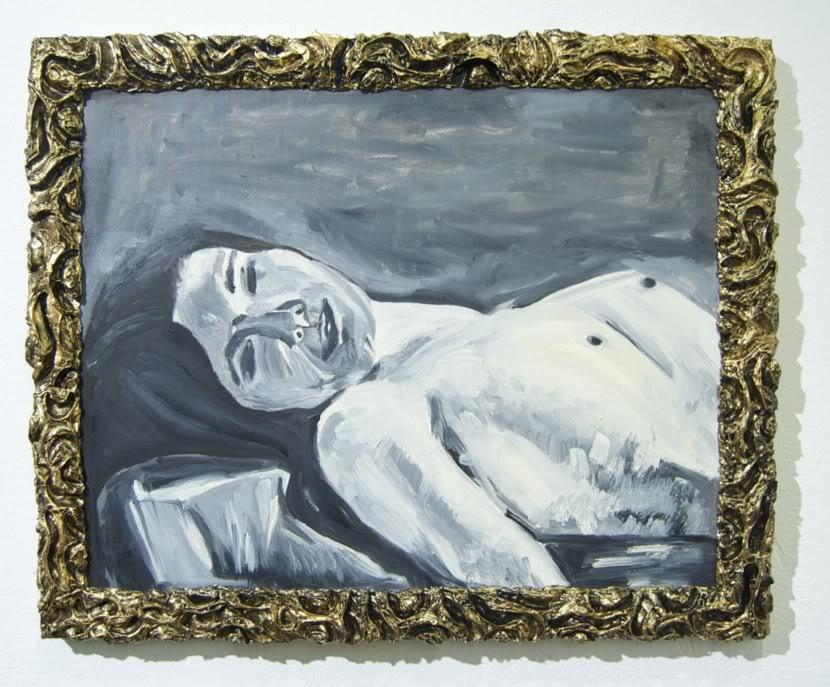

Gina Beavers, In this nude, the sculpturesque quality, 2011. Oil and acrylic on canvas, 26 x 32 in.

However obscure the sources of some of Beavers's images may be, the roots of her titles are, at least, not in doubt. The two mentioned above come from a 1942 textbook called Anyone Can Paint! From some artists, that buried reference would read as raw sarcasm ("no, most people cannot paint") or a snide remark ("yes, true enough, but they shouldn't"). But coming from Beavers, who borrows and reworks images — across genres, media, and styles — with a care and peculiarity that I can only read as somehow deeply personal, I'm tempted to understand it as an optimistic exhortation, albeit one with an edge. "Anyone can paint!" she says. Cue that blank painting. "Now, what will you have us look at?"

Monday, June 13, 2011

The Price Good Market Inc. at St. Cecilia's Convent


Denise Kupferschmidt and Gina Beavers, Price Good Market Inc., in "Art Book Club Presents:," at St. Cecilia's Convent, Brooklyn, June 3, 2011.

"This past June … the hordes of half-wild, half-crazed, and fully degenerate individuals who keep pouring out of the 42nd Street subway had occasion to check out a whole building full of art that was just as raw, raucous, trashy and perhaps even as exciting as some of the more notorious attractions of the tenderloin," Jeffrey Deitch wrote in Art in America in 1980. He was reviewing the now-infamous "Times Square Show," for which dozens of artists, led by Cara Perlman and Tom Otterness, used a four-story building on the corner of 41st Street and 7th Avenue for — to quote Deitch — "a month-long party, business enterprise and loosely curated exhibition of art, film, fashion and exotica."

Of Deitch's descriptors, it's the twin notions of a "month-long party" and a "loosely curated exhibition" that have congealed to form the show's storied legacy. "Several dozen of the organizers, participants and hangers-on virtually lived at the site for the show's duration," Deitch writes. Moreover, there were numerous performances and film screenings, alongside work by soon-to-be superstars like Keith Haring, Kenny Scharf, and SAMO — the graffiti name of Jean-Michel Basquiat and friends. (Deitch described SAMO's work in the show as "a knockout combination of de Kooning and subway spray-paint scribbles.") But that other phrase, "business enterprise," is equally important. As Deitch himself says, this wild, unruly show had a gift shop, filled with affordable artist multiples. "To the right, a souvenir shop was stocked with all sorts of bizarre trinkets," he notes.


Let's jump forward 31 years. Earlier this month, the "half-wild, half-crazed, and fully degenerate" denizens of the New York art world had the occasion to see a whole building full of art once again. The site this time was the three-story St. Cecilia's Convent in Greenpoint, Brooklyn, instead of an abandoned massage parlor in Midtown, and in place of Collaborative Projects, Inc. (Colab), this show was organized by the Art Book Club, which handed over each of the three floors to a different curator — Fran Holstrom, Saira McLaren, and Carolyn Salas. And, once again, there was a gift shop, the Price Good Market Inc., which was helmed by artists Denise Kupferschmidt and Gina Beavers, which offered small works by many of the shows' participants at bargain prices.

Kupferschmidt and Beavers cited as their inspiration The Shop, the East London art boutique and bar run by Tracey Emin and Sarah Lucas in 1993, which was included in Tate Modern's 2009 "Pop Life" show. Emin writes, in a piece published in advance of that show: "The recession was in full swing with hundreds of empty shops boarded up. Sarah and I looked at each other, more or less at the same time, and said, 'Let’s get a shop.'" They sold hand-made merchandise, like mugs and T-shirts, as well as small, affordable pieces by other artists. (The bestselling shirt, at least for a period, read "Complete Asshole," writer Gregor Muir mentions in this lively interview with a late-arriving Emin.)

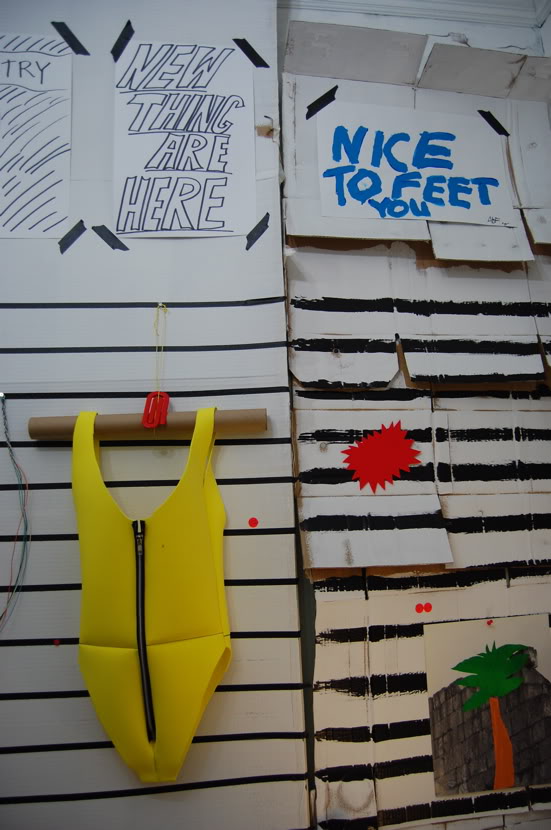
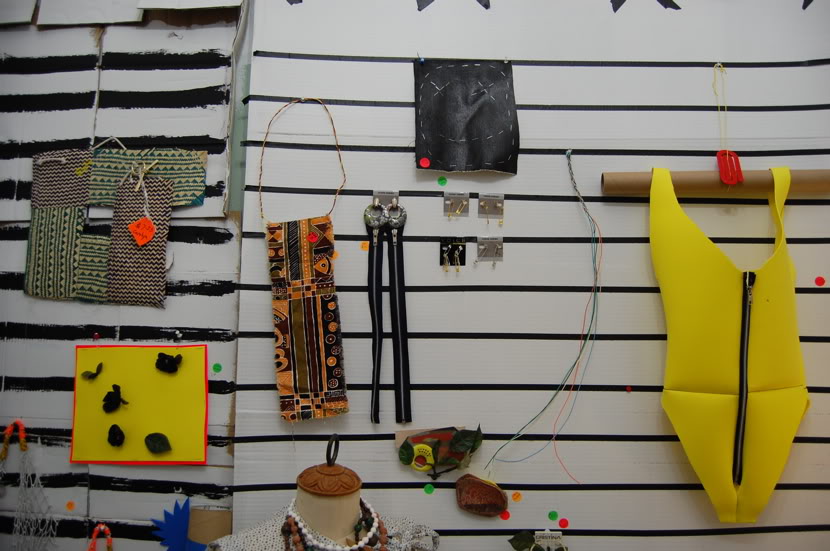
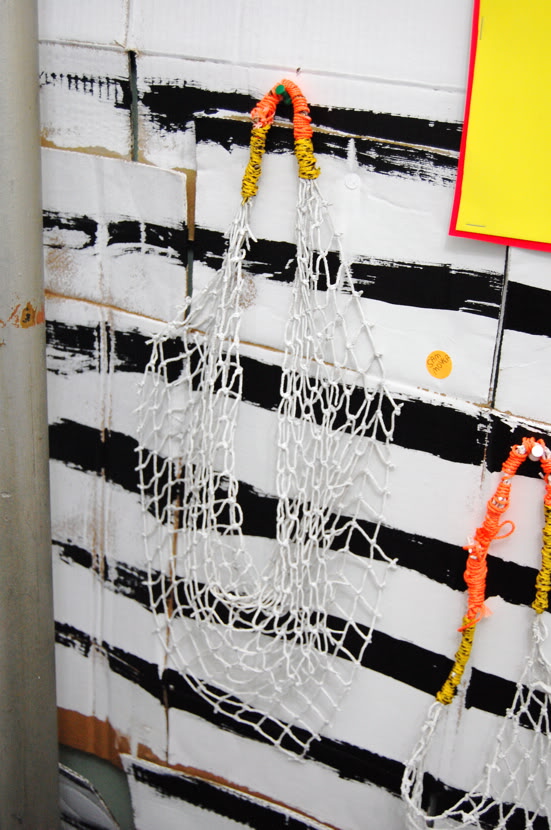
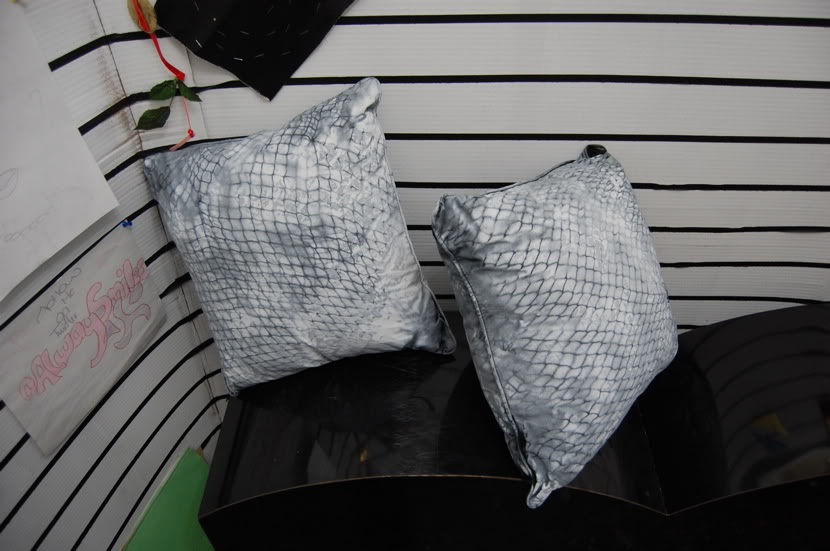
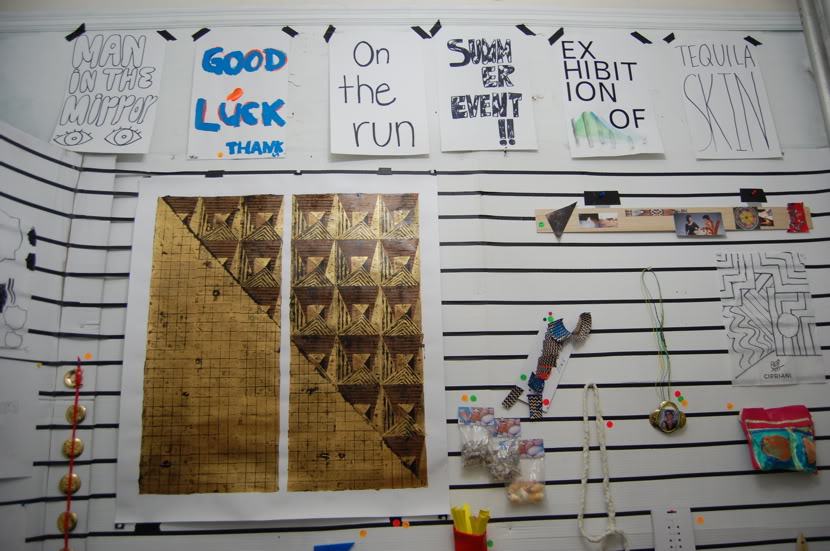
Price Good Market Inc. had hand-painted works of their own: signs emblazoned with declarations like "NICE TO FEET YOU" and "NEW THING ARE HERE" alongside papers with more ambiguous messages — "ON THE RUN" and "TEQUILA SKIN," for instance. Cheap, store-bought jewelry hung next to a bright-yellow one-piece bathing suit by Beavers, a paper construction by Stacy Fisher, and a necklace and pillows by Sam Moyer. The décor was pure strip-mall class: bright fluorescent lights hung up above and wraparound walls were lined with black electrical tape or painted with quick black lines, mimicking perfectly the omnipresent plastic sheeting that fills malls across the land. It felt like a slice of suburban American — or, to put it another way, childhood memories of many of the show's young attendees, myself included — had somehow slipped into this defunct convent.


The Price Good Market Inc. was, of course, more a glorious gag than a workable business: would-be buyers at the Friday-night opening were turned away and told to return on Sunday, the lone day that the shop was open, and the prices were in some cases absurdly low. It was an excuse to show work, see friends, spin some records, and drink beers. However (and I know this will sound simplistic and perhaps naïve), in an economy that is only now slowly recovering after the failure of massive, complex financial instruments, the opportunity to exchange a few bucks for a handmade sign or a Sam Moyer net necklace sounds just right: radically straightforward and accessible. A lot has changed in the three years that have elapsed since Takashi Murakami placed another kind of gift shop, a miniature Louis Vuitton boutique, at the center of his Brooklyn Museum exhibition.


More: Martin Bromirski has tons of photos from the opening of "Art Book Clubs Presents:" at Anaba and on his Flickr account.